


| # regnety_006 | |
| Implementation of RegNet proposed in [Designing Network Design | |
| Spaces](https://arxiv.org/abs/2003.13678) | |
| The main idea is to start with a high dimensional search space and | |
| iteratively reduce the search space by empirically apply constrains | |
| based on the best performing models sampled by the current search | |
| space. | |
| The resulting models are light, accurate, and faster than | |
| EfficientNets (up to 5x times!) | |
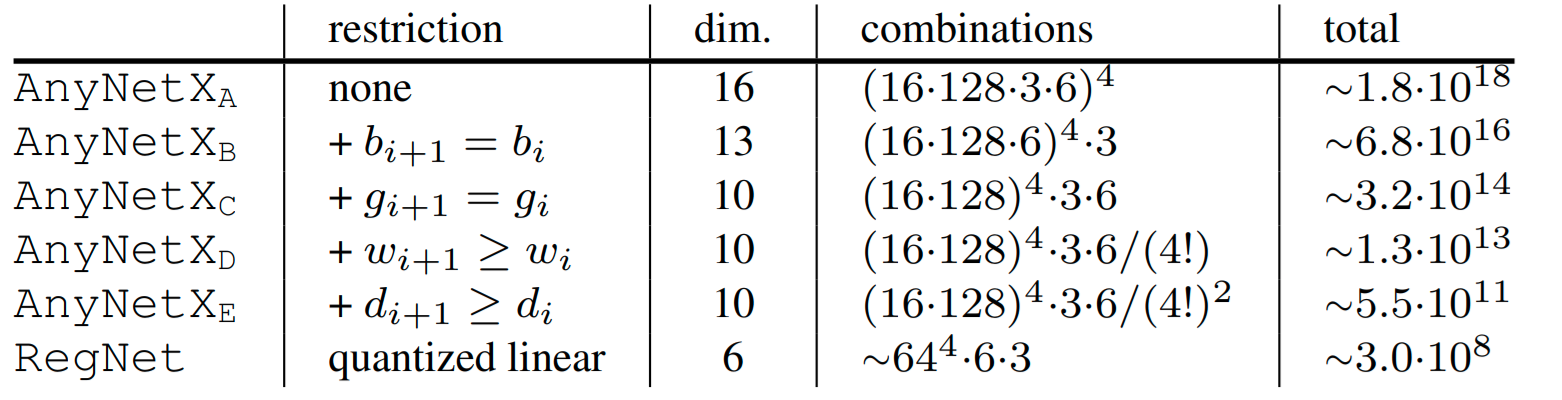
| For example, to go from $AnyNet_A$ to $AnyNet_B$ they fixed the | |
| bottleneck ratio $b_i$ for all stage $i$. The following table shows | |
| all the restrictions applied from one search space to the next one. | |
|  | |
| The paper is really well written and very interesting, I highly | |
| recommended read it. | |
| ``` python | |
| ResNet.regnetx_002() | |
| ResNet.regnetx_004() | |
| ResNet.regnetx_006() | |
| ResNet.regnetx_008() | |
| ResNet.regnetx_016() | |
| ResNet.regnetx_040() | |
| ResNet.regnetx_064() | |
| ResNet.regnetx_080() | |
| ResNet.regnetx_120() | |
| ResNet.regnetx_160() | |
| ResNet.regnetx_320() | |
| # Y variants (with SE) | |
| ResNet.regnety_002() | |
| # ... | |
| ResNet.regnetx_320() | |
| You can easily customize your model | |
| ``` | |
| Examples: | |
| ``` python | |
| # change activation | |
| RegNet.regnetx_004(activation = nn.SELU) | |
| # change number of classes (default is 1000 ) | |
| RegNet.regnetx_004(n_classes=100) | |
| # pass a different block | |
| RegNet.regnetx_004(block=RegNetYBotteneckBlock) | |
| # change the steam | |
| model = RegNet.regnetx_004(stem=ResNetStemC) | |
| change shortcut | |
| model = RegNet.regnetx_004(block=partial(RegNetYBotteneckBlock, shortcut=ResNetShorcutD)) | |
| # store each feature | |
| x = torch.rand((1, 3, 224, 224)) | |
| # get features | |
| model = RegNet.regnetx_004() | |
| # first call .features, this will activate the forward hooks and tells the model you'll like to get the features | |
| model.encoder.features | |
| model(torch.randn((1,3,224,224))) | |
| # get the features from the encoder | |
| features = model.encoder.features | |
| print([x.shape for x in features]) | |
| #[torch.Size([1, 32, 112, 112]), torch.Size([1, 32, 56, 56]), torch.Size([1, 64, 28, 28]), torch.Size([1, 160, 14, 14])] | |
| ``` | |