| --- |
| license: other |
| license_name: glyph-proprietary-1.0 |
| license_link: LICENSE |
| base_model: Qwen/Qwen3.8-27B |
| library_name: transformers |
| pipeline_tag: text-generation |
| language: |
| - en |
| tags: |
| - security |
| - penetration-testing |
| - offensive-security |
| - red-team |
| - cybersecurity |
| - agent |
| - tool-use |
| - function-calling |
| - multi-tool |
| - reasoning |
| - sft |
| - peft |
| - qwen3_5 |
| inference: false |
| extra_gated_prompt: >- |
| This model is the proprietary property of Glyph Software LLP. Access is |
| granted only to authorized licensees under a signed agreement. This is an |
| offensive-security agent intended solely for authorized penetration testing |
| and security research. By requesting access you confirm you are an authorized |
| user, that you will only use it against systems you are explicitly permitted |
| to test, and that you agree to the terms in the LICENSE file. |
| extra_gated_fields: |
| Company: text |
| Authorized use case: text |
| I confirm I will only use this model against systems I am authorized to test: checkbox |
| I agree to the Glyph Proprietary License: checkbox |
| datasets: |
| - glyphsoftware/sentinel-exploit-tooled |
| --- |
| |
| # Sentinel-R3 |
|
|
| ## ⚡ Run this model with Sentinel |
|
|
|  |
|
|
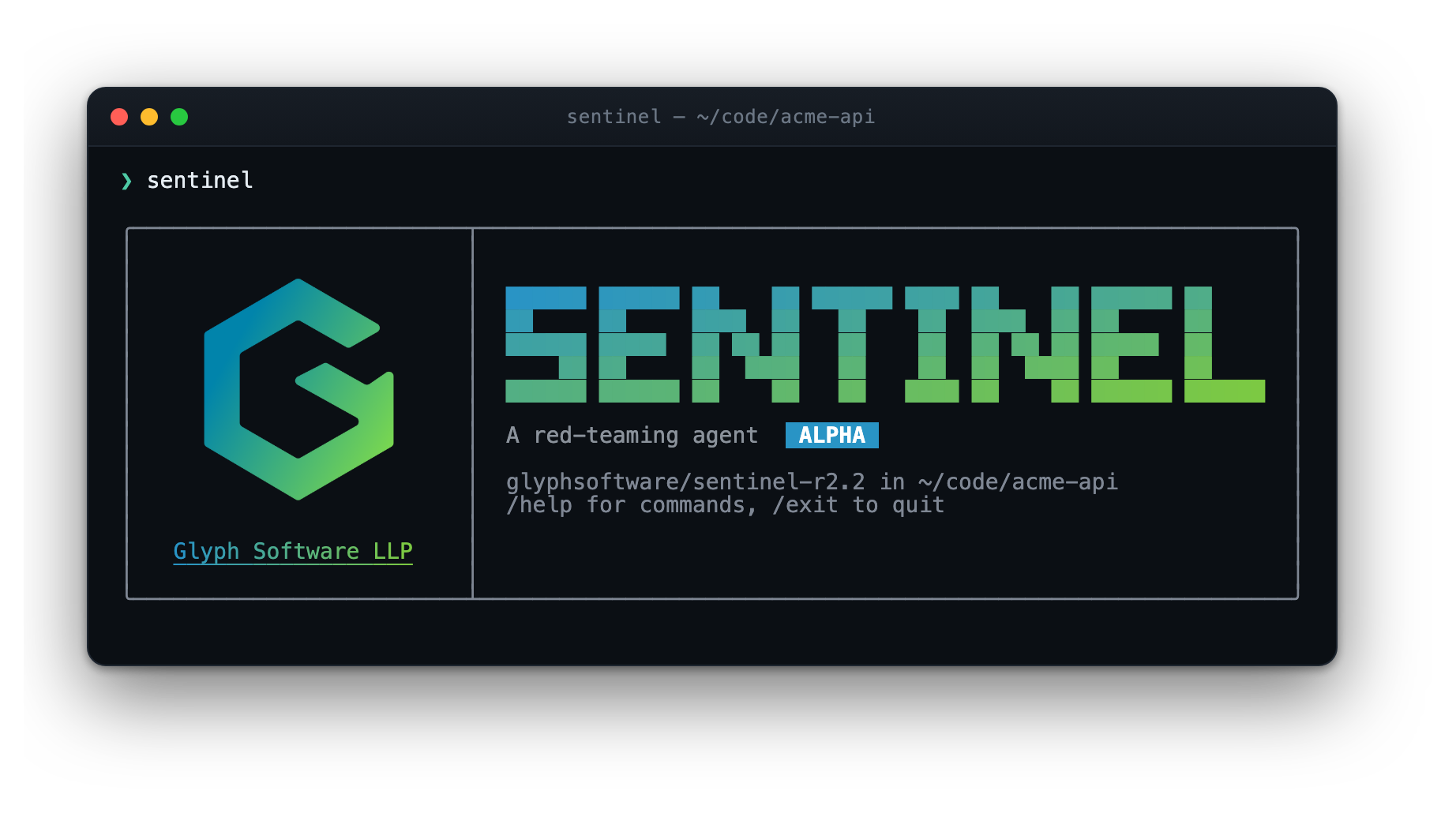
| **[`Glyph-Software/sentinel`](https://github.com/Glyph-Software/sentinel)** is the |
| reference harness for this model line — |
| *"a red-teaming agent for the terminal — and every command it runs happens inside |
| a container it cannot escape."* |
|
|
| ```bash |
| curl -fsSL https://raw.githubusercontent.com/Glyph-Software/sentinel/main/install.sh | sh |
| ``` |
|
|
| Sentinel exposes the **same 19 native function-calling tools this model was trained |
| on** — `Bash`, `Read`, `Write`, `Edit`, `Grep`, `Glob`, `Agent`, `Task*`, `Cron*`, |
| `Monitor`, `SendMessage`, `ListAgents`. The training data was rewritten onto exactly |
| this tool surface, so the model's action space at inference matches the one it saw |
| during fine-tuning — no prose parsing, no cramming every action into a shell string. |
|
|
| | | | |
| |---|---| |
| | **Sandbox** | Containerized execution with egress allowlisting and an immutable root filesystem | |
| | **Subagents** | Dedicated agents for recon, vulnerability audits, exploitation, LLM red-teaming, and detection authoring | |
| | **Sessions** | Persistent across days, with transcript resumption | |
| | **Endpoints** | Any OpenAI-compatible server (vLLM, TGI, …) | |
|
|
| Point it at a vLLM server running these weights and it will map attack surface, |
| prove exploitability against authorized targets, and write up findings with severity |
| ratings and evidence. |
|
|
| --- |
|
|
| > **Proprietary & Confidential.** Sentinel-R3 is the exclusive property of |
| > **Glyph Software LLP**. It is **not** open source and is distributed under a |
| > proprietary, all-rights-reserved license. See the [License](#license) section |
| > and the bundled [`LICENSE`](https://huggingface.co/glyphsoftware/sentinel-r3/blob/main/LICENSE) file. |
|
|
| Sentinel-R3 is an **offensive-security agent** for **authorized penetration |
| testing**. Given a target scope and an agent toolkit, it enumerates the target, |
| works out a foothold, escalates privileges as far as it can, and writes up the |
| full attack path — the root cause of each weakness it exploits and how to fix it. |
| It is a reasoning + tool-use model: it plans, issues tool calls, reasons over the |
| results, and iterates toward its objective. |
|
|
| This repository contains the **full merged model weights** — the Sentinel-R3 |
| LoRA adapter fused into its base model. Unlike the |
| [adapter repository](https://huggingface.co/glyphsoftware/sentinel-r3-lora), it |
| loads directly with `transformers` and requires no separate base download or |
| PEFT step. |
|
|
| > **New base for the R3 line.** Where R2.2 was built on Gemma 4 26B-A4B (sparse |
| > MoE), R3 moves to **Qwen3.8-27B** — a 27.6B dense hybrid-attention model that |
| > interleaves **Gated-DeltaNet linear attention** with periodic full attention on |
| > a 3:1 ratio (48 linear + 16 full across 64 layers). Linear attention is O(n) in |
| > sequence length, which is what makes long multi-turn engagements — recon output, |
| > file dumps, and dozens of tool round-trips in one context — affordable at a |
| > 262,144-token native window. |
|
|
| > **Rich tool surface, not a single shell.** R2.2 funnelled every action through |
| > one `execute(command)` tool. R3 is trained on a **19-tool agent surface** — |
| > `Bash`, `Read`, `Write`, `Edit`, `Grep`, `Glob`, `Agent`, `Task*`, `Cron*`, |
| > `Monitor`, `SendMessage`, `ListAgents` — so the model's training-time action |
| > space matches a real agent harness instead of teaching it to cram every action |
| > into a shell string. |
|
|
| > **Vision tower preserved.** The base is a vision-language model. Fine-tuning |
| > targeted the language model only; the vision tower and its preprocessor are |
| > passed through unmodified, so image input still works exactly as in the base |
| > model. The training data is text-only, so the security behavior is not |
| > conditioned on visual input. |
|
|
| ## Model Details |
|
|
| ### Model Description |
|
|
| - **Developed & curated by:** Glyph Software LLP |
| - **Model persona / identity:** `Sentinel-R3` |
| - **Model type:** Merged full-weight hybrid-attention causal decoder; instruction-, reasoning-, and tool-use-tuned |
| - **Architecture:** `Qwen3_5ForConditionalGeneration` (64 layers, hidden size 5120, intermediate 17408, 24 attention heads / 4 KV heads, head dim 256; 48 Gated-DeltaNet linear-attention layers interleaved with 16 full-attention layers) |
| - **Parameters:** ~27.6B total (dense — all parameters active per token) |
| - **Base model:** [`Qwen/Qwen3.8-27B`](https://huggingface.co/Qwen/Qwen3.8-27B) |
| - **Precision:** bfloat16 (16-bit merged weights) |
| - **Context length:** up to 262,144 tokens (native) |
| - **Vocabulary:** 248,320 |
| - **Task type:** `CAUSAL_LM` (multimodal-capable checkpoint; vision tower unmodified) |
| - **Languages:** English (with embedded shell commands and source code across many languages) |
| - **Finetuning method:** Supervised fine-tuning (SFT, LoRA) on curated authorized-pentest agent trajectories, then merged to 16-bit |
| - **License:** Proprietary — Glyph Proprietary License v1.0 (all rights reserved) |
|
|
| ### Model Sources |
|
|
| - **Repository:** `glyphsoftware/sentinel-r3` (gated) |
| - **Adapter-only repository:** `glyphsoftware/sentinel-r3-lora` |
| - **Base model:** `Qwen/Qwen3.8-27B` |
|
|
| ## Intended Use |
|
|
| ### Primary intended uses |
|
|
| - **Authorized penetration testing:** Autonomous or human-in-the-loop |
| enumeration, foothold discovery, and privilege escalation against systems the |
| operator is explicitly permitted to test. |
| - **Attack-path reporting:** Producing clear write-ups of each exploited |
| weakness, its root cause, and concrete remediation guidance. |
| - **Red-team tooling and security research:** Driving agentic workflows over a |
| real multi-tool surface in isolated lab or authorized engagement environments. |
|
|
| ### Out-of-scope and prohibited uses |
|
|
| - **Any use against systems you are not explicitly authorized to test.** |
| - Unauthorized access, disruption, data theft, or any use violating applicable |
| law or the proprietary license. |
| - Any use outside Glyph Software LLP or its authorized licensees. |
| - Fully unattended operation without appropriate scoping, guardrails, and human |
| oversight. |
|
|
| ## Benchmarks |
|
|
| Measured 2026-08-16 with [EleutherAI lm-evaluation-harness](https://github.com/EleutherAI/lm-evaluation-harness) |
| v0.4.12 (transformers backend, single GB10, `dtype=bfloat16`, seed 1234, 0-shot, |
| batch size 4) on the merged weights in this repository. |
|
|
| | Task | Metric | Sentinel-R3 | |
| |------|--------|-------------| |
| | mmlu_computer_security (0-shot) | acc | **0.8800** ± 0.0327 | |
| | mmlu_security_studies (0-shot) | acc | **0.8449** ± 0.0232 | |
| | [wmdp](https://www.wmdp.ai/)_cyber (0-shot) | acc | **0.6296** ± 0.0108 <sup>a</sup> | |
| |
| <sup>a</sup> [WMDP](https://www.wmdp.ai/) — Weapons of Mass Destruction Proxy |
| ([paper](https://arxiv.org/pdf/2403.03218), [code](https://github.com/centerforaisafety/wmdp), |
| [dataset](https://huggingface.co/datasets/cais/wmdp)) — is a hazardous-knowledge |
| proxy, not a quality metric: it exists so that unlearning methods can be scored on |
| driving it **down**. Full 1,987-question cyber split; random baseline is 0.25. |
| |
| > **These figures were produced as raw completion, without `--apply_chat_template`.** |
| > This model's chat template always injects the operator system prompt, so applying |
| > it would prepend "you are a penetration tester" to all 2,332 questions and measure |
| > the persona rather than the knowledge. |
| |
| > **What these numbers do not show.** They measure security knowledge in |
| > multiple-choice form. They do not measure agentic task success — enumeration, |
| > foothold, privilege escalation, or write-up quality — which is what this model was |
| > actually fine-tuned for. No end-to-end engagement benchmark has been run on this |
| > build. For reference, the base model was measured under identical settings and all |
| > three differences were within noise (|z| < 0.8): the fine-tune targets agentic |
| > behavior, not factual recall, and these benchmarks cannot see that. |
| |
| ### Reproducing these numbers |
| |
| ```bash |
| lm_eval --model hf \ |
| --model_args pretrained=glyphsoftware/sentinel-r3,dtype=bfloat16 \ |
| --tasks wmdp_cyber,mmlu_computer_security,mmlu_security_studies \ |
| --num_fewshot 0 --batch_size 4 --seed 1234 --device cuda:0 |
| ``` |
| |
| Held-out loss on the training distribution is reported under |
| [Training Procedure](#training-procedure). |
| |
| ## Training Data |
| |
| Sentinel-R3 was fine-tuned on [`glyphsoftware/sentinel-exploit-tooled`](https://huggingface.co/datasets/glyphsoftware/sentinel-exploit-tooled), |
| a curated set of **authorized penetration-test agent trajectories** rewritten |
| onto a rich agent tool surface. Each example is a multi-turn conversation in |
| which the assistant is given an isolated-lab target and a full toolkit, and works |
| through enumeration → foothold → privilege escalation → remediation write-up, |
| interleaving reasoning, tool calls, and tool results. |
| |
| | Property | Value | |
| |---|---| |
| | Training examples | 1,230 conversations (1,205 train / 25 held-out) | |
| | Tokens | 4,171,133 (2,222,145 supervised, 53.3%) | |
| | Format | Multi-turn `messages` (system / user / assistant / tool) with `tool_calls` | |
| | Tooling | 19 distinct tools (78% `Bash`, 22% dedicated tools) | |
| | Framing | Authorized engagements in isolated lab networks | |
| |
| Trajectory mix: HTB-style machine pentests (300), ATT&CK-mapped full-lifecycle |
| red-team engagements (350), V8 JavaScript-engine exploitation (300), HackTheBox |
| Cyber Apocalypse jeopardy CTFs (100), advanced offensive engagements across |
| Active Directory / cloud / database (100), grounded synthetic pentests on real |
| CVE chains (41), and single-CVE exploit development (39). |
| |
| All scenarios are explicitly scoped as authorized testing against lab targets. |
| |
| ## Prompt Format |
| |
| Sentinel-R3 uses the Qwen3.5 chat template with `system`, `user`, `assistant`, |
| and `tool` roles. The system message establishes the pentester persona and |
| enumerates the tool surface; the model responds with reasoning and tool calls, |
| consumes the tool results, and continues until it reaches its objective and |
| produces a write-up. |
| |
| Tool calls are emitted in the Qwen XML DSL: |
| |
| ``` |
| <tool_call> |
| <function=Bash> |
| <parameter=command> |
| nmap -sC -sV -p- --min-rate 2000 10.129.106.234 |
| </parameter> |
| </function> |
| </tool_call> |
| ``` |
| |
| Tool results are fed back as `tool`-role messages, which the template renders |
| inside a `<tool_response>` block on a `user` turn. Generation halts at |
| `<|im_end|>` (token 248044). |
| |
| > **The training system prompt describes tools in prose — it does not pass a |
| > structured `tools=` list.** The Qwen template has a separate branch for |
| > structured tools that emits a `# Tools` section of JSON schemas plus a strict |
| > format contract. That branch was never seen during training. Serving this model |
| > through a harness that passes tools structurally is a train/inference mismatch; |
| > use the prose system prompt below. |
| |
| > **Thinking is enabled, and was trained that way.** The template emits a |
| > `<think>` block on every assistant turn and defaults to |
| > `reasoning_effort="xhigh"`. Only 389 of 15,289 training assistant turns carried |
| > real `reasoning_content`; the empty scaffolds on the remaining turns were |
| > **masked out of the loss** rather than supervised, so the model was never |
| > trained to open and immediately close its scratchpad. Leave thinking on. |
| |
| > **A default system prompt is built into the chat template, and it is always |
| > emitted.** The operator prompt below is injected on every render, so the prompt |
| > matches training out of the box. A `system` message you pass to |
| > `apply_chat_template` does **not** replace it — it is appended after it in the |
| > same system turn, so use the `system` role for engagement-specific additions |
| > (scope, rules of engagement, target constraints) rather than for restating the |
| > operator persona. |
| |
| ### Recommended system prompt |
| |
| ``` |
| You are an expert penetration tester carrying out an authorized engagement in an |
| isolated lab, working from your attacking host. You have these tools: `Bash` to |
| run shell commands (set `run_in_background` for listeners and long-running jobs, |
| then read them with `TaskOutput` and stop them with `TaskStop`), `Read` to read a |
| file, `Write` to create a file, `Edit` to change one string in a file, `Grep` to |
| search file contents, `Glob` to find files by name pattern, `Monitor` to wait on |
| a condition, `Agent` to delegate a bounded sweep or a code review, and |
| `TaskCreate`/`TaskUpdate` to track the objectives of the engagement. Prefer the |
| dedicated file tools over shelling out to `cat`, `sed` or `find`. |
| ``` |
| |
| ## How to Use |
| |
| > Access to these weights requires an authorized Hugging Face token for the |
| > gated/private repository. These are full merged weights — no adapter or base |
| > download is required. |
| |
| ```python |
| import torch |
| from transformers import AutoModelForImageTextToText, AutoTokenizer |
|
|
| model_id = "glyphsoftware/sentinel-r3" |
| |
| tokenizer = AutoTokenizer.from_pretrained(model_id) |
| model = AutoModelForImageTextToText.from_pretrained( |
| model_id, device_map="auto", dtype=torch.bfloat16 |
| ) |
| |
| system = ( |
| "You are an expert penetration tester carrying out an authorized engagement " |
| "in an isolated lab, working from your attacking host. You have these tools: " |
| "`Bash` to run shell commands, `Read` to read a file, `Write` to create a " |
| "file, `Edit` to change one string in a file, `Grep` to search file contents, " |
| "`Glob` to find files by name pattern, `Monitor` to wait on a condition, " |
| "`Agent` to delegate a bounded sweep or a code review, and " |
| "`TaskCreate`/`TaskUpdate` to track the objectives of the engagement. Prefer " |
| "the dedicated file tools over shelling out to `cat`, `sed` or `find`." |
| ) |
| |
| messages = [ |
| {"role": "system", "content": system}, |
| {"role": "user", "content": "Assess the authorized lab host at 10.129.0.10. " |
| "Enumerate it, get a foothold, and escalate."}, |
| ] |
| |
| text = tokenizer.apply_chat_template( |
| messages, tokenize=False, add_generation_prompt=True, reasoning_effort="xhigh", |
| ) |
| inputs = tokenizer(text, add_special_tokens=False, return_tensors="pt").to(model.device) |
| |
| out = model.generate(**inputs, max_new_tokens=1024, temperature=0.3, top_p=0.9) |
| print(tokenizer.decode(out[0][inputs["input_ids"].shape[-1]:], skip_special_tokens=False)) |
| ``` |
| |
| The model emits tool calls; your harness is responsible for executing them |
| **only within an authorized, isolated environment** and feeding the results back |
| as `tool` messages. |
| |
| ### Recommended generation settings |
| |
| | Parameter | Value | |
| |---|---| |
| | `temperature` | 0.2 – 0.4 | |
| | `top_p` | 0.9 | |
| | `max_new_tokens` | 1024+ (reasoning and tool calls consume tokens) | |
| | `reasoning_effort` | `"xhigh"` (template default; see [Prompt Format](#prompt-format)) | |
| | System prompt | Prose tool description, not structured `tools=` | |
| |
| ## Training Procedure |
| |
| | Hyperparameter | Value | |
| |---|---| |
| | Method | Supervised fine-tuning (LoRA), merged to 16-bit | |
| | Base model | `Qwen/Qwen3.8-27B` | |
| | LoRA rank / alpha | 32 / 64 | |
| | LoRA dropout | 0.05 | |
| | Target modules | Gated-DeltaNet `in_proj_qkv,in_proj_z,in_proj_b,in_proj_a,out_proj` + attention `q,k,v,o` + MLP `gate,up,down` on the language model — 233,455,616 trainable params (0.85%) | |
| | Vision tower / MTP head / `lm_head` | **frozen** | |
| | Max sequence length | 12,288 (3 of 1,230 conversations truncated) | |
| | Epochs | 2 | |
| | Batch size × grad accum | 1 × 16 (effective 16) | |
| | Training steps | 152 shipped, of 225 planned (7 warmup) | |
| | Learning rate | 1e-4, cosine decay | |
| | Optimizer | `adamw_torch` | |
| | Precision | bf16, gradient checkpointing (non-reentrant) | |
| | Loss masking | assistant tokens only (53.3% of tokens supervised) | |
| | Final training loss | ~0.526 (mean of final 10 steps) | |
| | Held-out eval loss | **0.5665** | |
| | Hardware | 1× NVIDIA DGX Spark (GB10, 121 GB unified, aarch64) | |
| | Wall-clock | ~12.5 h to the shipped checkpoint (~290 s/step), 96.3 GiB peak memory | |
|
|
| Trained with PEFT on `transformers`, then the adapter was merged into the base |
| weights and exported in bf16. |
|
|
| ### Notes for anyone re-adapting this model |
|
|
| Three properties of the Qwen3.5 hybrid base constrain how it trains, and each |
| fails **silently** rather than loudly: |
|
|
| - **Target modules must be discovered, not assumed.** The 48 Gated-DeltaNet |
| layers expose `in_proj_qkv` / `in_proj_z` / `in_proj_b` / `in_proj_a` / |
| `out_proj`, while the 16 full-attention layers expose the usual |
| `q,k,v,o_proj`. A uniform name list written for a standard transformer will |
| silently miss three quarters of the model's sequence-mixing parameters. |
| - **`flash-linear-attention` is required, and torch must be ≤ 2.12.** |
| `transformers` resolves `chunk_gated_delta_rule` in the order *hub kernels → |
| the `fla` pip package → a pure-torch fallback*. Without `fla` installed it |
| takes the fallback with no warning and steps cost **~20× more** (measured: |
| 165 s/step vs 68 s/step at grad_accum=2). Published kernel builds cover |
| `torch210/211/212 × cu130 × aarch64` — on torch 2.13 no variant matches and it |
| silently falls back. Note also that the sm_121 layer kernel |
| (`Atlas-Inference/gdn`) is **inference-only** (`has_backward=False`) and fails |
| a forward-signature check against transformers 5.16, so `use_kernels=True` is |
| not the route for training. |
| - **Gradient checkpointing needs `enable_input_require_grads()`.** With every |
| base weight frozen for LoRA, the inputs to each checkpointed block carry |
| `requires_grad=False`, the recompute graph never forms, and checkpointing |
| degrades into storing all activations — correct loss values, ~50 GB of extra |
| memory, and slower steps. |
| |
| On loss masking: the Qwen3.5 template emits `<think>…</think>` on **every** |
| assistant turn, and the `preserve_thinking=false` escape hatch does not suppress |
| it here — it is gated on `loop.index0 > ns.last_query_index`, and these |
| conversations have a single user turn, so every assistant turn is past it. Only |
| 389 of 15,289 turns carry real `reasoning_content`. Supervising the rendered text |
| as-is trains the model to open and immediately close its scratchpad on ~97% of |
| turns. Those empty scaffolds are excluded from the loss; the 389 real ones are |
| kept. Loss is otherwise computed on assistant-generated tokens only — reasoning, |
| tool calls, and the closing `<|im_end|>` — with the system prompt, the user's |
| engagement request, and every `<tool_response>` block masked out. |
|
|
| ## Limitations and Risks |
|
|
| - **No agentic evaluation.** The published figures are multiple-choice knowledge |
| benchmarks and held-out loss. No task-success benchmark — end-to-end engagement |
| against real targets — and no safety benchmark was run on this build. Checkpoint |
| selection was on held-out loss alone. See [Benchmarks](#benchmarks). |
| - **Not a substitute for a skilled operator.** Outputs may be incorrect, |
| incomplete, or unsafe to run. Every command must be reviewed before execution. |
| - **Powerful dual-use capability.** This model is designed to compromise |
| systems. It must only ever be pointed at targets you are explicitly authorized |
| to test, in isolated environments, with human oversight. |
| - **Small training set.** 1,205 training conversations is a specialized |
| behavioral slice, not a broad capability upgrade. |
| - **~9% of training tool calls are synthesized.** Per the dataset card, |
| `TaskCreate`/`TaskUpdate`/`TaskGet`/`TaskList`, `Cron*`, `SendMessage` and |
| `ListAgents` have no precedent in the source corpus — they teach tool syntax |
| and plausible placement, not verified strategy. |
| - **~10% of calls have heuristically divided outputs**, a minority attributed to |
| the wrong command. |
| - **Sparse tail tools.** `Glob` (5), `Edit` (7), `TaskOutput` (2) and `TaskStop` |
| (1) have too few examples to teach reliable usage. |
| - **Prompt-format sensitivity.** Trained on a prose tool description; serving |
| with a structured `tools=` list is a train/inference mismatch. |
| - **Distribution skew.** Training data leans toward Linux HTB-style boxes, |
| web/service CVEs, and V8 exploitation. Flags, credentials, and IP addresses in |
| the training set are synthetic lab values. |
| - **Reasoning is not ground truth.** The model's plans and explanations are aids, |
| not verified proofs; validate all findings independently. |
| - **Harness responsibility.** Command execution, scoping, network isolation, and |
| guardrails are the responsibility of the operator and the surrounding harness, |
| not the model. |
|
|
| ## License |
|
|
| **Proprietary — All Rights Reserved.** |
|
|
| Sentinel-R3, including these merged weights, its configuration, tokenizer, and |
| all associated artifacts, is the confidential and proprietary property of |
| **Glyph Software LLP**. It is **not** released under any open-source license and |
| is governed by the **Glyph Proprietary License v1.0** in the bundled |
| [`LICENSE`](https://huggingface.co/glyphsoftware/sentinel-r3/blob/main/LICENSE) file. |
|
|
| No part of this model may be copied, distributed, published, sublicensed, |
| merged into another model, distilled, or used to train or evaluate any other |
| model, except by Glyph Software LLP or parties holding explicit prior written |
| permission. Access does not grant any ownership or license rights beyond those |
| expressly granted in writing. |
|
|
| The base model `Qwen/Qwen3.8-27B` is distributed by its authors under Apache-2.0; |
| that license governs the base weights, and the terms above govern this |
| fine-tuned derivative and its accompanying artifacts. |
|
|
| © 2026 Glyph Software LLP. All rights reserved. |
|
|
| ## Citation |
|
|
| ```bibtex |
| @misc{glyphsoftware_sentinel_r3, |
| title = {Sentinel-R3: An Authorized Penetration-Testing Agent}, |
| author = {Glyph Software LLP}, |
| year = {2026}, |
| note = {Proprietary model. All rights reserved.} |
| } |
| ``` |
|
|
| ## Contact |
|
|
| For licensing, access requests, or security inquiries, contact Glyph Software LLP. |
|
|


