| | --- |
| | language: de |
| | license: mit |
| | thumbnail: https://static.tildacdn.com/tild6438-3730-4164-b266-613634323466/german_bert.png |
| | tags: |
| | - exbert |
| | --- |
| | |
| | <a href="https://huggingface.co/exbert/?model=bert-base-german-cased"> |
| | <img width="300px" src="https://cdn-media.huggingface.co/exbert/button.png"> |
| | </a> |
| | |
| | # German BERT |
| |  |
| |
|
| | ## Table of Contents |
| | - [Model Details](#model-details) |
| | - [Uses](#uses) |
| | - [Risks, Limitations and Biases](#risks-limitations-and-biases) |
| | - [Training](#training) |
| | - [Evaluation](#evaluation) |
| | - [Environmental Impact](#environmental-impact) |
| | - [Model Card Contact](#model-card-contact) |
| | - [How to Get Started With the Model](#how-to-get-started-with-the-model) |
| |
|
| | ## Model Details |
| | - **Model Description:** |
| | German BERT allows the developers working with text data in German to be more efficient with their natural language processing (NLP) tasks. |
| | - **Developed by:** |
| | - [Branden Chan](branden.chan@deepset.ai) |
| | - [Timo Möller](timo.moeller@deepset.ai) |
| | - [Malte Pietsch](malte.pietsch@deepset.ai) |
| | - [Tanay Soni](tanay.soni@deepset.ai) |
| | - **Model Type:** Fill-Mask |
| | - **Language(s):** German |
| | - **License:** MIT |
| | - **Parent Model:** See the [BERT base cased model](https://huggingface.co/bert-base-cased) for more information about the BERT base model. |
| | - **Resources for more information:** |
| | - **Update October 2020:** [Research Paper](https://arxiv.org/abs/2010.10906) |
| | - [Website: German BERT](https://deepset.ai/german-bert) |
| | - [GitRepo: FARM](https://github.com/deepset-ai/FARM) |
| | - [Git Repo: Haystack](https://github.com/deepset-ai/haystack/) |
| |
|
| |
|
| | ## Uses |
| |
|
| | #### Direct Use |
| |
|
| | This model can be used for masked language modelling. |
| |
|
| | ## Risks, Limitations and Biases |
| | **CONTENT WARNING: Readers should be aware this section contains content that is disturbing, offensive, and can propagate historical and current stereotypes.** |
| |
|
| | Significant research has explored bias and fairness issues with language models (see, e.g., [Sheng et al. (2021)](https://aclanthology.org/2021.acl-long.330.pdf) and [Bender et al. (2021)](https://dl.acm.org/doi/pdf/10.1145/3442188.3445922)). |
| |
|
| | ## Training |
| |
|
| | #### Training Data |
| | **Training data:** Wiki, OpenLegalData, News (~ 12GB) |
| | - As training data we used the latest German Wikipedia dump (6GB of raw txt files), the OpenLegalData dump (2.4 GB) and news articles (3.6 GB). |
| |
|
| | - The data dumps were cleaned with tailored scripts and segmented sentences with spacy v2.1. To create tensorflow records the model developers used the recommended *sentencepiece* library for creating the word piece vocabulary and tensorflow scripts to convert the text to data usable by BERT. |
| |
|
| | **Update April 3rd, 2020**: the model developers updated the vocabulary file on deepset's s3 to conform with the default tokenization of punctuation tokens. |
| |
|
| | For details see the related [FARM issue](https://github.com/deepset-ai/FARM/issues/60). If you want to use the old vocab we have also uploaded a ["deepset/bert-base-german-cased-oldvocab"](https://huggingface.co/deepset/bert-base-german-cased-oldvocab) model. |
| | |
| |
|
| | #### Training Procedure |
| | - We trained using Google's Tensorflow code on a single cloud TPU v2 with standard settings. |
| | - We trained 810k steps with a batch size of 1024 for sequence length 128 and 30k steps with sequence length 512. Training took about 9 days. |
| |
|
| | See https://deepset.ai/german-bert for more details |
| |
|
| |
|
| | ## Hyperparameters |
| |
|
| | ``` |
| | batch_size = 1024 |
| | n_steps = 810_000 |
| | max_seq_len = 128 (and 512 later) |
| | learning_rate = 1e-4 |
| | lr_schedule = LinearWarmup |
| | num_warmup_steps = 10_000 |
| | ``` |
| |
|
| | ## Evaluation |
| |
|
| |
|
| | * **Eval data:** Conll03 (NER), GermEval14 (NER), GermEval18 (Classification), GNAD (Classification) |
| |
|
| | #### Performance |
| | During training we monitored the loss and evaluated different model checkpoints on the following German datasets: |
| |
|
| | - germEval18Fine: Macro f1 score for multiclass sentiment classification |
| | - germEval18coarse: Macro f1 score for binary sentiment classification |
| | - germEval14: Seq f1 score for NER (file names deuutf.\*) |
| | - CONLL03: Seq f1 score for NER |
| | - 10kGNAD: Accuracy for document classification |
| | |
| | Even without thorough hyperparameter tuning, we observed quite stable learning especially for our German model. Multiple restarts with different seeds produced quite similar results. |
| | |
| |  |
| | |
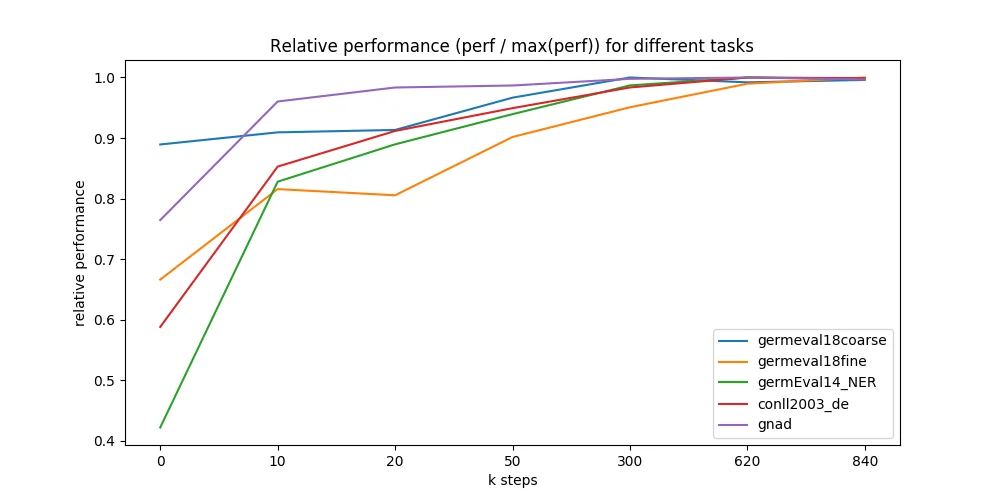
| | We further evaluated different points during the 9 days of pre-training and were astonished how fast the model converges to the maximally reachable performance. We ran all 5 downstream tasks on 7 different model checkpoints - taken at 0 up to 840k training steps (x-axis in figure below). Most checkpoints are taken from early training where we expected most performance changes. Surprisingly, even a randomly initialized BERT can be trained only on labeled downstream datasets and reach good performance (blue line, GermEval 2018 Coarse task, 795 kB trainset size). |
| | |
| |  |
| | |
| | |
| | ## Environmental Impact |
| | |
| | Carbon emissions can be estimated using the [Machine Learning Impact calculator](https://mlco2.github.io/impact#compute) presented in [Lacoste et al. (2019)](https://arxiv.org/abs/1910.09700). We present the hardware type based on the [associated paper](https://arxiv.org/pdf/2105.09680.pdf). |
| | |
| | |
| | - **Hardware Type:** Tensorflow code on a single cloud TPU v2 |
| | |
| | - **Hours used:** 216 (9 days) |
| | |
| | - **Cloud Provider:** GCP |
| | |
| | - **Compute Region:** [More information needed] |
| | |
| | - **Carbon Emitted:** [More information needed] |
| | |
| | |
| | ## Model Card Contact |
| | |
| | <details> |
| | <summary>Click to expand</summary> |
| | |
| | |
| |  |
| | |
| | We bring NLP to the industry via open source! |
| | Our focus: Industry specific language models & large scale QA systems. |
| | |
| | |
| | Get in touch: |
| | [Twitter](https://twitter.com/deepset_ai) | [LinkedIn](https://www.linkedin.com/company/deepset-ai/) | |
| | |
| | </details> |
| | |
| | |
| | ## How to Get Started With the Model |
| | |
| | ```python |
| | from transformers import AutoTokenizer, AutoModelForMaskedLM |
| | |
| | tokenizer = AutoTokenizer.from_pretrained("bert-base-german-cased") |
| | |
| | model = AutoModelForMaskedLM.from_pretrained("bert-base-german-cased") |
| | |
| | ``` |
| | |
| | |