| | --- |
| | language: |
| | - multilingual |
| | - af |
| | - am |
| | - ar |
| | - az |
| | - be |
| | - bg |
| | - bn |
| | - ca |
| | - ceb |
| | - co |
| | - cs |
| | - cy |
| | - da |
| | - de |
| | - el |
| | - en |
| | - eo |
| | - es |
| | - et |
| | - eu |
| | - fa |
| | - fi |
| | - fil |
| | - fr |
| | - fy |
| | - ga |
| | - gd |
| | - gl |
| | - gu |
| | - ha |
| | - haw |
| | - hi |
| | - hmn |
| | - ht |
| | - hu |
| | - hy |
| | - ig |
| | - is |
| | - it |
| | - iw |
| | - ja |
| | - jv |
| | - ka |
| | - kk |
| | - km |
| | - kn |
| | - ko |
| | - ku |
| | - ky |
| | - la |
| | - lb |
| | - lo |
| | - lt |
| | - lv |
| | - mg |
| | - mi |
| | - mk |
| | - ml |
| | - mn |
| | - mr |
| | - ms |
| | - mt |
| | - my |
| | - ne |
| | - nl |
| | - no |
| | - ny |
| | - pa |
| | - pl |
| | - ps |
| | - pt |
| | - ro |
| | - ru |
| | - sd |
| | - si |
| | - sk |
| | - sl |
| | - sm |
| | - sn |
| | - so |
| | - sq |
| | - sr |
| | - st |
| | - su |
| | - sv |
| | - sw |
| | - ta |
| | - te |
| | - tg |
| | - th |
| | - tr |
| | - uk |
| | - und |
| | - ur |
| | - uz |
| | - vi |
| | - xh |
| | - yi |
| | - yo |
| | - zh |
| | - zu |
| | datasets: |
| | - mc4 |
| |
|
| | license: apache-2.0 |
| | --- |
| | |
| | # ByT5 - Small |
| |
|
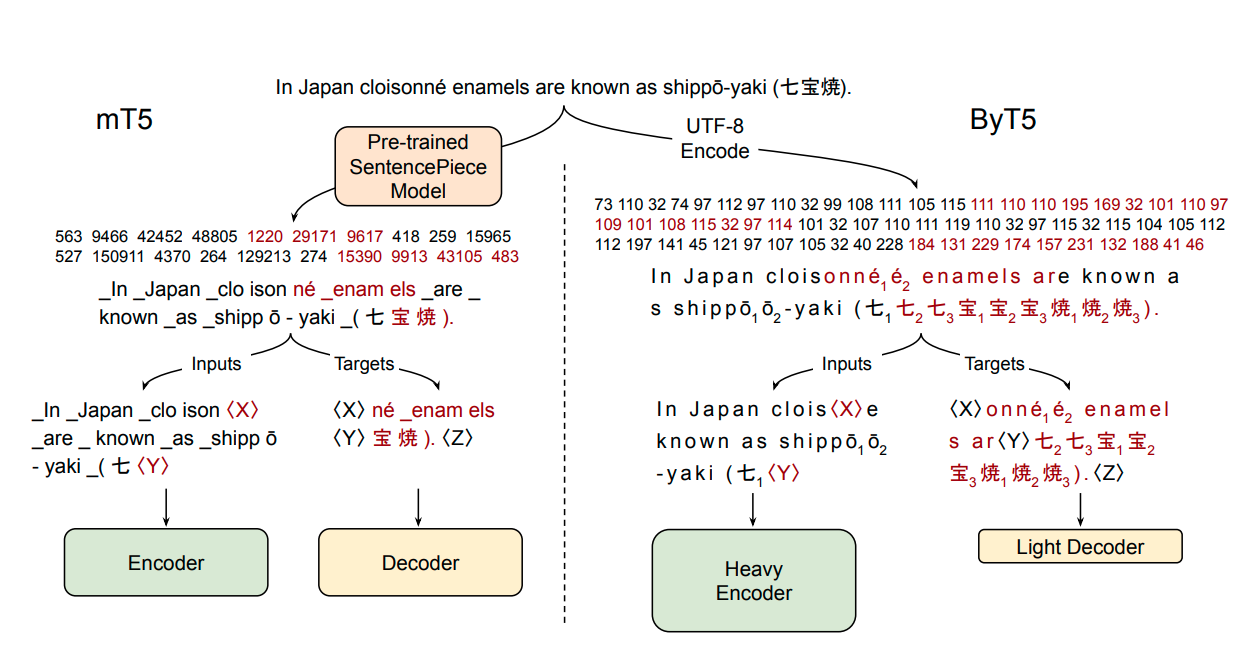
| | ByT5 is a tokenizer-free version of [Google's T5](https://ai.googleblog.com/2020/02/exploring-transfer-learning-with-t5.html) and generally follows the architecture of [MT5](https://huggingface.co/google/mt5-small). |
| |
|
| | ByT5 was only pre-trained on [mC4](https://www.tensorflow.org/datasets/catalog/c4#c4multilingual) excluding any supervised training with an average span-mask of 20 UTF-8 characters. Therefore, this model has to be fine-tuned before it is useable on a downstream task. |
| |
|
| | ByT5 works especially well on noisy text data,*e.g.*, `google/byt5-small` significantly outperforms [mt5-small](https://huggingface.co/google/mt5-small) on [TweetQA](https://arxiv.org/abs/1907.06292). |
| |
|
| | Paper: [ByT5: Towards a token-free future with pre-trained byte-to-byte models](https://arxiv.org/abs/2105.13626) |
| |
|
| | Authors: *Linting Xue, Aditya Barua, Noah Constant, Rami Al-Rfou, Sharan Narang, Mihir Kale, Adam Roberts, Colin Raffel* |
| |
|
| | ## Example Inference |
| |
|
| | ByT5 works on raw UTF-8 bytes and can be used without a tokenizer: |
| |
|
| | ```python |
| | from transformers import T5ForConditionalGeneration |
| | import torch |
| | |
| | model = T5ForConditionalGeneration.from_pretrained('google/byt5-small') |
| | |
| | input_ids = torch.tensor([list("Life is like a box of chocolates.".encode("utf-8"))]) + 3 # add 3 for special tokens |
| | labels = torch.tensor([list("La vie est comme une boîte de chocolat.".encode("utf-8"))]) + 3 # add 3 for special tokens |
| | |
| | loss = model(input_ids, labels=labels).loss # forward pass |
| | ``` |
| |
|
| | For batched inference & training it is however recommended using a tokenizer class for padding: |
| |
|
| | ```python |
| | from transformers import T5ForConditionalGeneration, AutoTokenizer |
| | |
| | model = T5ForConditionalGeneration.from_pretrained('google/byt5-small') |
| | tokenizer = AutoTokenizer.from_pretrained('google/byt5-small') |
| | |
| | model_inputs = tokenizer(["Life is like a box of chocolates.", "Today is Monday."], padding="longest", return_tensors="pt") |
| | labels = tokenizer(["La vie est comme une boîte de chocolat.", "Aujourd'hui c'est lundi."], padding="longest", return_tensors="pt").input_ids |
| | |
| | loss = model(**model_inputs, labels=labels).loss # forward pass |
| | ``` |
| |
|
| | ## Abstract |
| |
|
| | Most widely-used pre-trained language models operate on sequences of tokens corresponding to word or subword units. Encoding text as a sequence of tokens requires a tokenizer, which is typically created as an independent artifact from the model. Token-free models that instead operate directly on raw text (bytes or characters) have many benefits: they can process text in any language out of the box, they are more robust to noise, and they minimize technical debt by removing complex and error-prone text preprocessing pipelines. Since byte or character sequences are longer than token sequences, past work on token-free models has often introduced new model architectures designed to amortize the cost of operating directly on raw text. In this paper, we show that a standard Transformer architecture can be used with minimal modifications to process byte sequences. We carefully characterize the trade-offs in terms of parameter count, training FLOPs, and inference speed, and show that byte-level models are competitive with their token-level counterparts. We also demonstrate that byte-level models are significantly more robust to noise and perform better on tasks that are sensitive to spelling and pronunciation. As part of our contribution, we release a new set of pre-trained byte-level Transformer models based on the T5 architecture, as well as all code and data used in our experiments. |
| |
|
| |  |
| |
|
| |
|


