

Controllable Generation of Diverse Dermatological Imagery for Fair and Efficient Malignancy Classification
Paper • 2607.12987 • Published
This repository contains the textual inversion adaptation weights for stabilityai/stable-diffusion-2-1-base representing the keloid disease concept.
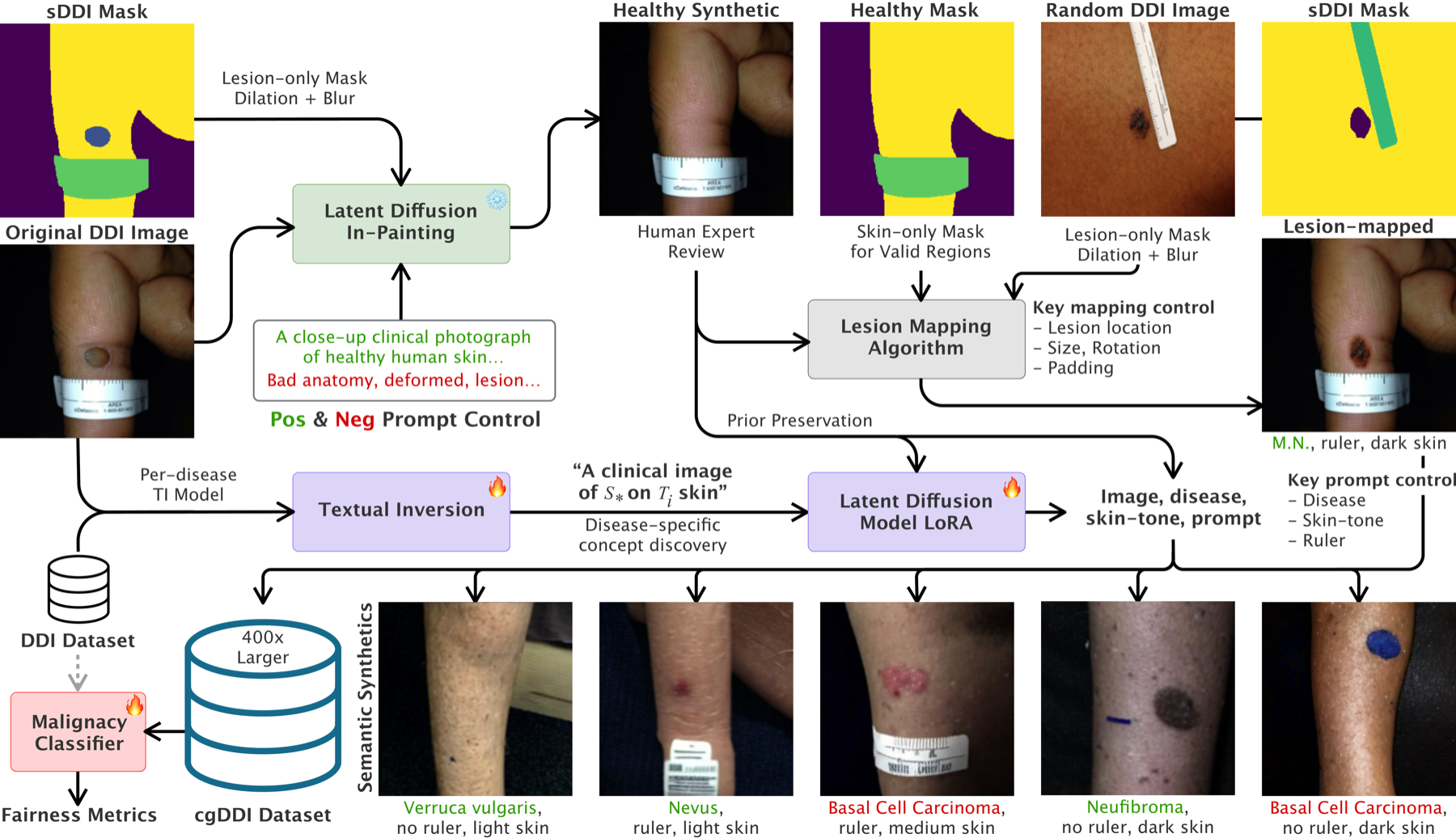
It is part of the cgDDI (Controllable Generation of Diverse Dermatological Imagery) framework introduced in the paper Controllable Generation of Diverse Dermatological Imagery for Fair and Efficient Malignancy Classification (MICCAI 2026).
cgDDI is a hybrid framework designed to address the systematic lack of expertly annotated dermatological images across diverse skin tones and rare diseases. This model learns the specific concept of keloid through textual inversion and fine-tuning, allowing the generation of diverse, realistic, and skin-tone-controlled synthetic samples.
<keloid-class>stabilityai/stable-diffusion-2-1-base
@inproceedings{carrion2026cgddi,
  title     = {Controllable Generation of Diverse Dermatological Imagery for Fair and Efficient Malignancy Classification},
  author    = {Carri{\'o}n, H{\'e}ctor and Norouzi, Narges},
  booktitle = {Medical Image Computing and Computer-Assisted Intervention (MICCAI)},
  year      = {2026},
  publisher = {Springer},
  series    = {Lecture Notes in Computer Science}
}
Base model
stabilityai/stable-diffusion-2-1-base