Instructions to use kostakoff/Qwen3-Coder-Next-GGUF with libraries, inference providers, notebooks, and local apps. Follow these links to get started.
- Libraries
- Transformers
How to use kostakoff/Qwen3-Coder-Next-GGUF with Transformers:
# Use a pipeline as a high-level helper from transformers import pipeline pipe = pipeline("text-generation", model="kostakoff/Qwen3-Coder-Next-GGUF") messages = [ {"role": "user", "content": "Who are you?"}, ] pipe(messages)# Load model directly from transformers import AutoModel model = AutoModel.from_pretrained("kostakoff/Qwen3-Coder-Next-GGUF", dtype="auto") - llama-cpp-python
How to use kostakoff/Qwen3-Coder-Next-GGUF with llama-cpp-python:
# !pip install llama-cpp-python from llama_cpp import Llama llm = Llama.from_pretrained( repo_id="kostakoff/Qwen3-Coder-Next-GGUF", filename="Qwen3-Coder-Next-F16/Qwen3-Coder-Next-00001-of-00004.gguf", )
llm.create_chat_completion( messages = [ { "role": "user", "content": "What is the capital of France?" } ] ) - Notebooks
- Google Colab
- Kaggle
- Local Apps
- llama.cpp
How to use kostakoff/Qwen3-Coder-Next-GGUF with llama.cpp:
Install from brew
brew install llama.cpp # Start a local OpenAI-compatible server with a web UI: llama-server -hf kostakoff/Qwen3-Coder-Next-GGUF:Q4_K_M # Run inference directly in the terminal: llama-cli -hf kostakoff/Qwen3-Coder-Next-GGUF:Q4_K_M
Install from WinGet (Windows)
winget install llama.cpp # Start a local OpenAI-compatible server with a web UI: llama-server -hf kostakoff/Qwen3-Coder-Next-GGUF:Q4_K_M # Run inference directly in the terminal: llama-cli -hf kostakoff/Qwen3-Coder-Next-GGUF:Q4_K_M
Use pre-built binary
# Download pre-built binary from: # https://github.com/ggerganov/llama.cpp/releases # Start a local OpenAI-compatible server with a web UI: ./llama-server -hf kostakoff/Qwen3-Coder-Next-GGUF:Q4_K_M # Run inference directly in the terminal: ./llama-cli -hf kostakoff/Qwen3-Coder-Next-GGUF:Q4_K_M
Build from source code
git clone https://github.com/ggerganov/llama.cpp.git cd llama.cpp cmake -B build cmake --build build -j --target llama-server llama-cli # Start a local OpenAI-compatible server with a web UI: ./build/bin/llama-server -hf kostakoff/Qwen3-Coder-Next-GGUF:Q4_K_M # Run inference directly in the terminal: ./build/bin/llama-cli -hf kostakoff/Qwen3-Coder-Next-GGUF:Q4_K_M
Use Docker
docker model run hf.co/kostakoff/Qwen3-Coder-Next-GGUF:Q4_K_M
- LM Studio
- Jan
- vLLM
How to use kostakoff/Qwen3-Coder-Next-GGUF with vLLM:
Install from pip and serve model
# Install vLLM from pip: pip install vllm # Start the vLLM server: vllm serve "kostakoff/Qwen3-Coder-Next-GGUF" # Call the server using curl (OpenAI-compatible API): curl -X POST "http://localhost:8000/v1/chat/completions" \ -H "Content-Type: application/json" \ --data '{ "model": "kostakoff/Qwen3-Coder-Next-GGUF", "messages": [ { "role": "user", "content": "What is the capital of France?" } ] }'Use Docker
docker model run hf.co/kostakoff/Qwen3-Coder-Next-GGUF:Q4_K_M
- SGLang
How to use kostakoff/Qwen3-Coder-Next-GGUF with SGLang:
Install from pip and serve model
# Install SGLang from pip: pip install sglang # Start the SGLang server: python3 -m sglang.launch_server \ --model-path "kostakoff/Qwen3-Coder-Next-GGUF" \ --host 0.0.0.0 \ --port 30000 # Call the server using curl (OpenAI-compatible API): curl -X POST "http://localhost:30000/v1/chat/completions" \ -H "Content-Type: application/json" \ --data '{ "model": "kostakoff/Qwen3-Coder-Next-GGUF", "messages": [ { "role": "user", "content": "What is the capital of France?" } ] }'Use Docker images
docker run --gpus all \ --shm-size 32g \ -p 30000:30000 \ -v ~/.cache/huggingface:/root/.cache/huggingface \ --env "HF_TOKEN=<secret>" \ --ipc=host \ lmsysorg/sglang:latest \ python3 -m sglang.launch_server \ --model-path "kostakoff/Qwen3-Coder-Next-GGUF" \ --host 0.0.0.0 \ --port 30000 # Call the server using curl (OpenAI-compatible API): curl -X POST "http://localhost:30000/v1/chat/completions" \ -H "Content-Type: application/json" \ --data '{ "model": "kostakoff/Qwen3-Coder-Next-GGUF", "messages": [ { "role": "user", "content": "What is the capital of France?" } ] }' - Ollama
How to use kostakoff/Qwen3-Coder-Next-GGUF with Ollama:
ollama run hf.co/kostakoff/Qwen3-Coder-Next-GGUF:Q4_K_M
- Unsloth Studio new
How to use kostakoff/Qwen3-Coder-Next-GGUF with Unsloth Studio:
Install Unsloth Studio (macOS, Linux, WSL)
curl -fsSL https://unsloth.ai/install.sh | sh # Run unsloth studio unsloth studio -H 0.0.0.0 -p 8888 # Then open http://localhost:8888 in your browser # Search for kostakoff/Qwen3-Coder-Next-GGUF to start chatting
Install Unsloth Studio (Windows)
irm https://unsloth.ai/install.ps1 | iex # Run unsloth studio unsloth studio -H 0.0.0.0 -p 8888 # Then open http://localhost:8888 in your browser # Search for kostakoff/Qwen3-Coder-Next-GGUF to start chatting
Using HuggingFace Spaces for Unsloth
# No setup required # Open https://huggingface.co/spaces/unsloth/studio in your browser # Search for kostakoff/Qwen3-Coder-Next-GGUF to start chatting
- Pi new
How to use kostakoff/Qwen3-Coder-Next-GGUF with Pi:
Start the llama.cpp server
# Install llama.cpp: brew install llama.cpp # Start a local OpenAI-compatible server: llama-server -hf kostakoff/Qwen3-Coder-Next-GGUF:Q4_K_M
Configure the model in Pi
# Install Pi: npm install -g @mariozechner/pi-coding-agent # Add to ~/.pi/agent/models.json: { "providers": { "llama-cpp": { "baseUrl": "http://localhost:8080/v1", "api": "openai-completions", "apiKey": "none", "models": [ { "id": "kostakoff/Qwen3-Coder-Next-GGUF:Q4_K_M" } ] } } }Run Pi
# Start Pi in your project directory: pi
- Hermes Agent new
How to use kostakoff/Qwen3-Coder-Next-GGUF with Hermes Agent:
Start the llama.cpp server
# Install llama.cpp: brew install llama.cpp # Start a local OpenAI-compatible server: llama-server -hf kostakoff/Qwen3-Coder-Next-GGUF:Q4_K_M
Configure Hermes
# Install Hermes: curl -fsSL https://hermes-agent.nousresearch.com/install.sh | bash hermes setup # Point Hermes at the local server: hermes config set model.provider custom hermes config set model.base_url http://127.0.0.1:8080/v1 hermes config set model.default kostakoff/Qwen3-Coder-Next-GGUF:Q4_K_M
Run Hermes
hermes
- Docker Model Runner
How to use kostakoff/Qwen3-Coder-Next-GGUF with Docker Model Runner:
docker model run hf.co/kostakoff/Qwen3-Coder-Next-GGUF:Q4_K_M
- Lemonade
How to use kostakoff/Qwen3-Coder-Next-GGUF with Lemonade:
Pull the model
# Download Lemonade from https://lemonade-server.ai/ lemonade pull kostakoff/Qwen3-Coder-Next-GGUF:Q4_K_M
Run and chat with the model
lemonade run user.Qwen3-Coder-Next-GGUF-Q4_K_M
List all available models
lemonade list
llm.create_chat_completion(
messages = [
{
"role": "user",
"content": "What is the capital of France?"
}
]
)Qwen3-Coder-Next
Highlights
Today, we're announcing Qwen3-Coder-Next, an open-weight language model designed specifically for coding agents and local development. It features the following key enhancements:
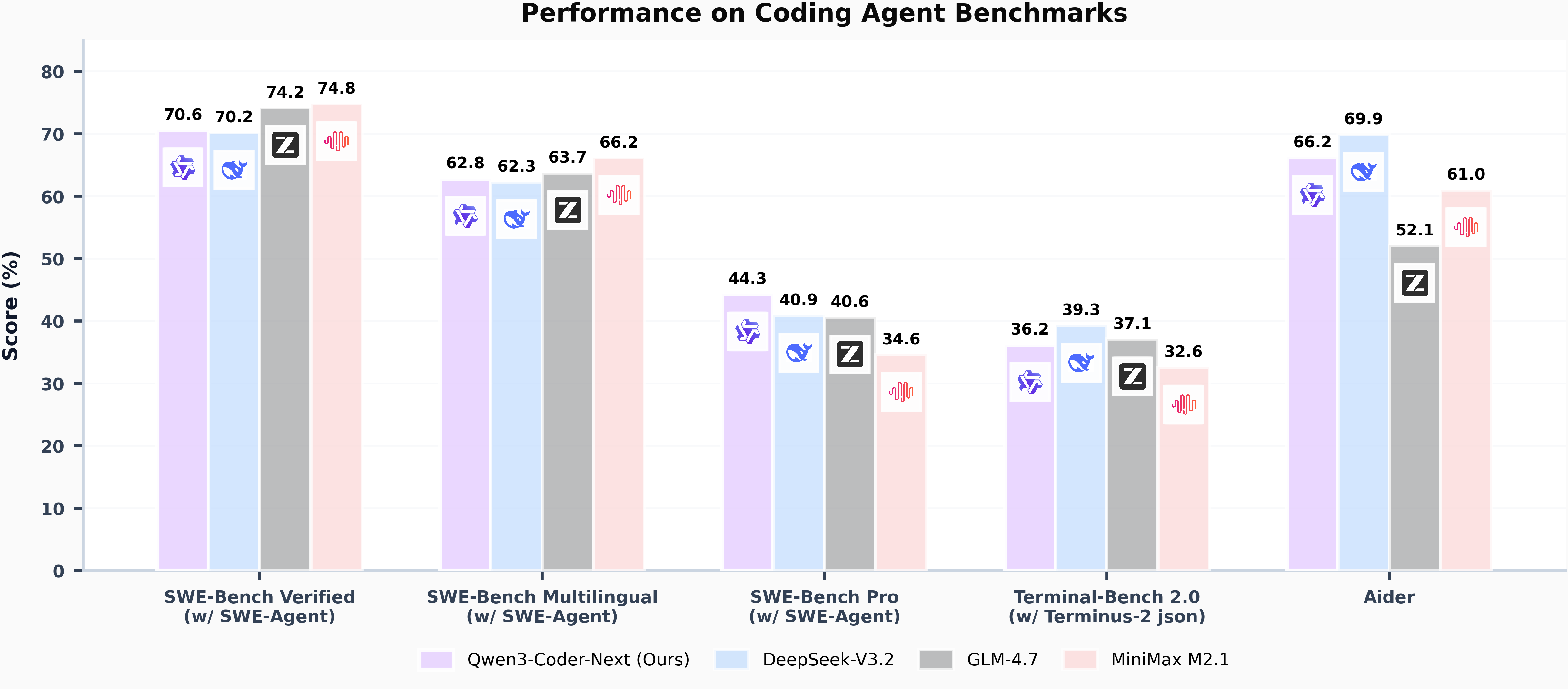
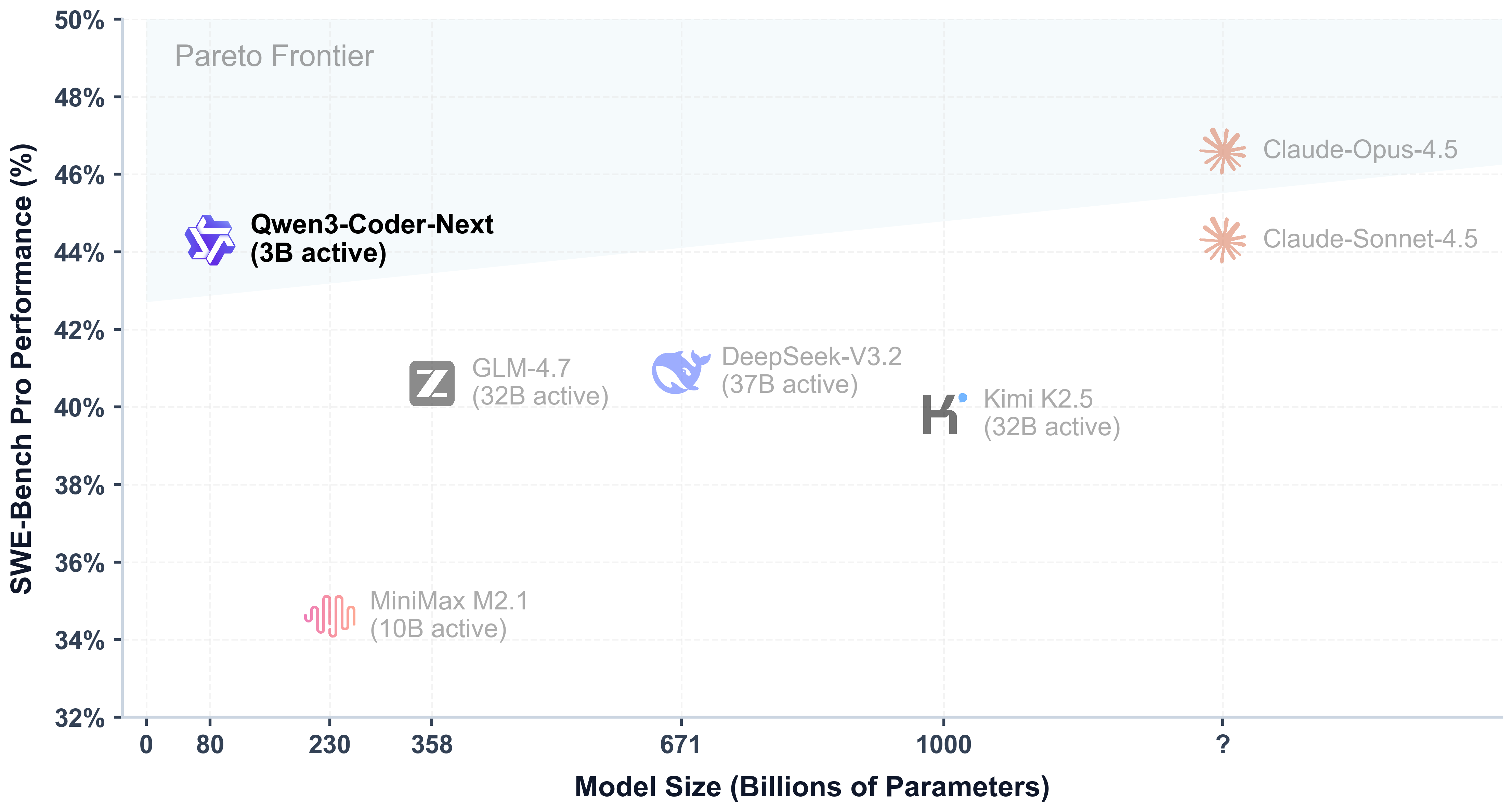
- Super Efficient with Significant Performance: With only 3B activated parameters (80B total parameters), it achieves performance comparable to models with 10–20x more active parameters, making it highly cost-effective for agent deployment.
- Advanced Agentic Capabilities: Through an elaborate training recipe, it excels at long-horizon reasoning, complex tool usage, and recovery from execution failures, ensuring robust performance in dynamic coding tasks.
- Versatile Integration with Real-World IDE: Its 256k context length, combined with adaptability to various scaffold templates, enables seamless integration with different CLI/IDE platforms (e.g., Claude Code, Qwen Code, Qoder, Kilo, Trae, Cline, etc.), supporting diverse development environments.
Model Overview
Qwen3-Coder-Next has the following features:
- Type: Causal Language Models
- Training Stage: Pretraining & Post-training
- Number of Parameters: 80B in total and 3B activated
- Number of Parameters (Non-Embedding): 79B
- Hidden Dimension: 2048
- Number of Layers: 48
- Hybrid Layout: 12 * (3 * (Gated DeltaNet -> MoE) -> 1 * (Gated Attention -> MoE))
- Gated Attention:
- Number of Attention Heads: 16 for Q and 2 for KV
- Head Dimension: 256
- Rotary Position Embedding Dimension: 64
- Gated DeltaNet:
- Number of Linear Attention Heads: 32 for V and 16 for QK
- Head Dimension: 128
- Mixture of Experts:
- Number of Experts: 512
- Number of Activated Experts: 10
- Number of Shared Experts: 1
- Expert Intermediate Dimension: 512
- Context Length: 262,144 natively
NOTE: This model supports only non-thinking mode and does not generate <think></think> blocks in its output. Meanwhile, specifying enable_thinking=False is no longer required.
For more details, including benchmark evaluation, hardware requirements, and inference performance, please refer to our blog, GitHub, and Documentation.
Quickstart
llama.cpp
Check out our llama.cpp documentation for more usage guide.
We advise you to clone llama.cpp and install it following the official guide. We follow the latest version of llama.cpp.
In the following demonstration, we assume that you are running commands under the repository llama.cpp.
huggingface-cli download Qwen/Qwen3-Coder-Next-GGUF --include "Qwen3-Coder-Next-Q5_K_M/*"
./llama-cli -m ./Qwen3-Coder-Next-Q5_K_M/Qwen3-Coder-Next-00001-of-00004.gguf --jinja -ngl 99 -fa on -sm row --temp 1.0 --top-k 40 --top-p 0.95 --min-p 0 -c 40960 -n 32768 --no-context-shift
Processing Long Texts
Qwen3 natively supports context lengths of up to 262,144 tokens. For conversations where the total length (including both input and output) significantly exceeds this limit, we recommend using RoPE scaling techniques to handle long texts effectively. We have validated the model's performance on context lengths of up to 131,072 tokens using the YaRN method.
To enable YARN in llama.cpp:
./llama-cli ... -c 1010000 --rope-scaling yarn --rope-scale 4 --yarn-orig-ctx 262144
Agentic Coding
Qwen3-Coder-Next excels in tool calling capabilities.
You can simply define or use any tools as following example.
# Your tool implementation
def square_the_number(num: float) -> dict:
return num ** 2
# Define Tools
tools=[
{
"type":"function",
"function":{
"name": "square_the_number",
"description": "output the square of the number.",
"parameters": {
"type": "object",
"required": ["input_num"],
"properties": {
'input_num': {
'type': 'number',
'description': 'input_num is a number that will be squared'
}
},
}
}
}
]
from openai import OpenAI
# Define LLM
client = OpenAI(
# Use a custom endpoint compatible with OpenAI API
base_url='http://localhost:8000/v1', # api_base
api_key="EMPTY"
)
messages = [{'role': 'user', 'content': 'square the number 1024'}]
completion = client.chat.completions.create(
messages=messages,
model="Qwen3-Coder-Next",
max_tokens=65536,
tools=tools,
)
print(completion.choices[0])
Best Practices
To achieve optimal performance, we recommend the following sampling parameters: temperature=1.0, top_p=0.95, top_k=40.
Citation
If you find our work helpful, feel free to give us a cite.
@techreport{qwen_qwen3_coder_next_tech_report,
title = {Qwen3-Coder-Next Technical Report},
author = {{Qwen Team}},
url = {https://github.com/QwenLM/Qwen3-Coder/blob/main/qwen3_coder_next_tech_report.pdf},
note = {Accessed: 2026-02-03}
}
- Downloads last month
- 160
4-bit
5-bit
6-bit
8-bit
16-bit


# !pip install llama-cpp-python from llama_cpp import Llama llm = Llama.from_pretrained( repo_id="kostakoff/Qwen3-Coder-Next-GGUF", filename="", )