| --- |
| license: other |
| license_name: lfm1.0 |
| license_link: https://huggingface.co/LiquidAI/LFM2.5-Encoder-350M-Prompt-Router/blob/main/LICENSE |
| base_model: LiquidAI/LFM2.5-Encoder-350M-Prompt-Router |
| base_model_relation: quantized |
| library_name: transformers.js |
| pipeline_tag: zero-shot-classification |
| tags: |
| - onnx |
| - transformers.js |
| - lfm2 |
| - quantized |
| language: |
| - en |
| - de |
| - es |
| - fr |
| - it |
| - nl |
| - pl |
| - pt |
| - ar |
| - hi |
| - ja |
| - ru |
| - tr |
| - vi |
| - zh |
| --- |
| |
| # LFM2.5-Encoder-350M-Prompt-Router-ONNX |
|
|
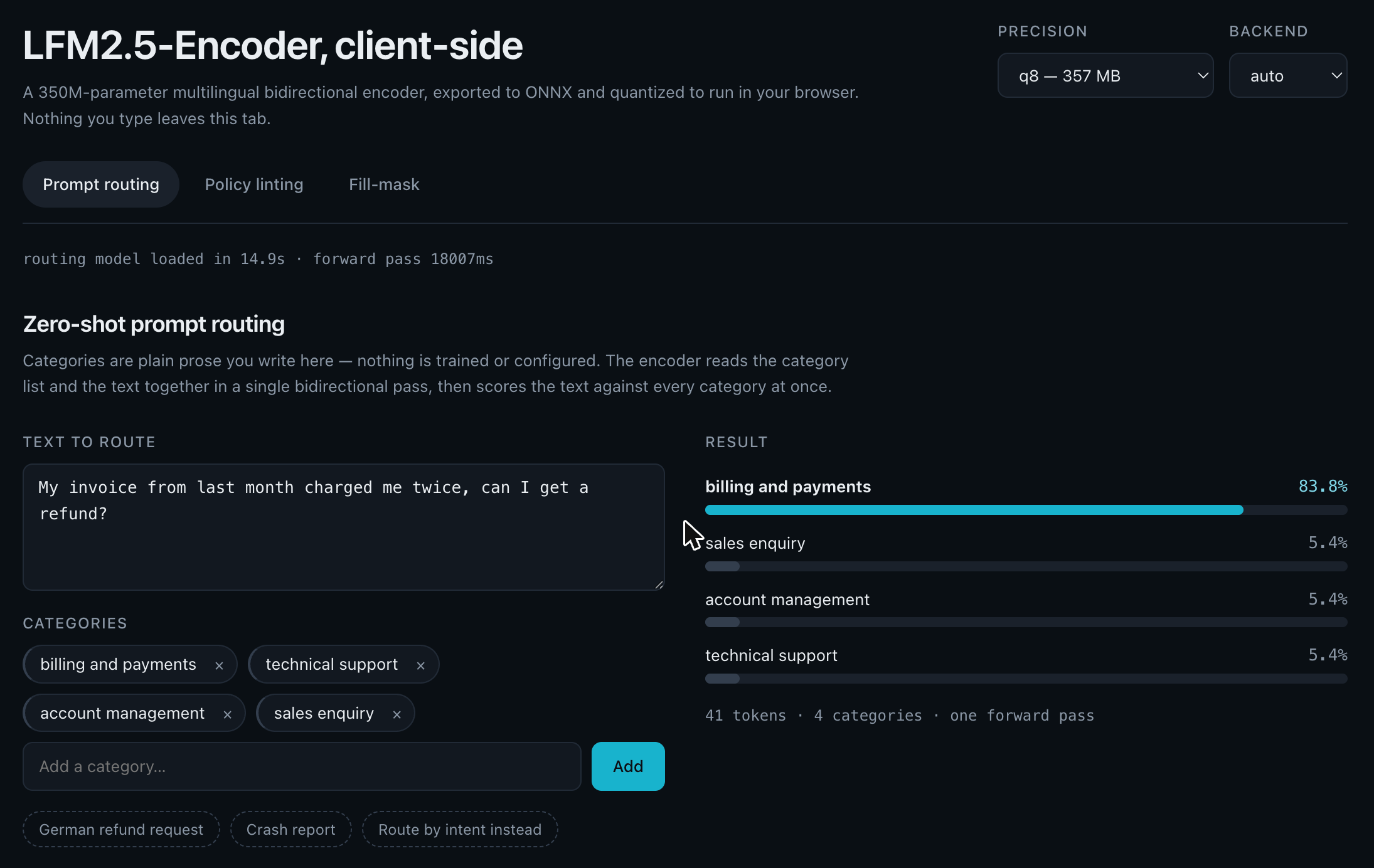
| ONNX export of [`LiquidAI/LFM2.5-Encoder-350M-Prompt-Router`](https://huggingface.co/LiquidAI/LFM2.5-Encoder-350M-Prompt-Router), quantized to run **fully in the browser** through |
| [transformers.js](https://github.com/huggingface/transformers.js). No inference server: the weights are |
| fetched once, cached, and every forward pass happens in the tab. |
|
|
| A zero-shot prompt router. Categories are ordinary prose supplied at call time — nothing is |
| trained or cached per label set. One bidirectional pass over the category list *and* the text |
| scores every category at once. |
|
|
| All credit for the model itself goes to [Liquid AI](https://huggingface.co/LiquidAI). This repository |
| contains only a re-export; the weights are unchanged apart from quantization, and the original |
| [LFM Open License v1.0](https://huggingface.co/LiquidAI/LFM2.5-Encoder-350M-Prompt-Router/blob/main/LICENSE) applies. |
|
|
| **[Try it in your browser →](https://kucukkanat.github.io/lfm-encoders/)** — no install, no API key. |
|
|
|  |
|
|
| Tooling, demo and the export pipeline: <https://github.com/kucukkanat/lfm-encoders> |
|
|
| ## Files |
|
|
| | dtype | File | Size | |
| | --- | --- | --: | |
| | `q8` | `onnx/model_quantized.onnx` | 357 MB | |
| | `q4` | `onnx/model_q4.onnx` | 449 MB | |
|
|
| The graph takes `input_ids` + `attention_mask`, is dynamic in batch and sequence, and returns |
| `token_proj` and `rule_proj`. |
|
|
| ## Usage |
|
|
| ```js |
| import { AutoTokenizer, PreTrainedModel, Tensor } from "@huggingface/transformers"; |
| |
| const id = "kucukkanat/LFM2.5-Encoder-350M-Prompt-Router-ONNX"; |
| const tokenizer = await AutoTokenizer.from_pretrained(id); |
| const model = await PreTrainedModel.from_pretrained(id, { dtype: "q8" }); |
| |
| const { input_ids } = tokenizer("some text"); |
| const out = await model({ |
| input_ids, |
| attention_mask: new Tensor("int64", new BigInt64Array(input_ids.dims[1]).fill(1n), input_ids.dims), |
| }); |
| ``` |
|
|
| `PreTrainedModel` rather than `AutoModel` is deliberate: this is a plain "feed the named inputs, read the |
| named outputs" session, not one of transformers.js's built-in architectures. |
|
|
| ### Prompt format |
|
|
| Both projection towers expect one string laid out exactly like this — the model was trained on it and the |
| character arithmetic that locates each label depends on it byte for byte: |
|
|
| ``` |
| Categories: |
| - label one |
| - label two |
| |
| Text: |
| <the text> |
| ``` |
|
|
| `token_proj` is the query tower and `rule_proj` the key tower, both 256-d and emitted **per token**. Pool |
| the tokens covering each label to get its vector. Pooling after projecting is exact rather than an |
| approximation: both towers are affine, and an affine map commutes with a mean — which is what keeps one |
| static graph usable for any number of labels. |
|
|
| Scoring is `cosine between the L2-normalised pooled towers, scaled by a learned temperature, then a softmax across labels`. |
|
|
| [`@lfm-encoder/tasks`](https://github.com/kucukkanat/lfm-encoders) implements all of this, including the |
| character-offset reconstruction transformers.js does not provide. |
|
|
|
|
| ## Accuracy |
|
|
| Measured from JavaScript against the fp32 PyTorch reference. Δ is the largest absolute difference in a |
| final probability. |
|
|
| | dtype | max Δ | mean Δ | top-1 flips (4 cases) | |
| | --- | --: | --: | --: | |
| | `fp32` | 6.4e-5 | 1.6e-5 | 0 | |
| | `q8` | 0.0910 | 0.0230 | 0 | |
| | `q4` | 0.1221 | 0.0309 | 0 | |
|
|
| ## Notes |
|
|
| - `q8` is smaller on disk but uses **more** browser RAM than fp32 and runs slower: onnxruntime's WASM |
| kernels compute in float, so quantized weights are unpacked at session load. Quantization here buys |
| download size, not speed or memory. |
| - Budget roughly 1.5 GB of RAM per resident model, and expect a tab to hold its high-water mark until |
| reloaded. |
| - `fp16` / `q4f16` are deliberately absent: RMSNorm's variance overflows fp16 on this architecture and |
| every hidden state collapses to zeros. |
|
|

