
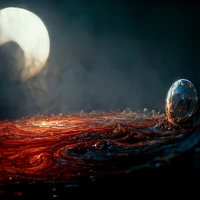

PixelDiT 1.3B — Diffusers-Compatible Pipeline
Two RTX 3060s. Infinite Lore. Zero Fear.
Unofficial HuggingFace diffusers-compatible conversion of NVIDIA's PixelDiT-1300M-1024px with dual text encoder support (Gemma-2-2B + Qwen3-2B), LoRA training, and ComfyUI integration.
All credit for the model architecture and weights goes to NVIDIA Research. This repo provides the pipeline wrapper, Qwen encoder integration, LoRA tooling, and scripts.
I do not own this model. Original weights, architecture, and training are the work of NVIDIA Research. For non-commercial use only (NSCLv1).
What is PixelDiT?
PixelDiT is a 1.3B parameter pixel-space diffusion transformer — no VAE, generates images directly in pixel space. Runs on 4GB VRAM.
- Architecture: MMDiT patch blocks + pixel pathway (PiT blocks)
- Text encoders: Gemma-2-2B (photorealistic) or Qwen3-2B (creative/fantasy)
- Native resolution: 1024×1024 (non-square supported)
- Samplers: Euler (default), Heun, LCM
- Minimum steps: 45–50 — below 45 produces garbage output
- LoRA: full PEFT-compatible LoRA training + inference
Install
python3 -m venv .venv && source .venv/bin/activate
pip install torch --index-url https://download.pytorch.org/whl/cu121
pip install "diffusers>=0.31.0" "transformers>=4.40.0,<5.0.0" accelerate safetensors pillow peft
git clone https://github.com/madtunebk/pixeldit-diffusers
cd pixeldit-diffusers
python scripts/setup_diffusers_pixeldit.py
Quick Start
# Gemma encoder (photorealistic, default)
python generate.py --prompt "a viking warrior on a cliff at sunset, cinematic"

# Portrait mode
python generate.py --height 1280 --width 768 --steps 60 --cfg 8.5 --prompt "your prompt"

# LCM fast mode (8 steps)
python generate.py --scheduler lcm --steps 8 --cfg 2.0 --prompt "your prompt"
Python API
import torch
from diffusers import PixelDiTPipeline


pipe = PixelDiTPipeline.from_pretrained("madtune/pixeldit-diffusers",  torch_dtype=torch.bfloat16)
pipe.enable_model_cpu_offload()

image = pipe(
    "a viking warrior on a cliff overlooking the stormy sea at sunset",
    negative_prompt="blurry, low quality, deformed, watermark",
    height=1024, width=1024,
    num_inference_steps=50,
    guidance_scale=7.5,
).images[0]

image.save("out.jpg")
ComfyUI
ln -s /path/to/pixeldit-diffusers/comfyui_pixeldit /path/to/ComfyUI/custom_nodes/comfyui_pixeldit
Three nodes under PixelDiT category:
- PixelDiT Text Encoder — load Gemma or any compatible encoder
- PixelDiT Model Loader — loads transformer from HF
- PixelDiT Sampler — prompt → image, all params exposed
Scripts
| Script | Purpose |
|---|---|
generate.py |
Main generation script |
scripts/upscale_images.py |
RealESRGAN 4× upscale before LoRA precompute |
scripts/setup_diffusers_pixeldit.py |
Install pipeline into active venv's diffusers |
Credits
- Original model & all credit: NVIDIA Research
- Paper: PixelDiT: Pixel-Space Diffusion Transformers for Text-to-Image Generation — NVIDIA
- This repo: unofficial diffusers conversion, Qwen integration, LoRA tooling only
- Downloads last month
- 67