



Overview
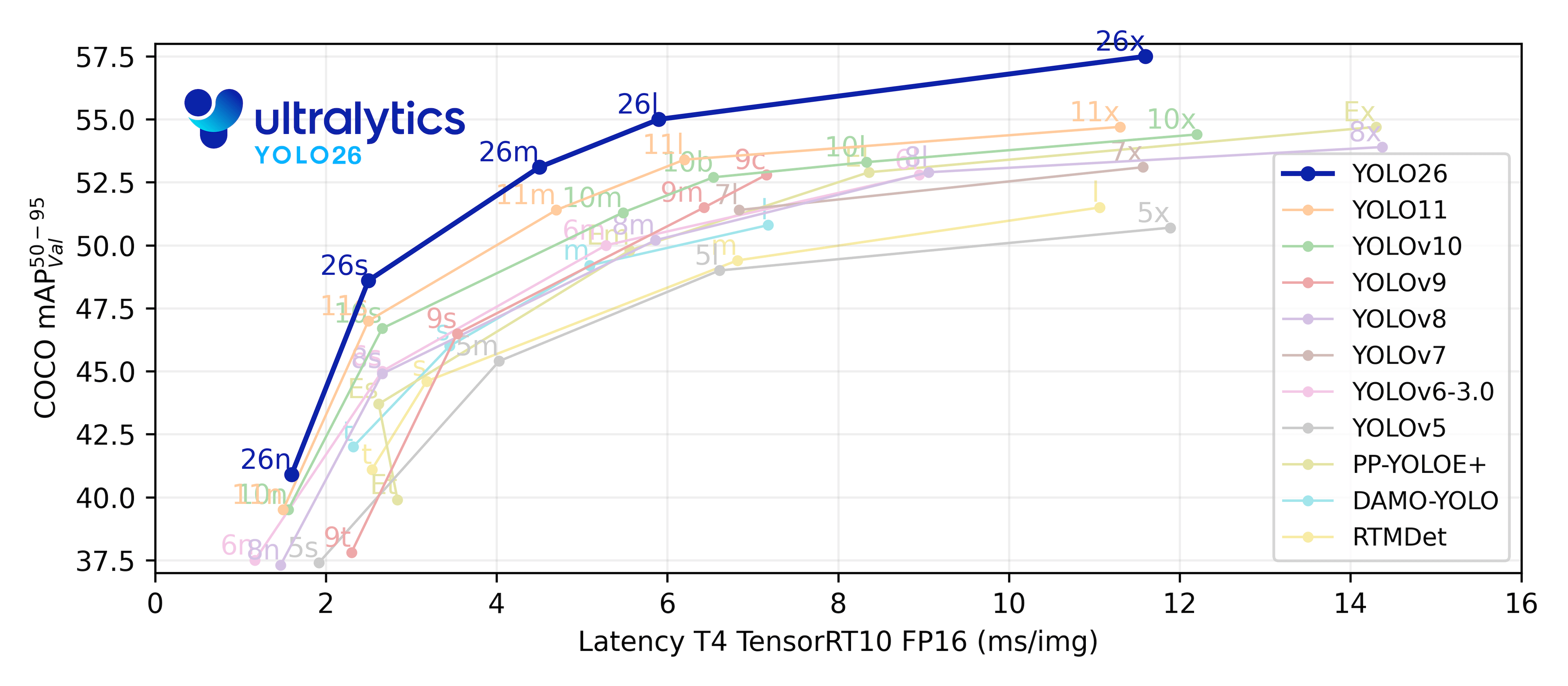
Ultralytics released Ultralytics YOLO11 on September 10, 2024, delivering state-of-the-art accuracy and speed. Building on the progress of earlier Ultralytics YOLO versions, YOLO11 introduces improved features and optimizations that make it a strong choice for a wide range of object detection, instance segmentation, classificationand pose estimation tasks across many applications.
Key Features of Ultralytics YOLO11
- Advanced Backbone and Neck Architectures: YOLO11 enhances the backbone and neck components of previous versions, improving feature extraction and boosting performance across different tasks.
- Efficient Performance Balance: The architecture used across the different YOLO11 models achieves an optimal trade-off between model size and accuracy, enabling short inference times without compromising performance.
- Higher Accuracy with Fewer Parameters: As per YOLO11 architecture, YOLO11m has almost 22% fewer parameters than YOLO8m, while still achieving a higher Mean Average Precision (mAP).
- Multi-Environment Deployment: YOLO11's versatility enables fast deployment in cloud platforms, edge devices, and systems supporting NVIDIA GPUs.
- Multi-Task Capabilities: YOLO11 supports traditional object detection and image classification, as well as pose estimation and oriented bounding box detection (OBB). Note: The models included in this repository are for object detection only.
Model Description
This repository contains Ultralytics YOLO11 pre-compiled models for object detection optimized for NXP Ara240 DNPU.
- Base Model: Ultralytics/YOLO11
- Original Model Authors: Ultralytics
- Original License: AGPL-3.0
- Modified by: NXP
Modifications
This model is a derivative work with the following changes from the original:
- Quantization: INT8, calibrated using COCO val2017
- Compilation: Compiled for the Ara240 DNPU
- Format: Converted to DVM format for NPU deployment
The original model is available at: Ultralytics YOLO11.
Performance Summary
Object Detection
| Model | Size (pixels) |
FP32 mAPval 50-95 |
INT8 mAPval 50-95 |
Latency Ara240 (ms) |
Performance Ara240 (inferences/s) |
Params (M) |
|---|---|---|---|---|---|---|
| YOLO11n | 640 | 39.5 | 35.29 | 3.14 | 317.86 | 2.6 |
| YOLO11s | 640 | 47.0 | 45.02 | 6.71 | 148.83 | 9.4 |
| YOLO11m | 640 | 51.5 | 49.64 | 20.82 | 48.01 | 20.1 |
| YOLO11l | 640 | 53.4 | 51.25 | 28.16 | 35.50 | 25.3 |
| YOLO11x | 640 | 54.7 | 51.87 | 59.17 | 16.89 | 56.9 |
- mAPval values are measured on the COCO val2017 validation dataset.
License
Ultralytics offers two licensing options to accommodate diverse use cases:
- AGPL-3.0 License: This OSI-approved open-source license is ideal for students and enthusiasts, promoting open collaboration and knowledge sharing. See the LICENSE file for more details.
- Enterprise License: Designed for commercial use, this license permits seamless integration of Ultralytics software and AI models into commercial goods and services, bypassing the open-source requirements of AGPL-3.0. If your scenario involves embedding our solutions into a commercial offering, reach out through Ultralytics Licensing.
- Downloads last month
- -
Model tree for nxp/Ultralytics-YOLO11-Detection-Ara240
Base model
Ultralytics/YOLO11