new

Get trending papers in your email inbox!

Subscribe

Trending Papers

byAK and the research community

Trending Papers
Submitted by
taesiri

Kimi K3: Open Frontier Intelligence

We introduce Kimi K3, a 2.8T parameter Mixture-of-Experts model with 104 billion activated parameters, native vision capabilities, and a 1-million-token context window. Kimi K3 is built on Kimi Delta Attention and Attention Residuals, which improve information flow across sequence length and model depth. Together with Stable LatentMoE, which effectively activates 16 of 896 routed experts per token, and refined training and data recipes, these advances yield an approximately 2.5x improvement in overall scaling efficiency over Kimi K2. Post-training highlights reinforcement learning across general, agentic, and coding domains and multiple reasoning-effort levels, enabling compositional generalization and robust long-horizon execution. At 2.8T scale, Kimi K3 is supported by infrastructure advances in multiple areas: algorithm-system co-design for KDA, perfectly balanced expert-parallel training with efficient memory management, million-token agentic RL with persistent rollout and sandbox states, and deployment innovations. Extensive evaluations show that Kimi K3 achieves frontier-level performance across long-horizon coding, agentic, knowledge, reasoning, and vision tasks. While its overall performance still trails the most powerful proprietary models, namely Claude Fable 5 and GPT-5.6 Sol, Kimi K3 consistently outperforms other open and proprietary models evaluated in our suite. We release the full Kimi K3 model weights to facilitate future research and accelerate the broader deployment and adoption of frontier intelligence.

moonshotai Moonshot AI · Jul 27, 2026
Submitted by
taesiri

Unlimited OCR Works

Unlimited OCR introduces Reference Sliding Window Attention to eliminate growing memory consumption during long-sequence OCR tasks, enabling efficient transcription of multiple pages in a single forward pass.

baidu BAIDU · Jun 22, 2026
Submitted by
taesiri

JoyAI-Video-Edit: Real-Time Open-Ended Video Editing with Autoregressive Diffusion

Real-time video editing requires low-latency causal generation with bounded computational resources while preserving source fidelity and long-term temporal consistency. We present JoyAI-Video-Edit, a 16B-parameter autoregressive diffusion framework for real-time, open-ended video editing without access to future frames or a predefined video duration. Our method combines chunk-wise autoregressive adaptation, Source-Anchored Distribution Matching Distillation (SA-DMD), and Long-Horizon Autoregressive Distillation to reduce train--inference mismatch, preserve source fidelity during two-step generation, and mitigate accumulated temporal drift. Extensive automatic and human evaluations show that JoyAI-Video-Edit substantially outperforms existing streaming editors and remains competitive with strong offline systems on both short and long videos. The complete system achieves end-to-end 720p video editing at approximately 30 FPS on a single Nvidia B200 GPU. Code is available at https://github.com/jd-opensource/JoyAI-Video-Edit.

jingdong1 jingdong · Aug 4, 2026

TradingAgents: Multi-Agents LLM Financial Trading Framework

A multi-agent framework using large language models for stock trading simulates real-world trading firms, improving performance metrics like cumulative returns and Sharpe ratio.

  • 4 authors
· Dec 28, 2024
Submitted by
seashell11

LongHorizon-Harness: Advancing Long-Horizon Agents for Real-World Tasks

Large language model (LLM) agents increasingly undertake long-horizon tasks that require sustained reasoning, tool use, and revision across many interdependent steps. However, existing agent harnesses maintain task execution, task state, and completion assessment within a growing context, making the state difficult to track and allowing incorrect self-assessments to propagate into later decisions. We reformulate long-horizon execution as a task-state management problem and propose LongHorizon-Harness, which maintains the task state explicitly outside execution and updates it only with facts independently verified from the environment. Its Manage-Execute-Audit(MEA) loop uses a manager to maintain the task state and determine the next subtask, a fresh-context executor to perform it, and a read-only auditor to verify the resulting environment state before the next round. A lightweight AgentAdapter supports interchangeable model and harness backends without modifying their native agent loops. LongHorizon-Harness improves Qwen~3.7-Plus from 51.8% to 80.7% on WeaveBench, from 69.7% to 77.2% on Terminal-Bench~2.1, and from 2.8% to 8.3% on OSWorld~2.0. It also raises Claude Opus~4.7 from 20.0% to 34.3% on an OSWorld2.0 subset, demonstrating consistent gains across models, harnesses, and interaction domains.

  • 8 authors
· Aug 3, 2026

Kronos: A Foundation Model for the Language of Financial Markets

Kronos, a specialized pre-training framework for financial K-line data, outperforms existing models in forecasting and synthetic data generation through a unique tokenizer and autoregressive pre-training on a large dataset.

  • 7 authors
· Aug 2, 2025
Submitted by
taesiri

MinerU2.5: A Decoupled Vision-Language Model for Efficient High-Resolution Document Parsing

MinerU2.5, a 1.2B-parameter document parsing vision-language model, achieves state-of-the-art recognition accuracy with computational efficiency through a coarse-to-fine parsing strategy.

  • 61 authors
· Sep 26, 2025
Submitted by
akhaliq

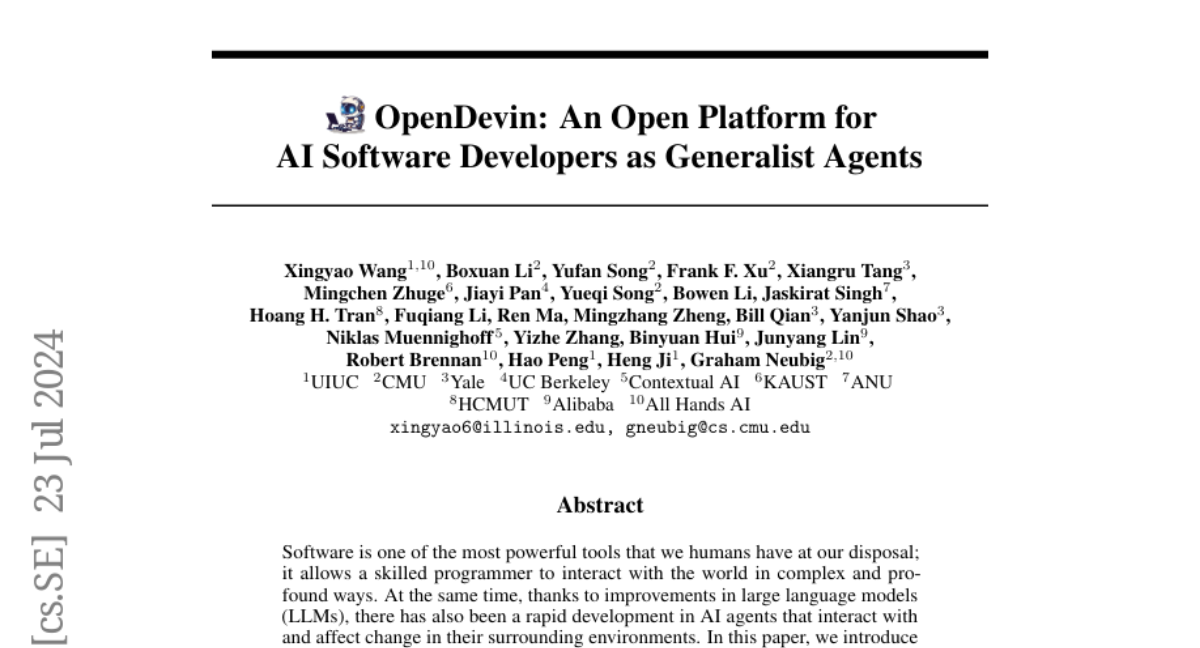
OpenDevin: An Open Platform for AI Software Developers as Generalist Agents

OpenDevin is a platform for developing AI agents that interact with the world by writing code, using command lines, and browsing the web, with support for multiple agents and evaluation benchmarks.

  • 24 authors
· Jul 23, 2024
Submitted by
akhaliq

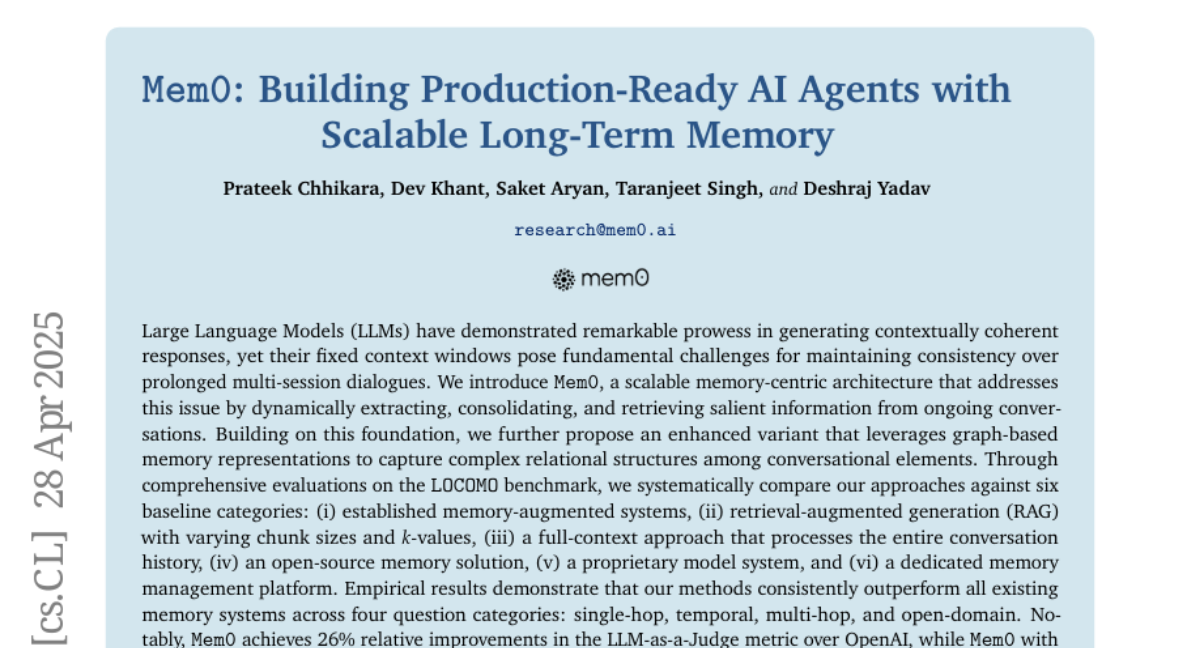
Mem0: Building Production-Ready AI Agents with Scalable Long-Term Memory

Mem0, a memory-centric architecture with graph-based memory, enhances long-term conversational coherence in LLMs by efficiently extracting, consolidating, and retrieving information, outperforming existing memory systems in terms of accuracy and computational efficiency.

  • 5 authors
· Apr 28, 2025
Submitted by
taesiri

ABot-World-0: Infinite Interactive World Rollout on a Single Desktop GPU

We present ABot-World-0, an action-conditioned video world model for real-time, long-horizon closed-loop interaction, supported by a multi-source data infrastructure spanning AAA games, simulation engines, and internet videos to learn controllable world dynamics. WorldExplorer performs agent-driven collection guided by training feedback, while a unified pipeline applies 14 deterministic quality checks, VLM-based assessment, and synchronized action and text annotation. We progressively distill a bidirectional action-conditioned teacher into a causal student through teacher forcing and ODE distillation, and introduce LongForcing to align long student self-rollouts with an extended-horizon teacher, mitigating accumulated distribution shift and autoregressive drift. Raw keyboard actions provide a unified control interface for scene roaming and third-person character interaction, while reference-character memory provides persistent appearance cues for identity consistency during third-person rollouts. For deployment, we co-design a streaming inference stack with a lightweight VAE decoder, efficient attention, memory-aware scheduling, and low-bit DiT inference. Across optimized low-bit configurations, ABot-World-0 streams 720P video at up to 16 FPS on a single NVIDIA RTX 5090 desktop GPU, with 1.2s action-to-first-frame latency and approximately 19GiB peak VRAM. Experiments on WorldRoamBench and extended interactive rollouts demonstrate competitive controllability and coherent long-horizon world evolution.

acvlab Alibaba AMAP CV Lab · Jul 21, 2026
Submitted by
akhaliq

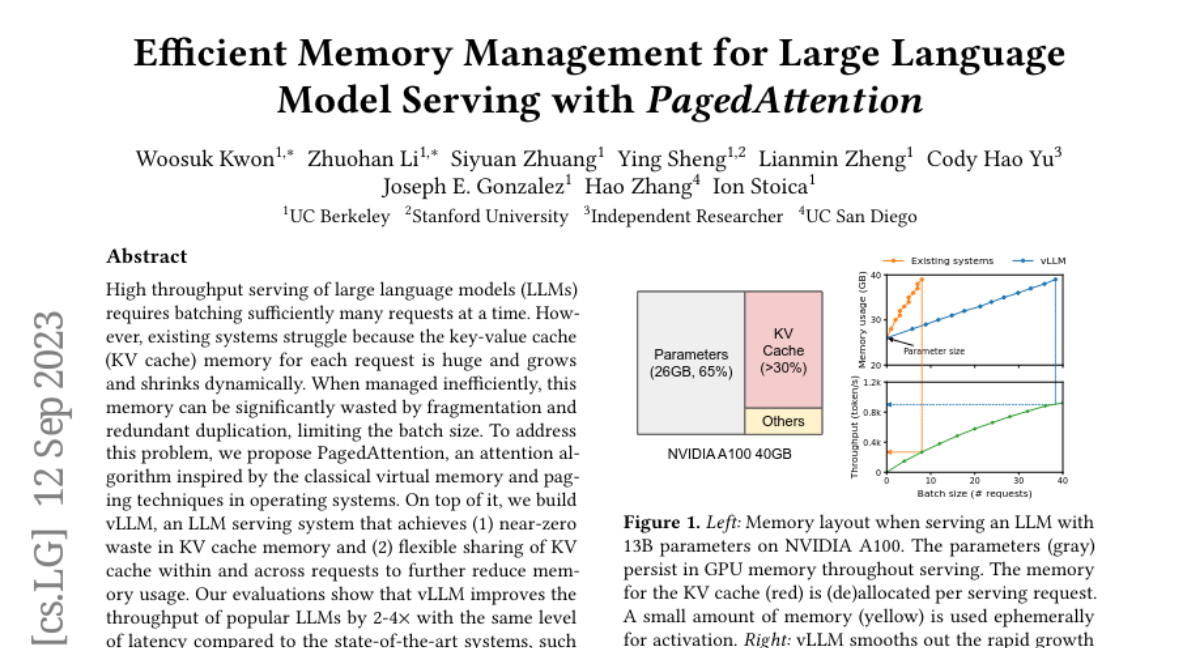
Efficient Memory Management for Large Language Model Serving with PagedAttention

PagedAttention algorithm and vLLM system enhance the throughput of large language models by efficiently managing memory and reducing waste in the key-value cache.

  • 9 authors
· Sep 12, 2023

Native and Compact Structured Latents for 3D Generation

A new sparse voxel representation called O-Voxel enables high-quality 3D generative modeling with efficient inference and robust topology handling.

microsoft Microsoft · Dec 16, 2025
Submitted by
ChengCui

PaddleOCR-VL-1.6: Expanding the Frontier of Document Parsing with Under-Optimized Region Refinement and Progressive Post-Training

PaddleOCR-VL-1.6 enhances document parsing performance through targeted data optimization and progressive post-training techniques, achieving state-of-the-art results on OmniDocBench v1.6.

PaddlePaddle PaddlePaddle · Jun 2, 2026
Submitted by
unilm

VibeVoice Technical Report

VibeVoice synthesizes long-form multi-speaker speech using next-token diffusion and a highly efficient continuous speech tokenizer, achieving superior performance and fidelity.

MicrosoftResearch Microsoft Research · Aug 26, 2025
Submitted by
taesiri

LongCat-Video Technical Report

LongCat-Video, a 13.6B parameter video generation model based on the Diffusion Transformer framework, excels in efficient and high-quality long video generation across multiple tasks using unified architecture, coarse-to-fine generation, and block sparse attention.

meituan-longcat LongCat · Oct 25, 2025
Submitted by
nielsr

Geometric Context Transformer for Streaming 3D Reconstruction

LingBot-Map is a feed-forward 3D foundation model that reconstructs scenes from video streams using a geometric context transformer architecture with specialized attention mechanisms for coordinate grounding, dense geometric cues, and long-range drift correction, achieving stable real-time performance at 20 FPS.

robbyant Robbyant · Apr 15, 2026
Submitted by
Rbin

RAG-Anything: All-in-One RAG Framework

RAG-Anything is a unified framework that enhances multimodal knowledge retrieval by integrating cross-modal relationships and semantic matching, outperforming existing methods on complex benchmarks.

Submitted by
taesiri

SkillOpt: Executive Strategy for Self-Evolving Agent Skills

SkillOpt introduces a systematic text-space optimizer for agent skills that trains skills as external agent state with stable updates and zero deployment inference overhead, achieving superior performance across multiple benchmarks and execution environments.

MicrosoftResearch Microsoft Research · May 22, 2026
Submitted by
PLUS-WAVE

InfiniSplat: Implicit Gaussian Decoding for Large-Baseline Monocular View Synthesis

Single-image feed-forward 3D Gaussian Splatting (3DGS) aims to directly generate a renderable 3D scene representation from one input image, avoiding the cost of multi-view capture and per-scene optimization. However, existing methods are often constrained by a pixel-aligned representation, where Gaussians are predicted from fixed image-grid locations. Such pixel-aligned primitives can produce promising nearby-view renderings, but they remain weakly coupled to underlying scene surfaces and struggle to preserve coherent structures under large viewpoint shifts. We present InfiniSplat, a feed-forward single-image 3DGS framework that moves from a pixel-aligned representation toward a surface-aligned representation. InfiniSplat constructs this representation by first using geometry-guided sampling to place 2D supports according to depth-induced local surface structure, and then applying a query-conditioned implicit decoder to predict Gaussian attributes from the image features queried at these supports.By grounding support locations in geometry while decoupling Gaussian prediction from fixed pixel centers, InfiniSplat produces Gaussian layouts that better follow scene surfaces and reduce scattered primitives caused by grid discretization.Across multiple cross-dataset NVS evaluations, InfiniSplat achieves state-of-the-art performance compared with single-image feed-forward baselines, and demonstrates zero-shot generalization from Hypersim indoor synthetic training to complex open-world scenes.Project page: https://zju3dv.github.io/InfiniSplat.

  • 10 authors
· Aug 3, 2026
Submitted by
andito

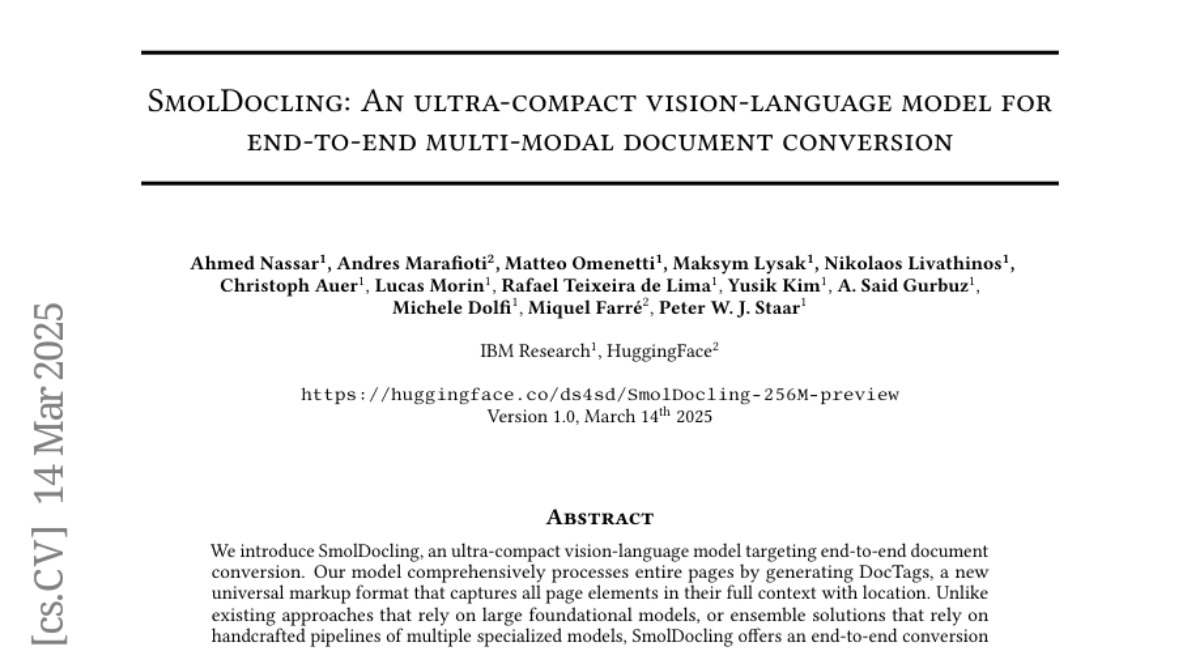
SmolDocling: An ultra-compact vision-language model for end-to-end multi-modal document conversion

SmolDocling is a compact vision-language model that performs end-to-end document conversion with robust performance across various document types using 256M parameters and a new markup format.

ibm-granite IBM Granite · Mar 14, 2025
Submitted by
YeWen27

Xiaomi-Robotics-1: Scaling Vision-Language-Action Models with over 100K Hours of Real-World Trajectories

We present Xiaomi-Robotics-1, a foundational vision-language-action (VLA) model capable of (1) following diverse language instructions to perform a wide range of mobile manipulation tasks in unseen environments out-of-the-box, and (2) efficiently adapting to novel downstream tasks with minimal fine-tuning data. We propose a two-stage training recipe consisting of pre-training and post-training. During pre-training, we imbue the model with broad and generalizable action-generation capabilities by training on over 100k hours of real-world manipulation trajectories collected via UMI devices. Crucially, we develop a scalable auto-labeling pipeline that annotates trajectory clips with natural languages describing scene state transitions, providing rich and precise conditioning for action learning. During post-training, we aim to align these capabilities with robot embodiments and imperative instructions that humans naturally use to prompt robots. Extensive experiments demonstrate strong scaling behavior. Xiaomi-Robotics-1 consistently improves with increased data scales and model sizes during pre-training. This scaling behavior directly transfers to post-training, where a stronger pre-training model yields better out-of-the-box real-robot performance in unseen environments. Furthermore, Xiaomi-Robotics-1 serves as a strong robot foundation policy that can be efficiently fine-tuned on complex, dexterous tasks with high data efficiency. Across multiple simulation benchmarks, Xiaomi-Robotics-1 outperforms state-of-the-art methods. Notably, it establishes a new state-of-the-art with a 57.6% success rate on RoboCasa365, surpassing the previous best of 46.6%. Furthermore, it achieves an average score of 20.07 on RoboDojo, significantly outperforming the prior state-of-the-art (13.07). Code and model checkpoints will be released. Project page: https://robotics.xiaomi.com/xiaomi-robotics-1.html

XiaomiRobotics Xiaomi Robotics · Jul 16, 2026
Submitted by
akhaliq

Very Large-Scale Multi-Agent Simulation in AgentScope

Enhancements to the AgentScope platform improve scalability, efficiency, and ease of use for large-scale multi-agent simulations through distributed mechanisms, flexible environments, and user-friendly tools.

  • 8 authors
· Jul 25, 2024
Submitted by
taesiri

AgentScope 1.0: A Developer-Centric Framework for Building Agentic Applications

AgentScope enhances agentic applications by providing flexible tool-based interactions, unified interfaces, and advanced infrastructure based on the ReAct paradigm, supporting efficient and safe development and deployment.

  • 23 authors
· Aug 22, 2025
Submitted by
qianhuiwu

Orchard: An Open-Source Agentic Modeling Framework

Orchard is an open-source framework for scalable agentic modeling that enables training diverse autonomous agents through specialized recipes for coding, GUI navigation, and personal assistance tasks.

MicrosoftResearch Microsoft Research · May 14, 2026
Submitted by
RuofengYang

ARIS: Autonomous Research via Adversarial Multi-Agent Collaboration

ARIS is an open-source research harness that uses cross-model adversarial collaboration to ensure reliable long-term research outcomes through coordinated execution, orchestration, and assurance layers.

Submitted by
heheyas

Scaling Properties of Text Conditioning in Visual Generation

We study empirical scaling properties for text conditioning in visual generation. Such properties have rarely been measured because diffusion loss does not scale with the number of tokens in natural-language prompts. Surprisingly, we find that the converged diffusion loss scales with the amount of structured language in the prompt. To quantify structured language, we adapt two complementary measures: a white-box likelihood metric (GPG) and a black-box attribute metric (ED). Across controlled training runs, the converged diffusion loss decreases approximately linearly with GPG and follows a power law with ED. Guided by these scaling properties, we improve diffusability by constructing structured prompts with semantic and geometric annotations derived from images, and improve promptability by training a prompter through supervised fine-tuning, cold-start, and verifier-gated on-policy distillation. The resulting system outperforms all evaluated open-weight models on nearly every compositional, reasoning, and world-knowledge benchmark, while matching or surpassing the strongest closed-weight models on most evaluations.

ByteDance-Seed ByteDance Seed · Jul 31, 2026
Submitted by
nielsr

Ultralytics YOLO26: Unified Real-Time End-to-End Vision Models

YOLO26 addresses real-time vision challenges through a unified model family with NMS-free inference, improved training strategies, and multi-task capabilities spanning detection, segmentation, and pose estimation.

Ultralytics Ultralytics · Jun 2, 2026

AutoDev: Automated AI-Driven Development

AutoDev is an AI-driven software development framework that automates complex engineering tasks within a secure Docker environment, achieving high performance in code and test generation.

  • 5 authors
· Mar 13, 2024
Submitted by
dkliang

TurboVLA: Real-Time Vision-Language-Action Model at 32 Hz on an RTX 4090 with <1 GB VRAM

Vision-language-action (VLA) models commonly adopt an LLM-centric V to L to A pathway, where visual observations are projected into the representation space of a large language model before being decoded into robot actions. Although effective, this design incurs substantial computation and memory overhead at every policy invocation. In this work, we introduce TurboVLA, a new VLA paradigm that reformulates the conventional V to L to A pathway as a direct V + L to A mapping. Instead of using a large language model as the central interface between perception and action, TurboVLA independently encodes visual observations and language instructions, directly exchanges information between them through lightweight bidirectional vision-language interaction, and predicts continuous action chunks with a compact decoder. This simple design constructs task-conditioned representations directly from visual and linguistic features, significantly reducing the computational and memory costs of VLA inference. On LIBERO, TurboVLA achieves 97.7% average success with only 0.2B parameters, 31.2 ms inference latency, and 0.9 GB inference VRAM on a consumer-grade RTX 4090, matching or outperforming substantially larger VLA policies. These results establish TurboVLA as a simple and effective alternative to the prevailing LLM-centric VLA paradigm, offering a new perspective on how vision, language, and action can be connected for efficient robotic manipulation. Code is available at https://github.com/H-EmbodVis/TurboVLA.

H-EmbodVis H-EmbodVis · Jul 29, 2026
Submitted by
taesiri

Fish Audio S2 Technical Report

Fish Audio S2 is an open-source text-to-speech system with multi-speaker capabilities, multi-turn generation, and instruction-following control through natural-language descriptions, utilizing a multi-stage training approach and production-ready inference engine.

fishaudio Fish Audio · Mar 9, 2026
Submitted by
Senqiao

Mage-VL: An Efficient Codec-Native Streaming Multimodal Foundation Model

Standard vision-language models (VLMs) suffer from Moravec's paradox: they excel at complex offline visual reasoning but struggle with simple streaming perception tasks and process them inefficiently. We present Mage-VL, an efficient codec-native streaming foundation model for real-time multimodal understanding and interaction. At its core, our custom tokenizer, Mage-ViT, replaces uniform frame sampling by selectively encoding dynamic, entropy-rich regions using motion vectors and residual energy across sparse anchor (I) and predicted (P) frames. Operating at a 16 x 16 patch level, this reduces visual token consumption by over 75% while preserving spatiotemporal context. Trained from scratch on approximately 560M unlabeled images and 100M unlabeled video frames, Mage-ViT matches or outperforms flagship encoders trained on billions of image-text pairs. We establish AI4AI data pipelines encompassing prompt-code joint optimization for multimodal captioning and AI-driven performance diagnosis to guide training recipes. Furthermore, through a bio-inspired dual-system architecture - a lightweight System 1 event gate and a causal System 2 decoder - Mage-VL enables proactive streaming perception. Extensive evaluations show that Mage-VL-4B matches Qwen3-VL-4B on static tasks while achieving strong gains in video understanding and 2D/3D spatial reasoning, with up to a 3.5x wall-clock inference speedup, and comprehensively surpasses the 15B Phi-4-reasoning-vision baseline. Beyond model artifacts, we deliver seven key empirical findings covering pre-training data efficiency, variable-resolution scaling, codec system acceleration, VideoQA SFT redundancy, motion-spatial synergy, AI4AI data pipelines, and Zero-Vision SFT for multimodal RL.

microsoft Microsoft · Jul 27, 2026
Submitted by
akhaliq

LlamaFactory: Unified Efficient Fine-Tuning of 100+ Language Models

LlamaFactory is a unified framework enabling efficient fine-tuning of large language models across various tasks using a web-based user interface.

  • 5 authors
· Mar 20, 2024

Zep: A Temporal Knowledge Graph Architecture for Agent Memory

Zep, a memory layer service, outperforms MemGPT in the DMR benchmark and LongMemEval by excelling in dynamic knowledge integration and temporal reasoning, critical for enterprise use cases.

  • 5 authors
· Jan 20, 2025

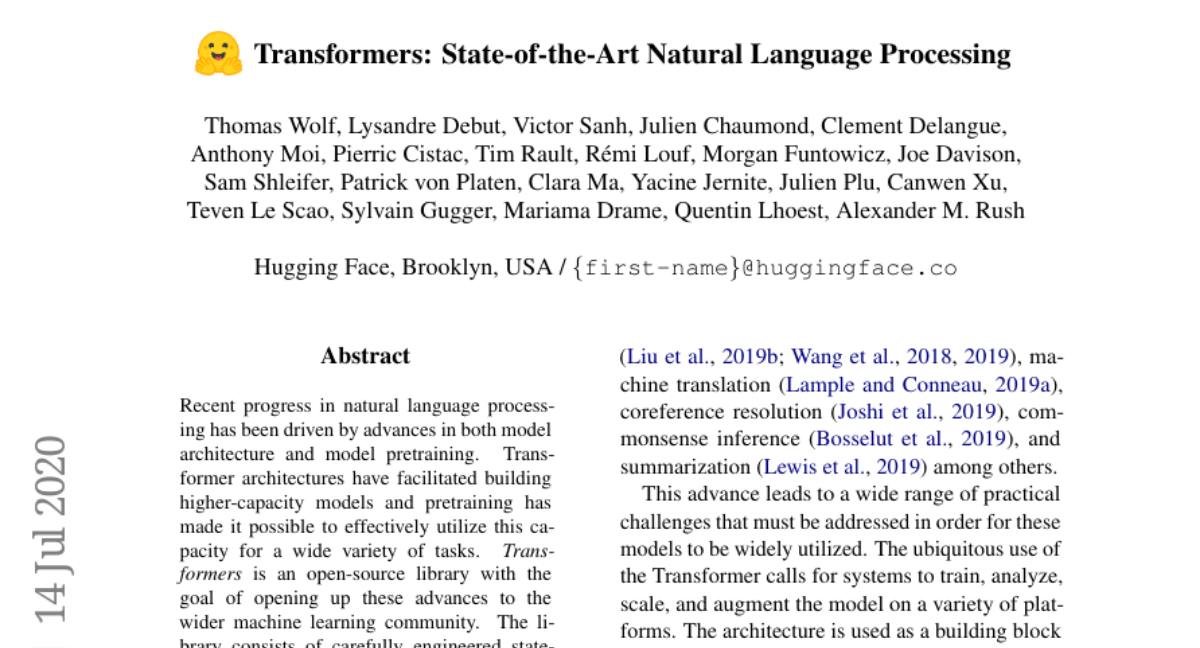
HuggingFace's Transformers: State-of-the-art Natural Language Processing

Transformers library provides state-of-the-art Transformer architectures and pretrained models for natural language processing tasks with a unified API and emphasis on extensibility and robust deployment.

huggingface Hugging Face · Oct 9, 2019

LightRAG: Simple and Fast Retrieval-Augmented Generation

LightRAG improves Retrieval-Augmented Generation by integrating graph structures for enhanced contextual awareness and efficient information retrieval, achieving better accuracy and response times.

  • 5 authors
· Oct 8, 2024
Submitted by
taesiri

DeepCode: Open Agentic Coding

DeepCode, a fully autonomous framework, addresses the challenges of document-to-codebase synthesis by optimizing information flow through source compression, structured indexing, knowledge injection, and error correction, achieving state-of-the-art performance and surpassing human experts.

  • 5 authors
· Dec 8, 2025
Submitted by
andito

SmolVLA: A Vision-Language-Action Model for Affordable and Efficient Robotics

SmolVLA is a compact, efficient vision-language-action model that achieves competitive performance at reduced computational costs and can be deployed on consumer-grade hardware.

  • 14 authors
· Jun 2, 2025
Submitted by
ldkong

Quo Vadis, World Modeling?

Continually improving agents require dynamic interaction feedback beyond static supervision, yet direct real-environment interaction is costly, slow, unsafe, and hard to parallelize. World modeling offers a natural intermediate proxy that allows agents to query lower-cost, more controllable feedback before committing to real actions. Classical world models instantiate this proxy primarily through future physical-state prediction, a formulation useful yet narrow for agents that require actionable feedback beyond raw state transitions. In this work, we conceptualize Agent-Centric Interactive World Proxies, shifting the fundamental paradigm from physical state transitions to agent-usable information transitions, such as execution outcomes, retrieved experiences or skills, and verification signals, broadening the scope of world modeling to provide versatile feedback for continually improving agents. To systematically map this design space, we organize world proxies into six functional forms based on their feedback modalities: dynamics, spatial, execution, memory/experience, skill, and reward/verification proxies, which together characterize the primary ways world modeling serves agent improvement. We further analyze how these proxies empower agents across three progressive levels: L.1 Inference-Time Guidance, where proxy outputs enrich in-context information for superior decisions; L.2 Training-Time Optimization, where proxy outputs yield rewards, critiques, or synthetic rollouts for policy learning; and L.3 Agent-Proxy Co-Evolution, where real-environment evidence continuously updates both the proxy and the agent for co-evolution. Ultimately, this work recasts world modeling into an agent-centric paradigm, establishing a roadmap for building world proxies that empower agents to plan better, learn faster, and evolve continually.

Submitted by
MikaStars39

EvoPolicyGym: Evaluating Autonomous Policy Evolution in Interactive Environments

Autonomous agents evaluate policy improvement through iterative editing within fixed budgets, revealing that successful policy evolution requires both task-specific mechanisms and feedback-constrained refinement.

  • 16 authors
· Jul 2, 2026
Submitted by
iseesaw

Frontis-MA1: Training an AI4AI Model towards Recursive Self-Improvement in Machine Learning Engineering

Recursive self-improvement (RSI) requires AI systems that improve the process of building AI (i.e., AI4AI); machine learning engineering (MLE) offers a concrete, executable testbed for studying this capability. We introduce OpenMLE, an open full-stack system for RSI research in MLE, spanning verifiable task environments with execution feedback (OpenMLE-Gym), operator learning (OpenMLE-RL), and long-horizon search (OpenMLE-Evo). On this stack we post-train Frontis-MA1 (35B) as a meta-evolution agent for MLE, aligning post-training and inference around four atomic program-evolution operators (Draft, Improve, Debug, Crossover): the same operators are trained via execution-grounded SFT and RL on data deduplicated against all evaluation benchmarks, then composed into long-horizon search, coupling learning and evolution in a single loop. On MLE-Bench Lite under a 12-hour per-task budget on one RTX 4090 capped at 12 GB VRAM, Frontis-MA1 (35B) improves Medal Average from 39.39% to 60.61% over its base model with OpenMLE-Evo, and reaches 71.21% with OpenMLE-Evo-Max (benchmark-independent experience priors and asynchronous search), exceeding GPT-5.5 + Codex and approaching GPT-5.6 Sol and the 2.8T Kimi K3. On held-out NatureBench Lite, both components transfer: with the framework fixed, swapping in the trained model raises Match-SOTA from 50% to 70%; with the model fixed, swapping in OpenMLE-Evo raises it from 20% to 50%. We release the model weights and the full OpenMLE stack to enable reproducible research on executable AI4AI toward RSI. Code: https://github.com/FrontisAI/OpenRSI

FrontisAI Frontis AI · Jul 30, 2026

OmniFlatten: An End-to-end GPT Model for Seamless Voice Conversation

A novel GPT-based model, OmniFlatten, enables real-time natural full-duplex spoken dialogue through a multi-stage post-training technique that integrates speech and text without altering the original model's architecture.

  • 9 authors
· Oct 23, 2024
Submitted by
nielsr

MonkeyOCRv2: A Visual-Text Foundation Model for Document AI

Mainstream visual encoders are pretrained on natural images and cannot be effectively applied to document images without document-oriented adaptation, as dense text and fine-grained character strokes demand character-level visual perception. We present MonkeyOCRv2, a visual-text pretrained model for document AI. First, we construct MonkeyDoc v2, to our knowledge the largest document-image pretraining corpus, comprising 113 million images spanning 17 languages. Second, we propose a pretraining strategy that jointly learns image-to-text generation and pixel-level document reconstruction: the former aligns visual representations with textual content, while the latter preserves character strokes and layout details. Extensive experiments are conducted on five representative document analysis tasks, including text recognition, formula recognition, text detection, document tampering detection, and overlapping text segmentation. Replacing the original encoders with MonkeyOCRv2 consistently improves performance across all five tasks. Finally, we validate its effectiveness as the vision encoder of multimodal large language models on the more challenging tasks of document parsing and document understanding. Kept frozen and paired with a lightweight language model, it yields a 0.7B document parsing model that sets a new open-source state-of-the-art on MDPBench, a recent benchmark spanning digital-born and photographed documents across 17 languages, surpassing the previous best 3B dots.mocr by 2.8% absolute with a vision encoder roughly 11times smaller. The frozen encoder also powers a document understanding model that outperforms counterparts built on CLIP, DINO, and SAM across eight benchmarks under identical training settings. These results suggest that document-oriented visual pretraining can serve as a foundation for document intelligence in its own right.

VLRLab-OCR VLRLab-OCR · Jul 13, 2026
Submitted by
Jeff-Wang

GigaWorld-1: A Roadmap to Build World Models for Robot Policy Evaluation

World models for robotic policy evaluation are systematically studied through a new benchmark, revealing that long-horizon rollout consistency and robot-specific controllability are more important than short-term visual realism for reliable policy assessment.

open-gigaai GigaAI · Jul 2, 2026

PyTorch Distributed: Experiences on Accelerating Data Parallel Training

The PyTorch distributed data parallel module optimizes large-scale model training using techniques like gradient bucketing, computation-communication overlap, and selective synchronization to achieve near-linear scalability.

  • 11 authors
· Jun 28, 2020
Submitted by
fistyyyy

ResearchStudio-Idea: An Evidence-Grounded Research-Ideation Skill Suite from ML Conference Outcomes

ResearchStudio-Idea provides a skill suite for effective research ideation that combines literature search, novelty checking, and pattern-guided generation to produce traceable research proposals.

microsoft Microsoft · Jul 5, 2026

Multi-module GRPO: Composing Policy Gradients and Prompt Optimization for Language Model Programs

mmGRPO, a multi-module extension of GRPO, enhances accuracy in modular AI systems by optimizing LM calls and prompts across various tasks.

  • 13 authors
· Aug 6, 2025

MLVC: Multi-platform Learned Video Codec for Real-World Deployment

Neural video codecs have surpassed classical codecs in coding efficiency but remain impractical for deployment due to cross-platform incompatibility and high computational cost. Existing quantization-based solutions fail to produce deterministic results across diverse hardware platforms, leading to catastrophic decoding failures. We introduce MLVC, a hardware-robust neural video codec designed for practical cross-platform inference. The key idea is to explicitly transmit scale parameters through the hyperprior, which guarantees entropy coding consistency across devices without requiring bit-exact arithmetic. While this increases bitrate overhead, we recover most of the coding efficiency through architectural improvements (gated memory, ReGLU activation), a long-term reference recovery mechanism, and domain-specific perceptual training. On the VCD video conferencing benchmark, MLVC achieves >70% BD-rate (MOS) improvement over hardware HEVC, the strongest deployable baseline, while reaching subjective quality competitive with DCVC-RT, which cannot operate across diverse platforms. Both the encoder and decoder run at 100 FPS on average on commodity NPUs from Apple, Intel, and Qualcomm. MLVC is the first neural video codec to combine competitive compression performance, real-time speed, and cross-platform robustness across diverse consumer devices, making it suitable for widespread deployment. Code will be released.

  • 6 authors
· Jun 26, 2026
Submitted by
akhaliq

Amphion: An Open-Source Audio, Music and Speech Generation Toolkit

Amphion is a toolkit for audio, music, and speech generation that includes model visualizations, vocoders, and evaluation metrics to support reproducible research and training for researchers.

  • 13 authors
· Dec 15, 2023
Submitted by
Jiabin99

MetaChain: A Fully-Automated and Zero-Code Framework for LLM Agents

MetaChain, a fully-automated natural language-based framework, enables non-technical users to create and deploy LLM agents efficiently, demonstrating superior performance on multi-agent tasks and retrieval-augmented generation.

  • 3 authors
· Feb 9, 2025
Submitted by
hao-li

Agent READMEs: An Empirical Study of Context Files for Agentic Coding

Agentic coding tools receive goals written in natural language as input, break them down into specific tasks, and write or execute the actual code with minimal human intervention. Central to this process are agent context files ("READMEs for agents") that provide persistent, project-level instructions. In this paper, we conduct the first large-scale empirical study of 2,303 agent context files from 1,925 repositories to characterize their structure, maintenance, and content. We find that these files are not static documentation but complex, difficult-to-read artifacts that evolve like configuration code, maintained through frequent, small additions. Our content analysis of 16 instruction types shows that developers prioritize functional context, such as build and run commands (62.3%), implementation details (69.9%), and architecture (67.7%). We also identify a significant gap: non-functional requirements like security (14.5%) and performance (14.5%) are rarely specified. These findings indicate that while developers use context files to make agents functional, they provide few guardrails to ensure that agent-written code is secure or performant, highlighting the need for improved tooling and practices.


  • 11 authors
· Nov 17, 2025