
Get trending papers in your email inbox once a day!
Get trending papers in your email inbox!
Subscribe
Discovering highly efficient low-weight quantum error-correcting codes with reinforcement learning
The realization of scalable fault-tolerant quantum computing is expected to hinge on quantum error-correcting codes. In the quest for more efficient quantum fault tolerance, a critical code parameter is the weight of measurements that extract information about errors to enable error correction: as higher measurement weights require higher implementation costs and introduce more errors, it is important in code design to optimize measurement weight. This underlies the surging interest in quantum low-density parity-check (qLDPC) codes, the study of which has primarily focused on the asymptotic (large-code-limit) properties. In this work, we introduce a versatile and computationally efficient approach to stabilizer code weight reduction based on reinforcement learning (RL), which produces new low-weight codes that substantially outperform the state of the art in practically relevant parameter regimes, extending significantly beyond previously accessible small distances. For example, our approach demonstrates savings in physical qubit overhead compared to existing results by 1 to 2 orders of magnitude for weight 6 codes and brings the overhead into a feasible range for near-future experiments. We also investigate the interplay between code parameters using our RL framework, offering new insights into the potential efficiency and power of practically viable coding strategies. Overall, our results demonstrate how RL can effectively advance the crucial yet challenging problem of quantum code discovery and thereby facilitate a faster path to the practical implementation of fault-tolerant quantum technologies.

Everything You Always Wanted to Know About Quantum Circuits
In this work, we provide an overview of circuits for quantum computing. We introduce gates used in quantum computation and then present resource cost measurements used to evaluate circuits made from these gates. We then illustrate how the gates shown are then combined into quantum circuits for basic arithmetic functions. Architectures for addition, subtraction, multiplication, and division are shown. We demonstrate how to calculate the resource costs of quantum circuits. We conclude this overview with by illustrating an application of the elementary quantum circuits for the image rotation operation.
Cutting Slack: Quantum Optimization with Slack-Free Methods for Combinatorial Benchmarks
Constraint handling remains a key bottleneck in quantum combinatorial optimization. While slack-variable-based encodings are straightforward, they significantly increase qubit counts and circuit depth, challenging the scalability of quantum solvers. In this work, we investigate a suite of Lagrangian-based optimization techniques including dual ascent, bundle methods, cutting plane approaches, and augmented Lagrangian formulations for solving constrained combinatorial problems on quantum simulators and hardware. Our framework is applied to three representative NP-hard problems: the Travelling Salesman Problem (TSP), the Multi-Dimensional Knapsack Problem (MDKP), and the Maximum Independent Set (MIS). We demonstrate that MDKP and TSP, with their inequality-based or degree-constrained structures, allow for slack-free reformulations, leading to significant qubit savings without compromising performance. In contrast, MIS does not inherently benefit from slack elimination but still gains in feasibility and objective quality from principled Lagrangian updates. We benchmark these methods across classically hard instances, analyzing trade-offs in qubit usage, feasibility, and optimality gaps. Our results highlight the flexibility of Lagrangian formulations as a scalable alternative to naive QUBO penalization, even when qubit savings are not always achievable. This work provides practical insights for deploying constraint-aware quantum optimization pipelines, with applications in logistics, network design, and resource allocation.

Adaptive Graph Shrinking for Quantum Optimization of Constrained Combinatorial Problems
A range of quantum algorithms, especially those leveraging variational parameterization and circuit-based optimization, are being studied as alternatives for solving classically intractable combinatorial optimization problems (COPs). However, their applicability is limited by hardware constraints, including shallow circuit depth, limited qubit counts, and noise. To mitigate these issues, we propose a hybrid classical--quantum framework based on graph shrinking to reduce the number of variables and constraints in QUBO formulations of COPs, while preserving problem structure. Our approach introduces three key ideas: (i) constraint-aware shrinking that prevents merges that will likely violate problem-specific feasibility constraints, (ii) a verification-and-repair pipeline to correct infeasible solutions post-optimization, and (iii) adaptive strategies for recalculating correlations and controlling the graph shrinking process. We apply our approach to three standard benchmark problems: Multidimensional Knapsack (MDKP), Maximum Independent Set (MIS), and the Quadratic Assignment Problem (QAP). Empirical results show that our approach improves solution feasibility, reduces repair complexity, and enhances quantum optimization quality on hardware-limited instances. These findings demonstrate a scalable pathway for applying near-term quantum algorithms to classically challenging constrained optimization problems.
A Comparative Study of Quantum Optimization Techniques for Solving Combinatorial Optimization Benchmark Problems
Quantum optimization holds promise for addressing classically intractable combinatorial problems, yet a standardized framework for benchmarking its performance, particularly in terms of solution quality, computational speed, and scalability is still lacking. In this work, we introduce a comprehensive benchmarking framework designed to systematically evaluate a range of quantum optimization techniques against well-established NP-hard combinatorial problems. Our framework focuses on key problem classes, including the Multi-Dimensional Knapsack Problem (MDKP), Maximum Independent Set (MIS), Quadratic Assignment Problem (QAP), and Market Share Problem (MSP). Our study evaluates gate-based quantum approaches, including the Variational Quantum Eigensolver (VQE) and its CVaR-enhanced variant, alongside advanced quantum algorithms such as the Quantum Approximate Optimization Algorithm (QAOA) and its extensions. To address resource constraints, we incorporate qubit compression techniques like Pauli Correlation Encoding (PCE) and Quantum Random Access Optimization (QRAO). Experimental results, obtained from simulated quantum environments and classical solvers, provide key insights into feasibility, optimality gaps, and scalability. Our findings highlight both the promise and current limitations of quantum optimization, offering a structured pathway for future research and practical applications in quantum-enhanced decision-making.
Option Pricing using Quantum Computers
We present a methodology to price options and portfolios of options on a gate-based quantum computer using amplitude estimation, an algorithm which provides a quadratic speedup compared to classical Monte Carlo methods. The options that we cover include vanilla options, multi-asset options and path-dependent options such as barrier options. We put an emphasis on the implementation of the quantum circuits required to build the input states and operators needed by amplitude estimation to price the different option types. Additionally, we show simulation results to highlight how the circuits that we implement price the different option contracts. Finally, we examine the performance of option pricing circuits on quantum hardware using the IBM Q Tokyo quantum device. We employ a simple, yet effective, error mitigation scheme that allows us to significantly reduce the errors arising from noisy two-qubit gates.
Enhancing a Convolutional Autoencoder with a Quantum Approximate Optimization Algorithm for Image Noise Reduction
Image denoising is essential for removing noise in images caused by electric device malfunctions or other factors during image acquisition. It helps preserve image quality and interpretation. Many convolutional autoencoder algorithms have proven effective in image denoising. Owing to their promising efficiency, quantum computers have gained popularity. This study introduces a quantum convolutional autoencoder (QCAE) method for improved image denoising. This method was developed by substituting the representative latent space of the autoencoder with a quantum circuit. To enhance efficiency, we leveraged the advantages of the quantum approximate optimization algorithm (QAOA)-incorporated parameter-shift rule to identify an optimized cost function, facilitating effective learning from data and gradient computation on an actual quantum computer. The proposed QCAE method outperformed its classical counterpart as it exhibited lower training loss and a higher structural similarity index (SSIM) value. QCAE also outperformed its classical counterpart in denoising the MNIST dataset by up to 40% in terms of SSIM value, confirming its enhanced capabilities in real-world applications. Evaluation of QAOA performance across different circuit configurations and layer variations showed that our technique outperformed other circuit designs by 25% on average.
Quantum Multi-Model Fitting
Geometric model fitting is a challenging but fundamental computer vision problem. Recently, quantum optimization has been shown to enhance robust fitting for the case of a single model, while leaving the question of multi-model fitting open. In response to this challenge, this paper shows that the latter case can significantly benefit from quantum hardware and proposes the first quantum approach to multi-model fitting (MMF). We formulate MMF as a problem that can be efficiently sampled by modern adiabatic quantum computers without the relaxation of the objective function. We also propose an iterative and decomposed version of our method, which supports real-world-sized problems. The experimental evaluation demonstrates promising results on a variety of datasets. The source code is available at: https://github.com/FarinaMatteo/qmmf.
Quantum Policy Gradient Algorithm with Optimized Action Decoding
Quantum machine learning implemented by variational quantum circuits (VQCs) is considered a promising concept for the noisy intermediate-scale quantum computing era. Focusing on applications in quantum reinforcement learning, we propose a specific action decoding procedure for a quantum policy gradient approach. We introduce a novel quality measure that enables us to optimize the classical post-processing required for action selection, inspired by local and global quantum measurements. The resulting algorithm demonstrates a significant performance improvement in several benchmark environments. With this technique, we successfully execute a full training routine on a 5-qubit hardware device. Our method introduces only negligible classical overhead and has the potential to improve VQC-based algorithms beyond the field of quantum reinforcement learning.
Quantum Relaxation for Solving Multiple Knapsack Problems
Combinatorial problems are a common challenge in business, requiring finding optimal solutions under specified constraints. While significant progress has been made with variational approaches such as QAOA, most problems addressed are unconstrained (such as Max-Cut). In this study, we investigate a hybrid quantum-classical method for constrained optimization problems, particularly those with knapsack constraints that occur frequently in financial and supply chain applications. Our proposed method relies firstly on relaxations to local quantum Hamiltonians, defined through commutative maps. Drawing inspiration from quantum random access code (QRAC) concepts, particularly Quantum Random Access Optimizer (QRAO), we explore QRAO's potential in solving large constrained optimization problems. We employ classical techniques like Linear Relaxation as a presolve mechanism to handle constraints and cope further with scalability. We compare our approach with QAOA and present the final results for a real-world procurement optimization problem: a significant sized multi-knapsack-constrained problem.
QUBE: Enhancing Automatic Heuristic Design via Quality-Uncertainty Balanced Evolution
Solving NP-hard problems traditionally relies on heuristics, yet manually designing effective heuristics for complex problems remains a significant challenge. While recent advancements like FunSearch have shown that large language models (LLMs) can be integrated into evolutionary algorithms (EAs) for heuristic design, their potential is hindered by limitations in balancing exploitation and exploration. We introduce Quality-Uncertainty Balanced Evolution (QUBE), a novel approach that enhances LLM+EA methods by redefining the priority criterion within the FunSearch framework. QUBE employs the Quality-Uncertainty Trade-off Criterion (QUTC), based on our proposed Uncertainty-Inclusive Quality metric, to evaluate and guide the evolutionary process. Through extensive experiments on challenging NP-complete problems, QUBE demonstrates significant performance improvements over FunSearch and baseline methods. Our code are available at https://github.com/zzjchen/QUBE\_code.


How quantum and evolutionary algorithms can help each other: two examples
We investigate the potential of bio-inspired evolutionary algorithms for designing quantum circuits with specific goals, focusing on two particular tasks. The first one is motivated by the ideas of Artificial Life that are used to reproduce stochastic cellular automata with given rules. We test the robustness of quantum implementations of the cellular automata for different numbers of quantum gates The second task deals with the sampling of quantum circuits that generate highly entangled quantum states, which constitute an important resource for quantum computing. In particular, an evolutionary algorithm is employed to optimize circuits with respect to a fitness function defined with the Mayer-Wallach entanglement measure. We demonstrate that, by balancing the mutation rate between exploration and exploitation, we can find entangling quantum circuits for up to five qubits. We also discuss the trade-off between the number of gates in quantum circuits and the computational costs of finding the gate arrangements leading to a strongly entangled state. Our findings provide additional insight into the trade-off between the complexity of a circuit and its performance, which is an important factor in the design of quantum circuits.

Quantum Variational Activation Functions Empower Kolmogorov-Arnold Networks
Variational quantum circuits (VQCs) are central to quantum machine learning, while recent progress in Kolmogorov-Arnold networks (KANs) highlights the power of learnable activation functions. We unify these directions by introducing quantum variational activation functions (QVAFs), realized through single-qubit data re-uploading circuits called DatA Re-Uploading ActivatioNs (DARUANs). We show that DARUAN with trainable weights in data pre-processing possesses an exponentially growing frequency spectrum with data repetitions, enabling an exponential reduction in parameter size compared with Fourier-based activations without loss of expressivity. Embedding DARUAN into KANs yields quantum-inspired KANs (QKANs), which retain the interpretability of KANs while improving their parameter efficiency, expressivity, and generalization. We further introduce two novel techniques to enhance scalability, feasibility and computational efficiency, such as layer extension and hybrid QKANs (HQKANs) as drop-in replacements of multi-layer perceptrons (MLPs) for feed-forward networks in large-scale models. We provide theoretical analysis and extensive experiments on function regression, image classification, and autoregressive generative language modeling, demonstrating the efficiency and scalability of QKANs. DARUANs and QKANs offer a promising direction for advancing quantum machine learning on both noisy intermediate-scale quantum (NISQ) hardware and classical quantum simulators.

Bridging Theory and Practice in Quantum Game Theory: Optimized Implementation of the Battle of the Sexes with Error Mitigation on NISQ Hardware
Implementing quantum game theory on real hardware is challenging due to noise, decoherence, and limited qubit connectivity, yet such demonstrations are essential to validate theoretical predictions. We present one of the first full experimental realizations of the Battle of the Sexes game under the Eisert-Wilkens-Lewenstein (EWL) framework on IBM Quantum's ibm sherbrooke superconducting processor. Four quantum strategies (I, H, R(pi/4), R(pi)) were evaluated across 31 entanglement values gamma in [0, pi] using 2048 shots per configuration, enabling a direct comparison between analytical predictions and hardware execution. To mitigate noise and variability, we introduce a Guided Circuit Mapping (GCM) method that dynamically selects qubit pairs and optimizes routing based on real-time topology and calibration data. The analytical model forecasts up to 108% payoff improvement over the classical equilibrium, and despite hardware-induced deviations, experimental results with GCM preserve the expected payoff trends within 3.5%-12% relative error. These findings show that quantum advantages in strategic coordination can persist under realistic NISQ conditions, providing a pathway toward practical applications of quantum game theory in multi-agent, economic, and distributed decision-making systems.



Quantum-Enhanced Conformal Methods for Multi-Output Uncertainty: A Holistic Exploration and Experimental Analysis
In this paper, we propose a unified approach to harness quantum conformal methods for multi-output distributions, with a particular emphasis on two experimental paradigms: (i) a standard 2-qubit circuit scenario producing a four-dimensional outcome distribution, and (ii) a multi-basis measurement setting that concatenates measurement probabilities in different bases (Z, X, Y) into a twelve-dimensional output space. By combining a multioutput regression model (e.g., random forests) with distributional conformal prediction, we validate coverage and interval-set sizes on both simulated quantum data and multi-basis measurement data. Our results confirm that classical conformal prediction can effectively provide coverage guarantees even when the target probabilities derive from inherently quantum processes. Such synergy opens the door to next-generation quantum-classical hybrid frameworks, providing both improved interpretability and rigorous coverage for quantum machine learning tasks. All codes and full reproducible Colab notebooks are made available at https://github.com/detasar/QECMMOU.
BenchRL-QAS: Benchmarking reinforcement learning algorithms for quantum architecture search
We present BenchRL-QAS, a unified benchmarking framework for reinforcement learning (RL) in quantum architecture search (QAS) across a spectrum of variational quantum algorithm tasks on 2- to 8-qubit systems. Our study systematically evaluates 9 different RL agents, including both value-based and policy-gradient methods, on quantum problems such as variational eigensolver, quantum state diagonalization, variational quantum classification (VQC), and state preparation, under both noiseless and noisy execution settings. To ensure fair comparison, we propose a weighted ranking metric that integrates accuracy, circuit depth, gate count, and training time. Results demonstrate that no single RL method dominates universally, the performance dependents on task type, qubit count, and noise conditions providing strong evidence of no free lunch principle in RL-QAS. As a byproduct we observe that a carefully chosen RL algorithm in RL-based VQC outperforms baseline VQCs. BenchRL-QAS establishes the most extensive benchmark for RL-based QAS to date, codes and experimental made publicly available for reproducibility and future advances.

Pareto-Optimal Quantized ResNet Is Mostly 4-bit
Quantization has become a popular technique to compress neural networks and reduce compute cost, but most prior work focuses on studying quantization without changing the network size. Many real-world applications of neural networks have compute cost and memory budgets, which can be traded off with model quality by changing the number of parameters. In this work, we use ResNet as a case study to systematically investigate the effects of quantization on inference compute cost-quality tradeoff curves. Our results suggest that for each bfloat16 ResNet model, there are quantized models with lower cost and higher accuracy; in other words, the bfloat16 compute cost-quality tradeoff curve is Pareto-dominated by the 4-bit and 8-bit curves, with models primarily quantized to 4-bit yielding the best Pareto curve. Furthermore, we achieve state-of-the-art results on ImageNet for 4-bit ResNet-50 with quantization-aware training, obtaining a top-1 eval accuracy of 77.09%. We demonstrate the regularizing effect of quantization by measuring the generalization gap. The quantization method we used is optimized for practicality: It requires little tuning and is designed with hardware capabilities in mind. Our work motivates further research into optimal numeric formats for quantization, as well as the development of machine learning accelerators supporting these formats. As part of this work, we contribute a quantization library written in JAX, which is open-sourced at https://github.com/google-research/google-research/tree/master/aqt.
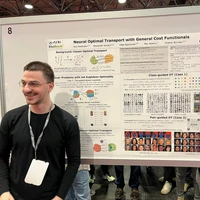
Neural Optimal Transport with General Cost Functionals
We introduce a novel neural network-based algorithm to compute optimal transport (OT) plans for general cost functionals. In contrast to common Euclidean costs, i.e., ell^1 or ell^2, such functionals provide more flexibility and allow using auxiliary information, such as class labels, to construct the required transport map. Existing methods for general costs are discrete and have limitations in practice, i.e. they do not provide an out-of-sample estimation. We address the challenge of designing a continuous OT approach for general costs that generalizes to new data points in high-dimensional spaces, such as images. Additionally, we provide the theoretical error analysis for our recovered transport plans. As an application, we construct a cost functional to map data distributions while preserving the class-wise structure.
Less Quantum, More Advantage: An End-to-End Quantum Algorithm for the Jones Polynomial
We present an end-to-end reconfigurable algorithmic pipeline for solving a famous problem in knot theory using a noisy digital quantum computer, namely computing the value of the Jones polynomial at the fifth root of unity within additive error for any input link, i.e. a closed braid. This problem is DQC1-complete for Markov-closed braids and BQP-complete for Plat-closed braids, and we accommodate both versions of the problem. Even though it is widely believed that DQC1 is strictly contained in BQP, and so is 'less quantum', the resource requirements of classical algorithms for the DQC1 version are at least as high as for the BQP version, and so we potentially gain 'more advantage' by focusing on Markov-closed braids in our exposition. We demonstrate our quantum algorithm on Quantinuum's H2-2 quantum computer and show the effect of problem-tailored error-mitigation techniques. Further, leveraging that the Jones polynomial is a link invariant, we construct an efficiently verifiable benchmark to characterise the effect of noise present in a given quantum processor. In parallel, we implement and benchmark the state-of-the-art tensor-network-based classical algorithms for computing the Jones polynomial. The practical tools provided in this work allow for precise resource estimation to identify near-term quantum advantage for a meaningful quantum-native problem in knot theory.
Synergy Between Quantum Circuits and Tensor Networks: Short-cutting the Race to Practical Quantum Advantage
While recent breakthroughs have proven the ability of noisy intermediate-scale quantum (NISQ) devices to achieve quantum advantage in classically-intractable sampling tasks, the use of these devices for solving more practically relevant computational problems remains a challenge. Proposals for attaining practical quantum advantage typically involve parametrized quantum circuits (PQCs), whose parameters can be optimized to find solutions to diverse problems throughout quantum simulation and machine learning. However, training PQCs for real-world problems remains a significant practical challenge, largely due to the phenomenon of barren plateaus in the optimization landscapes of randomly-initialized quantum circuits. In this work, we introduce a scalable procedure for harnessing classical computing resources to provide pre-optimized initializations for PQCs, which we show significantly improves the trainability and performance of PQCs on a variety of problems. Given a specific optimization task, this method first utilizes tensor network (TN) simulations to identify a promising quantum state, which is then converted into gate parameters of a PQC by means of a high-performance decomposition procedure. We show that this learned initialization avoids barren plateaus, and effectively translates increases in classical resources to enhanced performance and speed in training quantum circuits. By demonstrating a means of boosting limited quantum resources using classical computers, our approach illustrates the promise of this synergy between quantum and quantum-inspired models in quantum computing, and opens up new avenues to harness the power of modern quantum hardware for realizing practical quantum advantage.
Learning to Program Variational Quantum Circuits with Fast Weights
Quantum Machine Learning (QML) has surfaced as a pioneering framework addressing sequential control tasks and time-series modeling. It has demonstrated empirical quantum advantages notably within domains such as Reinforcement Learning (RL) and time-series prediction. A significant advancement lies in Quantum Recurrent Neural Networks (QRNNs), specifically tailored for memory-intensive tasks encompassing partially observable environments and non-linear time-series prediction. Nevertheless, QRNN-based models encounter challenges, notably prolonged training duration stemming from the necessity to compute quantum gradients using backpropagation-through-time (BPTT). This predicament exacerbates when executing the complete model on quantum devices, primarily due to the substantial demand for circuit evaluation arising from the parameter-shift rule. This paper introduces the Quantum Fast Weight Programmers (QFWP) as a solution to the temporal or sequential learning challenge. The QFWP leverages a classical neural network (referred to as the 'slow programmer') functioning as a quantum programmer to swiftly modify the parameters of a variational quantum circuit (termed the 'fast programmer'). Instead of completely overwriting the fast programmer at each time-step, the slow programmer generates parameter changes or updates for the quantum circuit parameters. This approach enables the fast programmer to incorporate past observations or information. Notably, the proposed QFWP model achieves learning of temporal dependencies without necessitating the use of quantum recurrent neural networks. Numerical simulations conducted in this study showcase the efficacy of the proposed QFWP model in both time-series prediction and RL tasks. The model exhibits performance levels either comparable to or surpassing those achieved by QLSTM-based models.
Automated Quantum Circuit Design with Nested Monte Carlo Tree Search
Quantum algorithms based on variational approaches are one of the most promising methods to construct quantum solutions and have found a myriad of applications in the last few years. Despite the adaptability and simplicity, their scalability and the selection of suitable ans\"atzs remain key challenges. In this work, we report an algorithmic framework based on nested Monte-Carlo Tree Search (MCTS) coupled with the combinatorial multi-armed bandit (CMAB) model for the automated design of quantum circuits. Through numerical experiments, we demonstrated our algorithm applied to various kinds of problems, including the ground energy problem in quantum chemistry, quantum optimisation on a graph, solving systems of linear equations, and finding encoding circuit for quantum error detection codes. Compared to the existing approaches, the results indicate that our circuit design algorithm can explore larger search spaces and optimise quantum circuits for larger systems, showing both versatility and scalability.

Deep-Q Learning with Hybrid Quantum Neural Network on Solving Maze Problems
Quantum computing holds great potential for advancing the limitations of machine learning algorithms to handle higher dimensions of data and reduce overall training parameters in deep learning (DL) models. This study uses a trainable variational quantum circuit (VQC) on a gate-based quantum computing model to investigate the potential for quantum benefit in a model-free reinforcement learning problem. Through a comprehensive investigation and evaluation of the current model and capabilities of quantum computers, we designed and trained a novel hybrid quantum neural network based on the latest Qiskit and PyTorch framework. We compared its performance with a full-classical CNN with and without an incorporated VQC. Our research provides insights into the potential of deep quantum learning to solve a maze problem and, potentially, other reinforcement learning problems. We conclude that reinforcement learning problems can be practical with reasonable training epochs. Moreover, a comparative study of full-classical and hybrid quantum neural networks is discussed to understand these two approaches' performance, advantages, and disadvantages to deep-Q learning problems, especially on larger-scale maze problems larger than 4x4.

Reinforcement learning with learned gadgets to tackle hard quantum problems on real hardware
Designing quantum circuits for specific tasks is challenging due to the exponential growth of the state space. We introduce gadget reinforcement learning (GRL), which integrates reinforcement learning with program synthesis to automatically generate and incorporate composite gates (gadgets) into the action space. This enhances the exploration of parameterized quantum circuits (PQCs) for complex tasks like approximating ground states of quantum Hamiltonians, an NP-hard problem. We evaluate GRL using the transverse field Ising model under typical computational budgets (e.g., 2- 3 days of GPU runtime). Our results show improved accuracy, hardware compatibility and scalability. GRL exhibits robust performance as the size and complexity of the problem increases, even with constrained computational resources. By integrating gadget extraction, GRL facilitates the discovery of reusable circuit components tailored for specific hardware, bridging the gap between algorithmic design and practical implementation. This makes GRL a versatile framework for optimizing quantum circuits with applications in hardware-specific optimizations and variational quantum algorithms. The code is available at: https://github.com/Aqasch/Gadget_RL

Quixer: A Quantum Transformer Model
Progress in the realisation of reliable large-scale quantum computers has motivated research into the design of quantum machine learning models. We present Quixer: a novel quantum transformer model which utilises the Linear Combination of Unitaries and Quantum Singular Value Transform primitives as building blocks. Quixer operates by preparing a superposition of tokens and applying a trainable non-linear transformation to this mix. We present the first results for a quantum transformer model applied to a practical language modelling task, obtaining results competitive with an equivalent classical baseline. In addition, we include resource estimates for evaluating the model on quantum hardware, and provide an open-source implementation for classical simulation. We conclude by highlighting the generality of Quixer, showing that its parameterised components can be substituted with fixed structures to yield new classes of quantum transformers.
Differentiable Quantum Architecture Search in Asynchronous Quantum Reinforcement Learning
The emergence of quantum reinforcement learning (QRL) is propelled by advancements in quantum computing (QC) and machine learning (ML), particularly through quantum neural networks (QNN) built on variational quantum circuits (VQC). These advancements have proven successful in addressing sequential decision-making tasks. However, constructing effective QRL models demands significant expertise due to challenges in designing quantum circuit architectures, including data encoding and parameterized circuits, which profoundly influence model performance. In this paper, we propose addressing this challenge with differentiable quantum architecture search (DiffQAS), enabling trainable circuit parameters and structure weights using gradient-based optimization. Furthermore, we enhance training efficiency through asynchronous reinforcement learning (RL) methods facilitating parallel training. Through numerical simulations, we demonstrate that our proposed DiffQAS-QRL approach achieves performance comparable to manually-crafted circuit architectures across considered environments, showcasing stability across diverse scenarios. This methodology offers a pathway for designing QRL models without extensive quantum knowledge, ensuring robust performance and fostering broader application of QRL.
Q-Cluster: Quantum Error Mitigation Through Noise-Aware Unsupervised Learning
Quantum error mitigation (QEM) is critical in reducing the impact of noise in the pre-fault-tolerant era, and is expected to complement error correction in fault-tolerant quantum computing (FTQC). In this paper, we propose a novel QEM approach, Q-Cluster, that uses unsupervised learning (clustering) to reshape the measured bit-string distribution. Our approach starts with a simplified bit-flip noise model. It first performs clustering on noisy measurement results, i.e., bit-strings, based on the Hamming distance. The centroid of each cluster is calculated using a qubit-wise majority vote. Next, the noisy distribution is adjusted with the clustering outcomes and the bit-flip error rates using Bayesian inference. Our simulation results show that Q-Cluster can mitigate high noise rates (up to 40% per qubit) with the simple bit-flip noise model. However, real quantum computers do not fit such a simple noise model. To address the problem, we (a) apply Pauli twirling to tailor the complex noise channels to Pauli errors, and (b) employ a machine learning model, ExtraTrees regressor, to estimate an effective bit-flip error rate using a feature vector consisting of machine calibration data (gate & measurement error rates), circuit features (number of qubits, numbers of different types of gates, etc.) and the shape of the noisy distribution (entropy). Our experimental results show that our proposed Q-Cluster scheme improves the fidelity by a factor of 1.46x, on average, compared to the unmitigated output distribution, for a set of low-entropy benchmarks on five different IBM quantum machines. Our approach outperforms the state-of-art QEM approaches M3 [24], Hammer [35], and QBEEP [33] by 1.29x, 1.47x, and 2.65x, respectively.
PauliComposer: Compute Tensor Products of Pauli Matrices Efficiently
We introduce a simple algorithm that efficiently computes tensor products of Pauli matrices. This is done by tailoring the calculations to this specific case, which allows to avoid unnecessary calculations. The strength of this strategy is benchmarked against state-of-the-art techniques, showing a remarkable acceleration. As a side product, we provide an optimized method for one key calculus in quantum simulations: the Pauli basis decomposition of Hamiltonians.
Outlier-Robust Multi-Model Fitting on Quantum Annealers
Multi-model fitting (MMF) presents a significant challenge in Computer Vision, particularly due to its combinatorial nature. While recent advancements in quantum computing offer promise for addressing NP-hard problems, existing quantum-based approaches for model fitting are either limited to a single model or consider multi-model scenarios within outlier-free datasets. This paper introduces a novel approach, the robust quantum multi-model fitting (R-QuMF) algorithm, designed to handle outliers effectively. Our method leverages the intrinsic capabilities of quantum hardware to tackle combinatorial challenges inherent in MMF tasks, and it does not require prior knowledge of the exact number of models, thereby enhancing its practical applicability. By formulating the problem as a maximum set coverage task for adiabatic quantum computers (AQC), R-QuMF outperforms existing quantum techniques, demonstrating superior performance across various synthetic and real-world 3D datasets. Our findings underscore the potential of quantum computing in addressing the complexities of MMF, especially in real-world scenarios with noisy and outlier-prone data.

Topological Quantum Compilation Using Mixed-Integer Programming
We introduce the Mixed-Integer Quadratically Constrained Quadratic Programming framework for the quantum compilation problem and apply it in the context of topological quantum computing. In this setting, quantum gates are realized by sequences of elementary braids of quasiparticles with exotic fractional statistics in certain two-dimensional topological condensed matter systems, described by effective topological quantum field theories. We specifically focus on a non-semisimple version of topological field theory, which provides a foundation for an extended theory of Ising anyons and which has recently been shown by Iulianelli et al., Nature Communications {\bf 16}, 6408 (2025), to permit universal quantum computation. While the proofs of this pioneering result are existential in nature, the mixed integer programming provides an approach to explicitly construct quantum gates in topological systems. We demonstrate this by focusing specifically on the entangling controlled-NOT operation, and its local equivalence class, using braiding operations in the non-semisimple Ising system. This illustrates the utility of the Mixed-Integer Quadratically Constrained Quadratic Programming for topological quantum compilation.
The Price of Freedom: Exploring Expressivity and Runtime Tradeoffs in Equivariant Tensor Products
E(3)-equivariant neural networks have demonstrated success across a wide range of 3D modelling tasks. A fundamental operation in these networks is the tensor product, which interacts two geometric features in an equivariant manner to create new features. Due to the high computational complexity of the tensor product, significant effort has been invested to optimize the runtime of this operation. For example, Luo et al. (2024) recently proposed the Gaunt tensor product (GTP) which promises a significant speedup. In this work, we provide a careful, systematic analysis of a number of tensor product operations. In particular, we emphasize that different tensor products are not performing the same operation. The reported speedups typically come at the cost of expressivity. We introduce measures of expressivity and interactability to characterize these differences. In addition, we realized the original implementation of GTP can be greatly simplified by directly using a spherical grid at no cost in asymptotic runtime. This spherical grid approach is faster on our benchmarks and in actual training of the MACE interatomic potential by 30%. Finally, we provide the first systematic microbenchmarks of the various tensor product operations. We find that the theoretical runtime guarantees can differ wildly from empirical performance, demonstrating the need for careful application-specific benchmarking. Code is available at https://github.com/atomicarchitects/PriceofFreedom.
Quantum Lower Bounds for Finding Stationary Points of Nonconvex Functions
Quantum algorithms for optimization problems are of general interest. Despite recent progress in classical lower bounds for nonconvex optimization under different settings and quantum lower bounds for convex optimization, quantum lower bounds for nonconvex optimization are still widely open. In this paper, we conduct a systematic study of quantum query lower bounds on finding epsilon-approximate stationary points of nonconvex functions, and we consider the following two important settings: 1) having access to p-th order derivatives; or 2) having access to stochastic gradients. The classical query lower bounds is Omegabig(epsilon^{-1+p{p}}big) regarding the first setting, and Omega(epsilon^{-4}) regarding the second setting (or Omega(epsilon^{-3}) if the stochastic gradient function is mean-squared smooth). In this paper, we extend all these classical lower bounds to the quantum setting. They match the classical algorithmic results respectively, demonstrating that there is no quantum speedup for finding epsilon-stationary points of nonconvex functions with p-th order derivative inputs or stochastic gradient inputs, whether with or without the mean-squared smoothness assumption. Technically, our quantum lower bounds are obtained by showing that the sequential nature of classical hard instances in all these settings also applies to quantum queries, preventing any quantum speedup other than revealing information of the stationary points sequentially.
Advanced Quantum Annealing Approach to Vehicle Routing Problems with Time Windows
In this paper, we explore the potential for quantum annealing to solve realistic routing problems. We focus on two NP-Hard problems, including the Traveling Salesman Problem with Time Windows and the Capacitated Vehicle Routing Problem with Time Windows. We utilize D-Wave's Quantum Annealer and Constrained Quadratic Model (CQM) solver within a hybrid framework to solve these problems. We demonstrate that while the CQM solver effectively minimizes route costs, it struggles to maintain time window feasibility as the problem size increases. To address this limitation, we implement a heuristic method that fixes infeasible solutions through a series of swapping operations. Testing on benchmark instances shows our method achieves promising results with an average optimality gap of 3.86%.
Accelerating Policy Gradient by Estimating Value Function from Prior Computation in Deep Reinforcement Learning
This paper investigates the use of prior computation to estimate the value function to improve sample efficiency in on-policy policy gradient methods in reinforcement learning. Our approach is to estimate the value function from prior computations, such as from the Q-network learned in DQN or the value function trained for different but related environments. In particular, we learn a new value function for the target task while combining it with a value estimate from the prior computation. Finally, the resulting value function is used as a baseline in the policy gradient method. This use of a baseline has the theoretical property of reducing variance in gradient computation and thus improving sample efficiency. The experiments show the successful use of prior value estimates in various settings and improved sample efficiency in several tasks.
QUASAR: Quantum Assembly Code Generation Using Tool-Augmented LLMs via Agentic RL
Designing and optimizing task-specific quantum circuits are crucial to leverage the advantage of quantum computing. Recent large language model (LLM)-based quantum circuit generation has emerged as a promising automatic solution. However, the fundamental challenges remain unaddressed: (i) parameterized quantum gates require precise numerical values for optimal performance, which also depend on multiple aspects, including the number of quantum gates, their parameters, and the layout/depth of the circuits. (ii) LLMs often generate low-quality or incorrect quantum circuits due to the lack of quantum domain-specific knowledge. We propose QUASAR, an agentic reinforcement learning (RL) framework for quantum circuits generation and optimization based on tool-augmented LLMs. To align the LLM with quantum-specific knowledge and improve the generated quantum circuits, QUASAR designs (i) a quantum circuit verification approach with external quantum simulators and (ii) a sophisticated hierarchical reward mechanism in RL training. Extensive evaluation shows improvements in both syntax and semantic performance of the generated quantum circuits. When augmenting a 4B LLM, QUASAR has achieved the validity of 99.31% in Pass@1 and 100% in Pass@10, outperforming industrial LLMs of GPT-4o, GPT-5 and DeepSeek-V3 and several supervised-fine-tuning (SFT)-only and RL-only baselines.



QTRAJ 1.0: A Lindblad equation solver for heavy-quarkonium dynamics
We introduce an open-source package called QTraj that solves the Lindblad equation for heavy-quarkonium dynamics using the quantum trajectories algorithm. The package allows users to simulate the suppression of heavy-quarkonium states using externally-supplied input from 3+1D hydrodynamics simulations. The code uses a split-step pseudo-spectral method for updating the wave-function between jumps, which is implemented using the open-source multi-threaded FFTW3 package. This allows one to have manifestly unitary evolution when using real-valued potentials. In this paper, we provide detailed documentation of QTraj 1.0, installation instructions, and present various tests and benchmarks of the code.
Fine-Tuning Large Language Models on Quantum Optimization Problems for Circuit Generation
Large language models (LLM) have achieved remarkable outcomes in addressing complex problems, including math, coding, and analyzing large amounts of scientific reports. Yet few works have explored the potential of LLM in quantum computing. The most challenging problem is how to leverage LLMs to automatically generate quantum circuits at a large scale. In this paper, we address such a challenge by fine-tuning LLMs and injecting the domain-specific knowledge of quantum computing. In particular, we investigate the mechanisms to generate training data sets and construct the end-to-end pipeline to fine-tune pre-trained LLMs that produce parameterized quantum circuits for optimization problems. We have prepared 14,000 quantum circuits covering a substantial part of the quantum optimization landscape: 12 optimization problem instances and their optimized QAOA, VQE, and adaptive VQE circuits. The fine-tuned LLMs can construct syntactically correct parametrized quantum circuits in the most recent OpenQASM 3.0. We have evaluated the quality of the parameters by comparing them to the optimized expectation values and distributions. Our evaluation shows that the fine-tuned LLM outperforms state-of-the-art models and that the parameters are better than random. The LLM-generated parametrized circuits and initial parameters can be used as a starting point for further optimization, e.g., templates in quantum machine learning and the benchmark for compilers and hardware.
Are queries and keys always relevant? A case study on Transformer wave functions
The dot product attention mechanism, originally designed for natural language processing tasks, is a cornerstone of modern Transformers. It adeptly captures semantic relationships between word pairs in sentences by computing a similarity overlap between queries and keys. In this work, we explore the suitability of Transformers, focusing on their attention mechanisms, in the specific domain of the parametrization of variational wave functions to approximate ground states of quantum many-body spin Hamiltonians. Specifically, we perform numerical simulations on the two-dimensional J_1-J_2 Heisenberg model, a common benchmark in the field of quantum many-body systems on lattice. By comparing the performance of standard attention mechanisms with a simplified version that excludes queries and keys, relying solely on positions, we achieve competitive results while reducing computational cost and parameter usage. Furthermore, through the analysis of the attention maps generated by standard attention mechanisms, we show that the attention weights become effectively input-independent at the end of the optimization. We support the numerical results with analytical calculations, providing physical insights of why queries and keys should be, in principle, omitted from the attention mechanism when studying large systems.
Covariant quantum kernels for data with group structure
The use of kernel functions is a common technique to extract important features from data sets. A quantum computer can be used to estimate kernel entries as transition amplitudes of unitary circuits. Quantum kernels exist that, subject to computational hardness assumptions, cannot be computed classically. It is an important challenge to find quantum kernels that provide an advantage in the classification of real-world data. We introduce a class of quantum kernels that can be used for data with a group structure. The kernel is defined in terms of a unitary representation of the group and a fiducial state that can be optimized using a technique called kernel alignment. We apply this method to a learning problem on a coset-space that embodies the structure of many essential learning problems on groups. We implement the learning algorithm with 27 qubits on a superconducting processor.
Quantum Policy Iteration via Amplitude Estimation and Grover Search -- Towards Quantum Advantage for Reinforcement Learning
We present a full implementation and simulation of a novel quantum reinforcement learning method. Our work is a detailed and formal proof of concept for how quantum algorithms can be used to solve reinforcement learning problems and shows that, given access to error-free, efficient quantum realizations of the agent and environment, quantum methods can yield provable improvements over classical Monte-Carlo based methods in terms of sample complexity. Our approach shows in detail how to combine amplitude estimation and Grover search into a policy evaluation and improvement scheme. We first develop quantum policy evaluation (QPE) which is quadratically more efficient compared to an analogous classical Monte Carlo estimation and is based on a quantum mechanical realization of a finite Markov decision process (MDP). Building on QPE, we derive a quantum policy iteration that repeatedly improves an initial policy using Grover search until the optimum is reached. Finally, we present an implementation of our algorithm for a two-armed bandit MDP which we then simulate.
Evaluating the Performance of Some Local Optimizers for Variational Quantum Classifiers
In this paper, we have studied the performance and role of local optimizers in quantum variational circuits. We studied the performance of the two most popular optimizers and compared their results with some popular classical machine learning algorithms. The classical algorithms we used in our study are support vector machine (SVM), gradient boosting (GB), and random forest (RF). These were compared with a variational quantum classifier (VQC) using two sets of local optimizers viz AQGD and COBYLA. For experimenting with VQC, IBM Quantum Experience and IBM Qiskit was used while for classical machine learning models, sci-kit learn was used. The results show that machine learning on noisy immediate scale quantum machines can produce comparable results as on classical machines. For our experiments, we have used a popular restaurant sentiment analysis dataset. The extracted features from this dataset and then after applying PCA reduced the feature set into 5 features. Quantum ML models were trained using 100 epochs and 150 epochs on using EfficientSU2 variational circuit. Overall, four Quantum ML models were trained and three Classical ML models were trained. The performance of the trained models was evaluated using standard evaluation measures viz, Accuracy, Precision, Recall, F-Score. In all the cases AQGD optimizer-based model with 100 Epochs performed better than all other models. It produced an accuracy of 77% and an F-Score of 0.785 which were highest across all the trained models.

Analyzing Convergence in Quantum Neural Networks: Deviations from Neural Tangent Kernels
A quantum neural network (QNN) is a parameterized mapping efficiently implementable on near-term Noisy Intermediate-Scale Quantum (NISQ) computers. It can be used for supervised learning when combined with classical gradient-based optimizers. Despite the existing empirical and theoretical investigations, the convergence of QNN training is not fully understood. Inspired by the success of the neural tangent kernels (NTKs) in probing into the dynamics of classical neural networks, a recent line of works proposes to study over-parameterized QNNs by examining a quantum version of tangent kernels. In this work, we study the dynamics of QNNs and show that contrary to popular belief it is qualitatively different from that of any kernel regression: due to the unitarity of quantum operations, there is a non-negligible deviation from the tangent kernel regression derived at the random initialization. As a result of the deviation, we prove the at-most sublinear convergence for QNNs with Pauli measurements, which is beyond the explanatory power of any kernel regression dynamics. We then present the actual dynamics of QNNs in the limit of over-parameterization. The new dynamics capture the change of convergence rate during training and implies that the range of measurements is crucial to the fast QNN convergence.
Quantum circuit synthesis of Bell and GHZ states using projective simulation in the NISQ era
Quantum Computing has been evolving in the last years. Although nowadays quantum algorithms performance has shown superior to their classical counterparts, quantum decoherence and additional auxiliary qubits needed for error tolerance routines have been huge barriers for quantum algorithms efficient use. These restrictions lead us to search for ways to minimize algorithms costs, i.e the number of quantum logical gates and the depth of the circuit. For this, quantum circuit synthesis and quantum circuit optimization techniques are explored. We studied the viability of using Projective Simulation, a reinforcement learning technique, to tackle the problem of quantum circuit synthesis for noise quantum computers with limited number of qubits. The agent had the task of creating quantum circuits up to 5 qubits to generate GHZ states in the IBM Tenerife (IBM QX4) quantum processor. Our simulations demonstrated that the agent had a good performance but its capacity for learning new circuits decreased as the number of qubits increased.
Dropout Q-Functions for Doubly Efficient Reinforcement Learning
Randomized ensembled double Q-learning (REDQ) (Chen et al., 2021b) has recently achieved state-of-the-art sample efficiency on continuous-action reinforcement learning benchmarks. This superior sample efficiency is made possible by using a large Q-function ensemble. However, REDQ is much less computationally efficient than non-ensemble counterparts such as Soft Actor-Critic (SAC) (Haarnoja et al., 2018a). To make REDQ more computationally efficient, we propose a method of improving computational efficiency called DroQ, which is a variant of REDQ that uses a small ensemble of dropout Q-functions. Our dropout Q-functions are simple Q-functions equipped with dropout connection and layer normalization. Despite its simplicity of implementation, our experimental results indicate that DroQ is doubly (sample and computationally) efficient. It achieved comparable sample efficiency with REDQ, much better computational efficiency than REDQ, and comparable computational efficiency with that of SAC.
Practical Benchmarking of Randomized Measurement Methods for Quantum Chemistry Hamiltonians
Many hybrid quantum-classical algorithms for the application of ground state energy estimation in quantum chemistry involve estimating the expectation value of a molecular Hamiltonian with respect to a quantum state through measurements on a quantum device. To guide the selection of measurement methods designed for this observable estimation problem, we propose a benchmark called CSHOREBench (Common States and Hamiltonians for ObseRvable Estimation Benchmark) that assesses the performance of these methods against a set of common molecular Hamiltonians and common states encountered during the runtime of hybrid quantum-classical algorithms. In CSHOREBench, we account for resource utilization of a quantum computer through measurements of a prepared state, and a classical computer through computational runtime spent in proposing measurements and classical post-processing of acquired measurement outcomes. We apply CSHOREBench considering a variety of measurement methods on Hamiltonians of size up to 16 qubits. Our discussion is aided by using the framework of decision diagrams which provides an efficient data structure for various randomized methods and illustrate how to derandomize distributions on decision diagrams. In numerical simulations, we find that the methods of decision diagrams and derandomization are the most preferable. In experiments on IBM quantum devices against small molecules, we observe that decision diagrams reduces the number of measurements made by classical shadows by more than 80%, that made by locally biased classical shadows by around 57%, and consistently require fewer quantum measurements along with lower classical computational runtime than derandomization. Furthermore, CSHOREBench is empirically efficient to run when considering states of random quantum ansatz with fixed depth.
Scalable quantum neural networks by few quantum resources
This paper focuses on the construction of a general parametric model that can be implemented executing multiple swap tests over few qubits and applying a suitable measurement protocol. The model turns out to be equivalent to a two-layer feedforward neural network which can be realized combining small quantum modules. The advantages and the perspectives of the proposed quantum method are discussed.
Reservoir Computing via Quantum Recurrent Neural Networks
Recent developments in quantum computing and machine learning have propelled the interdisciplinary study of quantum machine learning. Sequential modeling is an important task with high scientific and commercial value. Existing VQC or QNN-based methods require significant computational resources to perform the gradient-based optimization of a larger number of quantum circuit parameters. The major drawback is that such quantum gradient calculation requires a large amount of circuit evaluation, posing challenges in current near-term quantum hardware and simulation software. In this work, we approach sequential modeling by applying a reservoir computing (RC) framework to quantum recurrent neural networks (QRNN-RC) that are based on classical RNN, LSTM and GRU. The main idea to this RC approach is that the QRNN with randomly initialized weights is treated as a dynamical system and only the final classical linear layer is trained. Our numerical simulations show that the QRNN-RC can reach results comparable to fully trained QRNN models for several function approximation and time series prediction tasks. Since the QRNN training complexity is significantly reduced, the proposed model trains notably faster. In this work we also compare to corresponding classical RNN-based RC implementations and show that the quantum version learns faster by requiring fewer training epochs in most cases. Our results demonstrate a new possibility to utilize quantum neural network for sequential modeling with greater quantum hardware efficiency, an important design consideration for noisy intermediate-scale quantum (NISQ) computers.
The Virtual Quantum Optics Laboratory
We present a web-based software tool, the Virtual Quantum Optics Laboratory (VQOL), that may be used for designing and executing realistic simulations of quantum optics experiments. A graphical user interface allows one to rapidly build and configure a variety of different optical experiments, while the runtime environment provides unique capabilities for visualization and analysis. All standard linear optical components are available as well as sources of thermal, coherent, and entangled Gaussian states. A unique aspect of VQOL is the introduction of non-Gaussian measurements using detectors modeled as deterministic devices that "click" when the amplitude of the light falls above a given threshold. We describe the underlying theoretical models and provide several illustrative examples. We find that VQOL provides a a faithful representation of many experimental quantum optics phenomena and may serve as both a useful instructional tool for students as well as a valuable research tool for practitioners.
Near-Optimal Quantum Algorithm for Minimizing the Maximal Loss
The problem of minimizing the maximum of N convex, Lipschitz functions plays significant roles in optimization and machine learning. It has a series of results, with the most recent one requiring O(Nepsilon^{-2/3} + epsilon^{-8/3}) queries to a first-order oracle to compute an epsilon-suboptimal point. On the other hand, quantum algorithms for optimization are rapidly advancing with speedups shown on many important optimization problems. In this paper, we conduct a systematic study for quantum algorithms and lower bounds for minimizing the maximum of N convex, Lipschitz functions. On one hand, we develop quantum algorithms with an improved complexity bound of O(Nepsilon^{-5/3} + epsilon^{-8/3}). On the other hand, we prove that quantum algorithms must take Omega(Nepsilon^{-2/3}) queries to a first order quantum oracle, showing that our dependence on N is optimal up to poly-logarithmic factors.
Quantum Architecture Search via Continual Reinforcement Learning
Quantum computing has promised significant improvement in solving difficult computational tasks over classical computers. Designing quantum circuits for practical use, however, is not a trivial objective and requires expert-level knowledge. To aid this endeavor, this paper proposes a machine learning-based method to construct quantum circuit architectures. Previous works have demonstrated that classical deep reinforcement learning (DRL) algorithms can successfully construct quantum circuit architectures without encoded physics knowledge. However, these DRL-based works are not generalizable to settings with changing device noises, thus requiring considerable amounts of training resources to keep the RL models up-to-date. With this in mind, we incorporated continual learning to enhance the performance of our algorithm. In this paper, we present the Probabilistic Policy Reuse with deep Q-learning (PPR-DQL) framework to tackle this circuit design challenge. By conducting numerical simulations over various noise patterns, we demonstrate that the RL agent with PPR was able to find the quantum gate sequence to generate the two-qubit Bell state faster than the agent that was trained from scratch. The proposed framework is general and can be applied to other quantum gate synthesis or control problems -- including the automatic calibration of quantum devices.
Curriculum reinforcement learning for quantum architecture search under hardware errors
The key challenge in the noisy intermediate-scale quantum era is finding useful circuits compatible with current device limitations. Variational quantum algorithms (VQAs) offer a potential solution by fixing the circuit architecture and optimizing individual gate parameters in an external loop. However, parameter optimization can become intractable, and the overall performance of the algorithm depends heavily on the initially chosen circuit architecture. Several quantum architecture search (QAS) algorithms have been developed to design useful circuit architectures automatically. In the case of parameter optimization alone, noise effects have been observed to dramatically influence the performance of the optimizer and final outcomes, which is a key line of study. However, the effects of noise on the architecture search, which could be just as critical, are poorly understood. This work addresses this gap by introducing a curriculum-based reinforcement learning QAS (CRLQAS) algorithm designed to tackle challenges in realistic VQA deployment. The algorithm incorporates (i) a 3D architecture encoding and restrictions on environment dynamics to explore the search space of possible circuits efficiently, (ii) an episode halting scheme to steer the agent to find shorter circuits, and (iii) a novel variant of simultaneous perturbation stochastic approximation as an optimizer for faster convergence. To facilitate studies, we developed an optimized simulator for our algorithm, significantly improving computational efficiency in simulating noisy quantum circuits by employing the Pauli-transfer matrix formalism in the Pauli-Liouville basis. Numerical experiments focusing on quantum chemistry tasks demonstrate that CRLQAS outperforms existing QAS algorithms across several metrics in both noiseless and noisy environments.
Quantum Advantage Actor-Critic for Reinforcement Learning
Quantum computing offers efficient encapsulation of high-dimensional states. In this work, we propose a novel quantum reinforcement learning approach that combines the Advantage Actor-Critic algorithm with variational quantum circuits by substituting parts of the classical components. This approach addresses reinforcement learning's scalability concerns while maintaining high performance. We empirically test multiple quantum Advantage Actor-Critic configurations with the well known Cart Pole environment to evaluate our approach in control tasks with continuous state spaces. Our results indicate that the hybrid strategy of using either a quantum actor or quantum critic with classical post-processing yields a substantial performance increase compared to pure classical and pure quantum variants with similar parameter counts. They further reveal the limits of current quantum approaches due to the hardware constraints of noisy intermediate-scale quantum computers, suggesting further research to scale hybrid approaches for larger and more complex control tasks.
On Circuit-based Hybrid Quantum Neural Networks for Remote Sensing Imagery Classification
This article aims to investigate how circuit-based hybrid Quantum Convolutional Neural Networks (QCNNs) can be successfully employed as image classifiers in the context of remote sensing. The hybrid QCNNs enrich the classical architecture of CNNs by introducing a quantum layer within a standard neural network. The novel QCNN proposed in this work is applied to the Land Use and Land Cover (LULC) classification, chosen as an Earth Observation (EO) use case, and tested on the EuroSAT dataset used as reference benchmark. The results of the multiclass classification prove the effectiveness of the presented approach, by demonstrating that the QCNN performances are higher than the classical counterparts. Moreover, investigation of various quantum circuits shows that the ones exploiting quantum entanglement achieve the best classification scores. This study underlines the potentialities of applying quantum computing to an EO case study and provides the theoretical and experimental background for futures investigations.
Improving thermal state preparation of Sachdev-Ye-Kitaev model with reinforcement learning on quantum hardware
The Sachdev-Ye-Kitaev (SYK) model, known for its strong quantum correlations and chaotic behavior, serves as a key platform for quantum gravity studies. However, variationally preparing thermal states on near-term quantum processors for large systems (N>12, where N is the number of Majorana fermions) presents a significant challenge due to the rapid growth in the complexity of parameterized quantum circuits. This paper addresses this challenge by integrating reinforcement learning (RL) with convolutional neural networks, employing an iterative approach to optimize the quantum circuit and its parameters. The refinement process is guided by a composite reward signal derived from entropy and the expectation values of the SYK Hamiltonian. This approach reduces the number of CNOT gates by two orders of magnitude for systems Ngeq12 compared to traditional methods like first-order Trotterization. We demonstrate the effectiveness of the RL framework in both noiseless and noisy quantum hardware environments, maintaining high accuracy in thermal state preparation. This work advances a scalable, RL-based framework with applications for quantum gravity studies and out-of-time-ordered thermal correlators computation in quantum many-body systems on near-term quantum hardware. The code is available at https://github.com/Aqasch/solving_SYK_model_with_RL.
KANQAS: Kolmogorov-Arnold Network for Quantum Architecture Search
Quantum architecture Search (QAS) is a promising direction for optimization and automated design of quantum circuits towards quantum advantage. Recent techniques in QAS emphasize Multi-Layer Perceptron (MLP)-based deep Q-networks. However, their interpretability remains challenging due to the large number of learnable parameters and the complexities involved in selecting appropriate activation functions. In this work, to overcome these challenges, we utilize the Kolmogorov-Arnold Network (KAN) in the QAS algorithm, analyzing their efficiency in the task of quantum state preparation and quantum chemistry. In quantum state preparation, our results show that in a noiseless scenario, the probability of success is 2 to 5 times higher than MLPs. In noisy environments, KAN outperforms MLPs in fidelity when approximating these states, showcasing its robustness against noise. In tackling quantum chemistry problems, we enhance the recently proposed QAS algorithm by integrating curriculum reinforcement learning with a KAN structure. This facilitates a more efficient design of parameterized quantum circuits by reducing the number of required 2-qubit gates and circuit depth. Further investigation reveals that KAN requires a significantly smaller number of learnable parameters compared to MLPs; however, the average time of executing each episode for KAN is higher.
Approximate Quantum Compiling for Quantum Simulation: A Tensor Network based approach
We introduce AQCtensor, a novel algorithm to produce short-depth quantum circuits from Matrix Product States (MPS). Our approach is specifically tailored to the preparation of quantum states generated from the time evolution of quantum many-body Hamiltonians. This tailored approach has two clear advantages over previous algorithms that were designed to map a generic MPS to a quantum circuit. First, we optimize all parameters of a parametric circuit at once using Approximate Quantum Compiling (AQC) - this is to be contrasted with other approaches based on locally optimizing a subset of circuit parameters and "sweeping" across the system. We introduce an optimization scheme to avoid the so-called ``orthogonality catastrophe" - i.e. the fact that the fidelity of two arbitrary quantum states decays exponentially with the number of qubits - that would otherwise render a global optimization of the circuit impractical. Second, the depth of our parametric circuit is constant in the number of qubits for a fixed simulation time and fixed error tolerance. This is to be contrasted with the linear circuit Ansatz used in generic algorithms whose depth scales linearly in the number of qubits. For simulation problems on 100 qubits, we show that AQCtensor thus achieves at least an order of magnitude reduction in the depth of the resulting optimized circuit, as compared with the best generic MPS to quantum circuit algorithms. We demonstrate our approach on simulation problems on Heisenberg-like Hamiltonians on up to 100 qubits and find optimized quantum circuits that have significantly reduced depth as compared to standard Trotterized circuits.
Machine Learning in the Quantum Age: Quantum vs. Classical Support Vector Machines
This work endeavors to juxtapose the efficacy of machine learning algorithms within classical and quantum computational paradigms. Particularly, by emphasizing on Support Vector Machines (SVM), we scrutinize the classification prowess of classical SVM and Quantum Support Vector Machines (QSVM) operational on quantum hardware over the Iris dataset. The methodology embraced encapsulates an extensive array of experiments orchestrated through the Qiskit library, alongside hyperparameter optimization. The findings unveil that in particular scenarios, QSVMs extend a level of accuracy that can vie with classical SVMs, albeit the execution times are presently protracted. Moreover, we underscore that augmenting quantum computational capacity and the magnitude of parallelism can markedly ameliorate the performance of quantum machine learning algorithms. This inquiry furnishes invaluable insights regarding the extant scenario and future potentiality of machine learning applications in the quantum epoch. Colab: https://t.ly/QKuz0
A* Search Without Expansions: Learning Heuristic Functions with Deep Q-Networks
Efficiently solving problems with large action spaces using A* search has been of importance to the artificial intelligence community for decades. This is because the computation and memory requirements of A* search grow linearly with the size of the action space. This burden becomes even more apparent when A* search uses a heuristic function learned by computationally expensive function approximators, such as deep neural networks. To address this problem, we introduce Q* search, a search algorithm that uses deep Q-networks to guide search in order to take advantage of the fact that the sum of the transition costs and heuristic values of the children of a node can be computed with a single forward pass through a deep Q-network without explicitly generating those children. This significantly reduces computation time and requires only one node to be generated per iteration. We use Q* search to solve the Rubik's cube when formulated with a large action space that includes 1872 meta-actions and find that this 157-fold increase in the size of the action space incurs less than a 4-fold increase in computation time and less than a 3-fold increase in number of nodes generated when performing Q* search. Furthermore, Q* search is up to 129 times faster and generates up to 1288 times fewer nodes than A* search. Finally, although obtaining admissible heuristic functions from deep neural networks is an ongoing area of research, we prove that Q* search is guaranteed to find a shortest path given a heuristic function that neither overestimates the cost of a shortest path nor underestimates the transition cost.

Quantum machine learning for image classification
Image classification, a pivotal task in multiple industries, faces computational challenges due to the burgeoning volume of visual data. This research addresses these challenges by introducing two quantum machine learning models that leverage the principles of quantum mechanics for effective computations. Our first model, a hybrid quantum neural network with parallel quantum circuits, enables the execution of computations even in the noisy intermediate-scale quantum era, where circuits with a large number of qubits are currently infeasible. This model demonstrated a record-breaking classification accuracy of 99.21% on the full MNIST dataset, surpassing the performance of known quantum-classical models, while having eight times fewer parameters than its classical counterpart. Also, the results of testing this hybrid model on a Medical MNIST (classification accuracy over 99%), and on CIFAR-10 (classification accuracy over 82%), can serve as evidence of the generalizability of the model and highlights the efficiency of quantum layers in distinguishing common features of input data. Our second model introduces a hybrid quantum neural network with a Quanvolutional layer, reducing image resolution via a convolution process. The model matches the performance of its classical counterpart, having four times fewer trainable parameters, and outperforms a classical model with equal weight parameters. These models represent advancements in quantum machine learning research and illuminate the path towards more accurate image classification systems.
Qutrit-inspired Fully Self-supervised Shallow Quantum Learning Network for Brain Tumor Segmentation
Classical self-supervised networks suffer from convergence problems and reduced segmentation accuracy due to forceful termination. Qubits or bi-level quantum bits often describe quantum neural network models. In this article, a novel self-supervised shallow learning network model exploiting the sophisticated three-level qutrit-inspired quantum information system referred to as Quantum Fully Self-Supervised Neural Network (QFS-Net) is presented for automated segmentation of brain MR images. The QFS-Net model comprises a trinity of a layered structure of qutrits inter-connected through parametric Hadamard gates using an 8-connected second-order neighborhood-based topology. The non-linear transformation of the qutrit states allows the underlying quantum neural network model to encode the quantum states, thereby enabling a faster self-organized counter-propagation of these states between the layers without supervision. The suggested QFS-Net model is tailored and extensively validated on Cancer Imaging Archive (TCIA) data set collected from Nature repository and also compared with state of the art supervised (U-Net and URes-Net architectures) and the self-supervised QIS-Net model. Results shed promising segmented outcome in detecting tumors in terms of dice similarity and accuracy with minimum human intervention and computational resources.
Quantum Verifiable Rewards for Post-Training Qiskit Code Assistant
Qiskit is an open-source quantum computing framework that allows users to design, simulate, and run quantum circuits on real quantum hardware. We explore post-training techniques for LLMs to assist in writing Qiskit code. We introduce quantum verification as an effective method for ensuring code quality and executability on quantum hardware. To support this, we developed a synthetic data pipeline that generates quantum problem-unit test pairs and used it to create preference data for aligning LLMs with DPO. Additionally, we trained models using GRPO, leveraging quantum-verifiable rewards provided by the quantum hardware. Our best-performing model, combining DPO and GRPO, surpasses the strongest open-source baselines on the challenging Qiskit-HumanEval-hard benchmark.
QUTE: Quantifying Uncertainty in TinyML models with Early-exit-assisted ensembles
Existing methods for uncertainty quantification incur massive memory and compute overhead, often requiring multiple models/inferences. Hence they are impractical on ultra-low-power KB-sized TinyML devices. To reduce overhead, prior works have proposed the use of early-exit networks as ensembles to quantify uncertainty in a single forward-pass. However, they still have a prohibitive cost for tinyML. To address these challenges, we propose QUTE, a novel resource-efficient early-exit-assisted ensemble architecture optimized for tinyML models. QUTE adds additional output blocks at the final exit of the base network and distills the knowledge of early-exits into these blocks to create a diverse and lightweight ensemble architecture. Our results show that QUTE outperforms popular prior works, and improves the quality of uncertainty estimates by 6% with 3.1x lower model size on average compared to the most relevant prior work. Furthermore, we demonstrate that QUTE is also effective in detecting co-variate shifted and out-of-distribution inputs, and shows competitive performance relative to G-ODIN, a state-of-the-art generalized OOD detector.
Exploiting Movable Logical Qubits for Lattice Surgery Compilation
Lattice surgery with two-dimensional quantum error correcting codes is among the leading schemes for fault-tolerant quantum computation, motivated by superconducting hardware architectures. In conventional lattice surgery compilation schemes, logical circuits are compiled following a place-and-route paradigm, where logical qubits remain statically fixed in space throughout the computation. In this work, we introduce a paradigm shift by exploiting movable logical qubits via teleportation during the logical lattice surgery CNOT gate. Focusing on lattice surgery with the color code, we propose a proof-of-concept compilation scheme that leverages this capability. Numerical simulations show that the proposed approach can substantially reduce the routed circuit depth compared to standard place-and-route compilation techniques. Our results demonstrate that optimizations based on movable logical qubits are not limited to architectures with physically movable qubits, such as neutral atoms or trapped ions - they are also readily applicable to superconducting quantum hardware. An open-source implementation of our method is available on GitHub https://github.com/munich-quantum-toolkit/qecc.
Adam assisted Fully informed Particle Swarm Optimzation ( Adam-FIPSO ) based Parameter Prediction for the Quantum Approximate Optimization Algorithm (QAOA)
The Quantum Approximate Optimization Algorithm (QAOA) is a prominent variational algorithm used for solving combinatorial optimization problems such as the Max-Cut problem. A key challenge in QAOA lies in efficiently identifying suitable parameters (gamma, beta) that lead to high-quality solutions. In this paper, we propose a framework that combines Fully Informed Particle Swarm Optimization (FIPSO) with adaptive gradient correction using the Adam Optimizer to navigate the QAOA parameter space. This approach aims to avoid issues such as barren plateaus and convergence to local minima. The proposed algorithm is evaluated against two classes of graph instances, Erdos Renyi and Watts-Strogatz. Experimental results across multiple QAOA depths consistently demonstrate superior performance compared to random initialization, underscoring the effectiveness and robustness of the proposed optimization framework.
Towards Quantum Machine Learning with Tensor Networks
Machine learning is a promising application of quantum computing, but challenges remain as near-term devices will have a limited number of physical qubits and high error rates. Motivated by the usefulness of tensor networks for machine learning in the classical context, we propose quantum computing approaches to both discriminative and generative learning, with circuits based on tree and matrix product state tensor networks that could have benefits for near-term devices. The result is a unified framework where classical and quantum computing can benefit from the same theoretical and algorithmic developments, and the same model can be trained classically then transferred to the quantum setting for additional optimization. Tensor network circuits can also provide qubit-efficient schemes where, depending on the architecture, the number of physical qubits required scales only logarithmically with, or independently of the input or output data sizes. We demonstrate our proposals with numerical experiments, training a discriminative model to perform handwriting recognition using a optimization procedure that could be carried out on quantum hardware, and testing the noise resilience of the trained model.
Hybrid Learning and Optimization methods for solving Capacitated Vehicle Routing Problem
The Capacitated Vehicle Routing Problem (CVRP) is a fundamental NP-hard problem in logistics. Augmented Lagrangian Methods (ALM) for solving CVRP performance depends heavily on well-tuned penalty parameters. In this paper, we propose a hybrid optimization approach that integrates deep reinforcement learning (RL) to automate the selection of penalty parameter values within both classical (RL-C-ALM) and quantum-enhanced (RL-Q-ALM) ALM solvers. Using Soft Actor-Critic, our approach learns penalty values from CVRP instance features and constraint violations. In RL-Q-ALM, subproblems are encoded as QUBOs and solved using Variational Quantum Eigensolvers (VQE). The agent learns across episodes by maximizing solution feasibility and minimizing cost. Experiments show that RL-C-ALM outperforms manually tuned ALM on synthetic and benchmark CVRP instances, achieving better solutions with fewer iterations. Also, RL-Q-ALM matches classical solution quality on small instances but incurs higher runtimes due to quantum overhead. Our results highlight the potential of combining RL with classical and quantum solvers for scalable, adaptive combinatorial optimization.
Supervised learning with quantum enhanced feature spaces
Machine learning and quantum computing are two technologies each with the potential for altering how computation is performed to address previously untenable problems. Kernel methods for machine learning are ubiquitous for pattern recognition, with support vector machines (SVMs) being the most well-known method for classification problems. However, there are limitations to the successful solution to such problems when the feature space becomes large, and the kernel functions become computationally expensive to estimate. A core element to computational speed-ups afforded by quantum algorithms is the exploitation of an exponentially large quantum state space through controllable entanglement and interference. Here, we propose and experimentally implement two novel methods on a superconducting processor. Both methods represent the feature space of a classification problem by a quantum state, taking advantage of the large dimensionality of quantum Hilbert space to obtain an enhanced solution. One method, the quantum variational classifier builds on [1,2] and operates through using a variational quantum circuit to classify a training set in direct analogy to conventional SVMs. In the second, a quantum kernel estimator, we estimate the kernel function and optimize the classifier directly. The two methods present a new class of tools for exploring the applications of noisy intermediate scale quantum computers [3] to machine learning.
Financial Fraud Detection: A Comparative Study of Quantum Machine Learning Models
In this research, a comparative study of four Quantum Machine Learning (QML) models was conducted for fraud detection in finance. We proved that the Quantum Support Vector Classifier model achieved the highest performance, with F1 scores of 0.98 for fraud and non-fraud classes. Other models like the Variational Quantum Classifier, Estimator Quantum Neural Network (QNN), and Sampler QNN demonstrate promising results, propelling the potential of QML classification for financial applications. While they exhibit certain limitations, the insights attained pave the way for future enhancements and optimisation strategies. However, challenges exist, including the need for more efficient Quantum algorithms and larger and more complex datasets. The article provides solutions to overcome current limitations and contributes new insights to the field of Quantum Machine Learning in fraud detection, with important implications for its future development.

Iterated Q-Network: Beyond One-Step Bellman Updates in Deep Reinforcement Learning
The vast majority of Reinforcement Learning methods is largely impacted by the computation effort and data requirements needed to obtain effective estimates of action-value functions, which in turn determine the quality of the overall performance and the sample-efficiency of the learning procedure. Typically, action-value functions are estimated through an iterative scheme that alternates the application of an empirical approximation of the Bellman operator and a subsequent projection step onto a considered function space. It has been observed that this scheme can be potentially generalized to carry out multiple iterations of the Bellman operator at once, benefiting the underlying learning algorithm. However, till now, it has been challenging to effectively implement this idea, especially in high-dimensional problems. In this paper, we introduce iterated Q-Network (i-QN), a novel principled approach that enables multiple consecutive Bellman updates by learning a tailored sequence of action-value functions where each serves as the target for the next. We show that i-QN is theoretically grounded and that it can be seamlessly used in value-based and actor-critic methods. We empirically demonstrate the advantages of i-QN in Atari 2600 games and MuJoCo continuous control problems.
CostBench: Evaluating Multi-Turn Cost-Optimal Planning and Adaptation in Dynamic Environments for LLM Tool-Use Agents
Current evaluations of Large Language Model (LLM) agents primarily emphasize task completion, often overlooking resource efficiency and adaptability. This neglects a crucial capability: agents' ability to devise and adjust cost-optimal plans in response to changing environments. To bridge this gap, we introduce CostBench, a scalable, cost-centric benchmark designed to evaluate agents' economic reasoning and replanning abilities. Situated in the travel-planning domain, CostBench comprises tasks solvable via multiple sequences of atomic and composite tools with diverse, customizable costs. It also supports four types of dynamic blocking events, such as tool failures and cost changes, to simulate real-world unpredictability and necessitate agents to adapt in real time. Evaluating leading open-sourced and proprietary models on CostBench reveals a substantial gap in cost-aware planning: agents frequently fail to identify cost-optimal solutions in static settings, with even GPT-5 achieving less than 75% exact match rate on the hardest tasks, and performance further dropping by around 40% under dynamic conditions. By diagnosing these weaknesses, CostBench lays the groundwork for developing future agents that are both economically rational and robust.

Quantum algorithm for collisionless Boltzmann simulation of self-gravitating systems
The collisionless Boltzmann equation (CBE) is a fundamental equation that governs the dynamics of a broad range of astrophysical systems from space plasma to star clusters and galaxies. It is computationally expensive to integrate the CBE directly in a multi-dimensional phase space, and thus the applications to realistic astrophysical problems have been limited so far. Recently, Todorova & Steijl (2020) proposed an efficient quantum algorithm to solve the CBE with significantly reduced computational complexity. We extend the algorithm to perform quantum simulations of self-gravitating systems, incorporating the method to calculate gravity with the major Fourier modes of the density distribution extracted from the solution-encoding quantum state. Our method improves the dependency of time and space complexities on Nv , the number of grid points in each velocity coordinate, compared to the classical simulation methods. We then conduct some numerical demonstrations of our method. We first run a 1+1 dimensional test calculation of free streaming motion on 64*64 grids using 13 simulated qubits and validate our method. We then perform simulations of Jeans collapse, and compare the result with analytic and linear theory calculations. It will thus allow us to perform large-scale CBE simulations on future quantum computers.
QuZO: Quantized Zeroth-Order Fine-Tuning for Large Language Models
Language Models (LLMs) are often quantized to lower precision to reduce the memory cost and latency in inference. However, quantization often degrades model performance, thus fine-tuning is required for various down-stream tasks. Traditional fine-tuning methods such as stochastic gradient descent and Adam optimization require backpropagation, which are error-prone in the low-precision settings. To overcome these limitations, we propose the Quantized Zeroth-Order (QuZO) framework, specifically designed for fine-tuning LLMs through low-precision (e.g., 4- or 8-bit) forward passes. Our method can avoid the error-prone low-precision straight-through estimator, and utilizes optimized stochastic rounding to mitigate the increased bias. QuZO simplifies the training process, while achieving results comparable to first-order methods in {rm FP}8 and superior accuracy in {rm INT}8 and {rm INT}4 training. Experiments demonstrate that low-bit training QuZO achieves performance comparable to MeZO optimization on GLUE, Multi-Choice, and Generation tasks, while reducing memory cost by 2.94 times in LLaMA2-7B fine-tuning compared to quantized first-order methods.
Accelerated Stochastic Optimization Methods under Quasar-convexity
Non-convex optimization plays a key role in a growing number of machine learning applications. This motivates the identification of specialized structure that enables sharper theoretical analysis. One such identified structure is quasar-convexity, a non-convex generalization of convexity that subsumes convex functions. Existing algorithms for minimizing quasar-convex functions in the stochastic setting have either high complexity or slow convergence, which prompts us to derive a new class of stochastic methods for optimizing smooth quasar-convex functions. We demonstrate that our algorithms have fast convergence and outperform existing algorithms on several examples, including the classical problem of learning linear dynamical systems. We also present a unified analysis of our newly proposed algorithms and a previously studied deterministic algorithm.
Flow-of-Options: Diversified and Improved LLM Reasoning by Thinking Through Options
We present a novel reasoning approach called Flow-of-Options (FoO), designed to address intrinsic biases in Large Language Models (LLMs). FoO enables LLMs to systematically explore a diverse range of possibilities in their reasoning, as demonstrated by an FoO-based agentic system for autonomously solving Machine Learning tasks (AutoML). Our framework outperforms state-of-the-art baselines, achieving improvements of 38.2% - 69.2% on standard data science tasks, and 37.4% - 47.9% on therapeutic chemistry tasks. With an overall operation cost under $1 per task, our framework is well-suited for cost-sensitive applications. Beyond classification and regression, we illustrate the broader applicability of our FoO-based agentic system to tasks such as reinforcement learning and image generation. Our framework presents significant advancements compared to current state-of-the-art agentic systems for AutoML, due to the benefits of FoO in enforcing diversity in LLM solutions through compressed, explainable representations that also support long-term memory when combined with case-based reasoning.

Quantum Speedups for Zero-Sum Games via Improved Dynamic Gibbs Sampling
We give a quantum algorithm for computing an epsilon-approximate Nash equilibrium of a zero-sum game in a m times n payoff matrix with bounded entries. Given a standard quantum oracle for accessing the payoff matrix our algorithm runs in time O(m + ncdot epsilon^{-2.5} + epsilon^{-3}) and outputs a classical representation of the epsilon-approximate Nash equilibrium. This improves upon the best prior quantum runtime of O(m + n cdot epsilon^{-3}) obtained by [vAG19] and the classic O((m + n) cdot epsilon^{-2}) runtime due to [GK95] whenever epsilon = Omega((m +n)^{-1}). We obtain this result by designing new quantum data structures for efficiently sampling from a slowly-changing Gibbs distribution.

On Investigating the Conservative Property of Score-Based Generative Models
Existing Score-Based Models (SBMs) can be categorized into constrained SBMs (CSBMs) or unconstrained SBMs (USBMs) according to their parameterization approaches. CSBMs model probability density functions as Boltzmann distributions, and assign their predictions as the negative gradients of some scalar-valued energy functions. On the other hand, USBMs employ flexible architectures capable of directly estimating scores without the need to explicitly model energy functions. In this paper, we demonstrate that the architectural constraints of CSBMs may limit their modeling ability. In addition, we show that USBMs' inability to preserve the property of conservativeness may lead to degraded performance in practice. To address the above issues, we propose Quasi-Conservative Score-Based Models (QCSBMs) for keeping the advantages of both CSBMs and USBMs. Our theoretical derivations demonstrate that the training objective of QCSBMs can be efficiently integrated into the training processes by leveraging the Hutchinson's trace estimator. In addition, our experimental results on the CIFAR-10, CIFAR-100, ImageNet, and SVHN datasets validate the effectiveness of QCSBMs. Finally, we justify the advantage of QCSBMs using an example of a one-layered autoencoder.

Bootstrap Embedding on a Quantum Computer
We extend molecular bootstrap embedding to make it appropriate for implementation on a quantum computer. This enables solution of the electronic structure problem of a large molecule as an optimization problem for a composite Lagrangian governing fragments of the total system, in such a way that fragment solutions can harness the capabilities of quantum computers. By employing state-of-art quantum subroutines including the quantum SWAP test and quantum amplitude amplification, we show how a quadratic speedup can be obtained over the classical algorithm, in principle. Utilization of quantum computation also allows the algorithm to match -- at little additional computational cost -- full density matrices at fragment boundaries, instead of being limited to 1-RDMs. Current quantum computers are small, but quantum bootstrap embedding provides a potentially generalizable strategy for harnessing such small machines through quantum fragment matching.
Generalized Reductions: Making any Hierarchical Clustering Fair and Balanced with Low Cost
Clustering is a fundamental building block of modern statistical analysis pipelines. Fair clustering has seen much attention from the machine learning community in recent years. We are some of the first to study fairness in the context of hierarchical clustering, after the results of Ahmadian et al. from NeurIPS in 2020. We evaluate our results using Dasgupta's cost function, perhaps one of the most prevalent theoretical metrics for hierarchical clustering evaluation. Our work vastly improves the previous O(n^{5/6}polylog(n)) fair approximation for cost to a near polylogarithmic O(n^delta polylog(n)) fair approximation for any constant deltain(0,1). This result establishes a cost-fairness tradeoff and extends to broader fairness constraints than the previous work. We also show how to alter existing hierarchical clusterings to guarantee fairness and cluster balance across any level in the hierarchy.

Preparing random state for quantum financing with quantum walks
In recent years, there has been an emerging trend of combining two innovations in computer science and physics to achieve better computation capability. Exploring the potential of quantum computation to achieve highly efficient performance in various tasks is a vital development in engineering and a valuable question in sciences, as it has a significant potential to provide exponential speedups for technologically complex problems that are specifically advantageous to quantum computers. However, one key issue in unleashing this potential is constructing an efficient approach to load classical data into quantum states that can be executed by quantum computers or quantum simulators on classical hardware. Therefore, the split-step quantum walks (SSQW) algorithm was proposed to address this limitation. We facilitate SSQW to design parameterized quantum circuits (PQC) that can generate probability distributions and optimize the parameters to achieve the desired distribution using a variational solver. A practical example of implementing SSQW using Qiskit has been released as open-source software. Showing its potential as a promising method for generating desired probability amplitude distributions highlights the potential application of SSQW in option pricing through quantum simulation.
Scaling Laws for Data Filtering -- Data Curation cannot be Compute Agnostic
Vision-language models (VLMs) are trained for thousands of GPU hours on carefully curated web datasets. In recent times, data curation has gained prominence with several works developing strategies to retain 'high-quality' subsets of 'raw' scraped data. For instance, the LAION public dataset retained only 10% of the total crawled data. However, these strategies are typically developed agnostic of the available compute for training. In this paper, we first demonstrate that making filtering decisions independent of training compute is often suboptimal: the limited high-quality data rapidly loses its utility when repeated, eventually requiring the inclusion of 'unseen' but 'lower-quality' data. To address this quality-quantity tradeoff (QQT), we introduce neural scaling laws that account for the non-homogeneous nature of web data, an angle ignored in existing literature. Our scaling laws (i) characterize the differing 'utility' of various quality subsets of web data; (ii) account for how utility diminishes for a data point at its 'nth' repetition; and (iii) formulate the mutual interaction of various data pools when combined, enabling the estimation of model performance on a combination of multiple data pools without ever jointly training on them. Our key message is that data curation cannot be agnostic of the total compute that a model will be trained for. Our scaling laws allow us to curate the best possible pool for achieving top performance on Datacomp at various compute budgets, carving out a pareto-frontier for data curation. Code is available at https://github.com/locuslab/scaling_laws_data_filtering.

Efficient and practical quantum compiler towards multi-qubit systems with deep reinforcement learning
Efficient quantum compiling tactics greatly enhance the capability of quantum computers to execute complicated quantum algorithms. Due to its fundamental importance, a plethora of quantum compilers has been designed in past years. However, there are several caveats to current protocols, which are low optimality, high inference time, limited scalability, and lack of universality. To compensate for these defects, here we devise an efficient and practical quantum compiler assisted by advanced deep reinforcement learning (RL) techniques, i.e., data generation, deep Q-learning, and AQ* search. In this way, our protocol is compatible with various quantum machines and can be used to compile multi-qubit operators. We systematically evaluate the performance of our proposal in compiling quantum operators with both inverse-closed and inverse-free universal basis sets. In the task of single-qubit operator compiling, our proposal outperforms other RL-based quantum compilers in the measure of compiling sequence length and inference time. Meanwhile, the output solution is near-optimal, guaranteed by the Solovay-Kitaev theorem. Notably, for the inverse-free universal basis set, the achieved sequence length complexity is comparable with the inverse-based setting and dramatically advances previous methods. These empirical results contribute to improving the inverse-free Solovay-Kitaev theorem. In addition, for the first time, we demonstrate how to leverage RL-based quantum compilers to accomplish two-qubit operator compiling. The achieved results open an avenue for integrating RL with quantum compiling to unify efficiency and practicality and thus facilitate the exploration of quantum advantages.
Quantum-Enhanced Simulation-Based Optimization for Newsvendor Problems
Simulation-based optimization is a widely used method to solve stochastic optimization problems. This method aims to identify an optimal solution by maximizing the expected value of the objective function. However, due to its computational complexity, the function cannot be accurately evaluated directly, hence it is estimated through simulation. Exploiting the enhanced efficiency of Quantum Amplitude Estimation (QAE) compared to classical Monte Carlo simulation, it frequently outpaces classical simulation-based optimization, resulting in notable performance enhancements in various scenarios. In this work, we make use of a quantum-enhanced algorithm for simulation-based optimization and apply it to solve a variant of the classical Newsvendor problem which is known to be NP-hard. Such problems provide the building block for supply chain management, particularly in inventory management and procurement optimization under risks and uncertainty
Synthesis of discrete-continuous quantum circuits with multimodal diffusion models
Efficiently compiling quantum operations remains a major bottleneck in scaling quantum computing. Today's state-of-the-art methods achieve low compilation error by combining search algorithms with gradient-based parameter optimization, but they incur long runtimes and require multiple calls to quantum hardware or expensive classical simulations, making their scaling prohibitive. Recently, machine-learning models have emerged as an alternative, though they are currently restricted to discrete gate sets. Here, we introduce a multimodal denoising diffusion model that simultaneously generates a circuit's structure and its continuous parameters for compiling a target unitary. It leverages two independent diffusion processes, one for discrete gate selection and one for parameter prediction. We benchmark the model over different experiments, analyzing the method's accuracy across varying qubit counts, circuit depths, and proportions of parameterized gates. Finally, by exploiting its rapid circuit generation, we create large datasets of circuits for particular operations and use these to extract valuable heuristics that can help us discover new insights into quantum circuit synthesis.
AuON: A Linear-time Alternative to Semi-Orthogonal Momentum Updates
Orthogonal gradient updates have emerged as a promising direction in optimization for machine learning. However, traditional approaches such as SVD/QR decomposition incur prohibitive computational costs of O(n^3) and underperform compared to well-tuned SGD with momentum, since momentum is applied only after strict orthogonalization. Recent advances, such as Muon, improve efficiency by applying momentum before orthogonalization and producing semi-orthogonal matrices via Newton-Schulz iterations, reducing complexity to O(n^2). Nevertheless, quadratic costs remain a bottleneck. In this work, we study the semi-orthogonal properties of momentum-based updates and develop a method to bound momentum updates under a spectral-norm trust region, preserving directional information without requiring explicit semi-orthogonalization. We propose AuON (Alternative Unit-norm momentum updates by Normalized nonlinear scaling), a linear-time optimizer that achieves strong performance without constructing semi-orthogonal matrices, while preserving structural alignment and reconditioning ill-posed updates. Our approach combines hyperbolic-cosine RMS scaling transformations with normalization, demonstrating both effectiveness and computational efficiency compared to Newton-Schulz methods. We further introduce a hybrid variant (Hybrid-AuON) that applies a single Newton-Schulz iteration. Experiments across vision and language benchmarks show that AuON and its hybrid variant achieve performance comparable to strong baselines such as AdamW and Muon. Code is available at: https://github.com/ryyzn9/AuON

SQuADDS: A validated design database and simulation workflow for superconducting qubit design
We present an open-source database of superconducting quantum device designs that may be used as the starting point for customized devices. Each design can be generated programmatically using the open-source Qiskit Metal package, and simulated using finite-element electromagnetic solvers. We present a robust workflow for achieving high accuracy on design simulations. Many designs in the database are experimentally validated, showing excellent agreement between simulated and measured parameters. Our database includes a front-end interface that allows users to generate ``best-guess'' designs based on desired circuit parameters. This project lowers the barrier to entry for research groups seeking to make a new class of devices by providing them a well-characterized starting point from which to refine their designs.
Enhancing Quantum Variational Algorithms with Zero Noise Extrapolation via Neural Networks
In the emergent realm of quantum computing, the Variational Quantum Eigensolver (VQE) stands out as a promising algorithm for solving complex quantum problems, especially in the noisy intermediate-scale quantum (NISQ) era. However, the ubiquitous presence of noise in quantum devices often limits the accuracy and reliability of VQE outcomes. This research introduces a novel approach to ameliorate this challenge by utilizing neural networks for zero noise extrapolation (ZNE) in VQE computations. By employing the Qiskit framework, we crafted parameterized quantum circuits using the RY-RZ ansatz and examined their behavior under varying levels of depolarizing noise. Our investigations spanned from determining the expectation values of a Hamiltonian, defined as a tensor product of Z operators, under different noise intensities to extracting the ground state energy. To bridge the observed outcomes under noise with the ideal noise-free scenario, we trained a Feed Forward Neural Network on the error probabilities and their associated expectation values. Remarkably, our model proficiently predicted the VQE outcome under hypothetical noise-free conditions. By juxtaposing the simulation results with real quantum device executions, we unveiled the discrepancies induced by noise and showcased the efficacy of our neural network-based ZNE technique in rectifying them. This integrative approach not only paves the way for enhanced accuracy in VQE computations on NISQ devices but also underlines the immense potential of hybrid quantum-classical paradigms in circumventing the challenges posed by quantum noise. Through this research, we envision a future where quantum algorithms can be reliably executed on noisy devices, bringing us one step closer to realizing the full potential of quantum computing.

Enhancing Multi-Step Reasoning Abilities of Language Models through Direct Q-Function Optimization
Reinforcement Learning (RL) plays a crucial role in aligning large language models (LLMs) with human preferences and improving their ability to perform complex tasks. However, current approaches either require significant computational resources due to the use of multiple models and extensive online sampling for training (e.g., PPO) or are framed as bandit problems (e.g., DPO, DRO), which often struggle with multi-step reasoning tasks, such as math problem-solving and complex reasoning that involve long chains of thought. To overcome these limitations, we introduce Direct Q-function Optimization (DQO), which formulates the response generation process as a Markov Decision Process (MDP) and utilizes the soft actor-critic (SAC) framework to optimize a Q-function directly parameterized by the language model. The MDP formulation of DQO offers structural advantages over bandit-based methods, enabling more effective process supervision. Experimental results on two math problem-solving datasets, GSM8K and MATH, demonstrate that DQO outperforms previous methods, establishing it as a promising offline reinforcement learning approach for aligning language models.


A Quantum Algorithm for Solving Linear Differential Equations: Theory and Experiment
We present and experimentally realize a quantum algorithm for efficiently solving the following problem: given an Ntimes N matrix M, an N-dimensional vector emph{b}, and an initial vector emph{x}(0), obtain a target vector emph{x}(t) as a function of time t according to the constraint demph{x}(t)/dt=Memph{x}(t)+emph{b}. We show that our algorithm exhibits an exponential speedup over its classical counterpart in certain circumstances. In addition, we demonstrate our quantum algorithm for a 4times4 linear differential equation using a 4-qubit nuclear magnetic resonance quantum information processor. Our algorithm provides a key technique for solving many important problems which rely on the solutions to linear differential equations.
Energy-Consumption Advantage of Quantum Computation
Energy consumption in solving computational problems has been gaining growing attention as a part of the performance measures of computers. Quantum computation is known to offer advantages over classical computation in terms of various computational resources; however, its advantage in energy consumption has been challenging to analyze due to the lack of a theoretical foundation to relate the physical notion of energy and the computer-scientific notion of complexity for quantum computation with finite computational resources. To bridge this gap, we introduce a general framework for studying the energy consumption of quantum and classical computation based on a computational model that has been conventionally used for studying query complexity in computational complexity theory. With this framework, we derive an upper bound for the achievable energy consumption of quantum computation. We also develop techniques for proving a nonzero lower bound of energy consumption of classical computation based on the energy-conservation law and Landauer's principle. With these general bounds, we rigorously prove that quantum computation achieves an exponential energy-consumption advantage over classical computation for solving a specific computational problem, Simon's problem. Furthermore, we clarify how to demonstrate this energy-consumption advantage of quantum computation in an experimental setting. These results provide a fundamental framework and techniques to explore the physical meaning of quantum advantage in the query-complexity setting based on energy consumption, opening an alternative way to study the advantages of quantum computation.
Neural auto-designer for enhanced quantum kernels
Quantum kernels hold great promise for offering computational advantages over classical learners, with the effectiveness of these kernels closely tied to the design of the quantum feature map. However, the challenge of designing effective quantum feature maps for real-world datasets, particularly in the absence of sufficient prior information, remains a significant obstacle. In this study, we present a data-driven approach that automates the design of problem-specific quantum feature maps. Our approach leverages feature-selection techniques to handle high-dimensional data on near-term quantum machines with limited qubits, and incorporates a deep neural predictor to efficiently evaluate the performance of various candidate quantum kernels. Through extensive numerical simulations on different datasets, we demonstrate the superiority of our proposal over prior methods, especially for the capability of eliminating the kernel concentration issue and identifying the feature map with prediction advantages. Our work not only unlocks the potential of quantum kernels for enhancing real-world tasks but also highlights the substantial role of deep learning in advancing quantum machine learning.
Quantum Architecture Search with Unsupervised Representation Learning
Unsupervised representation learning presents new opportunities for advancing Quantum Architecture Search (QAS) on Noisy Intermediate-Scale Quantum (NISQ) devices. QAS is designed to optimize quantum circuits for Variational Quantum Algorithms (VQAs). Most QAS algorithms tightly couple the search space and search algorithm, typically requiring the evaluation of numerous quantum circuits, resulting in high computational costs and limiting scalability to larger quantum circuits. Predictor-based QAS algorithms mitigate this issue by estimating circuit performance based on structure or embedding. However, these methods often demand time-intensive labeling to optimize gate parameters across many circuits, which is crucial for training accurate predictors. Inspired by the classical neural architecture search algorithm Arch2vec, we investigate the potential of unsupervised representation learning for QAS without relying on predictors. Our framework decouples unsupervised architecture representation learning from the search process, enabling the learned representations to be applied across various downstream tasks. Additionally, it integrates an improved quantum circuit graph encoding scheme, addressing the limitations of existing representations and enhancing search efficiency. This predictor-free approach removes the need for large labeled datasets. During the search, we employ REINFORCE and Bayesian Optimization to explore the latent representation space and compare their performance against baseline methods. Our results demonstrate that the framework efficiently identifies high-performing quantum circuits with fewer search iterations.


Estimation of Non-Crossing Quantile Regression Process with Deep ReQU Neural Networks
We propose a penalized nonparametric approach to estimating the quantile regression process (QRP) in a nonseparable model using rectifier quadratic unit (ReQU) activated deep neural networks and introduce a novel penalty function to enforce non-crossing of quantile regression curves. We establish the non-asymptotic excess risk bounds for the estimated QRP and derive the mean integrated squared error for the estimated QRP under mild smoothness and regularity conditions. To establish these non-asymptotic risk and estimation error bounds, we also develop a new error bound for approximating C^s smooth functions with s >0 and their derivatives using ReQU activated neural networks. This is a new approximation result for ReQU networks and is of independent interest and may be useful in other problems. Our numerical experiments demonstrate that the proposed method is competitive with or outperforms two existing methods, including methods using reproducing kernels and random forests, for nonparametric quantile regression.
Category Theory for Quantum Natural Language Processing
This thesis introduces quantum natural language processing (QNLP) models based on a simple yet powerful analogy between computational linguistics and quantum mechanics: grammar as entanglement. The grammatical structure of text and sentences connects the meaning of words in the same way that entanglement structure connects the states of quantum systems. Category theory allows to make this language-to-qubit analogy formal: it is a monoidal functor from grammar to vector spaces. We turn this abstract analogy into a concrete algorithm that translates the grammatical structure onto the architecture of parameterised quantum circuits. We then use a hybrid classical-quantum algorithm to train the model so that evaluating the circuits computes the meaning of sentences in data-driven tasks. The implementation of QNLP models motivated the development of DisCoPy (Distributional Compositional Python), the toolkit for applied category theory of which the first chapter gives a comprehensive overview. String diagrams are the core data structure of DisCoPy, they allow to reason about computation at a high level of abstraction. We show how they can encode both grammatical structures and quantum circuits, but also logical formulae, neural networks or arbitrary Python code. Monoidal functors allow to translate these abstract diagrams into concrete computation, interfacing with optimised task-specific libraries. The second chapter uses DisCopy to implement QNLP models as parameterised functors from grammar to quantum circuits. It gives a first proof-of-concept for the more general concept of functorial learning: generalising machine learning from functions to functors by learning from diagram-like data. In order to learn optimal functor parameters via gradient descent, we introduce the notion of diagrammatic differentiation: a graphical calculus for computing the gradients of parameterised diagrams.
QMCPy: A Python Software for Randomized Low-Discrepancy Sequences, Quasi-Monte Carlo, and Fast Kernel Methods
Low-discrepancy (LD) sequences have been extensively used as efficient experimental designs across many scientific disciplines. QMCPy (https://qmcsoftware.github.io/QMCSoftware/) is an accessible Python library which provides a unified implementation of randomized LD sequences, automatic variable transformations, adaptive Quasi-Monte Carlo error estimation algorithms, and fast kernel methods. This article focuses on recent updates to QMCPy which broaden support for randomized LD sequences and add new tools to enable fast kernel methods using LD sequences. Specifically, we give a unified description of the supported LD lattices, digital nets, and Halton point sets, along with randomization options including random permutations / shifts, linear matrix scrambling (LMS), and nested uniform scrambling (NUS). We also support higher-order digital nets, higher-order scrambling with LMS or NUS, and Halton scrambling with LMS or NUS. For fast kernel methods, we provide shift-invariant (SI) and digitally-shift-invariant (DSI) kernels, including a new set of higher-order smoothness DSI kernels. When SI and DSI kernels are respectively paired with n LD lattice and digital net points, the resulting Gram matrices permit multiplication and inversion at only O(n log n) cost. These fast operations utilize QMCPy's implementation of the fast Fourier transform in bit-reversed order (FFTBR), inverse FFTBR (IFFTBR), and fast Walsh--Hadamard transform (FWHT).
Foundations for Near-Term Quantum Natural Language Processing
We provide conceptual and mathematical foundations for near-term quantum natural language processing (QNLP), and do so in quantum computer scientist friendly terms. We opted for an expository presentation style, and provide references for supporting empirical evidence and formal statements concerning mathematical generality. We recall how the quantum model for natural language that we employ canonically combines linguistic meanings with rich linguistic structure, most notably grammar. In particular, the fact that it takes a quantum-like model to combine meaning and structure, establishes QNLP as quantum-native, on par with simulation of quantum systems. Moreover, the now leading Noisy Intermediate-Scale Quantum (NISQ) paradigm for encoding classical data on quantum hardware, variational quantum circuits, makes NISQ exceptionally QNLP-friendly: linguistic structure can be encoded as a free lunch, in contrast to the apparently exponentially expensive classical encoding of grammar. Quantum speed-up for QNLP tasks has already been established in previous work with Will Zeng. Here we provide a broader range of tasks which all enjoy the same advantage. Diagrammatic reasoning is at the heart of QNLP. Firstly, the quantum model interprets language as quantum processes via the diagrammatic formalism of categorical quantum mechanics. Secondly, these diagrams are via ZX-calculus translated into quantum circuits. Parameterisations of meanings then become the circuit variables to be learned. Our encoding of linguistic structure within quantum circuits also embodies a novel approach for establishing word-meanings that goes beyond the current standards in mainstream AI, by placing linguistic structure at the heart of Wittgenstein's meaning-is-context.
Error Correction of Quantum Algorithms: Arbitrarily Accurate Recovery Of Noisy Quantum Signal Processing
The intrinsic probabilistic nature of quantum systems makes error correction or mitigation indispensable for quantum computation. While current error-correcting strategies focus on correcting errors in quantum states or quantum gates, these fine-grained error-correction methods can incur significant overhead for quantum algorithms of increasing complexity. We present a first step in achieving error correction at the level of quantum algorithms by combining a unified perspective on modern quantum algorithms via quantum signal processing (QSP). An error model of under- or over-rotation of the signal processing operator parameterized by epsilon < 1 is introduced. It is shown that while Pauli Z-errors are not recoverable without additional resources, Pauli X and Y errors can be arbitrarily suppressed by coherently appending a noisy `recovery QSP.' Furthermore, it is found that a recovery QSP of length O(2^k c^{k^2} d) is sufficient to correct any length-d QSP with c unique phases to k^{th}-order in error epsilon. Allowing an additional assumption, a lower bound of Omega(cd) is shown, which is tight for k = 1, on the length of the recovery sequence. Our algorithmic-level error correction method is applied to Grover's fixed-point search algorithm as a demonstration.
Variational Quantum Soft Actor-Critic for Robotic Arm Control
Deep Reinforcement Learning is emerging as a promising approach for the continuous control task of robotic arm movement. However, the challenges of learning robust and versatile control capabilities are still far from being resolved for real-world applications, mainly because of two common issues of this learning paradigm: the exploration strategy and the slow learning speed, sometimes known as "the curse of dimensionality". This work aims at exploring and assessing the advantages of the application of Quantum Computing to one of the state-of-art Reinforcement Learning techniques for continuous control - namely Soft Actor-Critic. Specifically, the performance of a Variational Quantum Soft Actor-Critic on the movement of a virtual robotic arm has been investigated by means of digital simulations of quantum circuits. A quantum advantage over the classical algorithm has been found in terms of a significant decrease in the amount of required parameters for satisfactory model training, paving the way for further promising developments.

PennyLane: Automatic differentiation of hybrid quantum-classical computations
PennyLane is a Python 3 software framework for differentiable programming of quantum computers. The library provides a unified architecture for near-term quantum computing devices, supporting both qubit and continuous-variable paradigms. PennyLane's core feature is the ability to compute gradients of variational quantum circuits in a way that is compatible with classical techniques such as backpropagation. PennyLane thus extends the automatic differentiation algorithms common in optimization and machine learning to include quantum and hybrid computations. A plugin system makes the framework compatible with any gate-based quantum simulator or hardware. We provide plugins for hardware providers including the Xanadu Cloud, Amazon Braket, and IBM Quantum, allowing PennyLane optimizations to be run on publicly accessible quantum devices. On the classical front, PennyLane interfaces with accelerated machine learning libraries such as TensorFlow, PyTorch, JAX, and Autograd. PennyLane can be used for the optimization of variational quantum eigensolvers, quantum approximate optimization, quantum machine learning models, and many other applications.
Adapting Quantum Machine Learning for Energy Dissociation of Bonds
Accurate prediction of bond dissociation energies (BDEs) underpins mechanistic insight and the rational design of molecules and materials. We present a systematic, reproducible benchmark comparing quantum and classical machine learning models for BDE prediction using a chemically curated feature set encompassing atomic properties (atomic numbers, hybridization), bond characteristics (bond order, type), and local environmental descriptors. Our quantum framework, implemented in Qiskit Aer on six qubits, employs ZZFeatureMap encodings with variational ansatz (RealAmplitudes) across multiple architectures Variational Quantum Regressors (VQR), Quantum Support Vector Regressors (QSVR), Quantum Neural Networks (QNN), Quantum Convolutional Neural Networks (QCNN), and Quantum Random Forests (QRF). These are rigorously benchmarked against strong classical baselines, including Support Vector Regression (SVR), Random Forests (RF), and Multi-Layer Perceptrons (MLP). Comprehensive evaluation spanning absolute and relative error metrics, threshold accuracies, and error distributions shows that top-performing quantum models (QCNN, QRF) match the predictive accuracy and robustness of classical ensembles and deep networks, particularly within the chemically prevalent mid-range BDE regime. These findings establish a transparent baseline for quantum-enhanced molecular property prediction and outline a practical foundation for advancing quantum computational chemistry toward near chemical accuracy.
Fine-tuning Quantized Neural Networks with Zeroth-order Optimization
As the size of large language models grows exponentially, GPU memory has become a bottleneck for adapting these models to downstream tasks. In this paper, we aim to push the limits of memory-efficient training by minimizing memory usage on model weights, gradients, and optimizer states, within a unified framework. Our idea is to eliminate both gradients and optimizer states using zeroth-order optimization, which approximates gradients by perturbing weights during forward passes to identify gradient directions. To minimize memory usage on weights, we employ model quantization, e.g., converting from bfloat16 to int4. However, directly applying zeroth-order optimization to quantized weights is infeasible due to the precision gap between discrete weights and continuous gradients, which would otherwise require de-quantization and re-quantization. To overcome this challenge, we propose Quantized Zeroth-order Optimization (QZO), a novel approach that perturbs the continuous quantization scale for gradient estimation and uses a directional derivative clipping method to stabilize training. QZO is orthogonal to both scalar-based and codebook-based post-training quantization methods. Compared to full-parameter fine-tuning in bfloat16, QZO can reduce the total memory cost by more than 18times for 4-bit LLMs, and enables fine-tuning Llama-2-13B and Stable Diffusion 3.5 Large within a single 24GB GPU.


Qiskit Code Assistant: Training LLMs for generating Quantum Computing Code
Code Large Language Models (Code LLMs) have emerged as powerful tools, revolutionizing the software development landscape by automating the coding process and reducing time and effort required to build applications. This paper focuses on training Code LLMs to specialize in the field of quantum computing. We begin by discussing the unique needs of quantum computing programming, which differ significantly from classical programming approaches or languages. A Code LLM specializing in quantum computing requires a foundational understanding of quantum computing and quantum information theory. However, the scarcity of available quantum code examples and the rapidly evolving field, which necessitates continuous dataset updates, present significant challenges. Moreover, we discuss our work on training Code LLMs to produce high-quality quantum code using the Qiskit library. This work includes an examination of the various aspects of the LLMs used for training and the specific training conditions, as well as the results obtained with our current models. To evaluate our models, we have developed a custom benchmark, similar to HumanEval, which includes a set of tests specifically designed for the field of quantum computing programming using Qiskit. Our findings indicate that our model outperforms existing state-of-the-art models in quantum computing tasks. We also provide examples of code suggestions, comparing our model to other relevant code LLMs. Finally, we introduce a discussion on the potential benefits of Code LLMs for quantum computing computational scientists, researchers, and practitioners. We also explore various features and future work that could be relevant in this context.
Fusion-based quantum computation
We introduce fusion-based quantum computing (FBQC) - a model of universal quantum computation in which entangling measurements, called fusions, are performed on the qubits of small constant-sized entangled resource states. We introduce a stabilizer formalism for analyzing fault tolerance and computation in these schemes. This framework naturally captures the error structure that arises in certain physical systems for quantum computing, such as photonics. FBQC can offer significant architectural simplifications, enabling hardware made up of many identical modules, requiring an extremely low depth of operations on each physical qubit and reducing classical processing requirements. We present two pedagogical examples of fault-tolerant schemes constructed in this framework and numerically evaluate their threshold under a hardware agnostic fusion error model including both erasure and Pauli error. We also study an error model of linear optical quantum computing with probabilistic fusion and photon loss. In FBQC the non-determinism of fusion is directly dealt with by the quantum error correction protocol, along with other errors. We find that tailoring the fault-tolerance framework to the physical system allows the scheme to have a higher threshold than schemes reported in literature. We present a ballistic scheme which can tolerate a 10.4% probability of suffering photon loss in each fusion.
Orchestrated Value Mapping for Reinforcement Learning
We present a general convergent class of reinforcement learning algorithms that is founded on two distinct principles: (1) mapping value estimates to a different space using arbitrary functions from a broad class, and (2) linearly decomposing the reward signal into multiple channels. The first principle enables incorporating specific properties into the value estimator that can enhance learning. The second principle, on the other hand, allows for the value function to be represented as a composition of multiple utility functions. This can be leveraged for various purposes, e.g. dealing with highly varying reward scales, incorporating a priori knowledge about the sources of reward, and ensemble learning. Combining the two principles yields a general blueprint for instantiating convergent algorithms by orchestrating diverse mapping functions over multiple reward channels. This blueprint generalizes and subsumes algorithms such as Q-Learning, Log Q-Learning, and Q-Decomposition. In addition, our convergence proof for this general class relaxes certain required assumptions in some of these algorithms. Based on our theory, we discuss several interesting configurations as special cases. Finally, to illustrate the potential of the design space that our theory opens up, we instantiate a particular algorithm and evaluate its performance on the Atari suite.

Is quantum computing green? An estimate for an energy-efficiency quantum advantage
The quantum advantage threshold determines when a quantum processing unit (QPU) is more efficient with respect to classical computing hardware in terms of algorithmic complexity. The "green" quantum advantage threshold - based on a comparison of energetic efficiency between the two - is going to play a fundamental role in the comparison between quantum and classical hardware. Indeed, its characterization would enable better decisions on energy-saving strategies, e.g. for distributing the workload in hybrid quantum-classical algorithms. Here, we show that the green quantum advantage threshold crucially depends on (i) the quality of the experimental quantum gates and (ii) the entanglement generated in the QPU. Indeed, for NISQ hardware and algorithms requiring a moderate amount of entanglement, a classical tensor network emulation can be more energy-efficient at equal final state fidelity than quantum computation. We compute the green quantum advantage threshold for a few paradigmatic examples in terms of algorithms and hardware platforms, and identify algorithms with a power-law decay of singular values of bipartitions - with power-law exponent alpha lesssim 1 - as the green quantum advantage threshold in the near future.
A*-Thought: Efficient Reasoning via Bidirectional Compression for Low-Resource Settings
Large Reasoning Models (LRMs) achieve superior performance by extending the thought length. However, a lengthy thinking trajectory leads to reduced efficiency. Most of the existing methods are stuck in the assumption of overthinking and attempt to reason efficiently by compressing the Chain-of-Thought, but this often leads to performance degradation. To address this problem, we introduce A*-Thought, an efficient tree search-based unified framework designed to identify and isolate the most essential thoughts from the extensive reasoning chains produced by these models. It formulates the reasoning process of LRMs as a search tree, where each node represents a reasoning span in the giant reasoning space. By combining the A* search algorithm with a cost function specific to the reasoning path, it can efficiently compress the chain of thought and determine a reasoning path with high information density and low cost. In addition, we also propose a bidirectional importance estimation mechanism, which further refines this search process and enhances its efficiency beyond uniform sampling. Extensive experiments on several advanced math tasks show that A*-Thought effectively balances performance and efficiency over a huge search space. Specifically, A*-Thought can improve the performance of QwQ-32B by 2.39times with low-budget and reduce the length of the output token by nearly 50% with high-budget. The proposed method is also compatible with several other LRMs, demonstrating its generalization capability. The code can be accessed at: https://github.com/AI9Stars/AStar-Thought.
QH9: A Quantum Hamiltonian Prediction Benchmark for QM9 Molecules
Supervised machine learning approaches have been increasingly used in accelerating electronic structure prediction as surrogates of first-principle computational methods, such as density functional theory (DFT). While numerous quantum chemistry datasets focus on chemical properties and atomic forces, the ability to achieve accurate and efficient prediction of the Hamiltonian matrix is highly desired, as it is the most important and fundamental physical quantity that determines the quantum states of physical systems and chemical properties. In this work, we generate a new Quantum Hamiltonian dataset, named as QH9, to provide precise Hamiltonian matrices for 999 or 2998 molecular dynamics trajectories and 130,831 stable molecular geometries, based on the QM9 dataset. By designing benchmark tasks with various molecules, we show that current machine learning models have the capacity to predict Hamiltonian matrices for arbitrary molecules. Both the QH9 dataset and the baseline models are provided to the community through an open-source benchmark, which can be highly valuable for developing machine learning methods and accelerating molecular and materials design for scientific and technological applications. Our benchmark is publicly available at https://github.com/divelab/AIRS/tree/main/OpenDFT/QHBench.


Cost-of-Pass: An Economic Framework for Evaluating Language Models
The widespread adoption of AI systems in the economy hinges on their ability to generate economic value that outweighs their inference costs. Evaluating this tradeoff requires metrics that account for both performance and costs. We propose a framework grounded in production theory for evaluating language models by combining accuracy and inference cost. We introduce "cost-of-pass", the expected monetary cost of generating a correct solution. We then define the "frontier cost-of-pass" as the minimum cost-of-pass achievable across available models or the "human-expert, using the approximate cost of hiring an expert. Our analysis reveals distinct economic insights. First, lightweight models are most cost-effective for basic quantitative tasks, large models for knowledge-intensive ones, and reasoning models for complex quantitative problems, despite higher per-token costs. Second, tracking this frontier cost-of-pass over the past year reveals significant progress, particularly for complex quantitative tasks where the cost has roughly halved every few months. Third, to trace key innovations driving this progress, we examine counterfactual frontiers: estimates of cost-efficiency without specific model classes. We find that innovations in lightweight, large, and reasoning models have been essential for pushing the frontier in basic quantitative, knowledge-intensive, and complex quantitative tasks, respectively. Finally, we assess the cost-reductions afforded by common inference-time techniques like majority voting and self-refinement, finding that their marginal accuracy gains rarely justify their costs. Our findings underscore that complementary model-level innovations are the primary drivers of cost-efficiency, and our economic framework provides a principled tool for measuring this progress and guiding deployment.

QKAN-LSTM: Quantum-inspired Kolmogorov-Arnold Long Short-term Memory
Long short-term memory (LSTM) models are a particular type of recurrent neural networks (RNNs) that are central to sequential modeling tasks in domains such as urban telecommunication forecasting, where temporal correlations and nonlinear dependencies dominate. However, conventional LSTMs suffer from high parameter redundancy and limited nonlinear expressivity. In this work, we propose the Quantum-inspired Kolmogorov-Arnold Long Short-Term Memory (QKAN-LSTM), which integrates Data Re-Uploading Activation (DARUAN) modules into the gating structure of LSTMs. Each DARUAN acts as a quantum variational activation function (QVAF), enhancing frequency adaptability and enabling an exponentially enriched spectral representation without multi-qubit entanglement. The resulting architecture preserves quantum-level expressivity while remaining fully executable on classical hardware. Empirical evaluations on three datasets, Damped Simple Harmonic Motion, Bessel Function, and Urban Telecommunication, demonstrate that QKAN-LSTM achieves superior predictive accuracy and generalization with a 79% reduction in trainable parameters compared to classical LSTMs. We extend the framework to the Jiang-Huang-Chen-Goan Network (JHCG Net), which generalizes KAN to encoder-decoder structures, and then further use QKAN to realize the latent KAN, thereby creating a Hybrid QKAN (HQKAN) for hierarchical representation learning. The proposed HQKAN-LSTM thus provides a scalable and interpretable pathway toward quantum-inspired sequential modeling in real-world data environments.
A Grand Unification of Quantum Algorithms
Quantum algorithms offer significant speedups over their classical counterparts for a variety of problems. The strongest arguments for this advantage are borne by algorithms for quantum search, quantum phase estimation, and Hamiltonian simulation, which appear as subroutines for large families of composite quantum algorithms. A number of these quantum algorithms were recently tied together by a novel technique known as the quantum singular value transformation (QSVT), which enables one to perform a polynomial transformation of the singular values of a linear operator embedded in a unitary matrix. In the seminal GSLW'19 paper on QSVT [Gily\'en, Su, Low, and Wiebe, ACM STOC 2019], many algorithms are encompassed, including amplitude amplification, methods for the quantum linear systems problem, and quantum simulation. Here, we provide a pedagogical tutorial through these developments, first illustrating how quantum signal processing may be generalized to the quantum eigenvalue transform, from which QSVT naturally emerges. Paralleling GSLW'19, we then employ QSVT to construct intuitive quantum algorithms for search, phase estimation, and Hamiltonian simulation, and also showcase algorithms for the eigenvalue threshold problem and matrix inversion. This overview illustrates how QSVT is a single framework comprising the three major quantum algorithms, thus suggesting a grand unification of quantum algorithms.
On the State Constrained Optimal Control of the Stefan Type Free Boundary Problems
We analyze the state constrained inverse Stefan type parabolic free boundary problem as an optimal control problem in the Sobolev-Besov spaces framework. Boundary heat flux, density of heat sources, and free boundary are components of the control vector. Cost functional is the sum of the L_2-norm declinations of the temperature measurement at the final moment, the phase transition temperature, the final position of the free boundary, and the penalty term, taking into account the state constraint on the temperature. We prove the existence of optimal control, Frechet differentiability, and optimality condition in the Besov spaces under minimal regularity assumptions on the data. We pursue space-time discretization through finite differences and prove that the sequence of discrete optimal control problems converges to the original problem both with respect to functional and control.

Solving Rubik's Cube Without Tricky Sampling
The Rubiks Cube, with its vast state space and sparse reward structure, presents a significant challenge for reinforcement learning (RL) due to the difficulty of reaching rewarded states. Previous research addressed this by propagating cost-to-go estimates from the solved state and incorporating search techniques. These approaches differ from human strategies that start from fully scrambled cubes, which can be tricky for solving a general sparse-reward problem. In this paper, we introduce a novel RL algorithm using policy gradient methods to solve the Rubiks Cube without relying on near solved-state sampling. Our approach employs a neural network to predict cost patterns between states, allowing the agent to learn directly from scrambled states. Our method was tested on the 2x2x2 Rubiks Cube, where the cube was scrambled 50,000 times, and the model successfully solved it in over 99.4% of cases. Notably, this result was achieved using only the policy network without relying on tree search as in previous methods, demonstrating its effectiveness and potential for broader applications in sparse-reward problems.
Impact of Data Augmentation on QCNNs
In recent years, Classical Convolutional Neural Networks (CNNs) have been applied for image recognition successfully. Quantum Convolutional Neural Networks (QCNNs) are proposed as a novel generalization to CNNs by using quantum mechanisms. The quantum mechanisms lead to an efficient training process in QCNNs by reducing the size of input from N to log_2N. This paper implements and compares both CNNs and QCNNs by testing losses and prediction accuracy on three commonly used datasets. The datasets include the MNIST hand-written digits, Fashion MNIST and cat/dog face images. Additionally, data augmentation (DA), a technique commonly used in CNNs to improve the performance of classification by generating similar images based on original inputs, is also implemented in QCNNs. Surprisingly, the results showed that data augmentation didn't improve QCNNs performance. The reasons and logic behind this result are discussed, hoping to expand our understanding of Quantum machine learning theory.
Quamba2: A Robust and Scalable Post-training Quantization Framework for Selective State Space Models
State Space Models (SSMs) are emerging as a compelling alternative to Transformers because of their consistent memory usage and high performance. Despite this, scaling up SSMs on cloud services or limited-resource devices is challenging due to their storage requirements and computational power. To overcome this, quantizing SSMs with low bit-width data formats can reduce model size and benefit from hardware acceleration. As SSMs are prone to quantization-induced errors, recent efforts have focused on optimizing a particular model or bit-width for efficiency without sacrificing performance. However, distinct bit-width configurations are essential for different scenarios, like W4A8 for boosting large-batch decoding speed, and W4A16 for enhancing generation speed in short prompt applications for a single user. To this end, we present Quamba2, compatible with W8A8, W4A8, and W4A16 for both Mamba1 and Mamba2 backbones, addressing the growing demand for SSM deployment on various platforms. Based on the channel order preserving and activation persistence of SSMs, we propose an offline approach to quantize inputs of a linear recurrence in 8-bit by sorting and clustering for input x, combined with a per-state-group quantization for input-dependent parameters B and C. To ensure compute-invariance in the SSM output, we rearrange weights offline according to the clustering sequence. The experiments show that Quamba2-8B outperforms several state-of-the-art SSM quantization methods and delivers 1.3times and 3times speed-ups in the pre-filling and generation stages, respectively, while offering 4times memory reduction with only a 1.6% average accuracy drop. The evaluation on MMLU shows the generalizability and robustness of our framework. The code and quantized models will be released at: https://github.com/enyac-group/Quamba.

Advantages and Bottlenecks of Quantum Machine Learning for Remote Sensing
This concept paper aims to provide a brief outline of quantum computers, explore existing methods of quantum image classification techniques, so focusing on remote sensing applications, and discuss the bottlenecks of performing these algorithms on currently available open source platforms. Initial results demonstrate feasibility. Next steps include expanding the size of the quantum hidden layer and increasing the variety of output image options.
Quantum Visual Fields with Neural Amplitude Encoding
Quantum Implicit Neural Representations (QINRs) include components for learning and execution on gate-based quantum computers. While QINRs recently emerged as a promising new paradigm, many challenges concerning their architecture and ansatz design, the utility of quantum-mechanical properties, training efficiency and the interplay with classical modules remain. This paper advances the field by introducing a new type of QINR for 2D image and 3D geometric field learning, which we collectively refer to as Quantum Visual Field (QVF). QVF encodes classical data into quantum statevectors using neural amplitude encoding grounded in a learnable energy manifold, ensuring meaningful Hilbert space embeddings. Our ansatz follows a fully entangled design of learnable parametrised quantum circuits, with quantum (unitary) operations performed in the real Hilbert space, resulting in numerically stable training with fast convergence. QVF does not rely on classical post-processing -- in contrast to the previous QINR learning approach -- and directly employs projective measurement to extract learned signals encoded in the ansatz. Experiments on a quantum hardware simulator demonstrate that QVF outperforms the existing quantum approach and widely used classical foundational baselines in terms of visual representation accuracy across various metrics and model characteristics, such as learning of high-frequency details. We also show applications of QVF in 2D and 3D field completion and 3D shape interpolation, highlighting its practical potential.
A General Framework for User-Guided Bayesian Optimization
The optimization of expensive-to-evaluate black-box functions is prevalent in various scientific disciplines. Bayesian optimization is an automatic, general and sample-efficient method to solve these problems with minimal knowledge of the underlying function dynamics. However, the ability of Bayesian optimization to incorporate prior knowledge or beliefs about the function at hand in order to accelerate the optimization is limited, which reduces its appeal for knowledgeable practitioners with tight budgets. To allow domain experts to customize the optimization routine, we propose ColaBO, the first Bayesian-principled framework for incorporating prior beliefs beyond the typical kernel structure, such as the likely location of the optimizer or the optimal value. The generality of ColaBO makes it applicable across different Monte Carlo acquisition functions and types of user beliefs. We empirically demonstrate ColaBO's ability to substantially accelerate optimization when the prior information is accurate, and to retain approximately default performance when it is misleading.
Let the Quantum Creep In: Designing Quantum Neural Network Models by Gradually Swapping Out Classical Components
Artificial Intelligence (AI), with its multiplier effect and wide applications in multiple areas, could potentially be an important application of quantum computing. Since modern AI systems are often built on neural networks, the design of quantum neural networks becomes a key challenge in integrating quantum computing into AI. To provide a more fine-grained characterisation of the impact of quantum components on the performance of neural networks, we propose a framework where classical neural network layers are gradually replaced by quantum layers that have the same type of input and output while keeping the flow of information between layers unchanged, different from most current research in quantum neural network, which favours an end-to-end quantum model. We start with a simple three-layer classical neural network without any normalisation layers or activation functions, and gradually change the classical layers to the corresponding quantum versions. We conduct numerical experiments on image classification datasets such as the MNIST, FashionMNIST and CIFAR-10 datasets to demonstrate the change of performance brought by the systematic introduction of quantum components. Through this framework, our research sheds new light on the design of future quantum neural network models where it could be more favourable to search for methods and frameworks that harness the advantages from both the classical and quantum worlds.
Quantum Denoising Diffusion Models
In recent years, machine learning models like DALL-E, Craiyon, and Stable Diffusion have gained significant attention for their ability to generate high-resolution images from concise descriptions. Concurrently, quantum computing is showing promising advances, especially with quantum machine learning which capitalizes on quantum mechanics to meet the increasing computational requirements of traditional machine learning algorithms. This paper explores the integration of quantum machine learning and variational quantum circuits to augment the efficacy of diffusion-based image generation models. Specifically, we address two challenges of classical diffusion models: their low sampling speed and the extensive parameter requirements. We introduce two quantum diffusion models and benchmark their capabilities against their classical counterparts using MNIST digits, Fashion MNIST, and CIFAR-10. Our models surpass the classical models with similar parameter counts in terms of performance metrics FID, SSIM, and PSNR. Moreover, we introduce a consistency model unitary single sampling architecture that combines the diffusion procedure into a single step, enabling a fast one-step image generation.


Optimizing quantum phase estimation for the simulation of Hamiltonian eigenstates
We revisit quantum phase estimation algorithms for the purpose of obtaining the energy levels of many-body Hamiltonians and pay particular attention to the statistical analysis of their outputs. We introduce the mean phase direction of the parent distribution associated with eigenstate inputs as a new post-processing tool. By connecting it with the unknown phase, we find that if used as its direct estimator, it exceeds the accuracy of the standard majority rule using one less bit of resolution, making evident that it can also be inverted to provide unbiased estimation. Moreover, we show how to directly use this quantity to accurately find the energy levels when the initialized state is an eigenstate of the simulated propagator during the whole time evolution, which allows for shallower algorithms. We then use IBM Q hardware to carry out the digital quantum simulation of three toy models: a two-level system, a two-spin Ising model and a two-site Hubbard model at half-filling. Methodologies are provided to implement Trotterization and reduce the variability of results in noisy intermediate scale quantum computers.
