
Get trending papers in your email inbox once a day!
Get trending papers in your email inbox!
Subscribe
What Can Be Learnt With Wide Convolutional Neural Networks?
Understanding how convolutional neural networks (CNNs) can efficiently learn high-dimensional functions remains a fundamental challenge. A popular belief is that these models harness the local and hierarchical structure of natural data such as images. Yet, we lack a quantitative understanding of how such structure affects performance, e.g., the rate of decay of the generalisation error with the number of training samples. In this paper, we study infinitely-wide deep CNNs in the kernel regime. First, we show that the spectrum of the corresponding kernel inherits the hierarchical structure of the network, and we characterise its asymptotics. Then, we use this result together with generalisation bounds to prove that deep CNNs adapt to the spatial scale of the target function. In particular, we find that if the target function depends on low-dimensional subsets of adjacent input variables, then the decay of the error is controlled by the effective dimensionality of these subsets. Conversely, if the target function depends on the full set of input variables, then the error decay is controlled by the input dimension. We conclude by computing the generalisation error of a deep CNN trained on the output of another deep CNN with randomly-initialised parameters. Interestingly, we find that, despite their hierarchical structure, the functions generated by infinitely-wide deep CNNs are too rich to be efficiently learnable in high dimension.
Many-Shot In-Context Learning
Large language models (LLMs) excel at few-shot in-context learning (ICL) -- learning from a few examples provided in context at inference, without any weight updates. Newly expanded context windows allow us to investigate ICL with hundreds or thousands of examples -- the many-shot regime. Going from few-shot to many-shot, we observe significant performance gains across a wide variety of generative and discriminative tasks. While promising, many-shot ICL can be bottlenecked by the available amount of human-generated examples. To mitigate this limitation, we explore two new settings: Reinforced and Unsupervised ICL. Reinforced ICL uses model-generated chain-of-thought rationales in place of human examples. Unsupervised ICL removes rationales from the prompt altogether, and prompts the model only with domain-specific questions. We find that both Reinforced and Unsupervised ICL can be quite effective in the many-shot regime, particularly on complex reasoning tasks. Finally, we demonstrate that, unlike few-shot learning, many-shot learning is effective at overriding pretraining biases and can learn high-dimensional functions with numerical inputs. Our analysis also reveals the limitations of next-token prediction loss as an indicator of downstream ICL performance.


B2Opt: Learning to Optimize Black-box Optimization with Little Budget
The core challenge of high-dimensional and expensive black-box optimization (BBO) is how to obtain better performance faster with little function evaluation cost. The essence of the problem is how to design an efficient optimization strategy tailored to the target task. This paper designs a powerful optimization framework to automatically learn the optimization strategies from the target or cheap surrogate task without human intervention. However, current methods are weak for this due to poor representation of optimization strategy. To achieve this, 1) drawing on the mechanism of genetic algorithm, we propose a deep neural network framework called B2Opt, which has a stronger representation of optimization strategies based on survival of the fittest; 2) B2Opt can utilize the cheap surrogate functions of the target task to guide the design of the efficient optimization strategies. Compared to the state-of-the-art BBO baselines, B2Opt can achieve multiple orders of magnitude performance improvement with less function evaluation cost. We validate our proposal on high-dimensional synthetic functions and two real-world applications. We also find that deep B2Opt performs better than shallow ones.
Diffusion Generative Flow Samplers: Improving learning signals through partial trajectory optimization
We tackle the problem of sampling from intractable high-dimensional density functions, a fundamental task that often appears in machine learning and statistics. We extend recent sampling-based approaches that leverage controlled stochastic processes to model approximate samples from these target densities. The main drawback of these approaches is that the training objective requires full trajectories to compute, resulting in sluggish credit assignment issues due to use of entire trajectories and a learning signal present only at the terminal time. In this work, we present Diffusion Generative Flow Samplers (DGFS), a sampling-based framework where the learning process can be tractably broken down into short partial trajectory segments, via parameterizing an additional "flow function". Our method takes inspiration from the theory developed for generative flow networks (GFlowNets), allowing us to make use of intermediate learning signals. Through various challenging experiments, we demonstrate that DGFS achieves more accurate estimates of the normalization constant than closely-related prior methods.

Likelihood Adjusted Semidefinite Programs for Clustering Heterogeneous Data
Clustering is a widely deployed unsupervised learning tool. Model-based clustering is a flexible framework to tackle data heterogeneity when the clusters have different shapes. Likelihood-based inference for mixture distributions often involves non-convex and high-dimensional objective functions, imposing difficult computational and statistical challenges. The classic expectation-maximization (EM) algorithm is a computationally thrifty iterative method that maximizes a surrogate function minorizing the log-likelihood of observed data in each iteration, which however suffers from bad local maxima even in the special case of the standard Gaussian mixture model with common isotropic covariance matrices. On the other hand, recent studies reveal that the unique global solution of a semidefinite programming (SDP) relaxed K-means achieves the information-theoretically sharp threshold for perfectly recovering the cluster labels under the standard Gaussian mixture model. In this paper, we extend the SDP approach to a general setting by integrating cluster labels as model parameters and propose an iterative likelihood adjusted SDP (iLA-SDP) method that directly maximizes the exact observed likelihood in the presence of data heterogeneity. By lifting the cluster assignment to group-specific membership matrices, iLA-SDP avoids centroids estimation -- a key feature that allows exact recovery under well-separateness of centroids without being trapped by their adversarial configurations. Thus iLA-SDP is less sensitive than EM to initialization and more stable on high-dimensional data. Our numeric experiments demonstrate that iLA-SDP can achieve lower mis-clustering errors over several widely used clustering methods including K-means, SDP and EM algorithms.
Use Your INSTINCT: INSTruction optimization for LLMs usIng Neural bandits Coupled with Transformers
Large language models (LLMs) have shown remarkable instruction-following capabilities and achieved impressive performances in various applications. However, the performances of LLMs depend heavily on the instructions given to them, which are typically manually tuned with substantial human efforts. Recent work has used the query-efficient Bayesian optimization (BO) algorithm to automatically optimize the instructions given to black-box LLMs. However, BO usually falls short when optimizing highly sophisticated (e.g., high-dimensional) objective functions, such as the functions mapping an instruction to the performance of an LLM. This is mainly due to the limited expressive power of the Gaussian process (GP) which is used by BO as a surrogate to model the objective function. Meanwhile, it has been repeatedly shown that neural networks (NNs), especially pre-trained transformers, possess strong expressive power and can model highly complex functions. So, we adopt a neural bandit algorithm which replaces the GP in BO by an NN surrogate to optimize instructions for black-box LLMs. More importantly, the neural bandit algorithm allows us to naturally couple the NN surrogate with the hidden representation learned by a pre-trained transformer (i.e., an open-source LLM), which significantly boosts its performance. These motivate us to propose our INSTruction optimization usIng Neural bandits Coupled with Transformers (INSTINCT) algorithm. We perform instruction optimization for ChatGPT and use extensive experiments to show that INSTINCT consistently outperforms baselines in different tasks, e.g., various instruction induction tasks and the task of improving zero-shot chain-of-thought instructions. Our code is available at https://github.com/xqlin98/INSTINCT.


High-Dimensional Continuous Control Using Generalized Advantage Estimation
Policy gradient methods are an appealing approach in reinforcement learning because they directly optimize the cumulative reward and can straightforwardly be used with nonlinear function approximators such as neural networks. The two main challenges are the large number of samples typically required, and the difficulty of obtaining stable and steady improvement despite the nonstationarity of the incoming data. We address the first challenge by using value functions to substantially reduce the variance of policy gradient estimates at the cost of some bias, with an exponentially-weighted estimator of the advantage function that is analogous to TD(lambda). We address the second challenge by using trust region optimization procedure for both the policy and the value function, which are represented by neural networks. Our approach yields strong empirical results on highly challenging 3D locomotion tasks, learning running gaits for bipedal and quadrupedal simulated robots, and learning a policy for getting the biped to stand up from starting out lying on the ground. In contrast to a body of prior work that uses hand-crafted policy representations, our neural network policies map directly from raw kinematics to joint torques. Our algorithm is fully model-free, and the amount of simulated experience required for the learning tasks on 3D bipeds corresponds to 1-2 weeks of real time.
New high-dimensional generalizations of Nesbitt's inequality and relative applications
Two kinds of novel generalizations of Nesbitt's inequality are explored in various cases regarding dimensions and parameters in this article. Some other cases are also discussed elaborately by using the semiconcave-semiconvex theorem. The general inequalities are then employed to deduce some alternate inequalities and mathematical competition questions. At last, a relation about Hurwitz-Lerch zeta functions is obtained.
Are Random Decompositions all we need in High Dimensional Bayesian Optimisation?
Learning decompositions of expensive-to-evaluate black-box functions promises to scale Bayesian optimisation (BO) to high-dimensional problems. However, the success of these techniques depends on finding proper decompositions that accurately represent the black-box. While previous works learn those decompositions based on data, we investigate data-independent decomposition sampling rules in this paper. We find that data-driven learners of decompositions can be easily misled towards local decompositions that do not hold globally across the search space. Then, we formally show that a random tree-based decomposition sampler exhibits favourable theoretical guarantees that effectively trade off maximal information gain and functional mismatch between the actual black-box and its surrogate as provided by the decomposition. Those results motivate the development of the random decomposition upper-confidence bound algorithm (RDUCB) that is straightforward to implement - (almost) plug-and-play - and, surprisingly, yields significant empirical gains compared to the previous state-of-the-art on a comprehensive set of benchmarks. We also confirm the plug-and-play nature of our modelling component by integrating our method with HEBO, showing improved practical gains in the highest dimensional tasks from Bayesmark.

Approximation and Estimation Ability of Transformers for Sequence-to-Sequence Functions with Infinite Dimensional Input
Despite the great success of Transformer networks in various applications such as natural language processing and computer vision, their theoretical aspects are not well understood. In this paper, we study the approximation and estimation ability of Transformers as sequence-to-sequence functions with infinite dimensional inputs. Although inputs and outputs are both infinite dimensional, we show that when the target function has anisotropic smoothness, Transformers can avoid the curse of dimensionality due to their feature extraction ability and parameter sharing property. In addition, we show that even if the smoothness changes depending on each input, Transformers can estimate the importance of features for each input and extract important features dynamically. Then, we proved that Transformers achieve similar convergence rate as in the case of the fixed smoothness. Our theoretical results support the practical success of Transformers for high dimensional data.
Non-asymptotic oracle inequalities for the Lasso in high-dimensional mixture of experts
Mixture of experts (MoE) has a well-principled finite mixture model construction for prediction, allowing the gating network (mixture weights) to learn from the predictors (explanatory variables) together with the experts' network (mixture component densities). We investigate the estimation properties of MoEs in a high-dimensional setting, where the number of predictors is much larger than the sample size, for which the literature lacks computational and especially theoretical results. We consider the class of finite MoE models with softmax gating functions and Gaussian regression experts, and focus on the theoretical properties of their l_1-regularized estimation via the Lasso. We provide a lower bound on the regularization parameter of the Lasso penalty that ensures an l_1-oracle inequality is satisfied by the Lasso estimator according to the Kullback--Leibler loss. We further state an l_1-ball oracle inequality for the l_1-penalized maximum likelihood estimator from the model selection.
Polynomial Width is Sufficient for Set Representation with High-dimensional Features
Set representation has become ubiquitous in deep learning for modeling the inductive bias of neural networks that are insensitive to the input order. DeepSets is the most widely used neural network architecture for set representation. It involves embedding each set element into a latent space with dimension L, followed by a sum pooling to obtain a whole-set embedding, and finally mapping the whole-set embedding to the output. In this work, we investigate the impact of the dimension L on the expressive power of DeepSets. Previous analyses either oversimplified high-dimensional features to be one-dimensional features or were limited to analytic activations, thereby diverging from practical use or resulting in L that grows exponentially with the set size N and feature dimension D. To investigate the minimal value of L that achieves sufficient expressive power, we present two set-element embedding layers: (a) linear + power activation (LP) and (b) linear + exponential activations (LE). We demonstrate that L being poly(N, D) is sufficient for set representation using both embedding layers. We also provide a lower bound of L for the LP embedding layer. Furthermore, we extend our results to permutation-equivariant set functions and the complex field.

Generalized Neural Sorting Networks with Error-Free Differentiable Swap Functions
Sorting is a fundamental operation of all computer systems, having been a long-standing significant research topic. Beyond the problem formulation of traditional sorting algorithms, we consider sorting problems for more abstract yet expressive inputs, e.g., multi-digit images and image fragments, through a neural sorting network. To learn a mapping from a high-dimensional input to an ordinal variable, the differentiability of sorting networks needs to be guaranteed. In this paper we define a softening error by a differentiable swap function, and develop an error-free swap function that holds a non-decreasing condition and differentiability. Furthermore, a permutation-equivariant Transformer network with multi-head attention is adopted to capture dependency between given inputs and also leverage its model capacity with self-attention. Experiments on diverse sorting benchmarks show that our methods perform better than or comparable to baseline methods.

Discovering Object-Centric Generalized Value Functions From Pixels
Deep Reinforcement Learning has shown significant progress in extracting useful representations from high-dimensional inputs albeit using hand-crafted auxiliary tasks and pseudo rewards. Automatically learning such representations in an object-centric manner geared towards control and fast adaptation remains an open research problem. In this paper, we introduce a method that tries to discover meaningful features from objects, translating them to temporally coherent "question" functions and leveraging the subsequent learned general value functions for control. We compare our approach with state-of-the-art techniques alongside other ablations and show competitive performance in both stationary and non-stationary settings. Finally, we also investigate the discovered general value functions and through qualitative analysis show that the learned representations are not only interpretable but also, centered around objects that are invariant to changes across tasks facilitating fast adaptation.

Gaussian RBFNet: Gaussian Radial Basis Functions for Fast and Accurate Representation and Reconstruction of Neural Fields
Neural fields such as DeepSDF and Neural Radiance Fields have recently revolutionized novel-view synthesis and 3D reconstruction from RGB images and videos. However, achieving high-quality representation, reconstruction, and rendering requires deep neural networks, which are slow to train and evaluate. Although several acceleration techniques have been proposed, they often trade off speed for memory. Gaussian splatting-based methods, on the other hand, accelerate the rendering time but remain costly in terms of training speed and memory needed to store the parameters of a large number of Gaussians. In this paper, we introduce a novel neural representation that is fast, both at training and inference times, and lightweight. Our key observation is that the neurons used in traditional MLPs perform simple computations (a dot product followed by ReLU activation) and thus one needs to use either wide and deep MLPs or high-resolution and high-dimensional feature grids to parameterize complex nonlinear functions. We show in this paper that by replacing traditional neurons with Radial Basis Function (RBF) kernels, one can achieve highly accurate representation of 2D (RGB images), 3D (geometry), and 5D (radiance fields) signals with just a single layer of such neurons. The representation is highly parallelizable, operates on low-resolution feature grids, and is compact and memory-efficient. We demonstrate that the proposed novel representation can be trained for 3D geometry representation in less than 15 seconds and for novel view synthesis in less than 15 mins. At runtime, it can synthesize novel views at more than 60 fps without sacrificing quality.
Accurate Computation of the Logarithm of Modified Bessel Functions on GPUs
Bessel functions are critical in scientific computing for applications such as machine learning, protein structure modeling, and robotics. However, currently, available routines lack precision or fail for certain input ranges, such as when the order v is large, and GPU-specific implementations are limited. We address the precision limitations of current numerical implementations while dramatically improving the runtime. We propose two novel algorithms for computing the logarithm of modified Bessel functions of the first and second kinds by computing intermediate values on a logarithmic scale. Our algorithms are robust and never have issues with underflows or overflows while having relative errors on the order of machine precision, even for inputs where existing libraries fail. In C++/CUDA, our algorithms have median and maximum speedups of 45x and 6150x for GPU and 17x and 3403x for CPU, respectively, over the ranges of inputs and third-party libraries tested. Compared to SciPy, the algorithms have median and maximum speedups of 77x and 300x for GPU and 35x and 98x for CPU, respectively, over the tested inputs. The ability to robustly compute a solution and the low relative errors allow us to fit von Mises-Fisher, vMF, distributions to high-dimensional neural network features. This is, e.g., relevant for uncertainty quantification in metric learning. We obtain image feature data by processing CIFAR10 training images with the convolutional layers of a pre-trained ResNet50. We successfully fit vMF distributions to 2048-, 8192-, and 32768-dimensional image feature data using our algorithms. Our approach provides fast and accurate results while existing implementations in SciPy and mpmath fail to fit successfully. Our approach is readily implementable on GPUs, and we provide a fast open-source implementation alongside this paper.

Physics-based parameterized neural ordinary differential equations: prediction of laser ignition in a rocket combustor
In this work, we present a novel physics-based data-driven framework for reduced-order modeling of laser ignition in a model rocket combustor based on parameterized neural ordinary differential equations (PNODE). Deep neural networks are embedded as functions of high-dimensional parameters of laser ignition to predict various terms in a 0D flow model including the heat source function, pre-exponential factors, and activation energy. Using the governing equations of a 0D flow model, our PNODE needs only a limited number of training samples and predicts trajectories of various quantities such as temperature, pressure, and mass fractions of species while satisfying physical constraints. We validate our physics-based PNODE on solution snapshots of high-fidelity Computational Fluid Dynamics (CFD) simulations of laser-induced ignition in a prototype rocket combustor. We compare the performance of our physics-based PNODE with that of kernel ridge regression and fully connected neural networks. Our results show that our physics-based PNODE provides solutions with lower mean absolute errors of average temperature over time, thus improving the prediction of successful laser ignition with high-dimensional parameters.
Analytical Lyapunov Function Discovery: An RL-based Generative Approach
Despite advances in learning-based methods, finding valid Lyapunov functions for nonlinear dynamical systems remains challenging. Current neural network approaches face two main issues: challenges in scalable verification and limited interpretability. To address these, we propose an end-to-end framework using transformers to construct analytical Lyapunov functions (local), which simplifies formal verification, enhances interpretability, and provides valuable insights for control engineers. Our framework consists of a transformer-based trainer that generates candidate Lyapunov functions and a falsifier that verifies candidate expressions and refines the model via risk-seeking policy gradient. Unlike Alfarano et al. (2024), which utilizes pre-training and seeks global Lyapunov functions for low-dimensional systems, our model is trained from scratch via reinforcement learning (RL) and succeeds in finding local Lyapunov functions for high-dimensional and non-polynomial systems. Given the analytical nature of the candidates, we employ efficient optimization methods for falsification during training and formal verification tools for the final verification. We demonstrate the efficiency of our approach on a range of nonlinear dynamical systems with up to ten dimensions and show that it can discover Lyapunov functions not previously identified in the control literature.
Learning Visually Guided Latent Actions for Assistive Teleoperation
It is challenging for humans -- particularly those living with physical disabilities -- to control high-dimensional, dexterous robots. Prior work explores learning embedding functions that map a human's low-dimensional inputs (e.g., via a joystick) to complex, high-dimensional robot actions for assistive teleoperation; however, a central problem is that there are many more high-dimensional actions than available low-dimensional inputs. To extract the correct action and maximally assist their human controller, robots must reason over their context: for example, pressing a joystick down when interacting with a coffee cup indicates a different action than when interacting with knife. In this work, we develop assistive robots that condition their latent embeddings on visual inputs. We explore a spectrum of visual encoders and show that incorporating object detectors pretrained on small amounts of cheap, easy-to-collect structured data enables i) accurately and robustly recognizing the current context and ii) generalizing control embeddings to new objects and tasks. In user studies with a high-dimensional physical robot arm, participants leverage this approach to perform new tasks with unseen objects. Our results indicate that structured visual representations improve few-shot performance and are subjectively preferred by users.

The greedy side of the LASSO: New algorithms for weighted sparse recovery via loss function-based orthogonal matching pursuit
We propose a class of greedy algorithms for weighted sparse recovery by considering new loss function-based generalizations of Orthogonal Matching Pursuit (OMP). Given a (regularized) loss function, the proposed algorithms alternate the iterative construction of the signal support via greedy index selection and a signal update based on solving a local data-fitting problem restricted to the current support. We show that greedy selection rules associated with popular weighted sparsity-promoting loss functions admit explicitly computable and simple formulas. Specifically, we consider ell^0 - and ell^1 -based versions of the weighted LASSO (Least Absolute Shrinkage and Selection Operator), the Square-Root LASSO (SR-LASSO) and the Least Absolute Deviations LASSO (LAD-LASSO). Through numerical experiments on Gaussian compressive sensing and high-dimensional function approximation, we demonstrate the effectiveness of the proposed algorithms and empirically show that they inherit desirable characteristics from the corresponding loss functions, such as SR-LASSO's noise-blind optimal parameter tuning and LAD-LASSO's fault tolerance. In doing so, our study sheds new light on the connection between greedy sparse recovery and convex relaxation.
Interpretable non-linear dimensionality reduction using gaussian weighted linear transformation
Dimensionality reduction techniques are fundamental for analyzing and visualizing high-dimensional data. With established methods like t-SNE and PCA presenting a trade-off between representational power and interpretability. This paper introduces a novel approach that bridges this gap by combining the interpretability of linear methods with the expressiveness of non-linear transformations. The proposed algorithm constructs a non-linear mapping between high-dimensional and low-dimensional spaces through a combination of linear transformations, each weighted by Gaussian functions. This architecture enables complex non-linear transformations while preserving the interpretability advantages of linear methods, as each transformation can be analyzed independently. The resulting model provides both powerful dimensionality reduction and transparent insights into the transformed space. Techniques for interpreting the learned transformations are presented, including methods for identifying suppressed dimensions and how space is expanded and contracted. These tools enable practitioners to understand how the algorithm preserves and modifies geometric relationships during dimensionality reduction. To ensure the practical utility of this algorithm, the creation of user-friendly software packages is emphasized, facilitating its adoption in both academia and industry.

Implicit Neural Representations with Fourier Kolmogorov-Arnold Networks
Implicit neural representations (INRs) use neural networks to provide continuous and resolution-independent representations of complex signals with a small number of parameters. However, existing INR models often fail to capture important frequency components specific to each task. To address this issue, in this paper, we propose a Fourier Kolmogorov Arnold network (FKAN) for INRs. The proposed FKAN utilizes learnable activation functions modeled as Fourier series in the first layer to effectively control and learn the task-specific frequency components. In addition, the activation functions with learnable Fourier coefficients improve the ability of the network to capture complex patterns and details, which is beneficial for high-resolution and high-dimensional data. Experimental results show that our proposed FKAN model outperforms three state-of-the-art baseline schemes, and improves the peak signal-to-noise ratio (PSNR) and structural similarity index measure (SSIM) for the image representation task and intersection over union (IoU) for the 3D occupancy volume representation task, respectively.


Benign Overfitting in Deep Neural Networks under Lazy Training
This paper focuses on over-parameterized deep neural networks (DNNs) with ReLU activation functions and proves that when the data distribution is well-separated, DNNs can achieve Bayes-optimal test error for classification while obtaining (nearly) zero-training error under the lazy training regime. For this purpose, we unify three interrelated concepts of overparameterization, benign overfitting, and the Lipschitz constant of DNNs. Our results indicate that interpolating with smoother functions leads to better generalization. Furthermore, we investigate the special case where interpolating smooth ground-truth functions is performed by DNNs under the Neural Tangent Kernel (NTK) regime for generalization. Our result demonstrates that the generalization error converges to a constant order that only depends on label noise and initialization noise, which theoretically verifies benign overfitting. Our analysis provides a tight lower bound on the normalized margin under non-smooth activation functions, as well as the minimum eigenvalue of NTK under high-dimensional settings, which has its own interest in learning theory.


Global Optimization with Parametric Function Approximation
We consider the problem of global optimization with noisy zeroth order oracles - a well-motivated problem useful for various applications ranging from hyper-parameter tuning for deep learning to new material design. Existing work relies on Gaussian processes or other non-parametric family, which suffers from the curse of dimensionality. In this paper, we propose a new algorithm GO-UCB that leverages a parametric family of functions (e.g., neural networks) instead. Under a realizable assumption and a few other mild geometric conditions, we show that GO-UCB achieves a cumulative regret of O(T) where T is the time horizon. At the core of GO-UCB is a carefully designed uncertainty set over parameters based on gradients that allows optimistic exploration. Synthetic and real-world experiments illustrate GO-UCB works better than Bayesian optimization approaches in high dimensional cases, even if the model is misspecified.
On the saddle point problem for non-convex optimization
A central challenge to many fields of science and engineering involves minimizing non-convex error functions over continuous, high dimensional spaces. Gradient descent or quasi-Newton methods are almost ubiquitously used to perform such minimizations, and it is often thought that a main source of difficulty for the ability of these local methods to find the global minimum is the proliferation of local minima with much higher error than the global minimum. Here we argue, based on results from statistical physics, random matrix theory, and neural network theory, that a deeper and more profound difficulty originates from the proliferation of saddle points, not local minima, especially in high dimensional problems of practical interest. Such saddle points are surrounded by high error plateaus that can dramatically slow down learning, and give the illusory impression of the existence of a local minimum. Motivated by these arguments, we propose a new algorithm, the saddle-free Newton method, that can rapidly escape high dimensional saddle points, unlike gradient descent and quasi-Newton methods. We apply this algorithm to deep neural network training, and provide preliminary numerical evidence for its superior performance.
Variational Wasserstein gradient flow
Wasserstein gradient flow has emerged as a promising approach to solve optimization problems over the space of probability distributions. A recent trend is to use the well-known JKO scheme in combination with input convex neural networks to numerically implement the proximal step. The most challenging step, in this setup, is to evaluate functions involving density explicitly, such as entropy, in terms of samples. This paper builds on the recent works with a slight but crucial difference: we propose to utilize a variational formulation of the objective function formulated as maximization over a parametric class of functions. Theoretically, the proposed variational formulation allows the construction of gradient flows directly for empirical distributions with a well-defined and meaningful objective function. Computationally, this approach replaces the computationally expensive step in existing methods, to handle objective functions involving density, with inner loop updates that only require a small batch of samples and scale well with the dimension. The performance and scalability of the proposed method are illustrated with the aid of several numerical experiments involving high-dimensional synthetic and real datasets.

What do you Mean? The Role of the Mean Function in Bayesian Optimisation
Bayesian optimisation is a popular approach for optimising expensive black-box functions. The next location to be evaluated is selected via maximising an acquisition function that balances exploitation and exploration. Gaussian processes, the surrogate models of choice in Bayesian optimisation, are often used with a constant prior mean function equal to the arithmetic mean of the observed function values. We show that the rate of convergence can depend sensitively on the choice of mean function. We empirically investigate 8 mean functions (constant functions equal to the arithmetic mean, minimum, median and maximum of the observed function evaluations, linear, quadratic polynomials, random forests and RBF networks), using 10 synthetic test problems and two real-world problems, and using the Expected Improvement and Upper Confidence Bound acquisition functions. We find that for design dimensions ge5 using a constant mean function equal to the worst observed quality value is consistently the best choice on the synthetic problems considered. We argue that this worst-observed-quality function promotes exploitation leading to more rapid convergence. However, for the real-world tasks the more complex mean functions capable of modelling the fitness landscape may be effective, although there is no clearly optimum choice.

AutoWS-Bench-101: Benchmarking Automated Weak Supervision with 100 Labels
Weak supervision (WS) is a powerful method to build labeled datasets for training supervised models in the face of little-to-no labeled data. It replaces hand-labeling data with aggregating multiple noisy-but-cheap label estimates expressed by labeling functions (LFs). While it has been used successfully in many domains, weak supervision's application scope is limited by the difficulty of constructing labeling functions for domains with complex or high-dimensional features. To address this, a handful of methods have proposed automating the LF design process using a small set of ground truth labels. In this work, we introduce AutoWS-Bench-101: a framework for evaluating automated WS (AutoWS) techniques in challenging WS settings -- a set of diverse application domains on which it has been previously difficult or impossible to apply traditional WS techniques. While AutoWS is a promising direction toward expanding the application-scope of WS, the emergence of powerful methods such as zero-shot foundation models reveals the need to understand how AutoWS techniques compare or cooperate with modern zero-shot or few-shot learners. This informs the central question of AutoWS-Bench-101: given an initial set of 100 labels for each task, we ask whether a practitioner should use an AutoWS method to generate additional labels or use some simpler baseline, such as zero-shot predictions from a foundation model or supervised learning. We observe that in many settings, it is necessary for AutoWS methods to incorporate signal from foundation models if they are to outperform simple few-shot baselines, and AutoWS-Bench-101 promotes future research in this direction. We conclude with a thorough ablation study of AutoWS methods.
Deep Neuroevolution: Genetic Algorithms Are a Competitive Alternative for Training Deep Neural Networks for Reinforcement Learning
Deep artificial neural networks (DNNs) are typically trained via gradient-based learning algorithms, namely backpropagation. Evolution strategies (ES) can rival backprop-based algorithms such as Q-learning and policy gradients on challenging deep reinforcement learning (RL) problems. However, ES can be considered a gradient-based algorithm because it performs stochastic gradient descent via an operation similar to a finite-difference approximation of the gradient. That raises the question of whether non-gradient-based evolutionary algorithms can work at DNN scales. Here we demonstrate they can: we evolve the weights of a DNN with a simple, gradient-free, population-based genetic algorithm (GA) and it performs well on hard deep RL problems, including Atari and humanoid locomotion. The Deep GA successfully evolves networks with over four million free parameters, the largest neural networks ever evolved with a traditional evolutionary algorithm. These results (1) expand our sense of the scale at which GAs can operate, (2) suggest intriguingly that in some cases following the gradient is not the best choice for optimizing performance, and (3) make immediately available the multitude of neuroevolution techniques that improve performance. We demonstrate the latter by showing that combining DNNs with novelty search, which encourages exploration on tasks with deceptive or sparse reward functions, can solve a high-dimensional problem on which reward-maximizing algorithms (e.g.\ DQN, A3C, ES, and the GA) fail. Additionally, the Deep GA is faster than ES, A3C, and DQN (it can train Atari in {raise.17ex\scriptstyle\sim}4 hours on one desktop or {raise.17ex\scriptstyle\sim}1 hour distributed on 720 cores), and enables a state-of-the-art, up to 10,000-fold compact encoding technique.
The Effect of Silence Feature in Dimensional Speech Emotion Recognition
Silence is a part of human-to-human communication, which can be a clue for human emotion perception. For automatic emotion recognition by a computer, it is not clear whether silence is useful to determine human emotion within a speech. This paper presents an investigation of the effect of using silence feature in dimensional emotion recognition. Since the silence feature is extracted per utterance, we grouped the silence feature with high statistical functions from a set of acoustic features. The result reveals that the silence features affect the arousal dimension more than other emotion dimensions. The proper choice of a threshold factor in the calculation of silence feature improved the performance of dimensional speech emotion recognition performance, in terms of a concordance correlation coefficient. On the other side, improper choice of that factor leads to a decrease in performance by using the same architecture.
High-dimensional Clustering onto Hamiltonian Cycle
Clustering aims to group unlabelled samples based on their similarities. It has become a significant tool for the analysis of high-dimensional data. However, most of the clustering methods merely generate pseudo labels and thus are unable to simultaneously present the similarities between different clusters and outliers. This paper proposes a new framework called High-dimensional Clustering onto Hamiltonian Cycle (HCHC) to solve the above problems. First, HCHC combines global structure with local structure in one objective function for deep clustering, improving the labels as relative probabilities, to mine the similarities between different clusters while keeping the local structure in each cluster. Then, the anchors of different clusters are sorted on the optimal Hamiltonian cycle generated by the cluster similarities and mapped on the circumference of a circle. Finally, a sample with a higher probability of a cluster will be mapped closer to the corresponding anchor. In this way, our framework allows us to appreciate three aspects visually and simultaneously - clusters (formed by samples with high probabilities), cluster similarities (represented as circular distances), and outliers (recognized as dots far away from all clusters). The experiments illustrate the superiority of HCHC.
Exploiting locality in high-dimensional factorial hidden Markov models
We propose algorithms for approximate filtering and smoothing in high-dimensional Factorial hidden Markov models. The approximation involves discarding, in a principled way, likelihood factors according to a notion of locality in a factor graph associated with the emission distribution. This allows the exponential-in-dimension cost of exact filtering and smoothing to be avoided. We prove that the approximation accuracy, measured in a local total variation norm, is "dimension-free" in the sense that as the overall dimension of the model increases the error bounds we derive do not necessarily degrade. A key step in the analysis is to quantify the error introduced by localizing the likelihood function in a Bayes' rule update. The factorial structure of the likelihood function which we exploit arises naturally when data have known spatial or network structure. We demonstrate the new algorithms on synthetic examples and a London Underground passenger flow problem, where the factor graph is effectively given by the train network.
Conformal Inference under High-Dimensional Covariate Shifts via Likelihood-Ratio Regularization
We consider the problem of conformal prediction under covariate shift. Given labeled data from a source domain and unlabeled data from a covariate shifted target domain, we seek to construct prediction sets with valid marginal coverage in the target domain. Most existing methods require estimating the unknown likelihood ratio function, which can be prohibitive for high-dimensional data such as images. To address this challenge, we introduce the likelihood ratio regularized quantile regression (LR-QR) algorithm, which combines the pinball loss with a novel choice of regularization in order to construct a threshold function without directly estimating the unknown likelihood ratio. We show that the LR-QR method has coverage at the desired level in the target domain, up to a small error term that we can control. Our proofs draw on a novel analysis of coverage via stability bounds from learning theory. Our experiments demonstrate that the LR-QR algorithm outperforms existing methods on high-dimensional prediction tasks, including a regression task for the Communities and Crime dataset, an image classification task from the WILDS repository, and an LLM question-answering task on the MMLU benchmark.

Emergence of a High-Dimensional Abstraction Phase in Language Transformers
A language model (LM) is a mapping from a linguistic context to an output token. However, much remains to be known about this mapping, including how its geometric properties relate to its function. We take a high-level geometric approach to its analysis, observing, across five pre-trained transformer-based LMs and three input datasets, a distinct phase characterized by high intrinsic dimensionality. During this phase, representations (1) correspond to the first full linguistic abstraction of the input; (2) are the first to viably transfer to downstream tasks; (3) predict each other across different LMs. Moreover, we find that an earlier onset of the phase strongly predicts better language modelling performance. In short, our results suggest that a central high-dimensionality phase underlies core linguistic processing in many common LM architectures.
Reliable Measures of Spread in High Dimensional Latent Spaces
Understanding geometric properties of natural language processing models' latent spaces allows the manipulation of these properties for improved performance on downstream tasks. One such property is the amount of data spread in a model's latent space, or how fully the available latent space is being used. In this work, we define data spread and demonstrate that the commonly used measures of data spread, Average Cosine Similarity and a partition function min/max ratio I(V), do not provide reliable metrics to compare the use of latent space across models. We propose and examine eight alternative measures of data spread, all but one of which improve over these current metrics when applied to seven synthetic data distributions. Of our proposed measures, we recommend one principal component-based measure and one entropy-based measure that provide reliable, relative measures of spread and can be used to compare models of different sizes and dimensionalities.


Interpreting Black-box Machine Learning Models for High Dimensional Datasets
Deep neural networks (DNNs) have been shown to outperform traditional machine learning algorithms in a broad variety of application domains due to their effectiveness in modeling complex problems and handling high-dimensional datasets. Many real-life datasets, however, are of increasingly high dimensionality, where a large number of features may be irrelevant for both supervised and unsupervised learning tasks. The inclusion of such features would not only introduce unwanted noise but also increase computational complexity. Furthermore, due to high non-linearity and dependency among a large number of features, DNN models tend to be unavoidably opaque and perceived as black-box methods because of their not well-understood internal functioning. Their algorithmic complexity is often simply beyond the capacities of humans to understand the interplay among myriads of hyperparameters. A well-interpretable model can identify statistically significant features and explain the way they affect the model's outcome. In this paper, we propose an efficient method to improve the interpretability of black-box models for classification tasks in the case of high-dimensional datasets. First, we train a black-box model on a high-dimensional dataset to learn the embeddings on which the classification is performed. To decompose the inner working principles of the black-box model and to identify top-k important features, we employ different probing and perturbing techniques. We then approximate the behavior of the black-box model by means of an interpretable surrogate model on the top-k feature space. Finally, we derive decision rules and local explanations from the surrogate model to explain individual decisions. Our approach outperforms state-of-the-art methods like TabNet and XGboost when tested on different datasets with varying dimensionality between 50 and 20,000 w.r.t metrics and explainability.
Cauchy activation function and XNet
We have developed a novel activation function, named the Cauchy Activation Function. This function is derived from the Cauchy Integral Theorem in complex analysis and is specifically tailored for problems requiring high precision. This innovation has led to the creation of a new class of neural networks, which we call (Comple)XNet, or simply XNet. We will demonstrate that XNet is particularly effective for high-dimensional challenges such as image classification and solving Partial Differential Equations (PDEs). Our evaluations show that XNet significantly outperforms established benchmarks like MNIST and CIFAR-10 in computer vision, and offers substantial advantages over Physics-Informed Neural Networks (PINNs) in both low-dimensional and high-dimensional PDE scenarios.
Brain Harmony: A Multimodal Foundation Model Unifying Morphology and Function into 1D Tokens
We present Brain Harmony (BrainHarmonix), the first multimodal brain foundation model that unifies structural morphology and functional dynamics into compact 1D token representations. The model was pretrained on two of the largest neuroimaging datasets to date, encompassing 64,594 T1-weighted structural MRI 3D volumes (~ 14 million images) and 70,933 functional MRI (fMRI) time series. BrainHarmonix is grounded in two foundational neuroscience principles: structure complements function - structural and functional modalities offer distinct yet synergistic insights into brain organization; function follows structure - brain functional dynamics are shaped by cortical morphology. The modular pretraining process involves single-modality training with geometric pre-alignment followed by modality fusion through shared brain hub tokens. Notably, our dynamics encoder uniquely handles fMRI time series with heterogeneous repetition times (TRs), addressing a major limitation in existing models. BrainHarmonix is also the first to deeply compress high-dimensional neuroimaging signals into unified, continuous 1D tokens, forming a compact latent space of the human brain. BrainHarmonix achieves strong generalization across diverse downstream tasks, including neurodevelopmental and neurodegenerative disorder classification and cognition prediction - consistently outperforming previous approaches. Our models - pretrained on 8 H100 GPUs - aim to catalyze a new era of AI-driven neuroscience powered by large-scale multimodal neuroimaging.

F-INR: Functional Tensor Decomposition for Implicit Neural Representations
Implicit Neural Representation (INR) has emerged as a powerful tool for encoding discrete signals into continuous, differentiable functions using neural networks. However, these models often have an unfortunate reliance on monolithic architectures to represent high-dimensional data, leading to prohibitive computational costs as dimensionality grows. We propose F-INR, a framework that reformulates INR learning through functional tensor decomposition, breaking down high-dimensional tasks into lightweight, axis-specific sub-networks. Each sub-network learns a low-dimensional data component (e.g., spatial or temporal). Then, we combine these components via tensor operations, reducing forward pass complexity while improving accuracy through specialized learning. F-INR is modular and, therefore, architecture-agnostic, compatible with MLPs, SIREN, WIRE, or other state-of-the-art INR architecture. It is also decomposition-agnostic, supporting CP, TT, and Tucker modes with user-defined rank for speed-accuracy control. In our experiments, F-INR trains 100times faster than existing approaches on video tasks while achieving higher fidelity (+3.4 dB PSNR). Similar gains hold for image compression, physics simulations, and 3D geometry reconstruction. Through this, F-INR offers a new scalable, flexible solution for high-dimensional signal modeling.
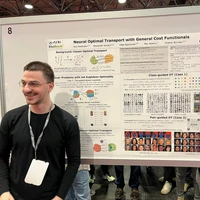
Neural Optimal Transport with General Cost Functionals
We introduce a novel neural network-based algorithm to compute optimal transport (OT) plans for general cost functionals. In contrast to common Euclidean costs, i.e., ell^1 or ell^2, such functionals provide more flexibility and allow using auxiliary information, such as class labels, to construct the required transport map. Existing methods for general costs are discrete and have limitations in practice, i.e. they do not provide an out-of-sample estimation. We address the challenge of designing a continuous OT approach for general costs that generalizes to new data points in high-dimensional spaces, such as images. Additionally, we provide the theoretical error analysis for our recovered transport plans. As an application, we construct a cost functional to map data distributions while preserving the class-wise structure.
Behavior Alignment via Reward Function Optimization
Designing reward functions for efficiently guiding reinforcement learning (RL) agents toward specific behaviors is a complex task. This is challenging since it requires the identification of reward structures that are not sparse and that avoid inadvertently inducing undesirable behaviors. Naively modifying the reward structure to offer denser and more frequent feedback can lead to unintended outcomes and promote behaviors that are not aligned with the designer's intended goal. Although potential-based reward shaping is often suggested as a remedy, we systematically investigate settings where deploying it often significantly impairs performance. To address these issues, we introduce a new framework that uses a bi-level objective to learn behavior alignment reward functions. These functions integrate auxiliary rewards reflecting a designer's heuristics and domain knowledge with the environment's primary rewards. Our approach automatically determines the most effective way to blend these types of feedback, thereby enhancing robustness against heuristic reward misspecification. Remarkably, it can also adapt an agent's policy optimization process to mitigate suboptimalities resulting from limitations and biases inherent in the underlying RL algorithms. We evaluate our method's efficacy on a diverse set of tasks, from small-scale experiments to high-dimensional control challenges. We investigate heuristic auxiliary rewards of varying quality -- some of which are beneficial and others detrimental to the learning process. Our results show that our framework offers a robust and principled way to integrate designer-specified heuristics. It not only addresses key shortcomings of existing approaches but also consistently leads to high-performing solutions, even when given misaligned or poorly-specified auxiliary reward functions.
IDEL: In-Database Entity Linking with Neural Embeddings
We present a novel architecture, In-Database Entity Linking (IDEL), in which we integrate the analytics-optimized RDBMS MonetDB with neural text mining abilities. Our system design abstracts core tasks of most neural entity linking systems for MonetDB. To the best of our knowledge, this is the first defacto implemented system integrating entity-linking in a database. We leverage the ability of MonetDB to support in-database-analytics with user defined functions (UDFs) implemented in Python. These functions call machine learning libraries for neural text mining, such as TensorFlow. The system achieves zero cost for data shipping and transformation by utilizing MonetDB's ability to embed Python processes in the database kernel and exchange data in NumPy arrays. IDEL represents text and relational data in a joint vector space with neural embeddings and can compensate errors with ambiguous entity representations. For detecting matching entities, we propose a novel similarity function based on joint neural embeddings which are learned via minimizing pairwise contrastive ranking loss. This function utilizes a high dimensional index structures for fast retrieval of matching entities. Our first implementation and experiments using the WebNLG corpus show the effectiveness and the potentials of IDEL.
Efficient Implementation of Gaussian Process Regression Accelerated Saddle Point Searches with Application to Molecular Reactions
The task of locating first order saddle points on high-dimensional surfaces describing the variation of energy as a function of atomic coordinates is an essential step for identifying the mechanism and estimating the rate of thermally activated events within the harmonic approximation of transition state theory. When combined directly with electronic structure calculations, the number of energy and atomic force evaluations needed for convergence is a primary issue. Here, we describe an efficient implementation of Gaussian process regression (GPR) acceleration of the minimum mode following method where a dimer is used to estimate the lowest eigenmode of the Hessian. A surrogate energy surface is constructed and updated after each electronic structure calculation. The method is applied to a test set of 500 molecular reactions previously generated by Hermez and coworkers [J. Chem. Theory Comput. 18, 6974 (2022)]. An order of magnitude reduction in the number of electronic structure calculations needed to reach the saddle point configurations is obtained by using the GPR compared to the dimer method. Despite the wide range in stiffness of the molecular degrees of freedom, the calculations are carried out using Cartesian coordinates and are found to require similar number of electronic structure calculations as an elaborate internal coordinate method implemented in the Sella software package. The present implementation of the GPR surrogate model in C++ is efficient enough for the wall time of the saddle point searches to be reduced in 3 out of 4 cases even though the calculations are carried out at a low Hartree-Fock level.

Nearest Neighbour Based Estimates of Gradients: Sharp Nonasymptotic Bounds and Applications
Motivated by a wide variety of applications, ranging from stochastic optimization to dimension reduction through variable selection, the problem of estimating gradients accurately is of crucial importance in statistics and learning theory. We consider here the classic regression setup, where a real valued square integrable r.v. Y is to be predicted upon observing a (possibly high dimensional) random vector X by means of a predictive function f(X) as accurately as possible in the mean-squared sense and study a nearest-neighbour-based pointwise estimate of the gradient of the optimal predictive function, the regression function m(x)=E[Ymid X=x]. Under classic smoothness conditions combined with the assumption that the tails of Y-m(X) are sub-Gaussian, we prove nonasymptotic bounds improving upon those obtained for alternative estimation methods. Beyond the novel theoretical results established, several illustrative numerical experiments have been carried out. The latter provide strong empirical evidence that the estimation method proposed works very well for various statistical problems involving gradient estimation, namely dimensionality reduction, stochastic gradient descent optimization and quantifying disentanglement.

Prompt a Robot to Walk with Large Language Models
Large language models (LLMs) pre-trained on vast internet-scale data have showcased remarkable capabilities across diverse domains. Recently, there has been escalating interest in deploying LLMs for robotics, aiming to harness the power of foundation models in real-world settings. However, this approach faces significant challenges, particularly in grounding these models in the physical world and in generating dynamic robot motions. To address these issues, we introduce a novel paradigm in which we use few-shot prompts collected from the physical environment, enabling the LLM to autoregressively generate low-level control commands for robots without task-specific fine-tuning. Experiments across various robots and environments validate that our method can effectively prompt a robot to walk. We thus illustrate how LLMs can proficiently function as low-level feedback controllers for dynamic motion control even in high-dimensional robotic systems. The project website and source code can be found at: https://prompt2walk.github.io/ .
A Reinforcement Learning Method for Environments with Stochastic Variables: Post-Decision Proximal Policy Optimization with Dual Critic Networks
This paper presents Post-Decision Proximal Policy Optimization (PDPPO), a novel variation of the leading deep reinforcement learning method, Proximal Policy Optimization (PPO). The PDPPO state transition process is divided into two steps: a deterministic step resulting in the post-decision state and a stochastic step leading to the next state. Our approach incorporates post-decision states and dual critics to reduce the problem's dimensionality and enhance the accuracy of value function estimation. Lot-sizing is a mixed integer programming problem for which we exemplify such dynamics. The objective of lot-sizing is to optimize production, delivery fulfillment, and inventory levels in uncertain demand and cost parameters. This paper evaluates the performance of PDPPO across various environments and configurations. Notably, PDPPO with a dual critic architecture achieves nearly double the maximum reward of vanilla PPO in specific scenarios, requiring fewer episode iterations and demonstrating faster and more consistent learning across different initializations. On average, PDPPO outperforms PPO in environments with a stochastic component in the state transition. These results support the benefits of using a post-decision state. Integrating this post-decision state in the value function approximation leads to more informed and efficient learning in high-dimensional and stochastic environments.

Sparse-softmax: A Simpler and Faster Alternative Softmax Transformation
The softmax function is widely used in artificial neural networks for the multiclass classification problems, where the softmax transformation enforces the output to be positive and sum to one, and the corresponding loss function allows to use maximum likelihood principle to optimize the model. However, softmax leaves a large margin for loss function to conduct optimizing operation when it comes to high-dimensional classification, which results in low-performance to some extent. In this paper, we provide an empirical study on a simple and concise softmax variant, namely sparse-softmax, to alleviate the problem that occurred in traditional softmax in terms of high-dimensional classification problems. We evaluate our approach in several interdisciplinary tasks, the experimental results show that sparse-softmax is simpler, faster, and produces better results than the baseline models.
Deep Learning Meets Sparse Regularization: A Signal Processing Perspective
Deep learning has been wildly successful in practice and most state-of-the-art machine learning methods are based on neural networks. Lacking, however, is a rigorous mathematical theory that adequately explains the amazing performance of deep neural networks. In this article, we present a relatively new mathematical framework that provides the beginning of a deeper understanding of deep learning. This framework precisely characterizes the functional properties of neural networks that are trained to fit to data. The key mathematical tools which support this framework include transform-domain sparse regularization, the Radon transform of computed tomography, and approximation theory, which are all techniques deeply rooted in signal processing. This framework explains the effect of weight decay regularization in neural network training, the use of skip connections and low-rank weight matrices in network architectures, the role of sparsity in neural networks, and explains why neural networks can perform well in high-dimensional problems.
NEAT: Neural Attention Fields for End-to-End Autonomous Driving
Efficient reasoning about the semantic, spatial, and temporal structure of a scene is a crucial prerequisite for autonomous driving. We present NEural ATtention fields (NEAT), a novel representation that enables such reasoning for end-to-end imitation learning models. NEAT is a continuous function which maps locations in Bird's Eye View (BEV) scene coordinates to waypoints and semantics, using intermediate attention maps to iteratively compress high-dimensional 2D image features into a compact representation. This allows our model to selectively attend to relevant regions in the input while ignoring information irrelevant to the driving task, effectively associating the images with the BEV representation. In a new evaluation setting involving adverse environmental conditions and challenging scenarios, NEAT outperforms several strong baselines and achieves driving scores on par with the privileged CARLA expert used to generate its training data. Furthermore, visualizing the attention maps for models with NEAT intermediate representations provides improved interpretability.

Efficiently Computing Similarities to Private Datasets
Many methods in differentially private model training rely on computing the similarity between a query point (such as public or synthetic data) and private data. We abstract out this common subroutine and study the following fundamental algorithmic problem: Given a similarity function f and a large high-dimensional private dataset X subset R^d, output a differentially private (DP) data structure which approximates sum_{x in X} f(x,y) for any query y. We consider the cases where f is a kernel function, such as f(x,y) = e^{-|x-y|_2^2/sigma^2} (also known as DP kernel density estimation), or a distance function such as f(x,y) = |x-y|_2, among others. Our theoretical results improve upon prior work and give better privacy-utility trade-offs as well as faster query times for a wide range of kernels and distance functions. The unifying approach behind our results is leveraging `low-dimensional structures' present in the specific functions f that we study, using tools such as provable dimensionality reduction, approximation theory, and one-dimensional decomposition of the functions. Our algorithms empirically exhibit improved query times and accuracy over prior state of the art. We also present an application to DP classification. Our experiments demonstrate that the simple methodology of classifying based on average similarity is orders of magnitude faster than prior DP-SGD based approaches for comparable accuracy.



GeoCLIP: Clip-Inspired Alignment between Locations and Images for Effective Worldwide Geo-localization
Worldwide Geo-localization aims to pinpoint the precise location of images taken anywhere on Earth. This task has considerable challenges due to immense variation in geographic landscapes. The image-to-image retrieval-based approaches fail to solve this problem on a global scale as it is not feasible to construct a large gallery of images covering the entire world. Instead, existing approaches divide the globe into discrete geographic cells, transforming the problem into a classification task. However, their performance is limited by the predefined classes and often results in inaccurate localizations when an image's location significantly deviates from its class center. To overcome these limitations, we propose GeoCLIP, a novel CLIP-inspired Image-to-GPS retrieval approach that enforces alignment between the image and its corresponding GPS locations. GeoCLIP's location encoder models the Earth as a continuous function by employing positional encoding through random Fourier features and constructing a hierarchical representation that captures information at varying resolutions to yield a semantically rich high-dimensional feature suitable to use even beyond geo-localization. To the best of our knowledge, this is the first work employing GPS encoding for geo-localization. We demonstrate the efficacy of our method via extensive experiments and ablations on benchmark datasets. We achieve competitive performance with just 20% of training data, highlighting its effectiveness even in limited-data settings. Furthermore, we qualitatively demonstrate geo-localization using a text query by leveraging CLIP backbone of our image encoder. The project webpage is available at: https://vicentevivan.github.io/GeoCLIP
Bayesian active learning for optimization and uncertainty quantification in protein docking
Motivation: Ab initio protein docking represents a major challenge for optimizing a noisy and costly "black box"-like function in a high-dimensional space. Despite progress in this field, there is no docking method available for rigorous uncertainty quantification (UQ) of its solution quality (e.g. interface RMSD or iRMSD). Results: We introduce a novel algorithm, Bayesian Active Learning (BAL), for optimization and UQ of such black-box functions and flexible protein docking. BAL directly models the posterior distribution of the global optimum (or native structures for protein docking) with active sampling and posterior estimation iteratively feeding each other. Furthermore, we use complex normal modes to represent a homogeneous Euclidean conformation space suitable for high-dimension optimization and construct funnel-like energy models for encounter complexes. Over a protein docking benchmark set and a CAPRI set including homology docking, we establish that BAL significantly improve against both starting points by rigid docking and refinements by particle swarm optimization, providing for one third targets a top-3 near-native prediction. BAL also generates tight confidence intervals with half range around 25% of iRMSD and confidence level at 85%. Its estimated probability of a prediction being native or not achieves binary classification AUROC at 0.93 and AUPRC over 0.60 (compared to 0.14 by chance); and also found to help ranking predictions. To the best of our knowledge, this study represents the first uncertainty quantification solution for protein docking, with theoretical rigor and comprehensive assessment. Source codes are available at https://github.com/Shen-Lab/BAL.
Generalization error of spectral algorithms
The asymptotically precise estimation of the generalization of kernel methods has recently received attention due to the parallels between neural networks and their associated kernels. However, prior works derive such estimates for training by kernel ridge regression (KRR), whereas neural networks are typically trained with gradient descent (GD). In the present work, we consider the training of kernels with a family of spectral algorithms specified by profile h(lambda), and including KRR and GD as special cases. Then, we derive the generalization error as a functional of learning profile h(lambda) for two data models: high-dimensional Gaussian and low-dimensional translation-invariant model. Under power-law assumptions on the spectrum of the kernel and target, we use our framework to (i) give full loss asymptotics for both noisy and noiseless observations (ii) show that the loss localizes on certain spectral scales, giving a new perspective on the KRR saturation phenomenon (iii) conjecture, and demonstrate for the considered data models, the universality of the loss w.r.t. non-spectral details of the problem, but only in case of noisy observation.

Bespoke Solvers for Generative Flow Models
Diffusion or flow-based models are powerful generative paradigms that are notoriously hard to sample as samples are defined as solutions to high-dimensional Ordinary or Stochastic Differential Equations (ODEs/SDEs) which require a large Number of Function Evaluations (NFE) to approximate well. Existing methods to alleviate the costly sampling process include model distillation and designing dedicated ODE solvers. However, distillation is costly to train and sometimes can deteriorate quality, while dedicated solvers still require relatively large NFE to produce high quality samples. In this paper we introduce "Bespoke solvers", a novel framework for constructing custom ODE solvers tailored to the ODE of a given pre-trained flow model. Our approach optimizes an order consistent and parameter-efficient solver (e.g., with 80 learnable parameters), is trained for roughly 1% of the GPU time required for training the pre-trained model, and significantly improves approximation and generation quality compared to dedicated solvers. For example, a Bespoke solver for a CIFAR10 model produces samples with Fr\'echet Inception Distance (FID) of 2.73 with 10 NFE, and gets to 1% of the Ground Truth (GT) FID (2.59) for this model with only 20 NFE. On the more challenging ImageNet-64times64, Bespoke samples at 2.2 FID with 10 NFE, and gets within 2% of GT FID (1.71) with 20 NFE.
Generative Marginalization Models
We introduce marginalization models (MaMs), a new family of generative models for high-dimensional discrete data. They offer scalable and flexible generative modeling with tractable likelihoods by explicitly modeling all induced marginal distributions. Marginalization models enable fast evaluation of arbitrary marginal probabilities with a single forward pass of the neural network, which overcomes a major limitation of methods with exact marginal inference, such as autoregressive models (ARMs). We propose scalable methods for learning the marginals, grounded in the concept of "marginalization self-consistency". Unlike previous methods, MaMs support scalable training of any-order generative models for high-dimensional problems under the setting of energy-based training, where the goal is to match the learned distribution to a given desired probability (specified by an unnormalized (log) probability function such as energy function or reward function). We demonstrate the effectiveness of the proposed model on a variety of discrete data distributions, including binary images, language, physical systems, and molecules, for maximum likelihood and energy-based training settings. MaMs achieve orders of magnitude speedup in evaluating the marginal probabilities on both settings. For energy-based training tasks, MaMs enable any-order generative modeling of high-dimensional problems beyond the capability of previous methods. Code is at https://github.com/PrincetonLIPS/MaM.
Progressive Fourier Neural Representation for Sequential Video Compilation
Neural Implicit Representation (NIR) has recently gained significant attention due to its remarkable ability to encode complex and high-dimensional data into representation space and easily reconstruct it through a trainable mapping function. However, NIR methods assume a one-to-one mapping between the target data and representation models regardless of data relevancy or similarity. This results in poor generalization over multiple complex data and limits their efficiency and scalability. Motivated by continual learning, this work investigates how to accumulate and transfer neural implicit representations for multiple complex video data over sequential encoding sessions. To overcome the limitation of NIR, we propose a novel method, Progressive Fourier Neural Representation (PFNR), that aims to find an adaptive and compact sub-module in Fourier space to encode videos in each training session. This sparsified neural encoding allows the neural network to hold free weights, enabling an improved adaptation for future videos. In addition, when learning a representation for a new video, PFNR transfers the representation of previous videos with frozen weights. This design allows the model to continuously accumulate high-quality neural representations for multiple videos while ensuring lossless decoding that perfectly preserves the learned representations for previous videos. We validate our PFNR method on the UVG8/17 and DAVIS50 video sequence benchmarks and achieve impressive performance gains over strong continual learning baselines. The PFNR code is available at https://github.com/ihaeyong/PFNR.git.

Foundations of Reinforcement Learning and Interactive Decision Making
These lecture notes give a statistical perspective on the foundations of reinforcement learning and interactive decision making. We present a unifying framework for addressing the exploration-exploitation dilemma using frequentist and Bayesian approaches, with connections and parallels between supervised learning/estimation and decision making as an overarching theme. Special attention is paid to function approximation and flexible model classes such as neural networks. Topics covered include multi-armed and contextual bandits, structured bandits, and reinforcement learning with high-dimensional feedback.
Aligning Logits Generatively for Principled Black-Box Knowledge Distillation
Black-Box Knowledge Distillation (B2KD) is a formulated problem for cloud-to-edge model compression with invisible data and models hosted on the server. B2KD faces challenges such as limited Internet exchange and edge-cloud disparity of data distributions. In this paper, we formalize a two-step workflow consisting of deprivatization and distillation, and theoretically provide a new optimization direction from logits to cell boundary different from direct logits alignment. With its guidance, we propose a new method Mapping-Emulation KD (MEKD) that distills a black-box cumbersome model into a lightweight one. Our method does not differentiate between treating soft or hard responses, and consists of: 1) deprivatization: emulating the inverse mapping of the teacher function with a generator, and 2) distillation: aligning low-dimensional logits of the teacher and student models by reducing the distance of high-dimensional image points. For different teacher-student pairs, our method yields inspiring distillation performance on various benchmarks, and outperforms the previous state-of-the-art approaches.
Kolmogorov-Arnold Fourier Networks
Although Kolmogorov-Arnold based interpretable networks (KAN) have strong theoretical expressiveness, they face significant parameter explosion and high-frequency feature capture challenges in high-dimensional tasks. To address this issue, we propose the Kolmogorov-Arnold-Fourier Network (KAF), which effectively integrates trainable Random Fourier Features (RFF) and a novel hybrid GELU-Fourier activation mechanism to balance parameter efficiency and spectral representation capabilities. Our key technical contributions include: (1) merging KAN's dual-matrix structure through matrix association properties to substantially reduce parameters; (2) introducing learnable RFF initialization strategies to eliminate spectral distortion in high-dimensional approximation tasks; (3) implementing an adaptive hybrid activation function that progressively enhances frequency representation during the training process. Comprehensive experiments demonstrate the superiority of our KAF across various domains including vision, NLP, audio processing, and differential equation-solving tasks, effectively combining theoretical interpretability with practical utility and computational efficiency.
A Study of Bayesian Neural Network Surrogates for Bayesian Optimization
Bayesian optimization is a highly efficient approach to optimizing objective functions which are expensive to query. These objectives are typically represented by Gaussian process (GP) surrogate models which are easy to optimize and support exact inference. While standard GP surrogates have been well-established in Bayesian optimization, Bayesian neural networks (BNNs) have recently become practical function approximators, with many benefits over standard GPs such as the ability to naturally handle non-stationarity and learn representations for high-dimensional data. In this paper, we study BNNs as alternatives to standard GP surrogates for optimization. We consider a variety of approximate inference procedures for finite-width BNNs, including high-quality Hamiltonian Monte Carlo, low-cost stochastic MCMC, and heuristics such as deep ensembles. We also consider infinite-width BNNs and partially stochastic models such as deep kernel learning. We evaluate this collection of surrogate models on diverse problems with varying dimensionality, number of objectives, non-stationarity, and discrete and continuous inputs. We find: (i) the ranking of methods is highly problem dependent, suggesting the need for tailored inductive biases; (ii) HMC is the most successful approximate inference procedure for fully stochastic BNNs; (iii) full stochasticity may be unnecessary as deep kernel learning is relatively competitive; (iv) infinite-width BNNs are particularly promising, especially in high dimensions.

Deep Clustering via Joint Convolutional Autoencoder Embedding and Relative Entropy Minimization
Image clustering is one of the most important computer vision applications, which has been extensively studied in literature. However, current clustering methods mostly suffer from lack of efficiency and scalability when dealing with large-scale and high-dimensional data. In this paper, we propose a new clustering model, called DEeP Embedded RegularIzed ClusTering (DEPICT), which efficiently maps data into a discriminative embedding subspace and precisely predicts cluster assignments. DEPICT generally consists of a multinomial logistic regression function stacked on top of a multi-layer convolutional autoencoder. We define a clustering objective function using relative entropy (KL divergence) minimization, regularized by a prior for the frequency of cluster assignments. An alternating strategy is then derived to optimize the objective by updating parameters and estimating cluster assignments. Furthermore, we employ the reconstruction loss functions in our autoencoder, as a data-dependent regularization term, to prevent the deep embedding function from overfitting. In order to benefit from end-to-end optimization and eliminate the necessity for layer-wise pretraining, we introduce a joint learning framework to minimize the unified clustering and reconstruction loss functions together and train all network layers simultaneously. Experimental results indicate the superiority and faster running time of DEPICT in real-world clustering tasks, where no labeled data is available for hyper-parameter tuning.


NeuralStagger: Accelerating Physics-constrained Neural PDE Solver with Spatial-temporal Decomposition
Neural networks have shown great potential in accelerating the solution of partial differential equations (PDEs). Recently, there has been a growing interest in introducing physics constraints into training neural PDE solvers to reduce the use of costly data and improve the generalization ability. However, these physics constraints, based on certain finite dimensional approximations over the function space, must resolve the smallest scaled physics to ensure the accuracy and stability of the simulation, resulting in high computational costs from large input, output, and neural networks. This paper proposes a general acceleration methodology called NeuralStagger by spatially and temporally decomposing the original learning tasks into several coarser-resolution subtasks. We define a coarse-resolution neural solver for each subtask, which requires fewer computational resources, and jointly train them with the vanilla physics-constrained loss by simply arranging their outputs to reconstruct the original solution. Due to the perfect parallelism between them, the solution is achieved as fast as a coarse-resolution neural solver. In addition, the trained solvers bring the flexibility of simulating with multiple levels of resolution. We demonstrate the successful application of NeuralStagger on 2D and 3D fluid dynamics simulations, which leads to an additional 10sim100times speed-up. Moreover, the experiment also shows that the learned model could be well used for optimal control.

ReasoningV: Efficient Verilog Code Generation with Adaptive Hybrid Reasoning Model
Large Language Models (LLMs) have advanced Verilog code generation significantly, yet face challenges in data quality, reasoning capabilities, and computational efficiency. This paper presents ReasoningV, a novel model employing a hybrid reasoning strategy that integrates trained intrinsic capabilities with dynamic inference adaptation for Verilog code generation. Our framework introduces three complementary innovations: (1) ReasoningV-5K, a high-quality dataset of 5,000 functionally verified instances with reasoning paths created through multi-dimensional filtering of PyraNet samples; (2) a two-stage training approach combining parameter-efficient fine-tuning for foundational knowledge with full-parameter optimization for enhanced reasoning; and (3) an adaptive reasoning mechanism that dynamically adjusts reasoning depth based on problem complexity, reducing token consumption by up to 75\% while preserving performance. Experimental results demonstrate ReasoningV's effectiveness with a pass@1 accuracy of 57.8\% on VerilogEval-human, achieving performance competitive with leading commercial models like Gemini-2.0-flash (59.5\%) and exceeding the previous best open-source model by 10.4 percentage points. ReasoningV offers a more reliable and accessible pathway for advancing AI-driven hardware design automation, with our model, data, and code available at https://github.com/BUAA-CLab/ReasoningV.
Decodable and Sample Invariant Continuous Object Encoder
We propose Hyper-Dimensional Function Encoding (HDFE). Given samples of a continuous object (e.g. a function), HDFE produces an explicit vector representation of the given object, invariant to the sample distribution and density. Sample distribution and density invariance enables HDFE to consistently encode continuous objects regardless of their sampling, and therefore allows neural networks to receive continuous objects as inputs for machine learning tasks, such as classification and regression. Besides, HDFE does not require any training and is proved to map the object into an organized embedding space, which facilitates the training of the downstream tasks. In addition, the encoding is decodable, which enables neural networks to regress continuous objects by regressing their encodings. Therefore, HDFE serves as an interface for processing continuous objects. We apply HDFE to function-to-function mapping, where vanilla HDFE achieves competitive performance as the state-of-the-art algorithm. We apply HDFE to point cloud surface normal estimation, where a simple replacement from PointNet to HDFE leads to immediate 12% and 15% error reductions in two benchmarks. In addition, by integrating HDFE into the PointNet-based SOTA network, we improve the SOTA baseline by 2.5% and 1.7% in the same benchmarks.


Volumetric Wireframe Parsing from Neural Attraction Fields
The primal sketch is a fundamental representation in Marr's vision theory, which allows for parsimonious image-level processing from 2D to 2.5D perception. This paper takes a further step by computing 3D primal sketch of wireframes from a set of images with known camera poses, in which we take the 2D wireframes in multi-view images as the basis to compute 3D wireframes in a volumetric rendering formulation. In our method, we first propose a NEural Attraction (NEAT) Fields that parameterizes the 3D line segments with coordinate Multi-Layer Perceptrons (MLPs), enabling us to learn the 3D line segments from 2D observation without incurring any explicit feature correspondences across views. We then present a novel Global Junction Perceiving (GJP) module to perceive meaningful 3D junctions from the NEAT Fields of 3D line segments by optimizing a randomly initialized high-dimensional latent array and a lightweight decoding MLP. Benefitting from our explicit modeling of 3D junctions, we finally compute the primal sketch of 3D wireframes by attracting the queried 3D line segments to the 3D junctions, significantly simplifying the computation paradigm of 3D wireframe parsing. In experiments, we evaluate our approach on the DTU and BlendedMVS datasets with promising performance obtained. As far as we know, our method is the first approach to achieve high-fidelity 3D wireframe parsing without requiring explicit matching.


Deep Learning for Functional Data Analysis with Adaptive Basis Layers
Despite their widespread success, the application of deep neural networks to functional data remains scarce today. The infinite dimensionality of functional data means standard learning algorithms can be applied only after appropriate dimension reduction, typically achieved via basis expansions. Currently, these bases are chosen a priori without the information for the task at hand and thus may not be effective for the designated task. We instead propose to adaptively learn these bases in an end-to-end fashion. We introduce neural networks that employ a new Basis Layer whose hidden units are each basis functions themselves implemented as a micro neural network. Our architecture learns to apply parsimonious dimension reduction to functional inputs that focuses only on information relevant to the target rather than irrelevant variation in the input function. Across numerous classification/regression tasks with functional data, our method empirically outperforms other types of neural networks, and we prove that our approach is statistically consistent with low generalization error. Code is available at: https://github.com/jwyyy/AdaFNN.

Learning Hierarchical Polynomials with Three-Layer Neural Networks
We study the problem of learning hierarchical polynomials over the standard Gaussian distribution with three-layer neural networks. We specifically consider target functions of the form h = g circ p where p : R^d rightarrow R is a degree k polynomial and g: R rightarrow R is a degree q polynomial. This function class generalizes the single-index model, which corresponds to k=1, and is a natural class of functions possessing an underlying hierarchical structure. Our main result shows that for a large subclass of degree k polynomials p, a three-layer neural network trained via layerwise gradient descent on the square loss learns the target h up to vanishing test error in mathcal{O}(d^k) samples and polynomial time. This is a strict improvement over kernel methods, which require widetilde Theta(d^{kq}) samples, as well as existing guarantees for two-layer networks, which require the target function to be low-rank. Our result also generalizes prior works on three-layer neural networks, which were restricted to the case of p being a quadratic. When p is indeed a quadratic, we achieve the information-theoretically optimal sample complexity mathcal{O}(d^2), which is an improvement over prior work~nichani2023provable requiring a sample size of widetildeTheta(d^4). Our proof proceeds by showing that during the initial stage of training the network performs feature learning to recover the feature p with mathcal{O}(d^k) samples. This work demonstrates the ability of three-layer neural networks to learn complex features and as a result, learn a broad class of hierarchical functions.

Scaling Riemannian Diffusion Models
Riemannian diffusion models draw inspiration from standard Euclidean space diffusion models to learn distributions on general manifolds. Unfortunately, the additional geometric complexity renders the diffusion transition term inexpressible in closed form, so prior methods resort to imprecise approximations of the score matching training objective that degrade performance and preclude applications in high dimensions. In this work, we reexamine these approximations and propose several practical improvements. Our key observation is that most relevant manifolds are symmetric spaces, which are much more amenable to computation. By leveraging and combining various ans\"{a}tze, we can quickly compute relevant quantities to high precision. On low dimensional datasets, our correction produces a noticeable improvement, allowing diffusion to compete with other methods. Additionally, we show that our method enables us to scale to high dimensional tasks on nontrivial manifolds. In particular, we model QCD densities on SU(n) lattices and contrastively learned embeddings on high dimensional hyperspheres.
High-dimensional dynamics of generalization error in neural networks
We perform an average case analysis of the generalization dynamics of large neural networks trained using gradient descent. We study the practically-relevant "high-dimensional" regime where the number of free parameters in the network is on the order of or even larger than the number of examples in the dataset. Using random matrix theory and exact solutions in linear models, we derive the generalization error and training error dynamics of learning and analyze how they depend on the dimensionality of data and signal to noise ratio of the learning problem. We find that the dynamics of gradient descent learning naturally protect against overtraining and overfitting in large networks. Overtraining is worst at intermediate network sizes, when the effective number of free parameters equals the number of samples, and thus can be reduced by making a network smaller or larger. Additionally, in the high-dimensional regime, low generalization error requires starting with small initial weights. We then turn to non-linear neural networks, and show that making networks very large does not harm their generalization performance. On the contrary, it can in fact reduce overtraining, even without early stopping or regularization of any sort. We identify two novel phenomena underlying this behavior in overcomplete models: first, there is a frozen subspace of the weights in which no learning occurs under gradient descent; and second, the statistical properties of the high-dimensional regime yield better-conditioned input correlations which protect against overtraining. We demonstrate that naive application of worst-case theories such as Rademacher complexity are inaccurate in predicting the generalization performance of deep neural networks, and derive an alternative bound which incorporates the frozen subspace and conditioning effects and qualitatively matches the behavior observed in simulation.
Principled Approaches for Extending Neural Architectures to Function Spaces for Operator Learning
A wide range of scientific problems, such as those described by continuous-time dynamical systems and partial differential equations (PDEs), are naturally formulated on function spaces. While function spaces are typically infinite-dimensional, deep learning has predominantly advanced through applications in computer vision and natural language processing that focus on mappings between finite-dimensional spaces. Such fundamental disparities in the nature of the data have limited neural networks from achieving a comparable level of success in scientific applications as seen in other fields. Neural operators are a principled way to generalize neural networks to mappings between function spaces, offering a pathway to replicate deep learning's transformative impact on scientific problems. For instance, neural operators can learn solution operators for entire classes of PDEs, e.g., physical systems with different boundary conditions, coefficient functions, and geometries. A key factor in deep learning's success has been the careful engineering of neural architectures through extensive empirical testing. Translating these neural architectures into neural operators allows operator learning to enjoy these same empirical optimizations. However, prior neural operator architectures have often been introduced as standalone models, not directly derived as extensions of existing neural network architectures. In this paper, we identify and distill the key principles for constructing practical implementations of mappings between infinite-dimensional function spaces. Using these principles, we propose a recipe for converting several popular neural architectures into neural operators with minimal modifications. This paper aims to guide practitioners through this process and details the steps to make neural operators work in practice. Our code can be found at https://github.com/neuraloperator/NNs-to-NOs
Evolving Normalization-Activation Layers
Normalization layers and activation functions are fundamental components in deep networks and typically co-locate with each other. Here we propose to design them using an automated approach. Instead of designing them separately, we unify them into a single tensor-to-tensor computation graph, and evolve its structure starting from basic mathematical functions. Examples of such mathematical functions are addition, multiplication and statistical moments. The use of low-level mathematical functions, in contrast to the use of high-level modules in mainstream NAS, leads to a highly sparse and large search space which can be challenging for search methods. To address the challenge, we develop efficient rejection protocols to quickly filter out candidate layers that do not work well. We also use multi-objective evolution to optimize each layer's performance across many architectures to prevent overfitting. Our method leads to the discovery of EvoNorms, a set of new normalization-activation layers with novel, and sometimes surprising structures that go beyond existing design patterns. For example, some EvoNorms do not assume that normalization and activation functions must be applied sequentially, nor need to center the feature maps, nor require explicit activation functions. Our experiments show that EvoNorms work well on image classification models including ResNets, MobileNets and EfficientNets but also transfer well to Mask R-CNN with FPN/SpineNet for instance segmentation and to BigGAN for image synthesis, outperforming BatchNorm and GroupNorm based layers in many cases.
Neural Network Approximations of PDEs Beyond Linearity: A Representational Perspective
A burgeoning line of research leverages deep neural networks to approximate the solutions to high dimensional PDEs, opening lines of theoretical inquiry focused on explaining how it is that these models appear to evade the curse of dimensionality. However, most prior theoretical analyses have been limited to linear PDEs. In this work, we take a step towards studying the representational power of neural networks for approximating solutions to nonlinear PDEs. We focus on a class of PDEs known as nonlinear elliptic variational PDEs, whose solutions minimize an Euler-Lagrange energy functional E(u) = int_Omega L(x, u(x), nabla u(x)) - f(x) u(x)dx. We show that if composing a function with Barron norm b with partial derivatives of L produces a function of Barron norm at most B_L b^p, the solution to the PDE can be epsilon-approximated in the L^2 sense by a function with Barron norm Oleft(left(dB_Lright)^{max{p log(1/ epsilon), p^{log(1/epsilon)}}}right). By a classical result due to Barron [1993], this correspondingly bounds the size of a 2-layer neural network needed to approximate the solution. Treating p, epsilon, B_L as constants, this quantity is polynomial in dimension, thus showing neural networks can evade the curse of dimensionality. Our proof technique involves neurally simulating (preconditioned) gradient in an appropriate Hilbert space, which converges exponentially fast to the solution of the PDE, and such that we can bound the increase of the Barron norm at each iterate. Our results subsume and substantially generalize analogous prior results for linear elliptic PDEs over a unit hypercube.
Adversarially Robust PAC Learnability of Real-Valued Functions
We study robustness to test-time adversarial attacks in the regression setting with ell_p losses and arbitrary perturbation sets. We address the question of which function classes are PAC learnable in this setting. We show that classes of finite fat-shattering dimension are learnable in both realizable and agnostic settings. Moreover, for convex function classes, they are even properly learnable. In contrast, some non-convex function classes provably require improper learning algorithms. Our main technique is based on a construction of an adversarially robust sample compression scheme of a size determined by the fat-shattering dimension. Along the way, we introduce a novel agnostic sample compression scheme for real-valued functions, which may be of independent interest.
Stochastic Taylor Derivative Estimator: Efficient amortization for arbitrary differential operators
Optimizing neural networks with loss that contain high-dimensional and high-order differential operators is expensive to evaluate with back-propagation due to O(d^{k}) scaling of the derivative tensor size and the O(2^{k-1}L) scaling in the computation graph, where d is the dimension of the domain, L is the number of ops in the forward computation graph, and k is the derivative order. In previous works, the polynomial scaling in d was addressed by amortizing the computation over the optimization process via randomization. Separately, the exponential scaling in k for univariate functions (d=1) was addressed with high-order auto-differentiation (AD). In this work, we show how to efficiently perform arbitrary contraction of the derivative tensor of arbitrary order for multivariate functions, by properly constructing the input tangents to univariate high-order AD, which can be used to efficiently randomize any differential operator. When applied to Physics-Informed Neural Networks (PINNs), our method provides >1000times speed-up and >30times memory reduction over randomization with first-order AD, and we can now solve 1-million-dimensional PDEs in 8 minutes on a single NVIDIA A100 GPU. This work opens the possibility of using high-order differential operators in large-scale problems.
Manifold Diffusion Fields
We present Manifold Diffusion Fields (MDF), an approach to learn generative models of continuous functions defined over Riemannian manifolds. Leveraging insights from spectral geometry analysis, we define an intrinsic coordinate system on the manifold via the eigen-functions of the Laplace-Beltrami Operator. MDF represents functions using an explicit parametrization formed by a set of multiple input-output pairs. Our approach allows to sample continuous functions on manifolds and is invariant with respect to rigid and isometric transformations of the manifold. Empirical results on several datasets and manifolds show that MDF can capture distributions of such functions with better diversity and fidelity than previous approaches.

Contributions to Robust and Efficient Methods for Analysis of High Dimensional Data
A ubiquitous feature of data of our era is their extra-large sizes and dimensions. Analyzing such high-dimensional data poses significant challenges, since the feature dimension is often much larger than the sample size. This thesis introduces robust and computationally efficient methods to address several common challenges associated with high-dimensional data. In my first manuscript, I propose a coherent approach to variable screening that accommodates nonlinear associations. I develop a novel variable screening method that transcends traditional linear assumptions by leveraging mutual information, with an intended application in neuroimaging data. This approach allows for accurate identification of important variables by capturing nonlinear as well as linear relationships between the outcome and covariates. Building on this foundation, I develop new optimization methods for sparse estimation using nonconvex penalties in my second manuscript. These methods address notable challenges in current statistical computing practices, facilitating computationally efficient and robust analyses of complex datasets. The proposed method can be applied to a general class of optimization problems. In my third manuscript, I contribute to robust modeling of high-dimensional correlated observations by developing a mixed-effects model based on Tsallis power-law entropy maximization and discussed the theoretical properties of such distribution. This model surpasses the constraints of conventional Gaussian models by accommodating a broader class of distributions with enhanced robustness to outliers. Additionally, I develop a proximal nonlinear conjugate gradient algorithm that accelerates convergence while maintaining numerical stability, along with rigorous statistical properties for the proposed framework.

Visualizing Large-scale and High-dimensional Data
We study the problem of visualizing large-scale and high-dimensional data in a low-dimensional (typically 2D or 3D) space. Much success has been reported recently by techniques that first compute a similarity structure of the data points and then project them into a low-dimensional space with the structure preserved. These two steps suffer from considerable computational costs, preventing the state-of-the-art methods such as the t-SNE from scaling to large-scale and high-dimensional data (e.g., millions of data points and hundreds of dimensions). We propose the LargeVis, a technique that first constructs an accurately approximated K-nearest neighbor graph from the data and then layouts the graph in the low-dimensional space. Comparing to t-SNE, LargeVis significantly reduces the computational cost of the graph construction step and employs a principled probabilistic model for the visualization step, the objective of which can be effectively optimized through asynchronous stochastic gradient descent with a linear time complexity. The whole procedure thus easily scales to millions of high-dimensional data points. Experimental results on real-world data sets demonstrate that the LargeVis outperforms the state-of-the-art methods in both efficiency and effectiveness. The hyper-parameters of LargeVis are also much more stable over different data sets.
Adversarial Classification: Necessary conditions and geometric flows
We study a version of adversarial classification where an adversary is empowered to corrupt data inputs up to some distance varepsilon, using tools from variational analysis. In particular, we describe necessary conditions associated with the optimal classifier subject to such an adversary. Using the necessary conditions, we derive a geometric evolution equation which can be used to track the change in classification boundaries as varepsilon varies. This evolution equation may be described as an uncoupled system of differential equations in one dimension, or as a mean curvature type equation in higher dimension. In one dimension, and under mild assumptions on the data distribution, we rigorously prove that one can use the initial value problem starting from varepsilon=0, which is simply the Bayes classifier, in order to solve for the global minimizer of the adversarial problem for small values of varepsilon. In higher dimensions we provide a similar result, albeit conditional to the existence of regular solutions of the initial value problem. In the process of proving our main results we obtain a result of independent interest connecting the original adversarial problem with an optimal transport problem under no assumptions on whether classes are balanced or not. Numerical examples illustrating these ideas are also presented.
Operator Learning with Neural Fields: Tackling PDEs on General Geometries
Machine learning approaches for solving partial differential equations require learning mappings between function spaces. While convolutional or graph neural networks are constrained to discretized functions, neural operators present a promising milestone toward mapping functions directly. Despite impressive results they still face challenges with respect to the domain geometry and typically rely on some form of discretization. In order to alleviate such limitations, we present CORAL, a new method that leverages coordinate-based networks for solving PDEs on general geometries. CORAL is designed to remove constraints on the input mesh, making it applicable to any spatial sampling and geometry. Its ability extends to diverse problem domains, including PDE solving, spatio-temporal forecasting, and inverse problems like geometric design. CORAL demonstrates robust performance across multiple resolutions and performs well in both convex and non-convex domains, surpassing or performing on par with state-of-the-art models.


Weighted least-squares approximation with determinantal point processes and generalized volume sampling
We consider the problem of approximating a function from L^2 by an element of a given m-dimensional space V_m, associated with some feature map varphi, using evaluations of the function at random points x_1,dots,x_n. After recalling some results on optimal weighted least-squares using independent and identically distributed points, we consider weighted least-squares using projection determinantal point processes (DPP) or volume sampling. These distributions introduce dependence between the points that promotes diversity in the selected features varphi(x_i). We first provide a generalized version of volume-rescaled sampling yielding quasi-optimality results in expectation with a number of samples n = O(mlog(m)), that means that the expected L^2 error is bounded by a constant times the best approximation error in L^2. Also, further assuming that the function is in some normed vector space H continuously embedded in L^2, we further prove that the approximation is almost surely bounded by the best approximation error measured in the H-norm. This includes the cases of functions from L^infty or reproducing kernel Hilbert spaces. Finally, we present an alternative strategy consisting in using independent repetitions of projection DPP (or volume sampling), yielding similar error bounds as with i.i.d. or volume sampling, but in practice with a much lower number of samples. Numerical experiments illustrate the performance of the different strategies.
Representer Point Selection for Explaining Regularized High-dimensional Models
We introduce a novel class of sample-based explanations we term high-dimensional representers, that can be used to explain the predictions of a regularized high-dimensional model in terms of importance weights for each of the training samples. Our workhorse is a novel representer theorem for general regularized high-dimensional models, which decomposes the model prediction in terms of contributions from each of the training samples: with positive (negative) values corresponding to positive (negative) impact training samples to the model's prediction. We derive consequences for the canonical instances of ell_1 regularized sparse models, and nuclear norm regularized low-rank models. As a case study, we further investigate the application of low-rank models in the context of collaborative filtering, where we instantiate high-dimensional representers for specific popular classes of models. Finally, we study the empirical performance of our proposed methods on three real-world binary classification datasets and two recommender system datasets. We also showcase the utility of high-dimensional representers in explaining model recommendations.
Deep Sets
We study the problem of designing models for machine learning tasks defined on sets. In contrast to traditional approach of operating on fixed dimensional vectors, we consider objective functions defined on sets that are invariant to permutations. Such problems are widespread, ranging from estimation of population statistics poczos13aistats, to anomaly detection in piezometer data of embankment dams Jung15Exploration, to cosmology Ntampaka16Dynamical,Ravanbakhsh16ICML1. Our main theorem characterizes the permutation invariant functions and provides a family of functions to which any permutation invariant objective function must belong. This family of functions has a special structure which enables us to design a deep network architecture that can operate on sets and which can be deployed on a variety of scenarios including both unsupervised and supervised learning tasks. We also derive the necessary and sufficient conditions for permutation equivariance in deep models. We demonstrate the applicability of our method on population statistic estimation, point cloud classification, set expansion, and outlier detection.
Continuous-Time Functional Diffusion Processes
We introduce Functional Diffusion Processes (FDPs), which generalize score-based diffusion models to infinite-dimensional function spaces. FDPs require a new mathematical framework to describe the forward and backward dynamics, and several extensions to derive practical training objectives. These include infinite-dimensional versions of Girsanov theorem, in order to be able to compute an ELBO, and of the sampling theorem, in order to guarantee that functional evaluations in a countable set of points are equivalent to infinite-dimensional functions. We use FDPs to build a new breed of generative models in function spaces, which do not require specialized network architectures, and that can work with any kind of continuous data. Our results on real data show that FDPs achieve high-quality image generation, using a simple MLP architecture with orders of magnitude fewer parameters than existing diffusion models.



Functorial Manifold Learning
We adapt previous research on category theory and topological unsupervised learning to develop a functorial perspective on manifold learning, also known as nonlinear dimensionality reduction. We first characterize manifold learning algorithms as functors that map pseudometric spaces to optimization objectives and that factor through hierarchical clustering functors. We then use this characterization to prove refinement bounds on manifold learning loss functions and construct a hierarchy of manifold learning algorithms based on their equivariants. We express several popular manifold learning algorithms as functors at different levels of this hierarchy, including Metric Multidimensional Scaling, IsoMap, and UMAP. Next, we use interleaving distance to study the stability of a broad class of manifold learning algorithms. We present bounds on how closely the embeddings these algorithms produce from noisy data approximate the embeddings they would learn from noiseless data. Finally, we use our framework to derive a set of novel manifold learning algorithms, which we experimentally demonstrate are competitive with the state of the art.
Geometric Properties of Neural Multivariate Regression
Neural multivariate regression underpins a wide range of domains such as control, robotics, and finance, yet the geometry of its learned representations remains poorly characterized. While neural collapse has been shown to benefit generalization in classification, we find that analogous collapse in regression consistently degrades performance. To explain this contrast, we analyze models through the lens of intrinsic dimension. Across control tasks and synthetic datasets, we estimate the intrinsic dimension of last-layer features (ID_H) and compare it with that of the regression targets (ID_Y). Collapsed models exhibit ID_H < ID_Y, leading to over-compression and poor generalization, whereas non-collapsed models typically maintain ID_H > ID_Y. For the non-collapsed models, performance with respect to ID_H depends on the data quantity and noise levels. From these observations, we identify two regimes (over-compressed and under-compressed) that determine when expanding or reducing feature dimensionality improves performance. Our results provide new geometric insights into neural regression and suggest practical strategies for enhancing generalization.
Q-Transformer: Scalable Offline Reinforcement Learning via Autoregressive Q-Functions
In this work, we present a scalable reinforcement learning method for training multi-task policies from large offline datasets that can leverage both human demonstrations and autonomously collected data. Our method uses a Transformer to provide a scalable representation for Q-functions trained via offline temporal difference backups. We therefore refer to the method as Q-Transformer. By discretizing each action dimension and representing the Q-value of each action dimension as separate tokens, we can apply effective high-capacity sequence modeling techniques for Q-learning. We present several design decisions that enable good performance with offline RL training, and show that Q-Transformer outperforms prior offline RL algorithms and imitation learning techniques on a large diverse real-world robotic manipulation task suite. The project's website and videos can be found at https://q-transformer.github.io



Dynamic Novel View Synthesis in High Dynamic Range
High Dynamic Range Novel View Synthesis (HDR NVS) seeks to learn an HDR 3D model from Low Dynamic Range (LDR) training images captured under conventional imaging conditions. Current methods primarily focus on static scenes, implicitly assuming all scene elements remain stationary and non-living. However, real-world scenarios frequently feature dynamic elements, such as moving objects, varying lighting conditions, and other temporal events, thereby presenting a significantly more challenging scenario. To address this gap, we propose a more realistic problem named HDR Dynamic Novel View Synthesis (HDR DNVS), where the additional dimension ``Dynamic'' emphasizes the necessity of jointly modeling temporal radiance variations alongside sophisticated 3D translation between LDR and HDR. To tackle this complex, intertwined challenge, we introduce HDR-4DGS, a Gaussian Splatting-based architecture featured with an innovative dynamic tone-mapping module that explicitly connects HDR and LDR domains, maintaining temporal radiance coherence by dynamically adapting tone-mapping functions according to the evolving radiance distributions across the temporal dimension. As a result, HDR-4DGS achieves both temporal radiance consistency and spatially accurate color translation, enabling photorealistic HDR renderings from arbitrary viewpoints and time instances. Extensive experiments demonstrate that HDR-4DGS surpasses existing state-of-the-art methods in both quantitative performance and visual fidelity. Source code will be released.
On Generalizations of Some Distance Based Classifiers for HDLSS Data
In high dimension, low sample size (HDLSS) settings, classifiers based on Euclidean distances like the nearest neighbor classifier and the average distance classifier perform quite poorly if differences between locations of the underlying populations get masked by scale differences. To rectify this problem, several modifications of these classifiers have been proposed in the literature. However, existing methods are confined to location and scale differences only, and often fail to discriminate among populations differing outside of the first two moments. In this article, we propose some simple transformations of these classifiers resulting into improved performance even when the underlying populations have the same location and scale. We further propose a generalization of these classifiers based on the idea of grouping of variables. The high-dimensional behavior of the proposed classifiers is studied theoretically. Numerical experiments with a variety of simulated examples as well as an extensive analysis of real data sets exhibit advantages of the proposed methods.
On Enhancing Expressive Power via Compositions of Single Fixed-Size ReLU Network
This paper explores the expressive power of deep neural networks through the framework of function compositions. We demonstrate that the repeated compositions of a single fixed-size ReLU network exhibit surprising expressive power, despite the limited expressive capabilities of the individual network itself. Specifically, we prove by construction that L_2circ g^{circ r}circ mathcal{L}_1 can approximate 1-Lipschitz continuous functions on [0,1]^d with an error O(r^{-1/d}), where g is realized by a fixed-size ReLU network, mathcal{L}_1 and L_2 are two affine linear maps matching the dimensions, and g^{circ r} denotes the r-times composition of g. Furthermore, we extend such a result to generic continuous functions on [0,1]^d with the approximation error characterized by the modulus of continuity. Our results reveal that a continuous-depth network generated via a dynamical system has immense approximation power even if its dynamics function is time-independent and realized by a fixed-size ReLU network.
Measuring the Intrinsic Dimension of Objective Landscapes
Many recently trained neural networks employ large numbers of parameters to achieve good performance. One may intuitively use the number of parameters required as a rough gauge of the difficulty of a problem. But how accurate are such notions? How many parameters are really needed? In this paper we attempt to answer this question by training networks not in their native parameter space, but instead in a smaller, randomly oriented subspace. We slowly increase the dimension of this subspace, note at which dimension solutions first appear, and define this to be the intrinsic dimension of the objective landscape. The approach is simple to implement, computationally tractable, and produces several suggestive conclusions. Many problems have smaller intrinsic dimensions than one might suspect, and the intrinsic dimension for a given dataset varies little across a family of models with vastly different sizes. This latter result has the profound implication that once a parameter space is large enough to solve a problem, extra parameters serve directly to increase the dimensionality of the solution manifold. Intrinsic dimension allows some quantitative comparison of problem difficulty across supervised, reinforcement, and other types of learning where we conclude, for example, that solving the inverted pendulum problem is 100 times easier than classifying digits from MNIST, and playing Atari Pong from pixels is about as hard as classifying CIFAR-10. In addition to providing new cartography of the objective landscapes wandered by parameterized models, the method is a simple technique for constructively obtaining an upper bound on the minimum description length of a solution. A byproduct of this construction is a simple approach for compressing networks, in some cases by more than 100 times.
How DNNs break the Curse of Dimensionality: Compositionality and Symmetry Learning
We show that deep neural networks (DNNs) can efficiently learn any composition of functions with bounded F_{1}-norm, which allows DNNs to break the curse of dimensionality in ways that shallow networks cannot. More specifically, we derive a generalization bound that combines a covering number argument for compositionality, and the F_{1}-norm (or the related Barron norm) for large width adaptivity. We show that the global minimizer of the regularized loss of DNNs can fit for example the composition of two functions f^{*}=hcirc g from a small number of observations, assuming g is smooth/regular and reduces the dimensionality (e.g. g could be the modulo map of the symmetries of f^{*}), so that h can be learned in spite of its low regularity. The measures of regularity we consider is the Sobolev norm with different levels of differentiability, which is well adapted to the F_{1} norm. We compute scaling laws empirically and observe phase transitions depending on whether g or h is harder to learn, as predicted by our theory.

Kernel Density Estimators in Large Dimensions
This paper studies Kernel density estimation for a high-dimensional distribution rho(x). Traditional approaches have focused on the limit of large number of data points n and fixed dimension d. We analyze instead the regime where both the number n of data points y_i and their dimensionality d grow with a fixed ratio alpha=(log n)/d. Our study reveals three distinct statistical regimes for the kernel-based estimate of the density hat rho_h^{D}(x)=1{n h^d}sum_{i=1}^n Kleft(x-y_i{h}right), depending on the bandwidth h: a classical regime for large bandwidth where the Central Limit Theorem (CLT) holds, which is akin to the one found in traditional approaches. Below a certain value of the bandwidth, h_{CLT}(alpha), we find that the CLT breaks down. The statistics of hat rho_h^{D}(x) for a fixed x drawn from rho(x) is given by a heavy-tailed distribution (an alpha-stable distribution). In particular below a value h_G(alpha), we find that hat rho_h^{D}(x) is governed by extreme value statistics: only a few points in the database matter and give the dominant contribution to the density estimator. We provide a detailed analysis for high-dimensional multivariate Gaussian data. We show that the optimal bandwidth threshold based on Kullback-Leibler divergence lies in the new statistical regime identified in this paper. Our findings reveal limitations of classical approaches, show the relevance of these new statistical regimes, and offer new insights for Kernel density estimation in high-dimensional settings.
Effects of Data Geometry in Early Deep Learning
Deep neural networks can approximate functions on different types of data, from images to graphs, with varied underlying structure. This underlying structure can be viewed as the geometry of the data manifold. By extending recent advances in the theoretical understanding of neural networks, we study how a randomly initialized neural network with piece-wise linear activation splits the data manifold into regions where the neural network behaves as a linear function. We derive bounds on the density of boundary of linear regions and the distance to these boundaries on the data manifold. This leads to insights into the expressivity of randomly initialized deep neural networks on non-Euclidean data sets. We empirically corroborate our theoretical results using a toy supervised learning problem. Our experiments demonstrate that number of linear regions varies across manifolds and the results hold with changing neural network architectures. We further demonstrate how the complexity of linear regions is different on the low dimensional manifold of images as compared to the Euclidean space, using the MetFaces dataset.
Diffusion Nets
Non-linear manifold learning enables high-dimensional data analysis, but requires out-of-sample-extension methods to process new data points. In this paper, we propose a manifold learning algorithm based on deep learning to create an encoder, which maps a high-dimensional dataset and its low-dimensional embedding, and a decoder, which takes the embedded data back to the high-dimensional space. Stacking the encoder and decoder together constructs an autoencoder, which we term a diffusion net, that performs out-of-sample-extension as well as outlier detection. We introduce new neural net constraints for the encoder, which preserves the local geometry of the points, and we prove rates of convergence for the encoder. Also, our approach is efficient in both computational complexity and memory requirements, as opposed to previous methods that require storage of all training points in both the high-dimensional and the low-dimensional spaces to calculate the out-of-sample-extension and the pre-image.
Minimum Width of Leaky-ReLU Neural Networks for Uniform Universal Approximation
The study of universal approximation properties (UAP) for neural networks (NN) has a long history. When the network width is unlimited, only a single hidden layer is sufficient for UAP. In contrast, when the depth is unlimited, the width for UAP needs to be not less than the critical width w^*_{min}=max(d_x,d_y), where d_x and d_y are the dimensions of the input and output, respectively. Recently, cai2022achieve shows that a leaky-ReLU NN with this critical width can achieve UAP for L^p functions on a compact domain K, i.e., the UAP for L^p(K,R^{d_y}). This paper examines a uniform UAP for the function class C(K,R^{d_y}) and gives the exact minimum width of the leaky-ReLU NN as w_{min}=max(d_x+1,d_y)+1_{d_y=d_x+1}, which involves the effects of the output dimensions. To obtain this result, we propose a novel lift-flow-discretization approach that shows that the uniform UAP has a deep connection with topological theory.
O-MMGP: Optimal Mesh Morphing Gaussian Process Regression for Solving PDEs with non-Parametric Geometric Variations
We address the computational challenges of solving parametric PDEs with non parametrized geometric variations and non-reducible problems, such as those involving shocks and discontinuities of variable positions. Traditional dimensionality reduction methods like POD struggle with these scenarios due to slowly decaying Kolmogorov widths. To overcome this, we propose a novel non-linear dimensionality reduction technique to reduce the required modes for representation. The non-linear reduction is obtained through a POD after applying a transformation on the fields, which we call optimal mappings, and is a solution to an optimization problem in infinite dimension. The proposed learning framework combines morphing techniques, non-linear dimensionality reduction, and Gaussian Process Regression (GPR). The problem is reformulated on a reference geometry before applying the dimensionality reduction. Our method learns both the optimal mapping, and the solution fields, using a series of GPR models, enabling efficient and accurate modeling of complex parametric PDEs with geometrical variability. The results obtained concur with current state-of-the-art models. We mainly compare our method with the winning solution of the ML4CFD NeurIPS 2024 competition.

Capacity Analysis of Vector Symbolic Architectures
Hyperdimensional computing (HDC) is a biologically-inspired framework which represents symbols with high-dimensional vectors, and uses vector operations to manipulate them. The ensemble of a particular vector space and a prescribed set of vector operations (including one addition-like for "bundling" and one outer-product-like for "binding") form a *vector symbolic architecture* (VSA). While VSAs have been employed in numerous applications and have been studied empirically, many theoretical questions about VSAs remain open. We analyze the *representation capacities* of four common VSAs: MAP-I, MAP-B, and two VSAs based on sparse binary vectors. "Representation capacity' here refers to bounds on the dimensions of the VSA vectors required to perform certain symbolic tasks, such as testing for set membership i in S and estimating set intersection sizes |X cap Y| for two sets of symbols X and Y, to a given degree of accuracy. We also analyze the ability of a novel variant of a Hopfield network (a simple model of associative memory) to perform some of the same tasks that are typically asked of VSAs. In addition to providing new bounds on VSA capacities, our analyses establish and leverage connections between VSAs, "sketching" (dimensionality reduction) algorithms, and Bloom filters.
Dimensionality Reduction for General KDE Mode Finding
Finding the mode of a high dimensional probability distribution D is a fundamental algorithmic problem in statistics and data analysis. There has been particular interest in efficient methods for solving the problem when D is represented as a mixture model or kernel density estimate, although few algorithmic results with worst-case approximation and runtime guarantees are known. In this work, we significantly generalize a result of (LeeLiMusco:2021) on mode approximation for Gaussian mixture models. We develop randomized dimensionality reduction methods for mixtures involving a broader class of kernels, including the popular logistic, sigmoid, and generalized Gaussian kernels. As in Lee et al.'s work, our dimensionality reduction results yield quasi-polynomial algorithms for mode finding with multiplicative accuracy (1-epsilon) for any epsilon > 0. Moreover, when combined with gradient descent, they yield efficient practical heuristics for the problem. In addition to our positive results, we prove a hardness result for box kernels, showing that there is no polynomial time algorithm for finding the mode of a kernel density estimate, unless P = NP. Obtaining similar hardness results for kernels used in practice (like Gaussian or logistic kernels) is an interesting future direction.

LDReg: Local Dimensionality Regularized Self-Supervised Learning
Representations learned via self-supervised learning (SSL) can be susceptible to dimensional collapse, where the learned representation subspace is of extremely low dimensionality and thus fails to represent the full data distribution and modalities. Dimensional collapse also known as the "underfilling" phenomenon is one of the major causes of degraded performance on downstream tasks. Previous work has investigated the dimensional collapse problem of SSL at a global level. In this paper, we demonstrate that representations can span over high dimensional space globally, but collapse locally. To address this, we propose a method called local dimensionality regularization (LDReg). Our formulation is based on the derivation of the Fisher-Rao metric to compare and optimize local distance distributions at an asymptotically small radius for each data point. By increasing the local intrinsic dimensionality, we demonstrate through a range of experiments that LDReg improves the representation quality of SSL. The results also show that LDReg can regularize dimensionality at both local and global levels.

Nonlinear Multiple Response Regression and Learning of Latent Spaces
Identifying low-dimensional latent structures within high-dimensional data has long been a central topic in the machine learning community, driven by the need for data compression, storage, transmission, and deeper data understanding. Traditional methods, such as principal component analysis (PCA) and autoencoders (AE), operate in an unsupervised manner, ignoring label information even when it is available. In this work, we introduce a unified method capable of learning latent spaces in both unsupervised and supervised settings. We formulate the problem as a nonlinear multiple-response regression within an index model context. By applying the generalized Stein's lemma, the latent space can be estimated without knowing the nonlinear link functions. Our method can be viewed as a nonlinear generalization of PCA. Moreover, unlike AE and other neural network methods that operate as "black boxes", our approach not only offers better interpretability but also reduces computational complexity while providing strong theoretical guarantees. Comprehensive numerical experiments and real data analyses demonstrate the superior performance of our method.
Polynomial, trigonometric, and tropical activations
Which functions can be used as activations in deep neural networks? This article explores families of functions based on orthonormal bases, including the Hermite polynomial basis and the Fourier trigonometric basis, as well as a basis resulting from the tropicalization of a polynomial basis. Our study shows that, through simple variance-preserving initialization and without additional clamping mechanisms, these activations can successfully be used to train deep models, such as GPT-2 for next-token prediction on OpenWebText and ConvNeXt for image classification on ImageNet. Our work addresses the issue of exploding and vanishing activations and gradients, particularly prevalent with polynomial activations, and opens the door for improving the efficiency of large-scale learning tasks. Furthermore, our approach provides insight into the structure of neural networks, revealing that networks with polynomial activations can be interpreted as multivariate polynomial mappings. Finally, using Hermite interpolation, we show that our activations can closely approximate classical ones in pre-trained models by matching both the function and its derivative, making them especially useful for fine-tuning tasks. These activations are available in the torchortho library, which can be accessed via: https://github.com/K-H-Ismail/torchortho.
Building Neural Networks on Matrix Manifolds: A Gyrovector Space Approach
Matrix manifolds, such as manifolds of Symmetric Positive Definite (SPD) matrices and Grassmann manifolds, appear in many applications. Recently, by applying the theory of gyrogroups and gyrovector spaces that is a powerful framework for studying hyperbolic geometry, some works have attempted to build principled generalizations of Euclidean neural networks on matrix manifolds. However, due to the lack of many concepts in gyrovector spaces for the considered manifolds, e.g., the inner product and gyroangles, techniques and mathematical tools provided by these works are still limited compared to those developed for studying hyperbolic geometry. In this paper, we generalize some notions in gyrovector spaces for SPD and Grassmann manifolds, and propose new models and layers for building neural networks on these manifolds. We show the effectiveness of our approach in two applications, i.e., human action recognition and knowledge graph completion.
On the Existence of Universal Lottery Tickets
The lottery ticket hypothesis conjectures the existence of sparse subnetworks of large randomly initialized deep neural networks that can be successfully trained in isolation. Recent work has experimentally observed that some of these tickets can be practically reused across a variety of tasks, hinting at some form of universality. We formalize this concept and theoretically prove that not only do such universal tickets exist but they also do not require further training. Our proofs introduce a couple of technical innovations related to pruning for strong lottery tickets, including extensions of subset sum results and a strategy to leverage higher amounts of depth. Our explicit sparse constructions of universal function families might be of independent interest, as they highlight representational benefits induced by univariate convolutional architectures.
Cauchy-Schwarz Regularizers
We introduce a novel class of regularization functions, called Cauchy-Schwarz (CS) regularizers, which can be designed to induce a wide range of properties in solution vectors of optimization problems. To demonstrate the versatility of CS regularizers, we derive regularization functions that promote discrete-valued vectors, eigenvectors of a given matrix, and orthogonal matrices. The resulting CS regularizers are simple, differentiable, and can be free of spurious stationary points, making them suitable for gradient-based solvers and large-scale optimization problems. In addition, CS regularizers automatically adapt to the appropriate scale, which is, for example, beneficial when discretizing the weights of neural networks. To demonstrate the efficacy of CS regularizers, we provide results for solving underdetermined systems of linear equations and weight quantization in neural networks. Furthermore, we discuss specializations, variations, and generalizations, which lead to an even broader class of new and possibly more powerful regularizers.
Supervised learning with quantum enhanced feature spaces
Machine learning and quantum computing are two technologies each with the potential for altering how computation is performed to address previously untenable problems. Kernel methods for machine learning are ubiquitous for pattern recognition, with support vector machines (SVMs) being the most well-known method for classification problems. However, there are limitations to the successful solution to such problems when the feature space becomes large, and the kernel functions become computationally expensive to estimate. A core element to computational speed-ups afforded by quantum algorithms is the exploitation of an exponentially large quantum state space through controllable entanglement and interference. Here, we propose and experimentally implement two novel methods on a superconducting processor. Both methods represent the feature space of a classification problem by a quantum state, taking advantage of the large dimensionality of quantum Hilbert space to obtain an enhanced solution. One method, the quantum variational classifier builds on [1,2] and operates through using a variational quantum circuit to classify a training set in direct analogy to conventional SVMs. In the second, a quantum kernel estimator, we estimate the kernel function and optimize the classifier directly. The two methods present a new class of tools for exploring the applications of noisy intermediate scale quantum computers [3] to machine learning.
Torchhd: An Open Source Python Library to Support Research on Hyperdimensional Computing and Vector Symbolic Architectures
Hyperdimensional computing (HD), also known as vector symbolic architectures (VSA), is a framework for computing with distributed representations by exploiting properties of random high-dimensional vector spaces. The commitment of the scientific community to aggregate and disseminate research in this particularly multidisciplinary area has been fundamental for its advancement. Joining these efforts, we present Torchhd, a high-performance open source Python library for HD/VSA. Torchhd seeks to make HD/VSA more accessible and serves as an efficient foundation for further research and application development. The easy-to-use library builds on top of PyTorch and features state-of-the-art HD/VSA functionality, clear documentation, and implementation examples from well-known publications. Comparing publicly available code with their corresponding Torchhd implementation shows that experiments can run up to 100x faster. Torchhd is available at: https://github.com/hyperdimensional-computing/torchhd.

Unification of popular artificial neural network activation functions
We present a unified representation of the most popular neural network activation functions. Adopting Mittag-Leffler functions of fractional calculus, we propose a flexible and compact functional form that is able to interpolate between various activation functions and mitigate common problems in training neural networks such as vanishing and exploding gradients. The presented gated representation extends the scope of fixed-shape activation functions to their adaptive counterparts whose shape can be learnt from the training data. The derivatives of the proposed functional form can also be expressed in terms of Mittag-Leffler functions making it a suitable candidate for gradient-based backpropagation algorithms. By training multiple neural networks of different complexities on various datasets with different sizes, we demonstrate that adopting a unified gated representation of activation functions offers a promising and affordable alternative to individual built-in implementations of activation functions in conventional machine learning frameworks.

Sample complexity of data-driven tuning of model hyperparameters in neural networks with structured parameter-dependent dual function
Modern machine learning algorithms, especially deep learning based techniques, typically involve careful hyperparameter tuning to achieve the best performance. Despite the surge of intense interest in practical techniques like Bayesian optimization and random search based approaches to automating this laborious and compute intensive task, the fundamental learning theoretic complexity of tuning hyperparameters for deep neural networks is poorly understood. Inspired by this glaring gap, we initiate the formal study of hyperparameter tuning complexity in deep learning through a recently introduced data driven setting. We assume that we have a series of deep learning tasks, and we have to tune hyperparameters to do well on average over the distribution of tasks. A major difficulty is that the utility function as a function of the hyperparameter is very volatile and furthermore, it is given implicitly by an optimization problem over the model parameters. To tackle this challenge, we introduce a new technique to characterize the discontinuities and oscillations of the utility function on any fixed problem instance as we vary the hyperparameter; our analysis relies on subtle concepts including tools from differential/algebraic geometry and constrained optimization. This can be used to show that the learning theoretic complexity of the corresponding family of utility functions is bounded. We instantiate our results and provide sample complexity bounds for concrete applications tuning a hyperparameter that interpolates neural activation functions and setting the kernel parameter in graph neural networks.
Learning the Dynamics of Sparsely Observed Interacting Systems
We address the problem of learning the dynamics of an unknown non-parametric system linking a target and a feature time series. The feature time series is measured on a sparse and irregular grid, while we have access to only a few points of the target time series. Once learned, we can use these dynamics to predict values of the target from the previous values of the feature time series. We frame this task as learning the solution map of a controlled differential equation (CDE). By leveraging the rich theory of signatures, we are able to cast this non-linear problem as a high-dimensional linear regression. We provide an oracle bound on the prediction error which exhibits explicit dependencies on the individual-specific sampling schemes. Our theoretical results are illustrated by simulations which show that our method outperforms existing algorithms for recovering the full time series while being computationally cheap. We conclude by demonstrating its potential on real-world epidemiological data.
Expectation-Complete Graph Representations with Homomorphisms
We investigate novel random graph embeddings that can be computed in expected polynomial time and that are able to distinguish all non-isomorphic graphs in expectation. Previous graph embeddings have limited expressiveness and either cannot distinguish all graphs or cannot be computed efficiently for every graph. To be able to approximate arbitrary functions on graphs, we are interested in efficient alternatives that become arbitrarily expressive with increasing resources. Our approach is based on Lov\'asz' characterisation of graph isomorphism through an infinite dimensional vector of homomorphism counts. Our empirical evaluation shows competitive results on several benchmark graph learning tasks.

FAME: Adaptive Functional Attention with Expert Routing for Function-on-Function Regression
Functional data play a pivotal role across science and engineering, yet their infinite-dimensional nature makes representation learning challenging. Conventional statistical models depend on pre-chosen basis expansions or kernels, limiting the flexibility of data-driven discovery, while many deep-learning pipelines treat functions as fixed-grid vectors, ignoring inherent continuity. In this paper, we introduce Functional Attention with a Mixture-of-Experts (FAME), an end-to-end, fully data-driven framework for function-on-function regression. FAME forms continuous attention by coupling a bidirectional neural controlled differential equation with MoE-driven vector fields to capture intra-functional continuity, and further fuses change to inter-functional dependencies via multi-head cross attention. Extensive experiments on synthetic and real-world functional-regression benchmarks show that FAME achieves state-of-the-art accuracy, strong robustness to arbitrarily sampled discrete observations of functions.
Spacetime Neural Network for High Dimensional Quantum Dynamics
We develop a spacetime neural network method with second order optimization for solving quantum dynamics from the high dimensional Schr\"{o}dinger equation. In contrast to the standard iterative first order optimization and the time-dependent variational principle, our approach utilizes the implicit mid-point method and generates the solution for all spatial and temporal values simultaneously after optimization. We demonstrate the method in the Schr\"{o}dinger equation with a self-normalized autoregressive spacetime neural network construction. Future explorations for solving different high dimensional differential equations are discussed.

The boundary of neural network trainability is fractal
Some fractals -- for instance those associated with the Mandelbrot and quadratic Julia sets -- are computed by iterating a function, and identifying the boundary between hyperparameters for which the resulting series diverges or remains bounded. Neural network training similarly involves iterating an update function (e.g. repeated steps of gradient descent), can result in convergent or divergent behavior, and can be extremely sensitive to small changes in hyperparameters. Motivated by these similarities, we experimentally examine the boundary between neural network hyperparameters that lead to stable and divergent training. We find that this boundary is fractal over more than ten decades of scale in all tested configurations.

Symbolic Synthesis of Neural Networks
Neural networks adapt very well to distributed and continuous representations, but struggle to generalize from small amounts of data. Symbolic systems commonly achieve data efficient generalization by exploiting modularity to benefit from local and discrete features of a representation. These features allow symbolic programs to be improved one module at a time and to experience combinatorial growth in the values they can successfully process. However, it is difficult to design a component that can be used to form symbolic abstractions and which is adequately overparametrized to learn arbitrary high-dimensional transformations. I present Graph-based Symbolically Synthesized Neural Networks (G-SSNNs), a class of neural modules that operate on representations modified with synthesized symbolic programs to include a fixed set of local and discrete features. I demonstrate that the choice of injected features within a G-SSNN module modulates the data efficiency and generalization of baseline neural models, creating predictable patterns of both heightened and curtailed generalization. By training G-SSNNs, we also derive information about desirable semantics of symbolic programs without manual engineering. This information is compact and amenable to abstraction, but can also be flexibly recontextualized for other high-dimensional settings. In future work, I will investigate data efficient generalization and the transferability of learned symbolic representations in more complex G-SSNN designs based on more complex classes of symbolic programs. Experimental code and data are available at https://github.com/shlomenu/symbolically_synthesized_networks .
DeepONet: Learning nonlinear operators for identifying differential equations based on the universal approximation theorem of operators
While it is widely known that neural networks are universal approximators of continuous functions, a less known and perhaps more powerful result is that a neural network with a single hidden layer can approximate accurately any nonlinear continuous operator. This universal approximation theorem is suggestive of the potential application of neural networks in learning nonlinear operators from data. However, the theorem guarantees only a small approximation error for a sufficient large network, and does not consider the important optimization and generalization errors. To realize this theorem in practice, we propose deep operator networks (DeepONets) to learn operators accurately and efficiently from a relatively small dataset. A DeepONet consists of two sub-networks, one for encoding the input function at a fixed number of sensors x_i, i=1,dots,m (branch net), and another for encoding the locations for the output functions (trunk net). We perform systematic simulations for identifying two types of operators, i.e., dynamic systems and partial differential equations, and demonstrate that DeepONet significantly reduces the generalization error compared to the fully-connected networks. We also derive theoretically the dependence of the approximation error in terms of the number of sensors (where the input function is defined) as well as the input function type, and we verify the theorem with computational results. More importantly, we observe high-order error convergence in our computational tests, namely polynomial rates (from half order to fourth order) and even exponential convergence with respect to the training dataset size.
Model-Based and Sample-Efficient AI-Assisted Math Discovery in Sphere Packing
Sphere packing, Hilbert's eighteenth problem, asks for the densest arrangement of congruent spheres in n-dimensional Euclidean space. Although relevant to areas such as cryptography, crystallography, and medical imaging, the problem remains unresolved: beyond a few special dimensions, neither optimal packings nor tight upper bounds are known. Even a major breakthrough in dimension n=8, later recognised with a Fields Medal, underscores its difficulty. A leading technique for upper bounds, the three-point method, reduces the problem to solving large, high-precision semidefinite programs (SDPs). Because each candidate SDP may take days to evaluate, standard data-intensive AI approaches are infeasible. We address this challenge by formulating SDP construction as a sequential decision process, the SDP game, in which a policy assembles SDP formulations from a set of admissible components. Using a sample-efficient model-based framework that combines Bayesian optimisation with Monte Carlo Tree Search, we obtain new state-of-the-art upper bounds in dimensions 4-16, showing that model-based search can advance computational progress in longstanding geometric problems. Together, these results demonstrate that sample-efficient, model-based search can make tangible progress on mathematically rigid, evaluation limited problems, pointing towards a complementary direction for AI-assisted discovery beyond large-scale LLM-driven exploration.

Functional Bayesian Tucker Decomposition for Continuous-indexed Tensor Data
Tucker decomposition is a powerful tensor model to handle multi-aspect data. It demonstrates the low-rank property by decomposing the grid-structured data as interactions between a core tensor and a set of object representations (factors). A fundamental assumption of such decomposition is that there are finite objects in each aspect or mode, corresponding to discrete indexes of data entries. However, real-world data is often not naturally posed in this setting. For example, geographic data is represented as continuous indexes of latitude and longitude coordinates, and cannot fit tensor models directly. To generalize Tucker decomposition to such scenarios, we propose Functional Bayesian Tucker Decomposition (FunBaT). We treat the continuous-indexed data as the interaction between the Tucker core and a group of latent functions. We use Gaussian processes (GP) as functional priors to model the latent functions. Then, we convert each GP into a state-space prior by constructing an equivalent stochastic differential equation (SDE) to reduce computational cost. An efficient inference algorithm is developed for scalable posterior approximation based on advanced message-passing techniques. The advantage of our method is shown in both synthetic data and several real-world applications. We release the code of FunBaT at https://github.com/xuangu-fang/Functional-Bayesian-Tucker-Decomposition.
Three Decades of Activations: A Comprehensive Survey of 400 Activation Functions for Neural Networks
Neural networks have proven to be a highly effective tool for solving complex problems in many areas of life. Recently, their importance and practical usability have further been reinforced with the advent of deep learning. One of the important conditions for the success of neural networks is the choice of an appropriate activation function introducing non-linearity into the model. Many types of these functions have been proposed in the literature in the past, but there is no single comprehensive source containing their exhaustive overview. The absence of this overview, even in our experience, leads to redundancy and the unintentional rediscovery of already existing activation functions. To bridge this gap, our paper presents an extensive survey involving 400 activation functions, which is several times larger in scale than previous surveys. Our comprehensive compilation also references these surveys; however, its main goal is to provide the most comprehensive overview and systematization of previously published activation functions with links to their original sources. The secondary aim is to update the current understanding of this family of functions.
Wide and Deep Neural Networks Achieve Optimality for Classification
While neural networks are used for classification tasks across domains, a long-standing open problem in machine learning is determining whether neural networks trained using standard procedures are optimal for classification, i.e., whether such models minimize the probability of misclassification for arbitrary data distributions. In this work, we identify and construct an explicit set of neural network classifiers that achieve optimality. Since effective neural networks in practice are typically both wide and deep, we analyze infinitely wide networks that are also infinitely deep. In particular, using the recent connection between infinitely wide neural networks and Neural Tangent Kernels, we provide explicit activation functions that can be used to construct networks that achieve optimality. Interestingly, these activation functions are simple and easy to implement, yet differ from commonly used activations such as ReLU or sigmoid. More generally, we create a taxonomy of infinitely wide and deep networks and show that these models implement one of three well-known classifiers depending on the activation function used: (1) 1-nearest neighbor (model predictions are given by the label of the nearest training example); (2) majority vote (model predictions are given by the label of the class with greatest representation in the training set); or (3) singular kernel classifiers (a set of classifiers containing those that achieve optimality). Our results highlight the benefit of using deep networks for classification tasks, in contrast to regression tasks, where excessive depth is harmful.