

Laguna S 2.1
Collection
Our most capable model to date, designed for long-horizon work. • 13 items • Updated • 51
Use on OpenRouter · Use on Vercel AI Gateway · Release blog post
Laguna S 2.1-NVFP4 is a 117.6B total parameter Mixture-of-Experts model with 8.5B activated parameters per token designed for agentic coding and long-horizon work on a local machine. It uses Sliding Window Attention with per-head gating in 36 out of 48 layers for fast inference and low KV cache requirements.
Updated release (August 2026). This is a new checkpoint that supersedes the earlier version of this repository. The weights have changed, not only the config, so if you downloaded a previous copy please re-download to pick up the current checkpoint.
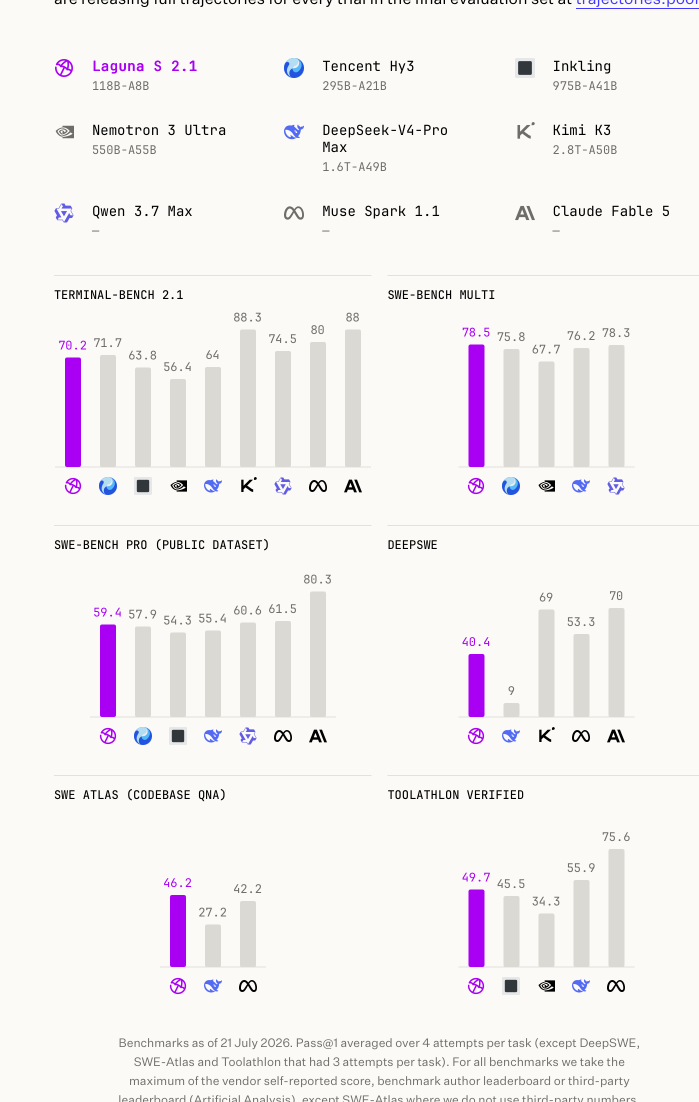
| Model | Size | Terminal-Bench 2.1 | SWE-bench Multilingual | SWE-Bench Pro (Public Dataset) | DeepSWE | SWE Atlas (Codebase QnA) | Toolathlon Verified |
|---|---|---|---|---|---|---|---|
| Laguna S 2.1 | 118B-A8B | 70.2% | 78.5% | 59.4% | 40.4% | 46.2% | 49.7% |
| Tencent Hy3 | 295B-A21B | 71.7% | 75.8% | 57.9% | - | - | - |
| Inkling | 975B-A41B | 63.8% | - | 54.3% | - | - | 45.5%* |
| Nemotron 3 Ultra | 550B-A55B | 56.4% | 67.7% | - | - | - | 34.3%* |
| DeepSeek-V4-Pro Max | 1.6T-A49B | 64.0%* | 76.2% | 55.4% | 9.0%* | 27.2%* | 55.9%* |
| Kimi K3 | 2800B-A50B | 88.3% | - | - | 69% | - | - |
| Qwen 3.7 Max | - | 74.5%* | 78.3% | 60.6% | - | - | - |
| Muse Spark 1.1 | - | 80% | - | 61.5% | 53.3% | 42.2%* | 75.6% |
| Claude Fable 5 | - | 88% | - | 80.3% | 70% | - | - |
Benchmarks as of 21 July 2026. Laguna S 2.1 in bold; a dash (-) marks a benchmark a model was not evaluated on. Scores marked * are as reported by third parties: Terminal-Bench 2.1 and DeepSWE via Artificial Analysis, SWE Atlas via Scale AI's official leaderboard, and Toolathlon Verified via its official leaderboard. Full evaluation trajectories: trajectories.poolside.ai.
This checkpoint ships configured for a 1,048,576-token (1M) context window. The weights are native 1M checkpoints: training included a long-context extension stage up to 1,048,576 tokens, and quantization was calibrated at the 1M configuration.
If you prefer to cap the context at 262,144 tokens (256K), edit config.json:
"rope_parameters": {
  "full_attention": {
    "factor": 32.0,
    "attention_factor": 1.3465735902799727
  }
},
"max_position_embeddings": 262144
At long context you may experience some quality degradation.
The sampling defaults in the checkpoint's generation_config.json are authoritative (top_k 20 is eval-certified truncation). Serve with those defaults rather than setting a separate temperature or top_p.
Laguna S 2.1-NVFP4 is supported in vLLM, Transformers, and TRT-LLM thanks to the support of the team at NVIDIA. NVFP4 does not currently run correctly on SGLang (see the SGLang note below). Use Laguna-S 2.1 with Ollama (with MLX support) or Llama.cpp (BF16 and Q4_K_M only) for the best results on your local machine.
Serving requires vLLM 0.25.0 or later. See the main Laguna S 2.1 model card for the full recipe.
The full vLLM recipe is on the main Laguna S 2.1 model card and on the vLLM recipes page. Quantization is detected automatically from quantization_config in this checkpoint, so the same command works with poolside/Laguna-S-2.1-NVFP4 substituted for the model ID. No extra flags required.
Optional: speculative decoding with DFlash. Pair with the quantization-matched draft model poolside/Laguna-S-2.1-DFlash-NVFP4 by adding
--speculative-config '{"model":"poolside/Laguna-S-2.1-DFlash-NVFP4","num_speculative_tokens":7,"method":"dflash"}'to the serve command.
Ollama is the quickest way to run Laguna S 2.1 on a single 128 GB box, whether that is an NVIDIA DGX Spark (GB10) or an Apple Silicon Mac Studio:
ollama run laguna-s-2.1
It pulls the Q4_K_M GGUF (about 75 GB) and runs on the GB10 GPU on the Spark or on Metal on the Mac, with no build step. We measured about 12.6 tokens/s on the Spark and 17.6 on Apple Silicon.
OLLAMA_LOAD_TIMEOUT=20m."think": false in the request to turn it off.laguna-s-2.1:q8_0 is about
128 GB (so a 192 GB Mac Studio) and laguna-s-2.1:f16 is about 235 GB (256 GB
or more). On the Spark's 128 GB, stick to Q4_K_M. Apple Silicon can also
run it through MLX.laguna branch of llama.cpp
serves the same GGUFs.Maximum performance on the DGX Spark (native NVFP4 + DFlash)
For the fastest setup on the Spark, serve this checkpoint with vLLM instead. That gives you the native NVFP4 kernels and DFlash speculative decoding.
One-time setup:
# Python headers: Triton JIT needs them and DGX OS ships without them.
# Without this, the first server start dies in triton/runtime/build.py.
sudo apt install -y python3.12-dev

curl -LsSf https://astral.sh/uv/install.sh | sh
uv venv ~/venvs/vllm025 -p 3.12

# vLLM 0.25.1 with CUDA-13 torch (aarch64 wheels are on PyPI)
uv pip install -p ~/venvs/vllm025 vllm==0.25.1 --torch-backend=cu130

# FlashInfer nightly trio: without flashinfer-python the NVFP4 path is not
# native; the jit-cache wheel avoids most first-start JIT compilation.
uv pip install -p ~/venvs/vllm025 \
  "flashinfer-python==0.6.15.dev20260712" \
  "flashinfer-cubin==0.6.15.dev20260712" \
  "flashinfer-jit-cache==0.6.15.dev20260712" \
  --extra-index-url https://flashinfer.ai/whl/nightly/ \
  --extra-index-url https://flashinfer.ai/whl/nightly/cu130/ \
  --index-strategy unsafe-best-match

hf download poolside/Laguna-S-2.1-NVFP4
hf download poolside/Laguna-S-2.1-DFlash-NVFP4   # 73 GB total
Serve:
export CUTE_DSL_ARCH=sm_121a          # arch string for FP4 kernel JIT
export PATH=/usr/local/cuda/bin:$PATH # nvcc for JIT
export MAX_JOBS=4                     # cap JIT fan-out; see warning below
source ~/venvs/vllm025/bin/activate

vllm serve poolside/Laguna-S-2.1-NVFP4 \
  --speculative-config '{"model":"poolside/Laguna-S-2.1-DFlash-NVFP4","num_speculative_tokens":7}' \
  --enable-auto-tool-choice \
  --tool-call-parser poolside_v1 \
  --reasoning-parser poolside_v1 \
  --max-num-seqs 32 \
  --max-model-len 262144 \
  --gpu-memory-utilization 0.85 \
  --host 0.0.0.0 --port 8000
sm_121. Do not set --linear-backend flashinfer_b12x on
0.25.1; the opt-in is broken there and it is slower anyway.generation_config.json (top_k 20
eval-certified truncation); serve with those defaults rather than overriding
them. Do not add min_p: vLLM rejects min_p and logit_bias under
speculative decoding, so putting it in the defaults returns a 400 on every
sampled request.--max-num-seqs 32 is required: DFlash crashes vLLM at the default of 256.Never drop
MAX_JOBS=4on a cold~/.cache/flashinfer. An uncapped nvcc fan-out can exhaust the 128 GB unified memory and take the whole machine down. A warm cache makes it a no-op, but the cache is cold again after any config or shape change.
Prefill runs 600-800 tok/s, decode is around 15 tok/s on prose and 22-24 on code, and DFlash accepts 2.9-3.1 tokens per step. At the 256K setting you get 830-870K KV tokens. Two requests at once roughly double total throughput. Without speculation, decode sits at 13-14 tok/s on every engine we tried on the GB10, which is the memory-bandwidth ceiling for this model. Speculation is how you get past it.
pool CLI against the box:
POOLSIDE_STANDALONE_BASE_URL=http://<spark-ip>:8000/v1 \
POOLSIDE_STANDALONE_MODEL=poolside/Laguna-S-2.1-NVFP4 \
POOLSIDE_STANDALONE_CONTEXT_LENGTH=262144 \
POOLSIDE_API_KEY=dummy pool
Use the box's IPv4 address rather than the .local mDNS name: Go's resolver can
pick the link-local IPv6 and fail with "no route to host". On macOS the terminal
app needs Local Network permission, and the system curl is exempt from that
check, so if curl works but pool does not, it is the permission and not the
network.
The Laguna S 2.1 architecture is supported in SGLang via sgl-project/sglang#24204. Quantization is detected automatically from quantization_config, so no extra flags are required. See the SGLang cookbook entry and the main Laguna S 2.1 model card for a serving recipe.
The full Transformers recipe is on the main Laguna S 2.1 model card. Substitute poolside/Laguna-S-2.1-NVFP4 for the model ID; quantization is detected automatically from quantization_config.
Laguna S 2.1 support ships in TensorRT-LLM >=1.3.0rc16; see the install recipe on the main Laguna S 2.1 model card. Substitute poolside/Laguna-S-2.1-NVFP4 for the model ID; quantization is detected automatically from quantization_config, no extra flags required.
from tensorrt_llm import LLM

llm = LLM(model="poolside/Laguna-S-2.1-NVFP4", trust_remote_code=True)
Available on the Ollama library.
Laguna S 2.1-NVFP4 uses the same reasoning controls (interleaved thinking, preserved reasoning, and the enable_thinking flag) as the base model. See the Controlling reasoning section of the main Laguna S 2.1 model card.
This model is licensed under the OpenMDW-1.1 License.
Laguna S 2.1-NVFP4 is designed for software engineering and agentic coding use cases, and you are responsible for confirming that it is appropriate for your intended application. Laguna S 2.1-NVFP4 is subject to the OpenMDW-1.1 License, and should be used consistently with Poolside's Acceptable Use Policy. We advise against circumventing Laguna S 2.1-NVFP4 safety guardrails without implementing substantially equivalent mitigations appropriate for your use case.
Please report security vulnerabilities or safety concerns to security@poolside.ai.