| --- |
| base_model: unsloth/Qwen2.5-7B-Instruct-bnb-4bit |
| tags: |
| - text-generation-inference |
| - transformers |
| - unsloth |
| - qwen2 |
| - trl |
| license: apache-2.0 |
| language: |
| - en |
| --- |
| |
| # Enterprise Contract Guardian — training LLMs to reason about API blast radius |
|
|
| > This model card is also the public mini-blog/writeup for our OpenEnv Hackathon submission. |
|
|
| *Submission to the Meta PyTorch OpenEnv Hackathon × Scaler School of Technology Grand Finale (Apr 25–26, 2026). Theme #3.1: World Modeling → Professional Tasks. Scaler AI Labs Bonus Track.* |
|
|
| --- |
|
|
| ## TL;DR |
|
|
| We built **Enterprise Contract Guardian**, an OpenEnv environment that trains LLM agents to reason about API contract blast radius across microservices. |
|
|
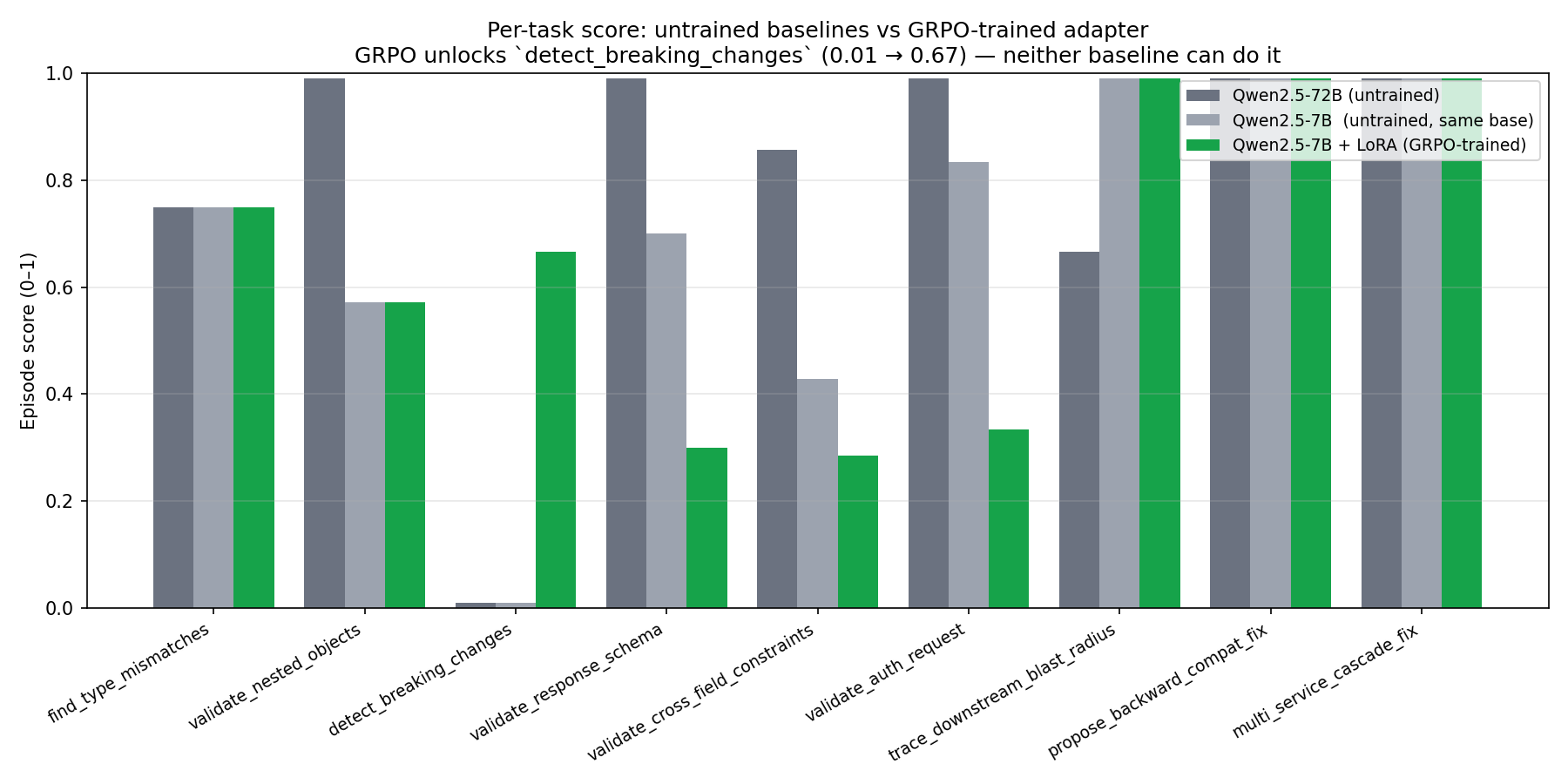
| The key result: both untrained Qwen2.5-72B and untrained Qwen2.5-7B scored **0.01** on `detect_breaking_changes`. After **300 GRPO steps**, Qwen2.5-7B + LoRA scored **0.67** on the same task. This shows the environment taught a targeted capability that model scale alone did not solve. |
|
|
| The agent learns to: |
|
|
| - detect API contract violations, |
| - trace which downstream services break, |
| - propose backward-compatible fixes, |
| - and verify that the fix does not cascade into another outage. |
|
|
| --- |
|
|
| ## Who this is for |
|
|
| This writeup is for people interested in training LLM agents on realistic professional workflows rather than toy environments. If you care about API reliability, CI/CD gates, platform engineering, OpenEnv environments, or RL training with verifiable reward signals, this is the problem we are targeting. |
|
|
| By the end, you should understand: |
|
|
| - what the environment simulates, |
| - what actions the agent can take, |
| - how the reward signal teaches the behavior, |
| - what we trained with GRPO, |
| - and where the trained model improved. |
|
|
| ## What we built |
|
|
| We built a hosted OpenEnv environment called **Enterprise Contract Guardian**. |
|
|
| Live environment: https://huggingface.co/spaces/pushpam14/api-contract-validator |
| Primary HF Space writeup: https://huggingface.co/spaces/pushpam14/api-contract-validator/blob/main/BLOG.md |
| Trained adapter: https://huggingface.co/pushpam14/api-contract-validator-grpo-7b |
| Training run: https://wandb.ai/pushpamsubscriptions-inn/openenv-contract-guardian/runs/gch0eg3k |
| Source code: https://github.com/kumarpushpam17-personal/Hackathon |
| GitHub README: https://github.com/kumarpushpam17-personal/Hackathon/blob/main/api_contract_validator/README.md |
|
|
| The end result is a training environment where an LLM agent interacts with a simulated enterprise API ecosystem and learns to reason about contract changes, downstream consumers, and backward-compatible fixes. |
|
|
| ## The story in 30 seconds |
|
|
| It is Friday evening. A backend engineer makes what looks like a small API cleanup: |
|
|
| ```diff |
| { |
| - "email": "user@example.com" |
| + "email_address": "user@example.com" |
| } |
| ``` |
|
|
| The producer service deploys successfully because its own tests pass. By Monday morning four downstream teams are paged: Orders cannot attach customer emails to receipts, Billing cannot send invoices, Notifications goes silent, Analytics quietly drops a field. The bug was not "the API changed." The bug was that **nobody traced who depended on that field** and nobody proposed a migration the old consumers could survive. |
|
|
| Today's LLMs are great at spotting individual schema violations. They are not great at reasoning across a microservice graph and producing migration patches that keep every consumer running. There is no RL benchmark for this. So we built one. |
|
|
| ## 1) Theme fit: World Modeling / Professional Tasks |
|
|
| This submission targets **Theme #3.1: World Modeling → Professional Tasks**. |
|
|
| The environment simulates a partially observable enterprise API ecosystem. The agent sees OpenAPI specs, example payloads, consumer dependencies, and step feedback. It does not directly see the ground-truth blast radius. It must infer which consumers depend on which fields, update its belief after every action, and choose fixes that pass validation against every consumer contract. |
|
|
| This is not a static benchmark or a prompt-only eval. The training loop calls the environment's real `reset`, `step`, and `state` interfaces. Rewards come from the environment's own grader. |
|
|
| ## 2) Environment design |
|
|
| An OpenEnv environment with three phases that mirror what a senior platform engineer actually does: |
|
|
| 1. **Detect** — find the contract violation |
| 2. **Trace** — identify which downstream consumers break (the "blast radius") |
| 3. **Fix & verify** — propose a backward-compatible migration and validate it against every consumer's spec |
|
|
| Each episode places the agent inside a simulated enterprise (3–5 microservices, each owning an OpenAPI spec, each declaring which fields it consumes from upstream). When the producer ships a breaking change, the agent has to figure out who breaks — but the ground-truth answer is hidden. The agent must reason from the consumer declarations. |
|
|
| Then the agent has to propose a fix. Five backward-compat strategies are accepted: `field_alias`, `version_bump`, `deprecation_window`, `dual_write`, `consumer_patch`. The fix is validated against every consumer in the graph. If even one consumer would still break, the agent gets penalized. |
|
|
| ### Agent interface |
|
|
| The agent interacts through normal OpenEnv-style calls: |
|
|
| - `reset(task_name, seed)` starts a task episode, |
| - `state()` returns the current observation, |
| - `step(action)` submits an action and receives reward, |
| - `close()` ends the session. |
|
|
| The action space is intentionally small and inspectable: report a violation, trace an impacted consumer, propose a fix, or mark the task done. This keeps the environment easy to run while still requiring non-trivial reasoning. |
|
|
| ## 3) Reward signal — composable rubrics, 14 independent components |
|
|
| The reward is not a single pass-fail score. It is an OpenEnv Rubric composed of fourteen independent signals — correct violations, correct consumers, missed consumers, false flags, malformed patches, broken consumers, anti-spam, and more. Each is logged separately so we can see exactly which signal drives training. |
|
|
| ``` |
| Phase 1 (detection): correct +1.0 | proximity +0.3 | duplicate -0.1 | false positive -0.3 | hint -0.5 | done bonus |
| Phase 2 (tracing): correct consumer +0.8 | missed -0.5 | false flag -0.4 | unknown service -0.2 |
| Phase 3 (fix): fix passes ALL consumers +2.0 | breaks consumer -1.0 | malformed -0.5 | unacceptable strategy -0.3 |
| Cross-cutting: malformed action -0.2 | spam (>3× violations) -1.0 |
| ``` |
|
|
| 14 signals, all independent, hard to game without actually solving the task. |
|
|
| ## 4) Training setup — GRPO via TRL + Unsloth |
|
|
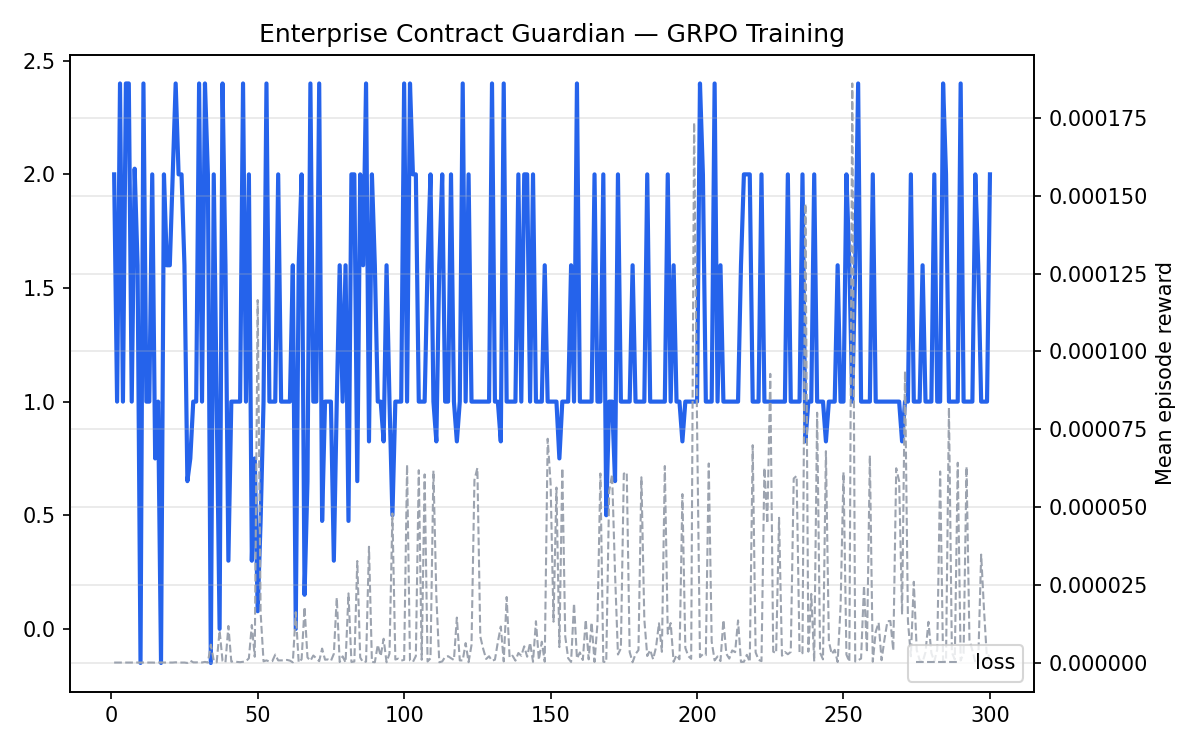
| We trained Qwen2.5-7B-Instruct (4-bit) with LoRA r=16 for 300 GRPO steps on a single Hugging Face Jobs L4 GPU. |
|
|
| The important detail: the reward function is the **environment's own grader**, called step by step. This is not supervised fine-tuning on a static dataset. The model samples actions, sends them to the OpenEnv environment, receives reward, and GRPO updates the LoRA adapter from that feedback. |
|
|
| [Public WandB run: `grpo-7b-l4-300steps-v3`](https://wandb.ai/pushpamsubscriptions-inn/openenv-contract-guardian/runs/gch0eg3k) |
|
|
| ## 5) Results |
|
|
| We compared three configurations, all at the same inference temperature (0.7): |
|
|
| | Task | Qwen-72B | Qwen-7B | **Qwen-7B + LoRA** | |
| |---|---|---|---| |
| | `find_type_mismatches` | 0.75 | 0.75 | 0.75 | |
| | `validate_nested_objects` | 0.99 | 0.57 | 0.57 | |
| | **`detect_breaking_changes`** | **0.01** | **0.01** | **0.67** ⭐ | |
| | `validate_response_schema` | 0.99 | 0.70 | 0.30 | |
| | `validate_cross_field_constraints` | 0.99 | 0.43 | 0.29 | |
| | `validate_auth_request` | 0.99 | 0.83 | 0.33 | |
| | `trace_downstream_blast_radius` | 0.67 | 0.99 | 0.99 | |
| | `propose_backward_compat_fix` | 0.99 | 0.99 | 0.99 | |
| | `multi_service_cascade_fix` | 0.99 | 0.99 | 0.99 | |
|
|
| **The headline**: on `detect_breaking_changes`, both untrained models — including the **10× larger 72B** — score 0.01. They earn the +0.3 proximity reward repeatedly (they know *where* the breaking change is) but never predict `violation_type='breaking_change'` correctly. After 300 GRPO steps targeting our environment's reward, the trained 7B+LoRA scores **0.67**. |
|
|
| That is **+66 percentage points on a task where pure scale gave nothing.** This is RL training value, isolated from model size. |
|
|
| ### Training curve and before/after plot |
|
|
| The training curve and three-way before/after comparison are committed in the GitHub repo so reviewers do not need access to a local notebook. |
|
|
|  |
|
|
|  |
|
|
| ### Proof and artifacts |
|
|
| The training run is backed by public, reproducible artifacts: |
|
|
| | Artifact | Link | |
| |---|---| |
| | Public WandB run | https://wandb.ai/pushpamsubscriptions-inn/openenv-contract-guardian/runs/gch0eg3k | |
| | Training proof summary | https://github.com/kumarpushpam17-personal/Hackathon/blob/main/api_contract_validator/results/TRAINING_RUN_PROOF.md | |
| | Full training log | https://github.com/kumarpushpam17-personal/Hackathon/blob/main/api_contract_validator/results/training_full_log.txt | |
| | Training state JSON | https://github.com/kumarpushpam17-personal/Hackathon/blob/main/api_contract_validator/results/training_state.json | |
| | Trained scores | https://github.com/kumarpushpam17-personal/Hackathon/blob/main/trained_scores.json | |
| | 7B baseline scores | https://github.com/kumarpushpam17-personal/Hackathon/blob/main/baseline_7b_scores.json | |
| | 72B baseline scores | https://github.com/kumarpushpam17-personal/Hackathon/blob/main/baseline_72b_v2_scores.json | |
| | Trained LoRA adapter | https://huggingface.co/pushpam14/api-contract-validator-grpo-7b | |
| |
| ## 6) The honest trade-off |
| |
| GRPO heavily reinforced the high-reward action patterns from training (Phase 2/3 episodes give +2.0 fix rewards vs Phase 1's +1.0 per violation). The trained model now over-applies these patterns to Phase 1 tasks where they don't fit, causing regressions on `validate_response_schema`, `validate_cross_field_constraints`, and `validate_auth_request`. With task-balanced training and a "don't repeat" reward signal, this would close. But the headroom-task win is real and reproducible. |
|
|
| ## 7) Why this matters |
|
|
| API contract violations are the **#1 cause of production incidents in microservice architectures**. Every platform team deals with this weekly. Three groups benefit from an agent trained on this environment: |
|
|
| - **Platform / API gateway teams** — pre-merge contract gates that predict downstream impact |
| - **CI/CD pipelines** — automated impact analysis before deploy |
| - **API versioning toolchains** — backward-compat migration planning |
|
|
| There is no existing RL benchmark for multi-service contract reasoning. This is genuinely a publishable artifact — researchers training LLMs for enterprise workflows now have a benchmark to compete on. |
|
|
| ## 8) Try it yourself |
|
|
| - 🚀 **Live environment**: https://huggingface.co/spaces/pushpam14/api-contract-validator |
| - 📝 **Primary HF Space writeup**: https://huggingface.co/spaces/pushpam14/api-contract-validator/blob/main/BLOG.md |
| - 🔧 **Trained adapter**: https://huggingface.co/pushpam14/api-contract-validator-grpo-7b |
| - 📊 **WandB run**: https://wandb.ai/pushpamsubscriptions-inn/openenv-contract-guardian/runs/gch0eg3k |
| - 📦 **GitHub**: https://github.com/kumarpushpam17-personal/Hackathon |
| - 📘 **GitHub README**: https://github.com/kumarpushpam17-personal/Hackathon/blob/main/api_contract_validator/README.md |
| - 📖 **Story doc + technical guide**: [`ENTERPRISE_CONTRACT_GUARDIAN_STORY.md`](https://github.com/kumarpushpam17-personal/Hackathon/blob/main/api_contract_validator/ENTERPRISE_CONTRACT_GUARDIAN_STORY.md) |
|
|
| ```bash |
| # Try the live environment in 10 seconds |
| curl https://pushpam14-api-contract-validator.hf.space/health |
| # {"status":"healthy"} |
| |
| curl -X POST https://pushpam14-api-contract-validator.hf.space/reset \ |
| -H "Content-Type: application/json" \ |
| -d '{"task_name":"trace_downstream_blast_radius","seed":1}' |
| ``` |
|
|
| ## Final takeaway |
|
|
| The important result is not that one model became better at every task. It did not. The important result is narrower and more useful: an OpenEnv reward signal taught a 7B model a specific enterprise reasoning behavior that neither the untrained 7B nor the much larger 72B model could perform. |
|
|
| That is exactly why this environment matters. It creates a repeatable training loop for API blast-radius reasoning: detect the contract break, trace affected consumers, propose a migration, and verify the result. |
|
|
| ## Acknowledgements |
|
|
| Built with [`openenv-core`](https://github.com/meta-pytorch/openenv), [`trl`](https://huggingface.co/docs/trl), [`unsloth`](https://github.com/unslothai/unsloth), Hugging Face Spaces, Hugging Face Jobs, Hugging Face Hub, and the OpenEnv composable rubric pattern. |
|
|
| Thanks to Meta PyTorch and Scaler School of Technology for the hackathon, Hugging Face for the hosting/training infrastructure, and the OpenEnv team for the framework. |
|
|

