


library_name: pytorch
license: bsd-3-clause
pipeline_tag: video-classification
tags:
  - backbone
  - android
ResNet-2Plus1D: Optimized for Mobile Deployment
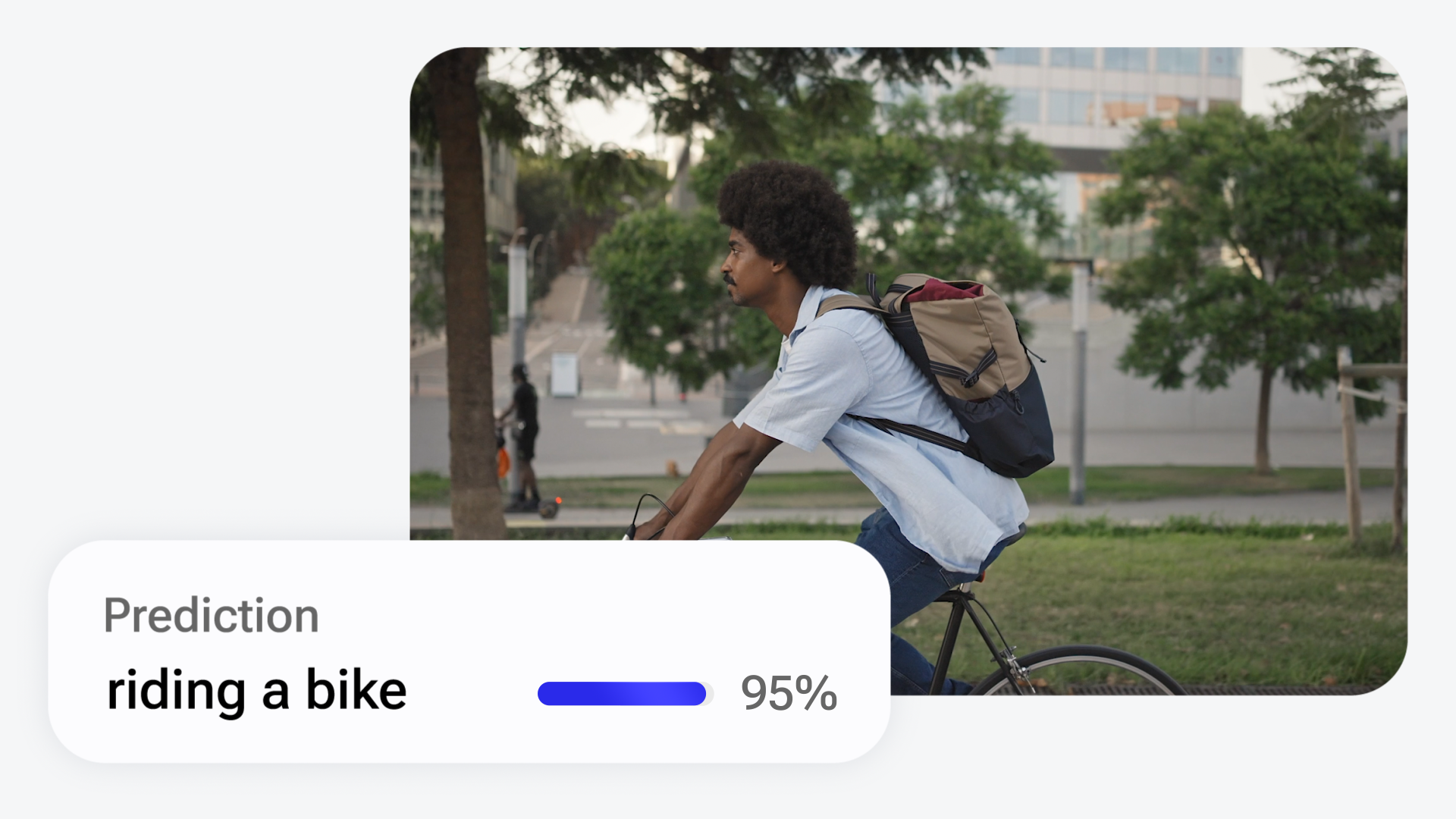
Sports and human action recognition in videos
ResNet (2+1)D Convolutions is a network which explicitly factorizes 3D convolution into two separate and successive operations, a 2D spatial convolution and a 1D temporal convolution. It used for video understanding applications.
This model is an implementation of ResNet-2Plus1D found here.
This repository provides scripts to run ResNet-2Plus1D on Qualcomm® devices. More details on model performance across various devices, can be found here.
Model Details
- Model Type: Video classification
- Model Stats:
- Model checkpoint: Kinetics-400
- Input resolution: 112x112
- Number of parameters: 31.5M
- Model size: 120 MB
| Model | Device | Chipset | Target Runtime | Inference Time (ms) | Peak Memory Range (MB) | Precision | Primary Compute Unit | Target Model |
|---|---|---|---|---|---|---|---|---|
| ResNet-2Plus1D | Samsung Galaxy S23 | Snapdragon® 8 Gen 2 | TFLITE | 116.337 ms | 4 - 601 MB | FP16 | NPU | ResNet-2Plus1D.tflite |
| ResNet-2Plus1D | Samsung Galaxy S23 | Snapdragon® 8 Gen 2 | ONNX | 14.065 ms | 0 - 200 MB | FP16 | NPU | ResNet-2Plus1D.onnx |
| ResNet-2Plus1D | Samsung Galaxy S24 | Snapdragon® 8 Gen 3 | TFLITE | 87.809 ms | 28 - 69 MB | FP16 | NPU | ResNet-2Plus1D.tflite |
| ResNet-2Plus1D | Samsung Galaxy S24 | Snapdragon® 8 Gen 3 | ONNX | 10.458 ms | 2 - 61 MB | FP16 | NPU | ResNet-2Plus1D.onnx |
| ResNet-2Plus1D | Snapdragon 8 Elite QRD | Snapdragon® 8 Elite | TFLITE | 104.072 ms | 27 - 64 MB | FP16 | NPU | ResNet-2Plus1D.tflite |
| ResNet-2Plus1D | Snapdragon 8 Elite QRD | Snapdragon® 8 Elite | ONNX | 10.015 ms | 2 - 59 MB | FP16 | NPU | ResNet-2Plus1D.onnx |
| ResNet-2Plus1D | QCS8550 (Proxy) | QCS8550 Proxy | TFLITE | 116.778 ms | 4 - 604 MB | FP16 | NPU | ResNet-2Plus1D.tflite |
| ResNet-2Plus1D | SA7255P ADP | SA7255P | TFLITE | 826.709 ms | 28 - 63 MB | FP16 | NPU | ResNet-2Plus1D.tflite |
| ResNet-2Plus1D | SA8255 (Proxy) | SA8255P Proxy | TFLITE | 115.504 ms | 4 - 604 MB | FP16 | NPU | ResNet-2Plus1D.tflite |
| ResNet-2Plus1D | SA8295P ADP | SA8295P | TFLITE | 143.259 ms | 28 - 66 MB | FP16 | NPU | ResNet-2Plus1D.tflite |
| ResNet-2Plus1D | SA8650 (Proxy) | SA8650P Proxy | TFLITE | 115.149 ms | 4 - 614 MB | FP16 | NPU | ResNet-2Plus1D.tflite |
| ResNet-2Plus1D | SA8775P ADP | SA8775P | TFLITE | 156.336 ms | 28 - 63 MB | FP16 | NPU | ResNet-2Plus1D.tflite |
| ResNet-2Plus1D | QCS8450 (Proxy) | QCS8450 Proxy | TFLITE | 127.438 ms | 28 - 69 MB | FP16 | NPU | ResNet-2Plus1D.tflite |
Installation
This model can be installed as a Python package via pip.
pip install "qai-hub-models[resnet_2plus1d]"
Configure Qualcomm® AI Hub to run this model on a cloud-hosted device
Sign-in to Qualcomm® AI Hub with your
Qualcomm® ID. Once signed in navigate to Account -> Settings -> API Token.
With this API token, you can configure your client to run models on the cloud hosted devices.
qai-hub configure --api_token API_TOKEN
Navigate to docs for more information.
Demo off target
The package contains a simple end-to-end demo that downloads pre-trained weights and runs this model on a sample input.
python -m qai_hub_models.models.resnet_2plus1d.demo
The above demo runs a reference implementation of pre-processing, model inference, and post processing.
NOTE: If you want running in a Jupyter Notebook or Google Colab like environment, please add the following to your cell (instead of the above).
%run -m qai_hub_models.models.resnet_2plus1d.demo
Run model on a cloud-hosted device
In addition to the demo, you can also run the model on a cloud-hosted Qualcomm® device. This script does the following:
- Performance check on-device on a cloud-hosted device
- Downloads compiled assets that can be deployed on-device for Android.
- Accuracy check between PyTorch and on-device outputs.
python -m qai_hub_models.models.resnet_2plus1d.export
Profiling Results
------------------------------------------------------------
ResNet-2Plus1D
Device                          : Samsung Galaxy S23 (13)
Runtime                         : TFLITE
Estimated inference time (ms)   : 116.3
Estimated peak memory usage (MB): [4, 601]
Total # Ops                     : 92
Compute Unit(s)                 : NPU (84 ops) CPU (8 ops)
How does this work?
This export script leverages Qualcomm® AI Hub to optimize, validate, and deploy this model on-device. Lets go through each step below in detail:
Step 1: Compile model for on-device deployment
To compile a PyTorch model for on-device deployment, we first trace the model
in memory using the jit.trace and then call the submit_compile_job API.
import torch

import qai_hub as hub
from qai_hub_models.models.resnet_2plus1d import Model

# Load the model
torch_model = Model.from_pretrained()

# Device
device = hub.Device("Samsung Galaxy S23")

# Trace model
input_shape = torch_model.get_input_spec()
sample_inputs = torch_model.sample_inputs()

pt_model = torch.jit.trace(torch_model, [torch.tensor(data[0]) for _, data in sample_inputs.items()])

# Compile model on a specific device
compile_job = hub.submit_compile_job(
    model=pt_model,
    device=device,
    input_specs=torch_model.get_input_spec(),
)

# Get target model to run on-device
target_model = compile_job.get_target_model()
Step 2: Performance profiling on cloud-hosted device
After compiling models from step 1. Models can be profiled model on-device using the
target_model. Note that this scripts runs the model on a device automatically
provisioned in the cloud. Once the job is submitted, you can navigate to a
provided job URL to view a variety of on-device performance metrics.
profile_job = hub.submit_profile_job(
    model=target_model,
    device=device,
)
Step 3: Verify on-device accuracy
To verify the accuracy of the model on-device, you can run on-device inference on sample input data on the same cloud hosted device.
input_data = torch_model.sample_inputs()
inference_job = hub.submit_inference_job(
    model=target_model,
    device=device,
    inputs=input_data,
)
    on_device_output = inference_job.download_output_data()
With the output of the model, you can compute like PSNR, relative errors or spot check the output with expected output.
Note: This on-device profiling and inference requires access to Qualcomm® AI Hub. Sign up for access.
Deploying compiled model to Android
The models can be deployed using multiple runtimes:
TensorFlow Lite (
.tfliteexport): This tutorial provides a guide to deploy the .tflite model in an Android application.QNN (
.soexport ): This sample app provides instructions on how to use the.soshared library in an Android application.
View on Qualcomm® AI Hub
Get more details on ResNet-2Plus1D's performance across various devices here. Explore all available models on Qualcomm® AI Hub
License
- The license for the original implementation of ResNet-2Plus1D can be found here.
- The license for the compiled assets for on-device deployment can be found here
References
Community
- Join our AI Hub Slack community to collaborate, post questions and learn more about on-device AI.
- For questions or feedback please reach out to us.