

license: mit
language:
  - en
pipeline_tag: text-generation
tags:
  - causal-lm
  - pytorch
  - small-language-model
  - autoresearch
  - from-scratch
datasets:
  - multivision
AutoResearch-multivision-depth8
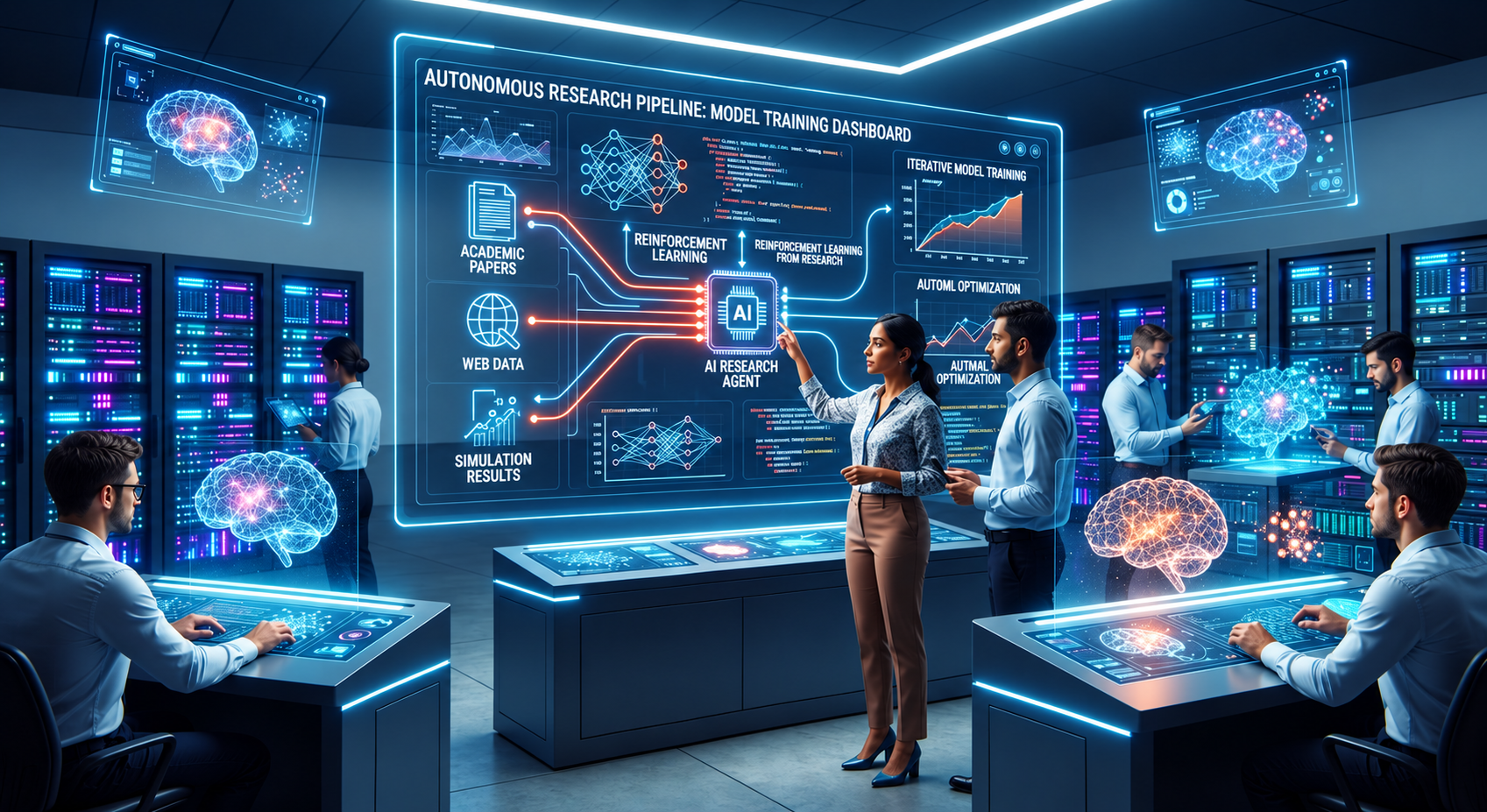
AutoResearch-multivision-depth8 is a 77.6M parameter decoder-only Transformer trained from scratch on multivision.
This model is part of the AutoResearch project, which focuses on training, evaluating, and releasing efficient language models with reproducible research workflows.
Overview
This is a 8-layer decoder-only Transformer trained on the multivision dataset for 1.0 hours of wall-clock training time. The model achieves a validation bits-per-byte (val_bpb) of 1.279732 (perplexity: 2.4279) on the held-out validation set.
References
Papers
- NanoGPT / NanoChat architecture patterns
Datasets
- Training: multivision
- Tokenizer: multivision
Related Projects
WANDB Run
Highlights
- Trained from scratch
- 77.6M parameters
- Trained on 112.7M tokens (215 steps)
- 8-layer decoder-only Transformer with sliding window attention
- RoPE positional encoding, RMSNorm, ReLU² activation
- MuonAdamW optimizer (Muon for matrices, AdamW for embeddings)
- Hugging Face Transformers compatible
Model Architecture
| Property | Value |
|---|---|
| Architecture | Decoder-only Transformer |
| Parameters | 77,575,312 (77.6M) |
| Layers | 8 |
| Hidden Size | 512 |
| Attention Heads | 4 |
| KV Heads | 4 |
| Head Dimension | 128 |
| Feed Forward Size | 2048 |
| Context Length | 2048 |
| Vocabulary Size | 16,384 |
| Positional Encoding | RoPE |
| Activation | ReLU² |
| Normalization | RMSNorm |
| Window Pattern | SSSL |
| Weight Tying | No |
Training
This model was trained from scratch for 1.0 hours (3613s) of wall-clock training time.
Training Configuration
| Setting | Value |
|---|---|
| Optimizer | MuonAdamW (Muon + AdamW) |
| Precision | torch.bfloat16 |
| Learning Rate | 0.04 (matrix) / 0.6 (embedding) |
| Weight Decay | 0.2 |
| Batch Size | 4 × 2048 = 8,192 tokens/step |
| Gradient Accumulation | 64 steps |
| Total Batch Size | 524,288 tokens |
| Context Length | 2048 |
| Vocabulary | 16,384 tokens (BPE) |
| LR Scheduler | Linear warmdown (50%) |
| Activation Checkpointing | Enabled |
Hardware
- GPU: NVIDIA GeForce RTX 4060 Ti
- VRAM: 16.0 GB
- Peak VRAM Used: 3.7 GB
- MFU: 9.31%
- Framework: PyTorch 2.9.1+cu128
Dataset
- Name: multivision
- Language: English
Preprocessing
Data is packed into fixed-length sequences of 2048 tokens using the nanochat-compatible BPE tokenizer (16,384 vocabulary, 9 special tokens). No additional filtering or deduplication is applied beyond what is in the source dataset.
Intended Use
This model is intended for:
- Educational purposes and research
- Text generation experiments
- Studying small language model training dynamics
Not recommended for:
- Production use or safety-critical applications
- Tasks requiring factual accuracy
Evaluation
Results
| Metric | Score |
|---|---|
| Validation BPB | 1.279732 |
| Perplexity | 2.4279 |
| Peak VRAM | 3.7 GB |
| MFU | 9.31% |
Example Generations
Example 1
Prompt
Once upon a time,
Generation
Once upon a time,,,,,,,,,,,,,,,,,,,,,,,,,,,,,,,,,,,,,,,,,,,,,,,,,,,
Example 2
Prompt
A lonely dragon
Generation
A lonely dragon dragon dragon dragon dragon
Example 3
Prompt
The opposite of boy is
Generation
The opposite of boy is is is is is. with is is as in all as as it is and is not the D is also is in the AAAAAAAAAAAAAAAAAAAAAAAAA
Example 4
Prompt
The opposite of queen is
Generation
The opposite of queen is..................................................
Example 5
Prompt
My name is
Generation
My name is called called by by by by by by by by by by by by by by by by by by by by by by by by by by by by by by by by by by by by by by by by by by by by by by by by
Usage
import torch
import pickle
import json
from train import GPT, GPTConfig, Tokenizer

# Load config
with open('config.json', 'r') as f:
    config_dict = json.load(f)
config = GPTConfig(**{k: v for k, v in config_dict.items() if k in GPTConfig.__dataclass_fields__})

# Load model
model = GPT(config)
state_dict = torch.load('model.pt', map_location='cpu')['state_dict']
model.load_state_dict(state_dict)
model.eval()

# Load tokenizer
with open('tokenizer.pkl', 'rb') as f:
    tokenizer = pickle.load(f)

# Generate
prompt = 'Once upon a time, '
input_ids = tokenizer.encode(prompt)
x = torch.tensor([input_ids], dtype=torch.long)
with torch.no_grad():
    for _ in range(50):
        logits = model(x)
        probs = torch.softmax(logits[:, -1, :] / 0.8, dim=-1)
        next_token = torch.multinomial(probs, num_samples=1)
        input_ids.append(next_token.item())
        x = torch.tensor([input_ids], dtype=torch.long)
print(tokenizer.decode(input_ids))
Repository Structure
model.pt                  # Model weights
config.json               # Model architecture config
dataset.txt               # Dataset name used for training
token_bytes.pt            # Token byte mappings
tokenizer.pkl             # Trained BPE tokenizer
tokenizer_config.json     # Tokenizer configuration
training_metrics.json     # Training metrics
README.md                 # This file
Limitations
- Small model size limits language understanding and coherence
- Trained on a single dataset (TinyStories) — limited domain
- Fixed time budget training — not fully trained to convergence
- No RLHF or safety alignment
Ethical Considerations
- This is a research artifact, not a production model
- The training data consists of synthetic stories (GPT-4 generated)
- No harmful content filtering was applied
- Intended for research and educational use only
Citation
@misc{autoresearch_multivision_depth8,
  title={AutoResearch-multivision-depth8},
  author={Dustin Loring},
  year={2026},
  howpublished={\url{https://huggingface.co/quik-models/fiery-sun-121}}
}}
Version History
| Version | Date | Notes |
|---|---|---|
| v1.0 | 2026-07-30 | Initial release |
Acknowledgements
Built with the AutoResearch training framework.
Thanks to:
- Hugging Face
- PyTorch
- The creators of the TinyStories dataset
- The open-source AI research community
License
This model is released under the MIT License unless otherwise specified.