| --- |
| license: mit |
| tags: |
| - comfyui |
| - comfyui-nodes |
| - custom-nodes |
| - video |
| - video-generation |
| - text-to-video |
| - image-to-video |
| - minimax-h3 |
| --- |
| |
| # Hand Tie Clips |
|
|
| One node. Write a shot plan, drop in your reference stills, queue. |
|
|
|  |
|
|
| *Six consecutive frames spanning the join between hop 1 and hop 2. One of these |
| is the last frame the first generation produced and the next is the first frame |
| of a second, separate generation. The pack exists so that you cannot tell which.* |
|
|
| > **Renamed 2026-08-29.** This pack was `ComfyUI-H3-Ref-Chain`. The nodes now |
| > live under the **Hand Tie Clips** category and register as `HandTieClips`, |
| > `HTCChainPreview`, `HTCToneCompensate` and `HTCContinuityState`. The old ids |
| > are still registered as deprecated aliases, so **every workflow saved before |
| > the rename keeps loading** — they are just hidden from node search. Nothing |
| > needs migrating. |
|
|
| > **0.4.1 — 2026-08-30.** The 0.4.0 feature set was built without a browser or a |
| > GPU and verified offline only. It has now been run in ComfyUI, and two things |
| > were broken: the five new dials were never added to the run panel's widget list |
| > (they worked, but rendered as raw dials on the node body), and a dry run |
| > returned a 1×1 placeholder image that **libx264 cannot encode** — so every dry |
| > run wired to `SaveVideo`, which is what the Starter ships, died in |
| > `avcodec_open2`. Both fixed. The Starter now also ships the seam report wired. |
| > Measurements are in [`docs/DEVLOG.md`](docs/DEVLOG.md) section 21. |
| |
| > **0.4.4 — 2026-08-30.** Two local models were given `prompt_pack/SYSTEM_PROMPT.md` |
| > and the same scene, and both made the same two mistakes — so both were the |
| > prompt's fault, not theirs. The register example had no place tag in it, so |
| > each model invented its own convention (`kitchen_plate`) while leaving |
| > `@kitchen` in the beat, and the run stopped on an unknown reference. One model |
| > also wrote `"name": "@cook_face"` into `subjects`, which parsed, rendered, and |
| > quietly put a literal at-sign in front of the text encoder on every |
| > continuation hop. The prompt now shows a place tag on both sides of the round |
| > trip and says the two spellings are one string; `refs.py` now rejects an |
| > `@tag` in `name`, `locked` or `context` instead of encoding it. The RUN panel |
| > also has its tooltips back — it read them from `widget.options`, where this |
| > frontend does not keep them. Section 22 of the devlog has the A/B. |
| |
| > **0.4.5 — 2026-08-30.** The hop cache no longer needs `ffmpeg` on PATH. It |
| > used to shell out to an ffmpeg binary to write its lossless FFV1, so the |
| > feature that makes a tone A/B cost 14 seconds instead of 164 raised a |
| > `RuntimeError` for anyone who did not happen to have ffmpeg installed — |
| > which ComfyUI itself never requires. It now encodes in process through PyAV, |
| > which ComfyUI already depends on. **The format is unchanged** (ffv1 / |
| > `rgb48le` / level 3), verified bit-exact in both directions, so caches |
| > written by the old path still read and a resumed chain still matches an |
| > uninterrupted one. This also clears the Comfy registry's security scan, |
| > which flags every `subprocess` call in a custom node regardless of how it is |
| > invoked. Section 23 of the devlog. |
| |
| **Writing for it:** [PROMPTING.md](PROMPTING.md) is the authoring guide — the rules that come from what this model actually does, not from taste. [prompt_pack/](prompt_pack/) has a copy-paste prompt that gets a language model to write plans for you. |
| |
| Each hop is native **MiniMax H3 Reference-to-Video**. Hops after the first are guided by the **previous hop's sampler AV latent** via `ComfyUI-H3-Motion-Context` when that pack is installed (22 picture frames + 24-frame end-aligned audio). Stock `MiniMaxH3AddGuide` is the fallback when Motion-Context is missing or the previous hop was a pixel cache hit. Voice stays as a reference every hop. Identity stills ride hop 1; later hops use the pin for wardrobe and room unless a ref lists those hops in `shots`. A 5 s hop drops the airlock on a continuous join — validate seams at 8 s or 15 s. |
| |
| This is not the seamless-chain pack. No airlock script, no Motion-Context, no interior patch. |
| |
| ## What v1.0 changed |
| |
| The prompt is no longer a wall of `---`-delimited text, and the MODEL wire is no longer four extra nodes. |
| |
| | | | |
| |---|---| |
| | **`shot_plan`** | The script, as JSON. One shot per hop — **the shot count is the hop count**, so `chains` can no longer disagree with it. | |
| | **`directives`** | `join` / `camera` / `framing` / `pace` / `tail` per shot, compiled to vetted prose. Improving a phrase improves every plan you have ever written. | |
| | **`ref_plan`** | Stable `@tags` for reference stills, grouped into subjects, each naming a picture file. Removing one can no longer silently renumber `<Picture N>`. | |
| | **`cache_hops`** | Lossless per-hop cache. Re-roll one shot, resume after a crash, and hold roughly one hop in RAM instead of the whole clip. Edit hop 5 of 8 and only 5-8 re-render. [How to use it](PROMPTING.md#re-rolling-one-hop). | |
| | **the editor** | Cards on the node, not JSON in a textarea. Hover any directive to read the exact sentence it puts in the prompt, or hit **Templates** for a ready-made pattern. | |
| |
| Simple mode keeps the old one-prompt workflow; the speed stack (LoRAs, AdaLN fix, low-VRAM, SLA) stays as four ordinary nodes on the MODEL wire, where you can see it. |
| |
| ## Install |
| |
| ### Clone it (recommended) |
| |
| From your `ComfyUI/custom_nodes/` folder: |
|
|
| ``` |
| cd ComfyUI/custom_nodes |
| git clone https://github.com/dntpi/ComfyUI-Hand-Tie-Clips.git |
| ``` |
|
|
| Or from HuggingFace, if that is where you found it -- the two are mirrors of the same repository and either is fine: |
|
|
| ``` |
| git clone https://huggingface.co/sandpies/ComfyUI-Hand-Tie-Clips |
| ``` |
|
|
| Cloning creates the folder at the right depth for you, which is the mistake the zip route invites. **Updating later is then one command** from inside the pack folder: |
|
|
| ``` |
| git pull |
| ``` |
|
|
| followed by a restart of ComfyUI. No re-downloading, and you can see exactly what changed with `git log`. |
|
|
| ### Or unzip it |
|
|
| Unzip the folder into `ComfyUI/custom_nodes/`, so that it lands as: |
|
|
| ``` |
| ComfyUI/custom_nodes/ComfyUI-Hand-Tie-Clips/ |
| __init__.py |
| h3_ref_chain.py |
| js/ |
| workflows/ |
| ``` |
|
|
| One folder level too deep (`custom_nodes/ComfyUI-Hand-Tie-Clips/ComfyUI-Hand-Tie-Clips/`) is the usual mistake, and the pack simply will not appear. |
|
|
| ### Either way |
|
|
| No dependencies to install. Everything it imports -- `torch`, `numpy`, `PIL`, `av`, `aiohttp` -- already ships with ComfyUI, which is why `dependencies` in `pyproject.toml` is empty. |
|
|
| Then: |
|
|
| 1. **Restart ComfyUI.** Python changed. |
| 2. **Hard-refresh the browser** (Ctrl+Shift+R / Cmd+Shift+R). The editor is served from `/extensions/ComfyUI-Hand-Tie-Clips/`, and a stale cache is the single most common reason the node mounts with no UI on a fresh install. |
|
|
| It is installed correctly when all three are true: |
|
|
| - the startup log carries a line beginning `[HandTieClips]` |
| - the browser console says `[HandTieClips] editor ui v1.5.0 loaded` |
| - node search shows a **Hand Tie Clips** category with four nodes, each listed once |
|
|
| Workflows saved before the 2026-08-29 rename keep loading: the old ids are still registered as deprecated aliases. Nothing needs migrating. |
|
|
| The two example graphs are in `workflows/` inside the pack folder -- open them with the **Workflow > Open** menu, or copy them into `ComfyUI/user/default/workflows/` to have them in the sidebar. Start with `HandTieClips_Starter.json`; it ships with no references on purpose, so it runs before you have supplied any pictures. |
|
|
| ## Needs |
|
|
| - ComfyUI new enough to include **Add Guide for MiniMax H3** (`MiniMaxH3AddGuide`) |
| - A **ref2va** (or hybrid ref2va) checkpoint — fl2va has no reference rows |
| - Video VAE + audio VAE + MiniMax text encoder |
| - **Optional but recommended:** [ComfyUI-H3-Motion-Context](https://github.com/NikoDemon80/ComfyUI-H3-Motion-Context). Hops after the first are guided by the previous hop's sampler AV latent through it. Without it the node falls back to stock `MiniMaxH3AddGuide`, which still works and still chains -- it is a different join, so a seam you are comparing against someone else's render may not be the same code path. The node detects it at runtime and prints which one it took. |
|
|
| The two shipped workflows wire the **turbo stack** this node is actually run with, because an example without it is not the graph anyone uses: |
|
|
| ``` |
| UNETLoader -> LoRA Loader Stack -> H3 AdaLN LoRA Fix -> MiniMax H3 Low VRAM |
| -> H3 SLA Attention -> Model Preview Override -> Hand Tie Clips |
| ``` |
|
|
| | pack | nodes | |
| |---|---| |
| | [ComfyUI-PlagueKind-Nodes](https://github.com/PlagueKind/ComfyUI-PlagueKind-Nodes) | LoRA Loader Stack, H3 AdaLN LoRA Fix, H3 SLA Attention | |
| | [ComfyUI-KJNodes](https://github.com/kijai/ComfyUI-KJNodes) | MiniMax H3 Low VRAM Attention (experimental), Model Preview Override | |
|
|
| On disk as well: the **turbo LoRA** named in the loader stack, and `taeh3.safetensors` for the live preview (or set `tiny_vae` to `none`). |
|
|
| Both shipped workflows are saved pointing at the exact files they were rendered with. These are quantised builds and are **not** the only ones that work -- any ref2va or hybrid ref2va set will do. Repoint the loaders at what you have; a loader showing an empty or red filename is naming a file you do not have, not a broken workflow. |
|
|
| | loader | file the example names | |
| |---|---| |
| | `UNETLoader` | `minimax_h3_hybrid_fl2va_ref2va_b30-49-int8.safetensors` | |
| | `CLIPLoader` | `qwen3vl_32b_minimax_h3_int8_convrot.safetensors` | |
| | `VAELoader` (video) | `minimax_h3_video_vae_int8_convrot.safetensors` | |
| | `VAELoader` (audio) | `minimax_h3_audio_vae_fp32.safetensors` | |
| | LoRA Loader Stack | `minimax_h3_ref2v_turbo_4step_v0.1_comfyui_bf16.safetensors` | |
| | `tiny_vae` | `taeh3.safetensors` (or `none`) | |
|
|
| **CLIP reaches the node from the LoRA loader, not from the encoder** — that is what makes the text half of every LoRA land. Do not rewire it back. |
|
|
| None of it is required by the node itself. Missing a pack, its nodes load as red boxes: delete them, wire the loader straight into `model` and the encoder into `clip`, and raise `steps` from 7 to around 20. |
|
|
| ## Use |
|
|
| 1. Restart ComfyUI and load **`workflows/HandTieClips_Starter.json`** — two hops, no references, runs as soon as the loaders are pointed at your files. It carries a six-card **READ ME** board on its own canvas, to the left of the loaders: the three laws, the directive table, the reference rules and the failure table, where you need them rather than in another file. `workflows/HandTieClips_Showcase.json` is the six-hop version and needs three pictures of your own. Both carry the turbo stack listed above. |
| 2. Point the loaders at your ref2va DiT, encoder, and both VAEs |
| 3. Add a row per identity still in the **REFERENCES** rail, then **drop a picture onto its thumbnail** (or click to browse, or pick one already uploaded). Give it a `@tag` and group photos of the same person under one subject number. There are no `Load Image` nodes to wire — files land in `ComfyUI/input/h3_refs`. |
| 4. In **SHOTS**, write one card per hop. Shot 1 is the whole opening; every later card is only the new beat. |
| 5. Optional: a `voice_file`, a `start_image_file`, a look `reference_video_file` — all picked in the **MEDIA** strip, all files under `input/h3_refs` |
| 6. Queue, and wire the **`info`** output to a Preview Text node — it prints the fully assembled prompt for every hop |
|
|
| Keep later-hop beats on **what happens next**. Do not re-describe the face; the photos, the register and the pin already carry it. |
|
|
| Two modes: |
|
|
| - **Simple** — one prompt box and a hop count, the way it always worked. Later hops advance the same action rather than replaying the opening. |
| - **Shots** — one card per hop with directives. Switching from Simple carries your prompt over and splits it on `---`. |
|
|
| Only one of them is on screen at a time, so there is never a text box quietly doing nothing. |
|
|
| Under the script sits **RUN**, collapsed, holding everything that is not per-shot: output size and length, sampling, the join and pin controls, and the hop cache. Its title line summarises the run — `1.0 MP 16:9 · 10s ×3 · 14 steps res_multistep · cache off` — so you can read the setup without opening it. In Shots mode `chains` and `hop_script` are not offered there, because the shot list already decides both. |
|
|
| **`tone_compensate`** lives in that panel's *join & pin* group. The H3 denoiser biases each hop's tone, so a chain gets steadily brighter; this measures the bias on the overlap each hop regenerated and undoes it, correcting each hop against the previous **corrected** one so the whole chain lands on hop 1's tone. `frame_shift` is the mode to reach for: all three modes remove the drift equally well (within 0.4/255 of each other), but `gain_bias` and `lut` pair pixels between a frame and its *regeneration*, which fits a slope that is not really there and flattens contrast a little more with every hop. `frame_shift` uses frame averages only, so it can shift but never distort. **Measured on a 3-hop render: chain drift 5.6/255 without it, 0.3/255 with it.** Worth turning on for anything past two hops. It ships off because enabling it also clamps the master to 0..1, and because the correction grows with hop count — by hop 10 it is subtracting ~23/255 and will start crushing blacks. Switching modes never invalidates the hop cache, so it is free to A/B. Do **not** judge it by whether the seams flatten to zero: real scene brightness changes across a cut should survive, and they do. |
|
|
| ## Shot plan |
|
|
| The cards write this; you rarely see it. It is under **JSON** on the node if you want to copy a plan between workflows. |
|
|
| ```json |
| { |
| "shots": [ |
| { |
| "beat": "The cook stands at the counter, looks up, and speaks one short line.", |
| "directives": {"camera": "hold", "framing": "medium", "pace": "steady", "tail": "ongoing"} |
| }, |
| { |
| "beat": "The cook sets the knife down and turns toward the window, still talking.", |
| "directives": {"join": "continuous", "camera": "push_in", "framing": "close"} |
| } |
| ] |
| } |
| ``` |
|
|
| Shot 1 is the whole opening. Every later shot is **only the new beat** — the node supplies the identity lock, the live-frame citation and the join itself. |
|
|
| Fields, all optional except `beat`: |
|
|
| | | | |
| |---|---| |
| | `beat` | What happens this hop. | |
| | `directives` | The five axes below. | |
| | `prose` | Free text appended verbatim, for anything the vocabulary lacks. | |
| | `seed`, `steps`, `duration` | Per-shot overrides. `duration` takes the same labels as the widget (`"8 s"`). | |
| | `locked` | Reuse this shot's cached render even when its inputs changed -- freeze a take you like while you rewrite the hops around it. Needs `cache_hops=on`, and give the shot an `id`. Not to be confused with `subjects.N.locked`, which is identity text. | |
| | `id` | Stable name, used as the cache pointer. Generated if absent. | |
|
|
| ### Directives |
|
|
| | axis | options | |
| |---|---| |
| | `join` | `continuous`, `match_cut`, `hard_cut` — ignored on shot 1, which has nothing to join to | |
| | `camera` | `hold`, `pan_follow`, `push_in`, `pull_back`, `orbit`, `handheld` | |
| | `framing` | `keep`, `wide`, `medium`, `close` | |
| | `pace` | `slow`, `steady`, `brisk` | |
| | `tail` | `ongoing` (default), `settle`, `hold` | |
|
|
| An unset axis emits nothing rather than asserting a default, so it costs no tokens. |
|
|
| **Everything is phrased affirmatively, on purpose.** Sampling runs at cfg 1.0 with no negative branch, so every concept named is additive — "no cut" puts the word `cut` in front of the encoder. If you add prose of your own, say what the shot *is* doing. |
|
|
| `join=continuous` together with a framing change and a held camera will warn: with the camera still, the only way to reach a new framing is a cut, so the two are asking for opposite things. Use `push_in` / `pull_back` / `pan_follow` to earn the framing on the move, or `framing: keep`. |
|
|
| A camera move that points the opposite way from the framing (`push_in` with `wide`, `pull_back` with `close`) warns too -- those are physically contradictory whatever the join. |
|
|
| When `join=continuous` and the camera *is* moving, the framing sentence is compiled as a **landing** ("The move settles into a close shot...") rather than as the shot's opening state, so it does not fight the pin that still holds the previous framing. |
|
|
| ## Writing beats |
|
|
| > The full authoring guide, including how to have a model write plans for you, is **[PROMPTING.md](PROMPTING.md)**. What follows is the short version. |
|
|
| Sampling runs at cfg 1.0 with no negative branch, so **the prompt is additive: |
| anything you name is added, and nothing can be removed by mentioning it.** Three |
| rules follow, each confirmed against renders rather than reasoned from the code. |
|
|
| **Point the action line at the reference you want used.** Describing a reference |
| in the register is not enough -- the beat is what drives the frame. Write the tag |
| into the action: |
|
|
| ``` |
| The cook stands at the counter in @kitchen, looks up from the chopping board, |
| and speaks one short line to someone off-frame. |
| ``` |
|
|
| `@kitchen` resolves to the right `<Picture N>` on every hop it is active, so |
| rewiring references never breaks the text. Phrase it as a place that is depicted, |
| not as a container to be placed inside -- otherwise you can get a literal |
| composite of the photograph. |
|
|
| **Never name the thing you want to end.** `The cook stops talking` keeps her |
| talking. Describe the state you want as a pose plus a sound: |
|
|
| ``` |
| The cook leans back against the counter with her lips closed, and lets her eyes |
| move slowly across the room. The kitchen is quiet apart from the hum of the |
| refrigerator and faint street noise through the window. |
| ``` |
|
|
| H3 generates audio for the whole hop no matter what, so silence must be written |
| as a sound -- room tone, a fridge, traffic. Written as an absence, you get speech. |
|
|
| **Put a state change at the end of the previous shot.** Every hop after the first |
| opens by holding the frames it was handed, and the audio pin carries the tail of |
| the previous hop across the join. If shot 2 ends mid-sentence, no wording in shot |
| 3 will make it start quiet. Finish the line where it actually finishes: |
|
|
| ``` |
| shot 2: The cook sets the knife down, turns toward the window, and finishes her |
| last word as she looks out. |
| shot 3: The cook leans back against the counter with her lips closed... |
| ``` |
|
|
| To be silent, still, or somewhere else in a shot, arrive there before the |
| previous shot ends. |
|
|
| **Pick ambience that is narrowband and specific.** After the first shot, official |
| soundscape fields are stripped and ambience is plain prose, so the exact words |
| matter. "faint street noise through the window" is broadband and renders as a |
| five-second hiss; "the low hum of the refrigerator" does not. If a continuous bed |
| still misbehaves, name a single discrete event instead -- "a single click from the |
| refrigerator, then stillness". |
|
|
| **Set `tail` on your last shot.** `settle` and `hold` change the final sentence of |
| the prompt, which governs the terminal state of the clip. Left on `ongoing`, the |
| model is told action is still underway at the final frame and will invent |
| something to satisfy it -- on a last shot that means a stray gesture or a stray |
| line of dialogue in the closing second. |
|
|
| ## Reference register |
|
|
| ```json |
| { |
| "refs": [ |
| {"tag": "hero_face", "file": "cook_face.jpg", "subject": 1, "retention": "fully_preserved"}, |
| {"tag": "hero_outfit", "file": "cook_apron.jpg", "subject": 1, "retention": "partially_copy"}, |
| {"tag": "kitchen", "file": "kitchen_wide.jpg", "retention": "reference"} |
| ], |
| "subjects": { |
| "1": {"name": "the cook", "locked": "the same face, the same short dark hair"} |
| } |
| } |
| ``` |
|
|
| `file` is a picture in `ComfyUI/input/h3_refs`, set by the rail. `tag` is what you write in your beats — `@hero_face` — and the node resolves it to the right `<Picture N>` **per hop**, so pulling a still out of the middle no longer breaks every later reference. |
|
|
| `subject` groups pictures per person. This matters: declaring every picture as a photo of `<Subject 1>` makes the model render the *average* of two different people. |
|
|
| `retention` says how much of a picture carries over — `fully_preserved` (face and bone structure exactly), `partially_copy` (the garment and its cut), `reference` (layout, surfaces and light, i.e. a place). Refs with a subject default to `fully_preserved`; everything else defaults to `reference`. |
|
|
| Add `"shots": [1, 2]` to a ref to keep it out of the hops it does not belong in. On a continuation chain (`hop_script=next` / a shot plan), omitting `shots` means **hop 1 only** — right for a place plate, which beats the pin if it rides a hop set somewhere else. **Put face plates on every hop:** a hop with no face reference comes back a different person and no later hop recovers. |
|
|
| ## Hop cache |
|
|
| `cache_hops=on` writes every rendered hop to ComfyUI's temp dir as lossless FFV1 video plus a float32 `.npy` waveform, evicting least-recently-used above `cache_budget_gb`. The key is chained and includes the model fingerprint and, per hop, which pin mechanism was used -- a hop pinned by the AddGuide fallback is not the same render as one pinned by Motion-Context. |
|
|
| The key **chains** — each hop's key includes the previous hop's — because hops are causally dependent. So: |
|
|
| - edit shot 3 and re-queue → shots 1 and 2 load from cache, only 3 renders; |
| - edit shot 1 → all three re-render, which is correct, not a bug; |
| - change resolution, sampler, a reference still, a LoRA, or an attention setting → the whole chain re-renders. |
|
|
| That last one is worth knowing about. The node cannot read the settings on your LoRA and attention nodes, so instead it fingerprints what they *did* to the model — which weight keys were patched, at what strengths, and the attention overrides. Change a LoRA strength and the cache correctly invalidates. Two different LoRAs touching exactly the same keys at exactly the same strengths would look identical to it; that is the one gap. |
|
|
| Set `locked: true` on a shot to pin it to its last render regardless. |
|
|
| ## Reading a plan before you render it |
|
|
| `dry_run=on` compiles every hop's prompt and stops. No model, no sampler, |
| seconds instead of minutes. The compiled text comes out on `info`; the same |
| thing comes out on `contact_sheet` as a page you can read at a glance. |
|
|
| This is the only way to see what the text encoder will actually receive. The |
| directive layer, the continuation scaffolding, the identity lock and the |
| `<Picture N>` citations are all assembled at render time, so until now the first |
| sight of the real prompt was in the log of a render you had already paid for. |
|
|
| `render_through=N` stops after N hops. With `cache_hops=on` the hops you already |
| rendered stay on disk, so 3 → 5 → 8 builds a chain up in stages and only ever |
| renders the new hops. The plan is not truncated: shot 4 still knows it is shot |
| 4, keeps its own seed, and keys the same way it will in the full run. |
|
|
| `quality=draft` forces 0.3 MP and 6 steps — enough to read blocking, camera and |
| whether a join lands. Resolution and steps are both in the cache key, so a draft |
| never overwrites the final it stands in for; the two simply cost two entries. |
|
|
| Treat it as a **fidelity** lever rather than a speed one. Measured at ~42 s/hop |
| against ~45 s/hop at 7 steps: if you already render at 0.3 MP and 6–8 steps — |
| the regime this pack targets — draft saves almost nothing, and `dry_run` is the |
| fast button. Draft earns its place when your final is genuinely heavier, 1.0 MP |
| at 14 steps. |
|
|
| ## Contact sheet |
|
|
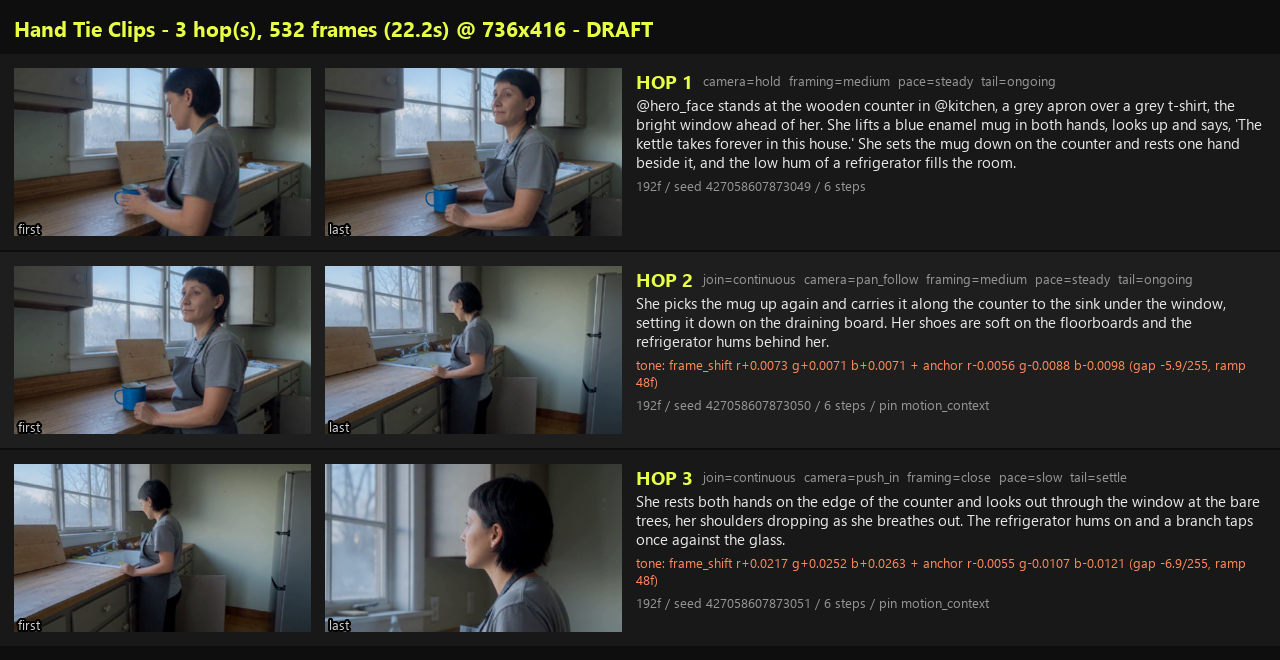
| `contact_sheet=on` adds an image on the fourth output: one row per hop, that |
| hop's first and last **delivered** frame side by side, its beat, its directives, |
| and what actually happened to it — seed, steps, whether it came from cache, what |
| the tone correction did. Wire it to a Save Image. |
|
|
|  |
|
|
| On a chain of any length this is the fastest way to find the hop that broke. The |
| one hard cut in the 114-second reference chain sat in a plan that passed every |
| automated check; it is obvious in one row of a contact sheet and invisible in a |
| progress bar. |
|
|
| ## Brightness drift, and the two things that fix it |
|
|
| These are different problems and they need different settings. |
|
|
| **The step at a join** is the denoiser's tone bias on a fresh generation. |
| `tone_compensate=frame_shift` measures it on the overlap the hop regenerated and |
| cancels it, which is why the seams in a corrected chain read as invisible. |
|
|
| **The slide across a whole chain** is different. Each hop also darkens across |
| its *own* frames, hands that darker tail to the next hop, and the next hop |
| starts from there. Seam correction cannot see this — every individual join is |
| exact while the film gets steadily dimmer. The 8×15 s reference chain slid from |
| luma 46 to 11 across hops 2–6 with every seam already corrected. |
|
|
| `tone_compensate=anchor` is frame_shift plus a pull back toward **hop 1's** |
| exposure — the one tone in the chain nothing drifted into. Two things keep it |
| from causing the problem it is fixing: |
| |
| - the pull **ramps in** across the first two seconds of each hop, so frame 0 |
| still matches the previous hop's last frame exactly and the seam stays as |
| clean as frame_shift left it; |
| - it is **capped** per hop (`tone_anchor`, default 0.35 = about a third of the |
| gap), so a long slide is corrected over several hops instead of one hop |
| snapping back and pumping. |
|
|
| A scene that is *meant* to get darker looks exactly like drift from the |
| inside, so a shot can opt out: |
|
|
| ```json |
| { "beat": "She steps down into the cellar.", "tone": "rebase" } |
| ``` |
|
|
| `"tone": "free"` skips the pull for that hop only. `"tone": "rebase"` also moves |
| the anchor onto that hop, which is how a scene that is genuinely darker from |
| here on stops being fought for the rest of the film. |
|
|
| Set `tone_anchor` to 0 to get plain frame_shift back. |
| |
| **Measured** on three hops from one seed and one cache — the hop store writes |
| before the tone stage runs, so flipping the mode re-grades the same renders and |
| only the correction differs: |
| |
| | `tone_anchor` | drift across the chain | worst seam | |
| |---|---|---| |
| | off | 13.5/255 | 2.1/255 | |
| | 0.15 | 7.4 | 1.3 | |
| | 0.35 | 5.1 | 1.9 | |
| | 0.60 | 2.9 | 2.6 | |
|
|
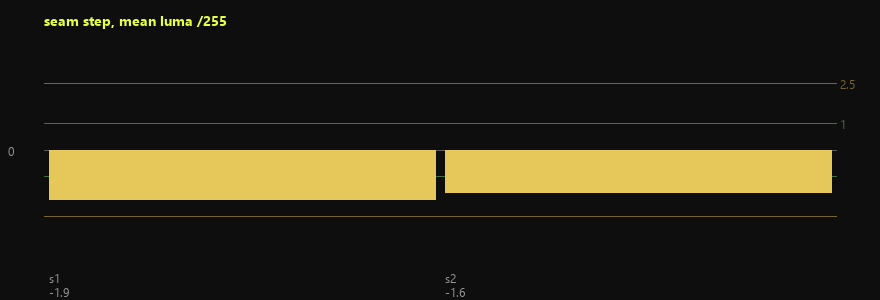
| Both columns are **H3 Seam Report's own numbers**, so what you measure matches |
| what this table says. |
|
|
|  |
|
|
| Drift falls evenly — 45%, 62%, 78% of the uncorrected slide. The seam does not: |
| `0.15` pulls it *tighter* than the uncorrected chain, and it grows from there at |
| roughly 0.6/255 per step of strength. Hop 1 is byte-identical in all four. |
| **0.35 is the default and stays** — it halves the drift while every seam still |
| reads as marginal or better. |
|
|
| One caveat the numbers cannot capture: a scene that brightens *for a reason* — |
| walking toward a window — is indistinguishable from drift from the inside, and |
| anchor will flatten it. That is what the per-shot `tone` field is for. |
|
|
| ## The MODEL wire |
|
|
| Four ordinary nodes, in this order: |
|
|
| UNETLoader → LoRA stack (mode=minimax) → H3 AdaLN Fix → MiniMax Low VRAM Attention → H3 SLA Attention → H3 Ref2VA Chain |
| |
| **Take CLIP from the LoRA loader's second output**, not straight from the encoder, or the text-side keys H3 LoRAs carry are silently dropped. |
|
|
| They briefly lived inside this node as a `model_patches` JSON widget. That made the graph shorter and the node harder to read, so it was reverted — these belong where you can see them. |
|
|
| ## Pinning the previous hop |
|
|
| Three widgets tune the pin, all defaulting to their pre-existing behaviour: |
|
|
| | widget | default | what it does | |
| |---|---|---| |
| | `audio_pin_frames` | `24` | Audio context handed to the pin, in frames. 24 is one second on the model's 40 Hz grid. Longer audio context costs conditioning rows but **no delivered frames**, so it is the cheap lever on speech that breaks across a join — try `96` (4 s) for continuous dialogue. | |
| | `pin_renorm` | `off` | Rescales each pinned latent so its spread matches the one hop 2 established. The pin's own sigma climbs hop over hop and that inflated pin conditions the next one, so texture ratchets along a long chain. A scalar rescale moves no structure, so it cannot blur detail. Video and audio are corrected separately — their sigmas drift by different amounts. Worth turning on for 3+ hops. | |
| | `pin_noise` | `0.0` | Mixes seeded noise into the pin — the other half of the same fix. Small values only; measured gains reverse above `0.10`, which is why the range stops there. | |
|
|
| The DiT pin is the previous hop’s **sampler latent** through Motion-Context when present (no decode/re-encode; audio window ends at the join). AddGuide on decoded frames is the fallback. `pin_to_qwen` still shows the incoming state to the text encoder: |
|
|
| | | | |
| |---|---| |
| | `off` | Pin stays DiT-only. | |
| | `last frame` (default) | Previous hop's last frame is `<Picture 1>`. Identity stills that still ride this hop shift to Picture 2+. | |
| | `pin clip` | Overlap frames become an extra `<Video>` at ~2 fps. No soundtrack on it, so `voice` stays `<Audio 1>`. | |
| | `both` | Last frame + pin clip. | |
|
|
| `@tags` in beats resolve per hop, so stills shifting to Picture 2+ does not break prose. Literal `<Picture N>` in hop 2+ beats would. |
|
|
| ## Defaults |
|
|
| | | | |
| |---|---| |
| | resolution | 1.0 MP (1280×736 landscape) | |
| | duration | 10 s (243 frames) | |
| | overlap | 0.9 s (22 frames) | |
| | steps | 8, with a 4-step turbo LoRA — the regime this node targets | |
| | sampler / scheduler | `res_multistep` / `beta` | |
| | seed per hop | on | |
| | sigma shift | 12 / 3 | |
| | cache budget | 20 GB | |
| | tone_compensate | off (both shipped workflows set `frame_shift`) | |
| | tone_anchor | 0.35, used only by `tone_compensate=anchor` | |
| | quality | final | |
|
|
| Three shots at 10 s with a 0.9 s overlap is about 28 s of master after the overlap is dropped. |
|
|
| ## Limits |
|
|
| - **A workflow saved before 2026-08-28 loses its reference pictures.** The old `ref_image_N` sockets carried tensors, so there is no filename to recover. The rail names each affected ref and asks you to pick its picture; nothing else about the plan is lost. |
| - There is no shot-level `refs` field. Activation lives on the reference: give a ref a `shots` list, or use the per-hop chips on its row in the rail. |
| - The reference `desc` and subject `locked` text go to the encoder verbatim, every hop. At cfg 1.0 there is no negative branch, so a detail that is not in the photograph is **asked for**, not ignored. Describe what you actually wired. |
| - `HTCContinuityState` is **setting only**. Characters live in the reference register; the node's `characters_*` fields were removed because filling in both injected identity text twice. |
| - Each join hard-cuts video but crossfades audio ~40 ms, so A/V drifts ~40 ms per hop. |
| - Texture still ratchets on long chains. Stay around 3–5 hops until that is handled. |
| - A 22-frame pin clip is ~2 Qwen frames at 2 fps. It is a live-state hint, not a full previous-clip watch. |
| - A longer overlap does not fix continuity — it can pin whatever content happens to be in that longer tail. |
|
|
| ## Nodes |
|
|
| **H3 Ref2VA Chain** — `images`, `audio`, `info`, `contact_sheet` out. Wire `CreateVideo` + `SaveVideo` as in the example workflow, `info` to a Preview Text node, and `contact_sheet` to a Save Image. |
|
|
| **H3 Chain Preview** — a passthrough panel for the IMAGE (and optionally AUDIO) wire, placed **between the chain and `CreateVideo`**. Images and audio come out unchanged, so adding or removing it changes no pixels. It shows the live sample, the seam (the previous hop's last frame beside this hop's first), a chain-wide progress bar, cache hit / seed / steps per hop, **which pin mechanism each hop actually used** — a latent Motion-Context pin or the AddGuide pixel fallback — and end-of-run A/V drift. Drag the grip to resize the stats panel; double-click it to reset. |
|
|
| **H3 Tone Compensate** — `images` out. Corrects a generated segment's tone against the previous one, estimated on the overlap they share. **For hand-built chains only.** It cannot fix `H3 Ref2VA Chain`'s output: that node joins its hops internally and drops each hop's first `overlap` frames at the seam, so the regenerated copies this needs are already gone by the time images leave it. Use the chain node's `tone_compensate` widget instead. Estimator ported from [rkfg/ComfyUI-MiniMaxH3-ToneCompensate](https://github.com/rkfg/ComfyUI-MiniMaxH3-ToneCompensate) (MIT). |
|
|
| **H3 Seam Report** — `report` (STRING) + `chart` (IMAGE). **Ships wired on the Starter canvas.** Set `hops` to your shot count: it derives hop length from frames, hops and overlap, so a wrong `hops` does not error — it returns a plausible length and puts every seam where no join exists. Wire the chain's `images` into it and it measures the brightness step at every join, says whether each is invisible / marginal / visible, and totals the chain's cumulative drift. A single reading includes whatever the scene did across the cut — the frames either side are ~0.9 s apart in scene time — so treat one number as an upper bound; to isolate the seam itself, render twice from the same seed and cache changing only `tone_compensate`, and compare. |
|
|
| **H3 Continuity State** — `continuity_state` (STRING) out. **Setting only**: `setting_locked` / `setting_context` / `setting_mutable`. Characters belong in `ref_plan`. |
|
|

