
Spaces:
Runtime error
Runtime error

| title: Agentic Code Analyser | |
| emoji: 🐢 | |
| colorFrom: purple | |
| colorTo: pink | |
| sdk: docker | |
| pinned: false | |
| license: mit | |
| tags: | |
| - agent-demo-track | |
| - mcp-server-track | |
| - custom-component-track | |
| - llamaindex | |
| - agents | |
| - modal | |
| - nebius | |
| short_description: Multi agent code analyser using industry standard tools | |
| # Multi-Agent Code Analysis System | |
| [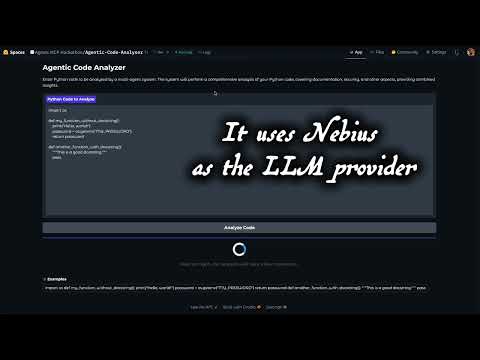](https://www.youtube.com/watch?v=GufJw-M6fgQ) | |
| **A sophisticated multi-agent system for intelligent, automated code analysis.** | |
| ## The Problem We Solve | |
| In today's fast-paced development environments, maintaining high code quality, robust security, and comprehensive documentation is a significant challenge. Manual code reviews are essential but can be: | |
| * **Time-consuming:** Taking valuable developer time away from feature development. | |
| * **Error-prone:** Reviewers can miss subtle bugs or inconsistencies. | |
| * **Inconsistent:** The depth and focus of reviews can vary between reviewers and over time. | |
| * **A Bottleneck:** Slowing down deployment pipelines. | |
| Neglecting these aspects leads to technical debt, security vulnerabilities, difficult onboarding, and increased maintenance costs. | |
| ## This Solution: Intelligent Automated Analysis | |
| The Multi-Agent Code Analysis System leverages a team of specialized AI agents to perform a thorough and consistent analysis of your codebase. It intelligently orchestrates these agents and aggregates their findings to provide actionable insights, helping you build better, safer, and more maintainable software. | |
| Key components include: | |
| * **Orchestrator:** An intelligent core that assesses the input code and decides the appropriate level of analysis and which specialized agents to deploy. | |
| * **DocAgent:** Focuses on analyzing code for documentation quality, ensuring docstrings are present, informative, and up-to-date. | |
| * **SecurityAgent:** Scans code for common security vulnerabilities, helping to proactively identify and mitigate risks. | |
| * **Aggregation Engine:** Synthesizes the outputs from all active agents into a single, comprehensive report with clear findings, recommendations, and even potential code fixes. | |
| ## Key Features | |
| * **Automated Documentation Analysis:** Ensures code is well-commented and easy to understand. | |
| * **Automated Security Vulnerability Detection:** Identifies potential security flaws before they reach production. | |
| * **Intelligent Orchestration:** Dynamically determines the required analysis depth and deploys relevant agents. | |
| * **Comprehensive & Actionable Reporting:** Provides clear summaries, lists of issues, and practical recommendations. | |
| * **LLM-Powered Insights:** Utilizes Large Language Models for nuanced understanding and generation of analysis. | |
| * **Scalable Architecture:** Designed to handle diverse code analysis tasks efficiently (with potential for scaling via technologies like Modal). | |
| * **User-Friendly Interface:** Presents analysis results through a Gradio-based UI, including a specialized `gradio-codeanalysisviewer`. | |
| ## How It Works | |
| The system follows a sophisticated workflow to analyze code: | |
|  | |
| (the items in red color are planned to be implemented) | |
| ## Workflow | |
|  | |
| 1. **Code Input:** The system receives the code to be analyzed. | |
| 2. **Initial Assessment:** An LLM-powered orchestrator evaluates the code and determines the analysis strategy (e.g., depth, which agents to invoke). | |
| 3. **Agent Dispatch:** Based on the assessment, tasks are dispatched to specialized agents (e.g., `DocAgent`, `SecurityAgent`). | |
| 4. **Parallel Analysis:** Agents perform their specific analysis tasks on the code. | |
| 5. **Results Collection:** Findings from all active agents are collected. | |
| 6. **Final Aggregation:** Another LLM-powered step synthesizes all collected data into a unified, actionable report. | |
| 7. **Report Output:** The system presents a comprehensive report detailing issues, recommendations, and potentially suggested fixes. | |
| ## Benefits for Your Business | |
| * **Increased Developer Productivity:** Automates routine checks, freeing up developers to focus on complex problem-solving and innovation. | |
| * **Enhanced Code Quality & Maintainability:** Enforces coding standards and documentation best practices, leading to cleaner, more understandable, and easier-to-maintain code. | |
| * **Improved Security & Compliance:** Proactively identifies and helps remediate security vulnerabilities, reducing risk and aiding compliance efforts. | |
| * **Reduced Review Bottlenecks:** Speeds up the code review process, enabling faster development cycles and quicker time-to-market. | |
| * **Consistent Standards:** Ensures uniform application of coding and security standards across all projects and teams. | |
| * **Better Onboarding:** Well-documented code makes it easier for new developers to get up to speed. | |
| ## Technology Stack | |
| * **Python** | |
| * **LlamaIndex:** For LLM integration, agentic workflows, and core AI capabilities. | |
| * **Pydantic:** For robust data validation and schema management | |
| * **Gradio:** For building the interactive user interface. | |
| * **Modal (potential):** For scalable cloud deployment and execution of analysis tasks. | |
| * **Nebius:** For LLM endpoint. | |
| ## Future Enhancements | |
| * *Support for more programming languages.* | |
| * *Additional specialized agents (e.g., performance profiler, style checker, refactoring agent).* | |
| * *Additional specialized tools for these agents via MCP.* | |
| * *Customizable analysis rules and policies.* |