
Spaces:
Running

title: Elffuss Code
emoji: 🧑💻
colorFrom: purple
colorTo: pink
sdk: static
app_file: index.html
pinned: false
license: apache-2.0
short_description: A VS Code-style IDE with a local AI agent, in-browser
tags:
- webgpu
- transformers.js
- local-llm
- agent
- code
- gemma
🧑💻 Elffuss Code — a VS Code-style IDE with an AI soul, 100% in your browser
Open a local folder and a full web IDE unfolds around it — real Monaco (the VS Code editor), a file tree, tabs — with an AI agent that reads, searches and edits your project for real. The model runs on your GPU via WebGPU. Your code never leaves your machine.
⚡ Build the best thing you can with Elffuss — 15-minute challenge, open until Sun 9 Aug 2026. Open one of your own folders and let the agent fix a real bug or add a small feature in 15 minutes, then post a screenshot of the diff (plus your prompt) as a reply on X or a comment on LinkedIn. Every like counts, wherever you post it — X, LinkedIn or the Community tab of this Space. We tally them all on Sunday; the most-liked entry wins and gets featured in this Space and in the repo.
⚠️ Open it full-screen (direct link) — the File System Access API (opening a local folder) is blocked inside the embedded iframe.
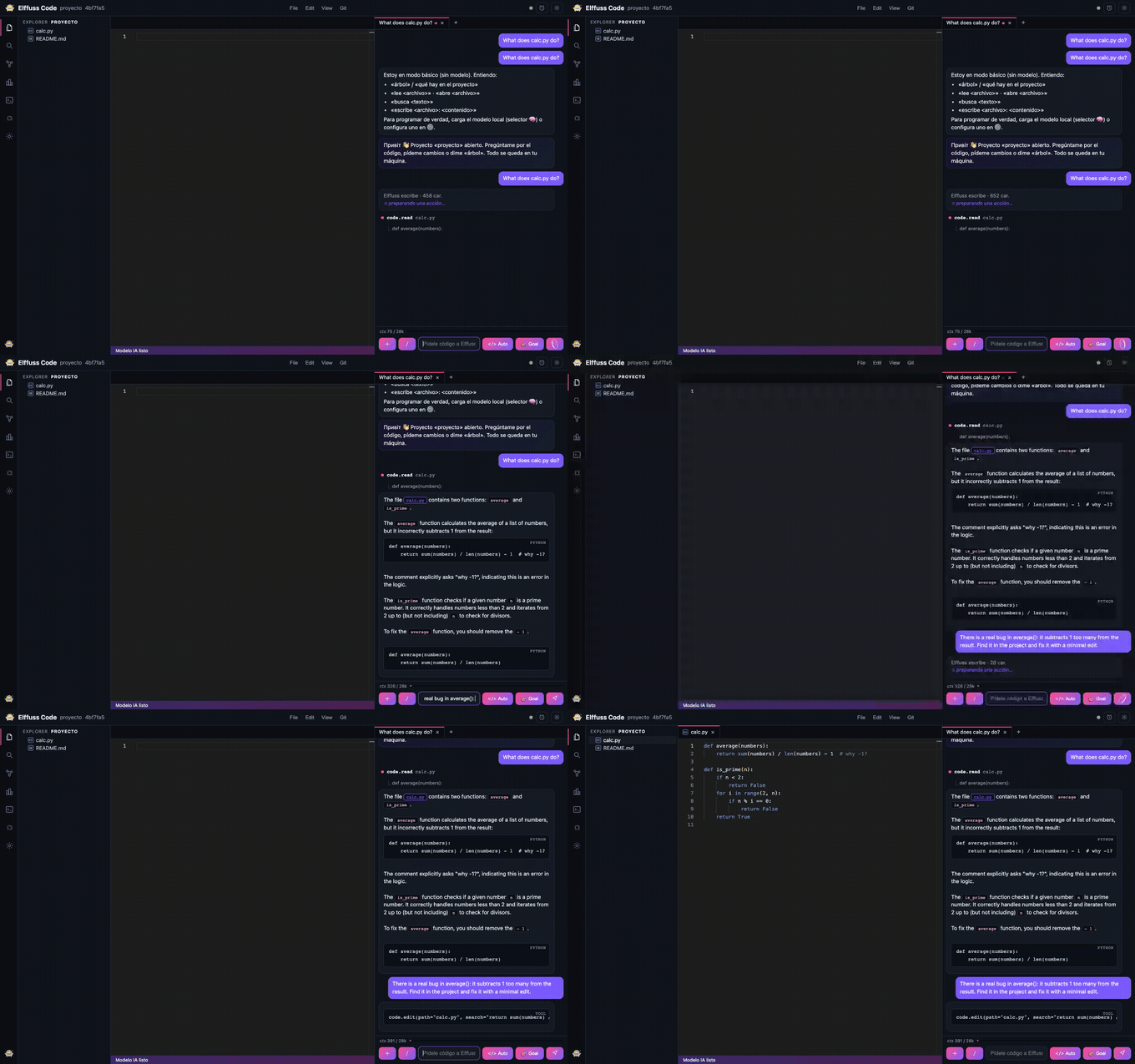
In the demo a small model running entirely in the browser reads calc.py, finds a real
bug and fixes it with a minimal edit — genuine tool-calling, not autocomplete.
Why it's different
- Your code stays local. The folder is opened via the File System Access API — no upload, no account.
- The model runs on your GPU (WebGPU, Gemma-4 E4B via LiteRT-LM; ONNX/transformers.js + our healed LFM2.5-1.2B as fallback).
- Real tool-calling:
code.tree,code.read,code.search,code.edit,code.write— you watch every call. - Real editor: Monaco, file tree, tabs,
Ctrl+S, and git branch/last commit parsed straight from.git. - Zero install, zero build. Vanilla ES modules.
- Your language: the whole IDE follows your browser's language (English, Spanish and more).
- External providers (OpenAI, Anthropic, Ollama) are opt-in; keys stay in your browser.
- Optional local bridge for real
node/npm/pythonexecution — downloaded from the main site.
How it's built
Four write-ups on the full stack — model, runtime, agent harness, editor and filesystem access, all in one tab: https://bitacora.utopiaia.com/#elffuss
Links
- 🌐 Full app: https://elffuss-code.utopiaia.com
- 💻 Source (Apache-2.0): https://github.com/KikoCis/elffuss-code
- ✳️ Sibling project — Elffuss Claw (agentic OS): https://huggingface.co/spaces/KikoCis/elffuss-claw
- 🧬 Shared core: https://github.com/KikoCis/elffuss
Gestión de contexto — cómo se mide
El empaquetador de contexto no se elige por intuición. Números medidos a igual presupuesto de tokens:
Sesiones reales de agente (25 sesiones, 174 sondas, recuerdo de hechos, sin juez LLM):
| recuerdo | |
|---|---|
| truncar por la cola | 7,0 % |
| versión anterior | 15,1 % |
| esta | 65,3 % ± 8,5 |
Memoria a largo plazo (200 preguntas, F1 del propio repo del banco, modelo real respondiendo, ~8 % del contexto):
| F1 | |
|---|---|
| el contexto COMPLETO, sin comprimir | 22,56 |
| truncar por la cola | 6,62 |
| heurísticas escritas a mano | 6,07 |
| BM25 sin IDF | 20,34 |
| BM25 | 23,59 |
| embeddings | 23,95 |
| fusión por rangos (BM25 + embeddings) | 28,09 |
Recuperar bien bate a tenerlo todo: 28,09 frente a 22,56 usando el 8 % de los tokens. Lo irrelevante no es lastre neutro — distrae.
Otras dos cosas que se miden y no se suponen: activar las heurísticas costaba −3,02 F1, y quitar la IDF cuesta −3,25. Lo semántico no sustituye al léxico, le cubre el punto ciego: sin solape de vocabulario entre pregunta y respuesta los embeddings ganan (24,28 vs 18,60), con solape gana BM25 (29,33 vs 23,58), y la fusión se queda con los dos.
Referencias: BM25 (Robertson et al., TREC-3 1994) · IDF (Spärck Jones, 1972) · RRF (Cormack et al., SIGIR 2009) · MMR (Carbonell & Goldstein, SIGIR 1998) · sumideros de atención (Xiao et al., ICLR 2024) · tiempo de validez (Snodgrass & Ahn, SIGMOD 1985).
La historia completa, con lo que salió mal: https://bitacora.utopiaia.com/posts/16-beaten-by-doing-nothing.html