
Spaces:
Running


title: Aileen 3 Core - Information Foraging MCP Server
emoji: 👩🏻💼
colorFrom: purple
colorTo: blue
sdk: docker
pinned: false
license: cc-by-4.0
short_description: Use priors to surface novel insights in noisy communications
tags:
- building-mcp-track-enterprise
- building-mcp-track-customer
Aileen 3 Core: Information Foraging MCP Server


 🔜
🔜


"Information is surprises. You learn something when things don’t turn out the way you expected." ⸺ Roger Schank
♨️ Problem: The Noise-Signal Ratio
Professionals working at the intersection of regulation and technology drink from a firehose of information. Staying current requires monitoring hours of conferences, webinars, and podcasts.
Standard AI summarization fails here because it creates "flat" summaries that rehash what you already know. It treats every sentence as equally important.
✅ Solution: Expectation-Driven Analysis
Aileen 3 Core is a Model Context Protocol (MCP) server designed for Information Foraging. Grounded in cognitive science, it models "novelty" as prediction error.
Instead of asking "Summarize this video," Aileen 3 Core allows users to task a Large Language Model with: "Here is what I already know, and here is what I expect the speaker to say. Tell me only where they deviate from this baseline.". As part of a larger agentic AI system, the prior knowledge can even be derived from a memory bank.
💪 Key Capabilities
- ⛳️ Expectation-Driven Briefings: Uses Google Gemini to analyze audio/video against user-supplied priors (context, expectations, and knowledge gaps) to surface genuine surprises.
- 🔍 Context-Biased Transcription: Prevents hallucinations (e.g., confusing the German treaty "NOOTS" for "emergency state") by feeding media metadata as priors to the model.
- 🖼️ Visual Slide Extraction: Automatically detects, extracts, and, on request, translates slide stills from video feeds, treating slides as high-density information artifacts.
- 🔌 Universal MCP Support: Works with Claude Desktop, or any custom Agent.
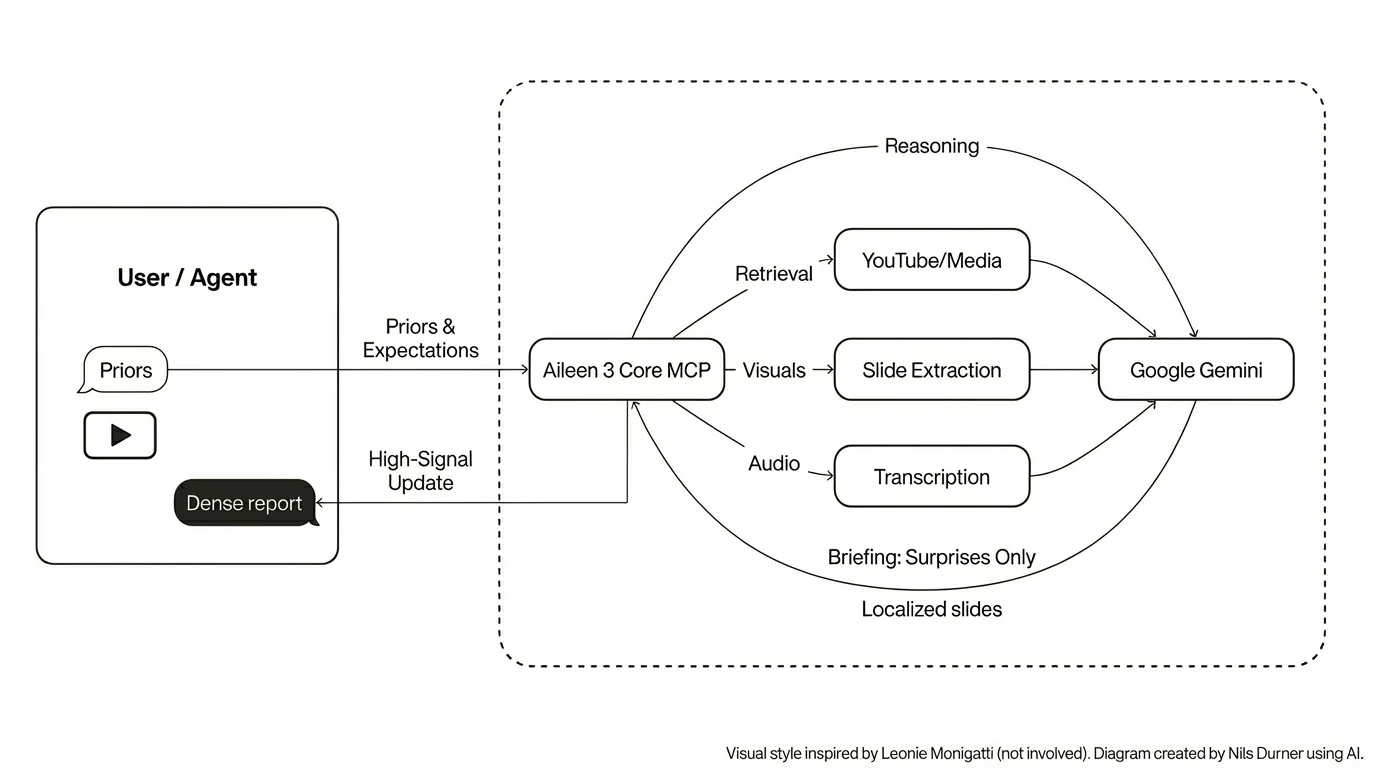
🏗️ Architecture
Aileen 3 Core exposes tools that bridge the gap between raw media and reasoning agents.
🚀 Quick Start: Claude Desktop
Aileen 3 Core is designed to be the "eyes and ears" for your local LLM client.
Install:
# Clone and install dependencies
pip install -e ./mcp
Obtain a Google Gemini API key: Google AI Studio
Configure
claude_desktop_config.json:. The Gemini API key will be read from the environment, so can also be set here:{ "mcpServers": { "aileen3-mcp": { "command": "python", "args": ["-m", "aileen3_mcp.server"], "env": { "GEMINI_API_KEY": "AI..." } } } }Restart Claude
The Haiku 4.5 model is sufficient for basic tasks. To make your plans fully transparent to the LLM, refer to "aileen3" explicitly in the prompt, e.g.:
Use aileen3 to translate slide 3 from YouTube video reference eXP-PvKcI9A to German.

🔍 Debugging
The message exchange and Claude-facing error messages can be read from Claude log files:
tail -n 20 -F ~/Library/Logs/Claude/mcp*.log
🧪 The Gradio Space (Interactive Demo)
We have built a custom Gradio 6 application that acts as a visual frontend for the MCP server. It demonstrates the pipeline step-by-step:
- Health Check: Verifies
ffmpeg,yt-dlp, and Gemini connectivity. - Hallucination Check: Demonstrates how lack of context leads to speech recognition errors.
- Context-biased Transcription: Fixes these errors by establishing priors.
- Expectation-driven Analysis: The core engine in action.
- Slide Translation: Extracting and localizing visual assets.
📘 MCP server overview
The MCP server is implemented in mcp/src/aileen3_mcp and exposes tools over stdio via aileen3_mcp.server. Google Gemini powers the analysis, transcription, and slide translation flows. Media retrieval is handled by yt-dlp and ffmpeg.
Environment prerequisites:
GEMINI_API_KEYset to a valid Gemini API keyffmpeginstalled and onPATH
Optional configuration:
AILEEN3_ANALYSIS_MODELto override the default Gemini model used for expectation-driven analysis (defaults togemini-flash-latestfor straightforward experimentation on the free tier of Google AI Studio;gemini-3-pro-previewrecommended for accuracy).AILEEN3_CACHE_DIRto change the base cache directory (default:~/.cache/aileen3).AILEEN3_DEBUG=1to enable additional debug artefacts on disk.
⭐️ Example client integration
The companion project Aileen 3 Agent uses this MCP server via the google.adk McpToolset, spawning aileen3_mcp.server over stdio with:
command:sys.executableargs:["-m", "aileen3_mcp.server"]env: explicitly forwardingGEMINI_API_KEYinto the MCP processtimeout:1200seconds at the MCP transport level, to accommodate long-running video analysis and transcription jobs beyond the 30 seconds default
When integrating this MCP into your own agent or client:
- Set transport-level timeouts generously (10–20 minutes) and rely on the tools’
wait_secondsargument plus status polling for progress. - Ensure
GEMINI_API_KEY(and any optionalAILEEN3_*variables you use) are visible in the environment of the MCP server process, not just the client.
🛠️ MCP tools and definitions
🩺 Health and search
health() -> { ok, detail, ffmpeg, gemini_api_key }- Purpose: Lightweight health probe mirroring the Gradio demo’s health check. Confirms that
ffmpegis callable andGEMINI_API_KEYis present. - Usage: Call before running longer flows to surface missing runtime dependencies early.
- Purpose: Lightweight health probe mirroring the Gradio demo’s health check. Confirms that
search_youtube(query: str, max_results: int = 10) -> { videos: [...] }- Purpose: Fast YouTube search using
yt-dlp(no downloads). - Arguments:
query(required): Free-form search terms (e.g."taler auditor bachelorthesis").max_results(optional, default10, clamped to1–50).
- Returns:
videoslist withid,title,webpage_url,duration_seconds,channel,channel_id. - Typical flow: Use from an agent to shortlist candidate videos before picking one
sourcefor retrieval.
- Purpose: Fast YouTube search using
📺 Media retrieval (entry point)
start_media_retrieval(source: str, prefer_audio_only: bool = False, wait_seconds: int = 54) -> dict- Purpose: Download long-form media (YouTube, podcasts, HTTP URLs) and normalize basic metadata.
- Arguments:
source: YouTube URL/ID, podcast URL, or otheryt-dlp-supported locator.prefer_audio_only: Whentrue, prefer audio-first formats; use when visuals are not needed.wait_seconds: How long to block before returning; if the job is still running, you get status + reference.
- Returns:
- On success:
{ reference, status: "done", metadata: {...}, cached? } - In progress:
{ reference, status: "pending"|"running", progress?, job_id } - On error:
{ is_error: true, status, detail, reference }
- On success:
- Typical flow: This is the first call once you have chosen a
source. Thereferencetoken is required for all downstream tools.
get_media_retrieval_status(reference: str, wait_seconds: int = 0) -> dict- Purpose: Poll the retrieval job or fetch cached metadata.
- Returns:
{ status: "done", reference, metadata }when cached or finished.{ status: "pending"|"running", ... }while in flight.{ status: "not_found", reference }if no job or cache exists.
🖼️ Slides: extraction and translation
start_slide_extraction(reference: str, wait_seconds: int = 55) -> dict- Purpose: Extract representative slide stills from a downloaded video.
- Note: Full media analysis (
start_media_analysis) automatically triggers slide extraction; call this explicitly only if you need slides on their own. - Returns: Standard job envelope with
slidesonce done orstatus+job_idwhile running.
get_extracted_slides(reference: str, wait_seconds: int = 0) -> dict- Purpose: Fetch extracted slides or current extraction status.
- Returns:
{ status: "done", reference, slides: [...] }on success, otherwise a job status or{ status: "not_found" }. Slides include indices that are used bytranslate_slide.
translate_slide(reference: str, slide_index: int, language: str) -> ImageContent- Purpose: Translate a single slide image into another language using Gemini image-to-image.
- Arguments:
reference: Token fromstart_media_retrieval.slide_index: Zero-based index intoget_extracted_slides.slides[].index.language: Target language name (e.g."German","Spanish").
- Returns:
ImageContentwith base64-encoded translated slide image. Responses are cached per(reference, language, slide_index).
⛳️ Expectation-driven analysis
start_media_analysis(reference: str, priors: object, wait_seconds: int = 55) -> dict- Purpose: Run expectation-driven analysis over the media’s audio and slides, surfacing surprises and new actors instead of rehashing everything.
- Arguments:
reference: Token produced bystart_media_retrieval.priors: Object with optional string fields:context: Scene setting (participants, venue, goal, spelled names).expectations: What the user already expects to hear.prior_knowledge: What the user already knows from past work.questions: Concrete questions to be answered.
- Important: Only populate
priorswith information coming from the user or trusted tools (e.g. Memory Bank); do not invent priors in the agent. - Returns: Same job envelope pattern as retrieval. When
status: "done", the payload includes ananalysismarkdown briefing optimised for fast reading.
get_media_analysis_result(reference: str, wait_seconds: int = 0) -> dict- Purpose: Poll for completion or fetch cached analysis for a
reference. - Returns:
status: "done"withanalysistext on success.status: "pending"|"running"during processing.- Errors include
is_error: true,detail,reference.
- Purpose: Poll for completion or fetch cached analysis for a
✍️ Transcription
start_media_transcription(reference: str, context: str = "", prefer_audio_only: bool = False, wait_seconds: int = 55) -> dict- Purpose: Produce a diarized, speaker-labelled transcription of the media’s audio channel.
- Arguments:
reference: Fromstart_media_retrieval.context: Optional grounding text with names, acronyms, or domain hints.prefer_audio_only: Whentrue, skip slide context for cheaper audio-only runs.wait_seconds: Poll window before returning.
- Returns: Job envelope, with
transcriptiononcestatus: "done".
get_media_transcription_result(reference: str, wait_seconds: int = 0) -> dict- Purpose: Retrieve a previously computed transcription or current job status.
- Returns: Same pattern as
get_media_analysis_result, but withtranscriptioninstead ofanalysis.
🏆 Hackathon Context & Journey
Aileen 3 Core was built for the MCP's 1st Birthday - Hosted by Anthropic and Gradio and serves as the backbone for the Aileen 3 Agent (developed for the AI Agents Intensive Course with Google).
While most agents are passive summarizers, Aileen 3 represents a shift toward active information foraging, enabling professionals to filter signal from an ocean of noise.
📦 Local Development
# Build the Docker image
docker build -t aileen3-core .

# Run the Gradio interface
docker run -it -p 7860:7860 aileen3-core
🛡️ Security & privacy
- Your Gemini key is used only server-side to call Gemini models.
- Media is downloaded to cache for repeatability; clear ~/.cache/aileen3 to remove artefacts.
- No analytics or third-party telemetry included.
🚧 Limitations
translate_slidedoes currently not benefit from priors; translation quality could be improved that way- No AI safety guardrails (tone, style, anti prompt-injection, ...)
- No cost control
- Hallucination risk - Aileen may make mistakes.
- Remote MCP operating mode not tested; would rely on external access protection
👾 Troubleshooting
- Gemini 401 “API keys are not supported…”: use AI Studio key starting with “AI…”, not Vertex keys (“AQ…”).
- Long jobs: increase transport timeout (10–20 min) and leverage wait_seconds + polling get_* tools.
- YouTube access:
- ensure YouTube is reachable
- yt-dlp is recent
- if site JS protection breaks, install yt-dlp-ejs (see Space health check).