
Spaces:
Sleeping

Sleeping
| title: OpenWind MCP (dev) | |
| emoji: ⛵ | |
| colorFrom: gray | |
| colorTo: yellow | |
| sdk: docker | |
| app_port: 7860 | |
| pinned: false | |
| license: mit | |
| short_description: (dev) French Atlantic + Med sailing planner via MCP. | |
| # OpenWind MCP (dev) ⛵ | |
| > **Talk to your LLM. Cast off with confidence.** | |
| > | |
| > Turns any MCP-capable assistant into a sailing planner for the French | |
| > Atlantic and Mediterranean coasts. Free, keyless, open source. | |
| 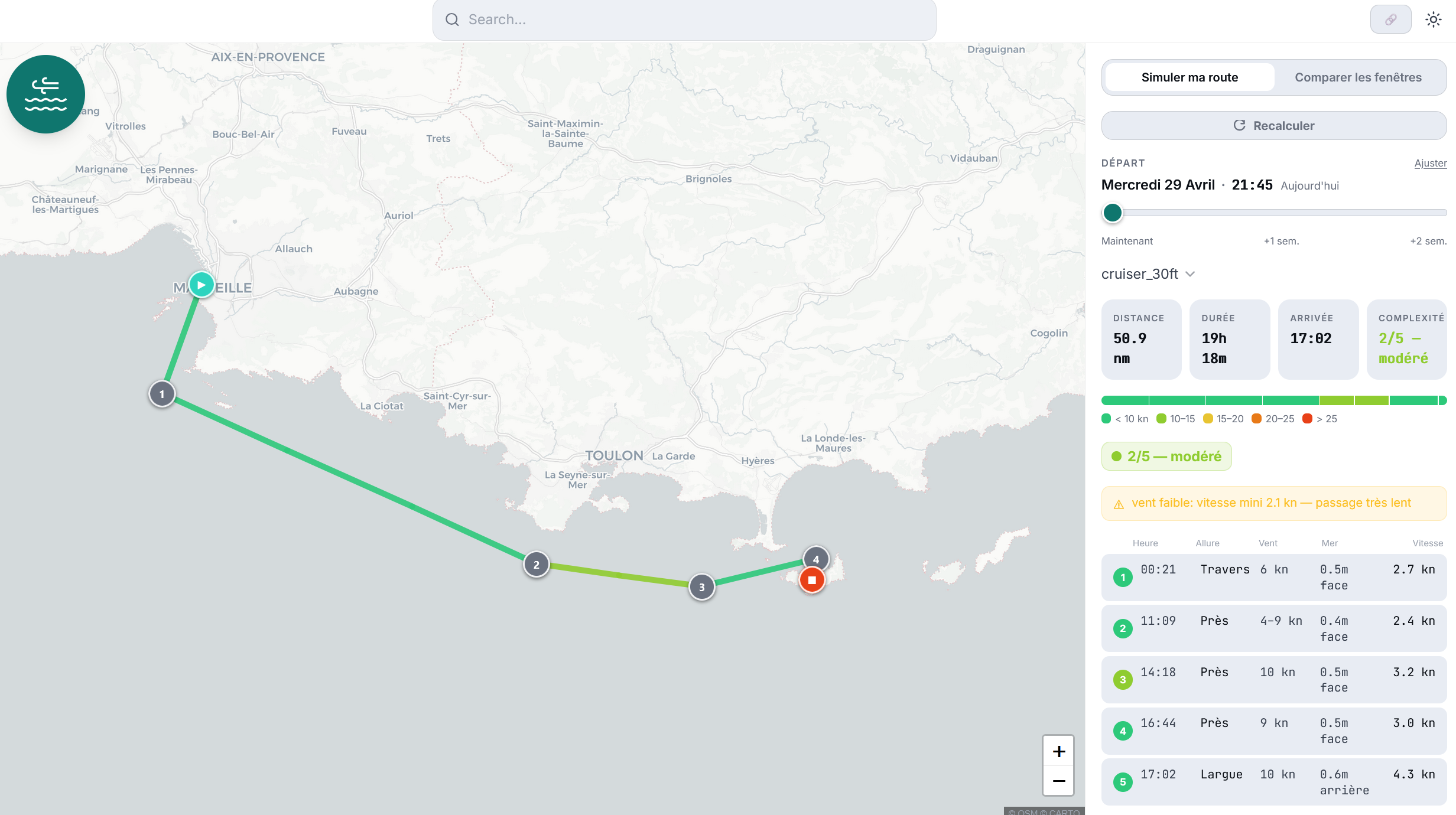 | |
| --- | |
| ## Try it in 30 seconds | |
| **1.** In your MCP client, add the endpoint: | |
| ``` | |
| https://qdonnars-openwind-mcp-dev.hf.space/mcp | |
| ``` | |
| **2.** Ask, in your own words: | |
| > *"I'm leaving Marseille tomorrow morning for Porquerolles on a Sun Odyssey | |
| > 36. How long is the passage and how tricky is it?"* | |
| **3.** Your assistant calls the OpenWind tools and answers in plain language. | |
| On hosts that support the [MCP Apps spec](https://modelcontextprotocol.io/extensions/client-matrix) | |
| (Claude, Claude Desktop, ChatGPT, VS Code Copilot, Goose, Postman, MCPJam) you | |
| also get the live [openwind.fr](https://openwind.fr) plan view rendered | |
| inline. On hosts that don't (Cursor, Le Chat, terminal), the assistant hands | |
| you the same plan as a deep-link instead. No account. No API key. No credit | |
| card. | |
| > **First time with MCP?** Pick your client on | |
| > [modelcontextprotocol.io/clients](https://modelcontextprotocol.io/clients), | |
| > then follow the | |
| > [remote-server quickstart](https://modelcontextprotocol.io/docs/develop/connect-remote-servers). | |
| > Works with Claude Desktop, Le Chat, Cursor, Goose, Zed, Continue, and any | |
| > other MCP-compatible host. In Le Chat, add it under **Connectors → Add | |
| > connector → Custom MCP connector** and paste the endpoint above. | |
| ## Why OpenWind | |
| - **Free and keyless.** Wind + sea data via [Open-Meteo](https://open-meteo.com) (CC BY 4.0). | |
| - **Mediterranean-tuned.** AROME 1.3 km by default, catches thermals and mistral. ICON-EU → ECMWF → GFS for longer reach. | |
| - **Boat-aware.** 7 archetypes from 20 to 50 ft, real polars, an `efficiency` parameter for trim and crew level. | |
| - **Window-aware.** One call sweeps up to 14 days of hourly departures so the LLM can pick the calmest slot. | |
| - **Client-agnostic.** One HTTP MCP endpoint, no vendor lock-in. Rich [MCP Apps](https://modelcontextprotocol.io/extensions/client-matrix) widget on supporting hosts; clean deep-link fallback on the rest. | |
| - **Open source, MIT.** Self-host on Fly, Modal, or your own VPS in minutes. | |
| ## Four tools | |
| | Tool | What it does | | |
| |---------------------------|---------------------------------------------------------------------------| | |
| | `list_boat_archetypes` | Seven descriptive archetypes; the LLM maps "Sun Odyssey 36" → `cruiser_30ft`. | | |
| | `get_marine_forecast` | Wind + sea around a point/window, multi-model. | | |
| | `plan_passage` | End-to-end: per-leg timing + 1–5 complexity + openwind.fr deep-link, in one call. Pass `latest_departure` and it walks every hourly window up to 14 days out so the LLM can compare side-by-side. Declares an MCP Apps UI resource; supporting hosts auto-render the live plan in a sandboxed iframe. | | |
| | `read_me` | Returns OpenWind's calculation methodology. Call it when the user asks how things are computed. | | |
| ## About this Space | |
| > ⚠️ This Space uses the **Docker SDK** (not Gradio). It does **not** carry | |
| > the HF MCP badge and isn't listed in | |
| > `huggingface.co/spaces?filter=mcp-server`. Discoverability lives at | |
| > [openwind.fr](https://openwind.fr) instead. | |
| **Source of truth:** <https://github.com/qdonnars/openwind>. This Space is | |
| auto-deployed by GitHub Actions from `packages/hf-space/` on `dev`. Don't | |
| commit directly to the Space repo; your changes will be overwritten at the | |
| next push. | |
| The Space wrapper is intentionally minimal (~20 lines in `app.py`). All logic | |
| lives in `openwind-mcp-core` and `openwind-data` upstream, re-deployable on | |
| Fly, Modal, or a VPS by writing a different wrapper. | |
| ## Cold-start | |
| Free CPU-basic hardware sleeps after 48 h of inactivity. First request after | |
| sleep takes ~5 s to wake. Acceptable for V1. | |
| ## License | |
| MIT. | |