
Spaces:
Running

Running
Upload 11 files
#1
by alexcpn - opened
- Dockerfile +41 -0
- Dockerfile.local +21 -0
- README.md +144 -6
- agent_interface.py +48 -0
- git_utils.py +31 -0
- pyproject.toml +25 -0
- review_orchestrator.py +348 -0
- start_hf.sh +32 -0
- test_client.py +25 -0
- uv.lock +0 -0
- web_server.py +162 -0
Dockerfile
ADDED
|
@@ -0,0 +1,41 @@
|
|
|
|
|
|
|
|
|
|
|
|
|
|
|
|
|
|
|
|
|
|
|
|
|
|
|
|
|
|
|
|
|
|
|
|
|
|
|
|
|
|
|
|
|
|
|
|
|
|
|
|
|
|
|
|
|
|
|
|
|
|
|
|
|
|
|
|
|
|
|
|
|
|
|
|
|
|
|
|
|
|
|
|
|
|
|
|
|
|
|
|
|
|
|
|
|
|
|
|
|
|
|
|
|
|
|
|
|
|
|
|
|
|
|
|
|
|
|
|
|
|
|
|
|
|
|
| 1 |
+
FROM python:3.10-slim
|
| 2 |
+
|
| 3 |
+
# Install system dependencies
|
| 4 |
+
RUN apt-get update && apt-get install -y \
|
| 5 |
+
git \
|
| 6 |
+
redis-server \
|
| 7 |
+
curl \
|
| 8 |
+
procps \
|
| 9 |
+
&& rm -rf /var/lib/apt/lists/*
|
| 10 |
+
|
| 11 |
+
# Install uv
|
| 12 |
+
COPY --from=ghcr.io/astral-sh/uv:latest /uv /uvx /bin/
|
| 13 |
+
|
| 14 |
+
WORKDIR /app
|
| 15 |
+
|
| 16 |
+
# Copy project files
|
| 17 |
+
COPY pyproject.toml uv.lock /app/
|
| 18 |
+
RUN uv sync --frozen --no-install-project
|
| 19 |
+
|
| 20 |
+
COPY . /app
|
| 21 |
+
RUN uv sync --frozen
|
| 22 |
+
|
| 23 |
+
# Clone MCP server
|
| 24 |
+
RUN git clone https://github.com/alexcpn/codereview_mcp_server.git
|
| 25 |
+
|
| 26 |
+
# Make startup script executable
|
| 27 |
+
RUN chmod +x start_hf.sh
|
| 28 |
+
|
| 29 |
+
# Create a user to run the app (optional but good practice, though HF often runs as 1000)
|
| 30 |
+
# For simplicity in this setup, we'll run as root or default user,
|
| 31 |
+
# but we need to make sure we can write to directories if needed.
|
| 32 |
+
# HF Spaces usually run as user 1000.
|
| 33 |
+
RUN useradd -m -u 1000 user
|
| 34 |
+
USER user
|
| 35 |
+
ENV HOME=/home/user \
|
| 36 |
+
PATH=/home/user/.local/bin:$PATH
|
| 37 |
+
|
| 38 |
+
# Expose the port (HF Spaces expects 7860)
|
| 39 |
+
EXPOSE 7860
|
| 40 |
+
|
| 41 |
+
CMD ["./start_hf.sh"]
|
Dockerfile.local
ADDED
|
@@ -0,0 +1,21 @@
|
|
|
|
|
|
|
|
|
|
|
|
|
|
|
|
|
|
|
|
|
|
|
|
|
|
|
|
|
|
|
|
|
|
|
|
|
|
|
|
|
|
|
|
|
|
|
|
|
|
|
|
|
|
|
|
|
|
|
|
|
|
|
|
|
|
|
| 1 |
+
FROM python:3.10-slim-trixie
|
| 2 |
+
|
| 3 |
+
COPY --from=ghcr.io/astral-sh/uv:latest /uv /uvx /bin/
|
| 4 |
+
WORKDIR /app
|
| 5 |
+
|
| 6 |
+
# Install dependencies first (cached unless lockfile changes)
|
| 7 |
+
COPY pyproject.toml uv.lock /app/
|
| 8 |
+
RUN uv sync --frozen --no-install-project
|
| 9 |
+
|
| 10 |
+
# Then copy the rest of the code
|
| 11 |
+
COPY . /app
|
| 12 |
+
RUN uv sync --frozen
|
| 13 |
+
|
| 14 |
+
# Run the server
|
| 15 |
+
# Run the server
|
| 16 |
+
CMD ["uv", "run", "python", "agent_interface.py"]
|
| 17 |
+
|
| 18 |
+
# Build the docker
|
| 19 |
+
# docker build -t codereview-agent .
|
| 20 |
+
# run as
|
| 21 |
+
# docker run -it --rm -p 7860:7860 codereview-agent
|
README.md
CHANGED
|
@@ -1,11 +1,149 @@
|
|
| 1 |
---
|
| 2 |
-
|
| 3 |
-
|
| 4 |
-
|
| 5 |
-
|
|
|
|
| 6 |
sdk: docker
|
|
|
|
| 7 |
pinned: false
|
| 8 |
-
short_description: An Angentic AI example with code review
|
| 9 |
---
|
| 10 |
|
| 11 |
-
|
|
|
|
|
|
|
|
|
|
|
|
|
|
|
|
|
|
|
|
|
|
|
|
|
|
|
|
|
|
|
|
|
|
|
|
|
|
|
|
|
|
|
|
|
|
|
|
|
|
|
|
|
|
|
|
|
|
|
|
|
|
|
|
|
|
|
|
|
|
|
|
|
|
|
|
|
|
|
|
|
|
|
|
|
|
|
|
|
|
|
|
|
|
|
|
|
|
|
|
|
|
|
|
|
|
|
|
|
|
|
|
|
|
|
|
|
|
|
|
|
|
|
|
|
|
|
|
|
|
|
|
|
|
|
|
|
|
|
|
|
|
|
|
|
|
|
|
|
|
|
|
|
|
|
|
|
|
|
|
|
|
|
|
|
|
|
|
|
|
|
|
|
|
|
|
|
|
|
|
|
|
|
|
|
|
|
|
|
|
|
|
|
|
|
|
|
|
|
|
|
|
|
|
|
|
|
|
|
|
|
|
|
|
|
|
|
|
|
|
|
|
|
|
|
|
|
|
|
|
|
|
|
|
|
|
|
|
|
|
|
|
|
|
|
|
|
|
|
|
|
|
|
|
|
|
|
|
|
|
|
|
|
|
|
|
|
|
|
|
|
|
|
|
|
|
|
|
|
|
|
|
|
|
|
|
|
|
|
|
|
|
|
|
|
|
|
|
|
|
|
|
|
|
|
|
|
|
|
|
|
|
|
|
|
|
|
|
|
|
|
|
|
|
|
|
|
|
|
|
|
|
|
|
|
|
|
|
|
|
|
|
|
|
|
|
|
|
|
|
|
|
|
|
|
|
|
|
|
|
|
|
|
|
|
|
|
|
|
|
|
|
|
|
|
|
|
|
|
|
|
|
|
|
|
|
|
|
|
|
|
|
|
|
|
|
|
|
|
|
|
|
|
|
|
|
|
|
|
|
|
|
|
|
| 1 |
---
|
| 2 |
+
|
| 3 |
+
title: Code Review Agentic AI based on MCP
|
| 4 |
+
emoji: 🛰️
|
| 5 |
+
colorFrom: indigo
|
| 6 |
+
colorTo: blue
|
| 7 |
sdk: docker
|
| 8 |
+
app_file: Dockerfile
|
| 9 |
pinned: false
|
|
|
|
| 10 |
---
|
| 11 |
|
| 12 |
+
# Agentic AI Code Review in Pure Python - No Agentic Framework
|
| 13 |
+
|
| 14 |
+
Agentic code review pipeline that plans, calls tools, and produces structured findings without any heavyweight framework. Implemented in plain Python using [uv](https://github.com/astral-sh/uv), [FastAPI](https://fastapi.tiangolo.com/), and a small footprint wrapper library [nmagents](https://github.com/alexcpn/noagent-ai). Deep code context comes from a Tree-Sitter-backed Model Context Protocol (MCP) server.
|
| 15 |
+
|
| 16 |
+
## What this repo demonstrates
|
| 17 |
+
- End-to-end AI review loop in a few hundred lines of Python (`code_review_agent.py`)
|
| 18 |
+
- Tool-augmented LLM via Tree-Sitter AST introspection from an MCP server
|
| 19 |
+
- Deterministic step planning/execution with JSON repair and YAML logs
|
| 20 |
+
- Works with OpenAI or any OpenAI-compatible endpoint (ollam,vllm)
|
| 21 |
+
- Ships as a FastAPI service, CLI helper, and Docker image
|
| 22 |
+
|
| 23 |
+
## How it works
|
| 24 |
+
- Fetch the PR diff, ask the LLM for a per-file review plan, then execute each step.
|
| 25 |
+
- MCP server ([codereview_mcp_server](https://github.com/alexcpn/codereview_mcp_server)) exposes AST tools (definitions, call-sites, docstrings) using [Tree-Sitter](https://tree-sitter.github.io/tree-sitter/).
|
| 26 |
+
- Minimal orchestration comes from [nmagents](https://github.com/alexcpn/noagent-ai) Command pattern: plan → optional tool calls → critique/patch suggestions → YAML logs.
|
| 27 |
+
|
| 28 |
+
Models are effective with very detailed prompts instead of one-liners. Illustration prompt is [prompts/code_review_prompts.txt](prompts/code_review_prompts.txt) with context populated at place holders.
|
| 29 |
+
|
| 30 |
+
Results are good if a task can be broken into steps and each step executed in place. This keeps the context tight.
|
| 31 |
+
|
| 32 |
+
Models which gives good result are GPT 4.1 Nano, GPT 5 Nano.
|
| 33 |
+
|
| 34 |
+
Also this will run with any OpenAI API comptatible model; Like ollam (with Microsoft phi3.5 model) and vllm (with Google gemma model) wtih a laptop GPU.
|
| 35 |
+
|
| 36 |
+
Note that these small models are really not that good with complex tasks like this.
|
| 37 |
+
|
| 38 |
+
### Core flow (excerpt from `review_orchestrator.py`)
|
| 39 |
+
|
| 40 |
+
```python
|
| 41 |
+
file_diffs = git_utils.get_pr_diff_url(repo_url, pr_number)
|
| 42 |
+
response = call_llm_command.execute(context) # plan steps
|
| 43 |
+
response_data, _ = parse_json_response_with_repair(...) # repair/parse plan
|
| 44 |
+
|
| 45 |
+
tools = step.get("tools", [])
|
| 46 |
+
if tools:
|
| 47 |
+
tool_outputs = await execute_step_tools(step, ast_tool_call_command)
|
| 48 |
+
|
| 49 |
+
step_context = load_prompt(diff_or_code_block=diff, tool_outputs=step.get("tool_results", ""))
|
| 50 |
+
step_response = call_llm_command.execute(step_context) # execute each step
|
| 51 |
+
```
|
| 52 |
+
|
| 53 |
+
## Prerequisites
|
| 54 |
+
- Python 3.10+
|
| 55 |
+
- [uv](https://github.com/astral-sh/uv) installed
|
| 56 |
+
- `.env` with `OPENAI_API_KEY=...`
|
| 57 |
+
- Running MCP server with AST tools (e.g., [codereview_mcp_server](https://github.com/alexcpn/codereview_mcp_server)) reachable at `CODE_AST_MCP_SERVER_URL`
|
| 58 |
+
|
| 59 |
+
# Setup
|
| 60 |
+
|
| 61 |
+
## Start the Code Review MCP server
|
| 62 |
+
```bash
|
| 63 |
+
git clone https://github.com/alexcpn/codereview_mcp_server.git
|
| 64 |
+
cd codereview_mcp_server
|
| 65 |
+
uv run python http_server.py # serves MCP at http://127.0.0.1:7860/mcp/
|
| 66 |
+
```
|
| 67 |
+
|
| 68 |
+
# Running Locally with Ray (Pure Ray)
|
| 69 |
+
|
| 70 |
+
This is the simplest way to run the agent without Kubernetes complexity.
|
| 71 |
+
|
| 72 |
+
## Start Ray
|
| 73 |
+
Start a local Ray cluster instance:
|
| 74 |
+
```bash
|
| 75 |
+
uv run ray start --head
|
| 76 |
+
# if there is problem with start up, kill old process
|
| 77 |
+
ray stop --force
|
| 78 |
+
```
|
| 79 |
+
*Note: This starts Ray on your local machine. You can view the dashboard at http://127.0.0.1:8265*
|
| 80 |
+
|
| 81 |
+
|
| 82 |
+
## Run Redis with persistent storage:
|
| 83 |
+
|
| 84 |
+
```
|
| 85 |
+
docker run -d \
|
| 86 |
+
-p 6380:6379 \
|
| 87 |
+
--name redis-review \
|
| 88 |
+
-v $(pwd)/redis-data:/data \
|
| 89 |
+
redis \
|
| 90 |
+
redis-server --appendonly yes
|
| 91 |
+
```
|
| 92 |
+
|
| 93 |
+
To delete older jobs
|
| 94 |
+
```
|
| 95 |
+
redis-cli --scan --pattern "review:*" | xargs redis-cli del
|
| 96 |
+
```
|
| 97 |
+
|
| 98 |
+
|
| 99 |
+
## Run the Agentic AI Webserver
|
| 100 |
+
|
| 101 |
+
Note - see the .env (copy) file and create a .env file with the same variables but correct values
|
| 102 |
+
|
| 103 |
+
```
|
| 104 |
+
OPENAI_API_KEY=xxx
|
| 105 |
+
REDIS_PORT=6380
|
| 106 |
+
AST_MCP_SERVER_URL=http://127.0.0.1:7860/mcp/
|
| 107 |
+
RAY_ADDRESS="auto"
|
| 108 |
+
```
|
| 109 |
+
|
| 110 |
+
```
|
| 111 |
+
uv run web_server.py
|
| 112 |
+
```
|
| 113 |
+
This will start the web server on http://0.0.0.0:8000/
|
| 114 |
+
|
| 115 |
+
You will get a UI to trigger the review and see triggered reviews and steps
|
| 116 |
+
|
| 117 |
+
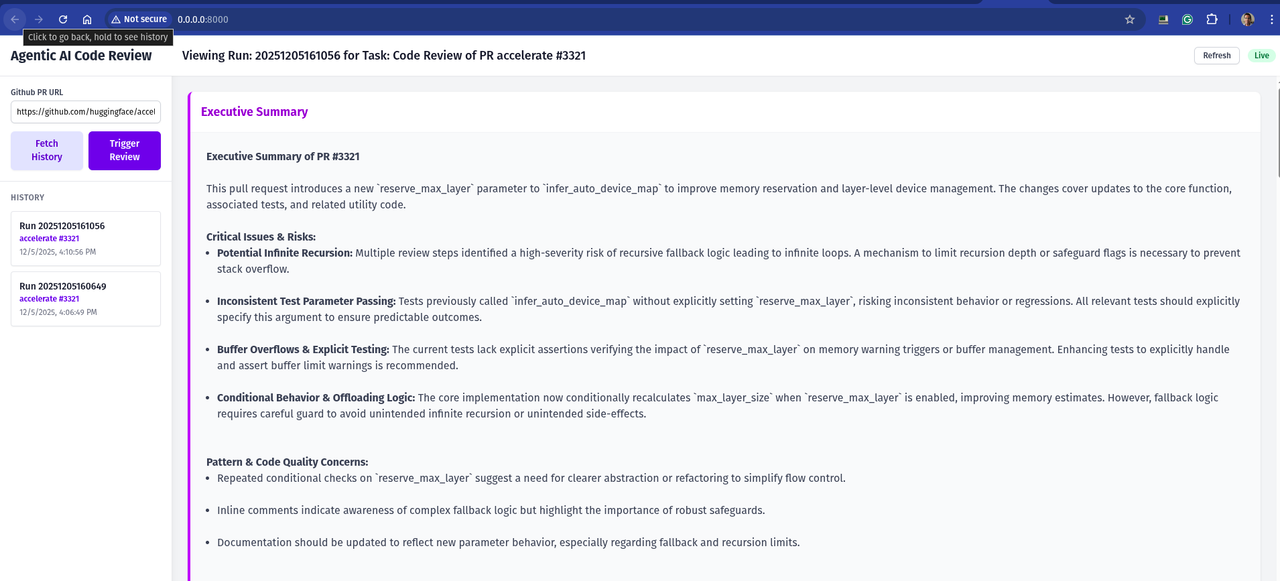
|
| 118 |
+
|
| 119 |
+
## Deploying to Hugging Face Spaces
|
| 120 |
+
|
| 121 |
+
This repository includes a configuration to deploy directly to Hugging Face Spaces (Docker SDK).
|
| 122 |
+
|
| 123 |
+
1. **Create a New Space**:
|
| 124 |
+
- Go to [Hugging Face Spaces](https://huggingface.co/spaces).
|
| 125 |
+
- Create a new Space.
|
| 126 |
+
- Select **Docker** as the SDK.
|
| 127 |
+
|
| 128 |
+
2. **Upload Files**:
|
| 129 |
+
- Upload the contents of this repository to your Space.
|
| 130 |
+
- **Important**: You must tell Hugging Face to use `Dockerfile.hf` instead of the default `Dockerfile`.
|
| 131 |
+
- You can do this by renaming `Dockerfile.hf` to `Dockerfile` in the Space, or by configuring the Space settings if supported.
|
| 132 |
+
- *Recommendation*: Rename `Dockerfile` to `Dockerfile.local` and `Dockerfile.hf` to `Dockerfile` before pushing to the Space.
|
| 133 |
+
|
| 134 |
+
3. **Set Secrets**:
|
| 135 |
+
- In your Space settings, go to **Settings > Variables and secrets**.
|
| 136 |
+
- Add a new secret: `OPENAI_API_KEY` with your API key.
|
| 137 |
+
|
| 138 |
+
4. **Run**:
|
| 139 |
+
- The Space will build and start.
|
| 140 |
+
- Once running, you will see the web interface.
|
| 141 |
+
|
| 142 |
+
---
|
| 143 |
+
|
| 144 |
+
## References
|
| 145 |
+
- [Model Context Protocol](https://github.com/modelcontextprotocol/specification)
|
| 146 |
+
- [Tree-Sitter](https://tree-sitter.github.io/tree-sitter/)
|
| 147 |
+
- [codereview_mcp_server](https://github.com/alexcpn/codereview_mcp_server)
|
| 148 |
+
- [nmagents (noagent-ai)](https://github.com/alexcpn/noagent-ai)
|
| 149 |
+
- [uv package manager](https://github.com/astral-sh/uv)
|
agent_interface.py
ADDED
|
@@ -0,0 +1,48 @@
|
|
|
|
|
|
|
|
|
|
|
|
|
|
|
|
|
|
|
|
|
|
|
|
|
|
|
|
|
|
|
|
|
|
|
|
|
|
|
|
|
|
|
|
|
|
|
|
|
|
|
|
|
|
|
|
|
|
|
|
|
|
|
|
|
|
|
|
|
|
|
|
|
|
|
|
|
|
|
|
|
|
|
|
|
|
|
|
|
|
|
|
|
|
|
|
|
|
|
|
|
|
|
|
|
|
|
|
|
|
|
|
|
|
|
|
|
|
|
|
|
|
|
|
|
|
|
|
|
|
|
|
|
|
|
|
|
|
|
|
|
|
|
|
|
|
|
|
| 1 |
+
import grpc
|
| 2 |
+
from concurrent import futures
|
| 3 |
+
import logging as log
|
| 4 |
+
import os
|
| 5 |
+
import asyncio
|
| 6 |
+
import protos.agent_pb2 as agent_pb2
|
| 7 |
+
import protos.agent_pb2_grpc as agent_pb2_grpc
|
| 8 |
+
from review_orchestrator import CodeReviewOrchestrator
|
| 9 |
+
from load_dotenv import load_dotenv
|
| 10 |
+
load_dotenv()
|
| 11 |
+
|
| 12 |
+
# Configure logging
|
| 13 |
+
log.basicConfig(level=log.INFO, format="%(asctime)s [%(levelname)s] %(message)s")
|
| 14 |
+
|
| 15 |
+
class CodeReviewAgentServicer(agent_pb2_grpc.CodeReviewAgentServicer):
|
| 16 |
+
def __init__(self):
|
| 17 |
+
self.orchestrator = CodeReviewOrchestrator()
|
| 18 |
+
|
| 19 |
+
def ReviewPR(self, request, context):
|
| 20 |
+
repo_url = request.repo_url
|
| 21 |
+
async def ReviewPR(self, request, context):
|
| 22 |
+
log.info(f"Received review request for PR #{request.pr_number}")
|
| 23 |
+
try:
|
| 24 |
+
async for result in self.orchestrator.review_pr_stream(request.repo_url, request.pr_number):
|
| 25 |
+
yield agent_pb2.ReviewResponse(
|
| 26 |
+
status="Success",
|
| 27 |
+
review_comment=result["comment"],
|
| 28 |
+
file_path=result["file_path"]
|
| 29 |
+
)
|
| 30 |
+
except Exception as e:
|
| 31 |
+
log.error(f"Error during review: {e}")
|
| 32 |
+
yield agent_pb2.ReviewResponse(
|
| 33 |
+
status="Error",
|
| 34 |
+
review_comment=str(e),
|
| 35 |
+
file_path=""
|
| 36 |
+
)
|
| 37 |
+
|
| 38 |
+
async def serve():
|
| 39 |
+
server = grpc.aio.server()
|
| 40 |
+
agent_pb2_grpc.add_CodeReviewAgentServicer_to_server(CodeReviewAgentServicer(), server)
|
| 41 |
+
server.add_insecure_port('[::]:50051')
|
| 42 |
+
log.info("Starting Async gRPC server on port 50051...")
|
| 43 |
+
await server.start()
|
| 44 |
+
await server.wait_for_termination()
|
| 45 |
+
|
| 46 |
+
if __name__ == '__main__':
|
| 47 |
+
import asyncio
|
| 48 |
+
asyncio.run(serve())
|
git_utils.py
ADDED
|
@@ -0,0 +1,31 @@
|
|
|
|
|
|
|
|
|
|
|
|
|
|
|
|
|
|
|
|
|
|
|
|
|
|
|
|
|
|
|
|
|
|
|
|
|
|
|
|
|
|
|
|
|
|
|
|
|
|
|
|
|
|
|
|
|
|
|
|
|
|
|
|
|
|
|
|
|
|
|
|
|
|
|
|
|
|
|
|
|
|
|
|
|
|
|
|
|
|
|
|
|
|
|
|
|
| 1 |
+
import requests
|
| 2 |
+
import re
|
| 3 |
+
from collections import defaultdict
|
| 4 |
+
import logging as log
|
| 5 |
+
|
| 6 |
+
|
| 7 |
+
def get_pr_diff_url(repo_url, pr_number):
|
| 8 |
+
"""
|
| 9 |
+
Get the diff URL for a specific pull request number.
|
| 10 |
+
Args:
|
| 11 |
+
repo_url (str): The URL of the GitHub repository.
|
| 12 |
+
pr_number (int): The pull request number.
|
| 13 |
+
"""
|
| 14 |
+
pr_diff_url = f"https://patch-diff.githubusercontent.com/raw/{repo_url.split('/')[-2]}/{repo_url.split('/')[-1]}/pull/{pr_number}.diff"
|
| 15 |
+
response = requests.get(pr_diff_url,verify=False)
|
| 16 |
+
|
| 17 |
+
if response.status_code != 200:
|
| 18 |
+
log.error(f"Failed to fetch diff: {response.status_code}")
|
| 19 |
+
raise ValueError(f"Failed to fetch diff: {response.status_code}")
|
| 20 |
+
|
| 21 |
+
diff_text = response.text
|
| 22 |
+
file_diffs = defaultdict(str)
|
| 23 |
+
file_diff_pattern = re.compile(r'^diff --git a/(.*?) b/\1$', re.MULTILINE)
|
| 24 |
+
split_points = list(file_diff_pattern.finditer(diff_text))
|
| 25 |
+
for i, match in enumerate(split_points):
|
| 26 |
+
file_path = match.group(1)
|
| 27 |
+
start = match.start()
|
| 28 |
+
end = split_points[i + 1].start() if i + 1 < len(split_points) else len(diff_text)
|
| 29 |
+
file_diffs[file_path] = diff_text[start:end]
|
| 30 |
+
return file_diffs
|
| 31 |
+
|
pyproject.toml
ADDED
|
@@ -0,0 +1,25 @@
|
|
|
|
|
|
|
|
|
|
|
|
|
|
|
|
|
|
|
|
|
|
|
|
|
|
|
|
|
|
|
|
|
|
|
|
|
|
|
|
|
|
|
|
|
|
|
|
|
|
|
|
|
|
|
|
|
|
|
|
|
|
|
|
|
|
|
|
|
|
|
|
|
|
|
|
|
|
|
| 1 |
+
[project]
|
| 2 |
+
name = "llm-code-review-agent"
|
| 3 |
+
version = "0.1.0"
|
| 4 |
+
description = "Add your description here"
|
| 5 |
+
readme = "README.md"
|
| 6 |
+
requires-python = ">=3.10"
|
| 7 |
+
dependencies = [
|
| 8 |
+
"fastapi>=0.115.12",
|
| 9 |
+
"fastmcp>=2.3.4",
|
| 10 |
+
"gitpython>=3.1.44",
|
| 11 |
+
"mcp[cli]>=1.9.0",
|
| 12 |
+
"openai>=1.79.0",
|
| 13 |
+
"openai-agents>=0.0.17",
|
| 14 |
+
"pyyaml>=6.0.2",
|
| 15 |
+
"requests>=2.32.3",
|
| 16 |
+
"tiktoken>=0.9.0",
|
| 17 |
+
"uvicorn>=0.34.2",
|
| 18 |
+
"ray[default]==2.41.0",
|
| 19 |
+
"grpcio>=1.60.0",
|
| 20 |
+
"grpcio-tools>=1.60.0",
|
| 21 |
+
"nmagents>=0.1.0",
|
| 22 |
+
"load-dotenv>=0.1.0",
|
| 23 |
+
"redis>=5.0.0",
|
| 24 |
+
"jinja2>=3.1.0",
|
| 25 |
+
]
|
review_orchestrator.py
ADDED
|
@@ -0,0 +1,348 @@
|
|
|
|
|
|
|
|
|
|
|
|
|
|
|
|
|
|
|
|
|
|
|
|
|
|
|
|
|
|
|
|
|
|
|
|
|
|
|
|
|
|
|
|
|
|
|
|
|
|
|
|
|
|
|
|
|
|
|
|
|
|
|
|
|
|
|
|
|
|
|
|
|
|
|
|
|
|
|
|
|
|
|
|
|
|
|
|
|
|
|
|
|
|
|
|
|
|
|
|
|
|
|
|
|
|
|
|
|
|
|
|
|
|
|
|
|
|
|
|
|
|
|
|
|
|
|
|
|
|
|
|
|
|
|
|
|
|
|
|
|
|
|
|
|
|
|
|
|
|
|
|
|
|
|
|
|
|
|
|
|
|
|
|
|
|
|
|
|
|
|
|
|
|
|
|
|
|
|
|
|
|
|
|
|
|
|
|
|
|
|
|
|
|
|
|
|
|
|
|
|
|
|
|
|
|
|
|
|
|
|
|
|
|
|
|
|
|
|
|
|
|
|
|
|
|
|
|
|
|
|
|
|
|
|
|
|
|
|
|
|
|
|
|
|
|
|
|
|
|
|
|
|
|
|
|
|
|
|
|
|
|
|
|
|
|
|
|
|
|
|
|
|
|
|
|
|
|
|
|
|
|
|
|
|
|
|
|
|
|
|
|
|
|
|
|
|
|
|
|
|
|
|
|
|
|
|
|
|
|
|
|
|
|
|
|
|
|
|
|
|
|
|
|
|
|
|
|
|
|
|
|
|
|
|
|
|
|
|
|
|
|
|
|
|
|
|
|
|
|
|
|
|
|
|
|
|
|
|
|
|
|
|
|
|
|
|
|
|
|
|
|
|
|
|
|
|
|
|
|
|
|
|
|
|
|
|
|
|
|
|
|
|
|
|
|
|
|
|
|
|
|
|
|
|
|
|
|
|
|
|
|
|
|
|
|
|
|
|
|
|
|
|
|
|
|
|
|
|
|
|
|
|
|
|
|
|
|
|
|
|
|
|
|
|
|
|
|
|
|
|
|
|
|
|
|
|
|
|
|
|
|
|
|
|
|
|
|
|
|
|
|
|
|
|
|
|
|
|
|
|
|
|
|
|
|
|
|
|
|
|
|
|
|
|
|
|
|
|
|
|
|
|
|
|
|
|
|
|
|
|
|
|
|
|
|
|
|
|
|
|
|
|
|
|
|
|
|
|
|
|
|
|
|
|
|
|
|
|
|
|
|
|
|
|
|
|
|
|
|
|
|
|
|
|
|
|
|
|
|
|
|
|
|
|
|
|
|
|
|
|
|
|
|
|
|
|
|
|
|
|
|
|
|
|
|
|
|
|
|
|
|
|
|
|
|
|
|
|
|
|
|
|
|
|
|
|
|
|
|
|
|
|
|
|
|
|
|
|
|
|
|
|
|
|
|
|
|
|
|
|
|
|
|
|
|
|
|
|
|
|
|
|
|
|
|
|
|
|
|
|
|
|
|
|
|
|
|
|
|
|
|
|
|
|
|
|
|
|
|
|
|
|
|
|
|
|
|
|
|
|
|
|
|
|
|
|
|
|
|
|
|
|
|
|
|
|
|
|
|
|
|
|
|
|
|
|
|
|
|
|
|
|
|
|
|
|
|
|
|
|
|
|
|
|
|
|
|
|
|
|
|
|
|
|
|
|
|
|
|
|
|
|
|
|
|
|
|
|
|
|
|
|
|
|
|
|
|
|
|
|
|
|
|
|
|
|
|
|
|
|
|
|
|
|
|
|
|
|
|
|
|
|
|
|
|
|
|
|
|
|
|
|
|
|
|
|
|
|
|
|
|
|
|
|
|
|
|
|
|
|
|
|
|
|
|
|
|
|
|
|
|
|
|
|
|
|
|
|
|
|
|
|
|
|
|
|
|
|
|
|
|
|
|
|
|
|
|
|
|
|
|
|
|
|
|
|
|
|
|
|
|
|
|
|
|
|
|
|
|
|
|
|
|
|
|
|
|
|
|
|
|
|
|
|
|
|
|
|
|
|
|
|
|
|
|
|
|
|
|
|
|
|
|
|
|
|
|
|
|
|
|
|
|
|
|
|
|
|
|
|
|
|
|
|
|
|
|
|
|
|
|
|
|
|
|
|
|
|
|
|
|
|
|
|
|
|
|
|
|
|
|
|
|
|
|
|
|
|
|
|
|
|
|
|
|
|
|
|
|
|
|
|
|
|
|
|
|
|
|
|
|
|
|
|
|
|
|
|
|
|
|
|
|
|
|
|
|
|
|
|
|
|
|
|
|
|
|
|
|
|
|
|
|
|
|
|
|
|
|
|
|
|
|
|
|
|
|
|
|
|
|
|
|
|
|
|
|
|
|
|
|
|
|
|
|
|
|
| 1 |
+
import ray
|
| 2 |
+
import os
|
| 3 |
+
import logging as log
|
| 4 |
+
import yaml
|
| 5 |
+
from datetime import datetime
|
| 6 |
+
from typing import Any, List, Dict
|
| 7 |
+
import git_utils
|
| 8 |
+
from fastmcp import Client
|
| 9 |
+
from openai import OpenAI
|
| 10 |
+
from dotenv import load_dotenv
|
| 11 |
+
from nmagents.command import CallLLM, ToolCall, ToolList
|
| 12 |
+
from nmagents.utils import parse_json_response_with_repair, execute_step_tools
|
| 13 |
+
from pathlib import Path
|
| 14 |
+
import redis
|
| 15 |
+
import json
|
| 16 |
+
|
| 17 |
+
# Configure logging
|
| 18 |
+
log.basicConfig(level=log.INFO, format="%(asctime)s [%(levelname)s] %(message)s")
|
| 19 |
+
|
| 20 |
+
# Load environment variables
|
| 21 |
+
load_dotenv()
|
| 22 |
+
|
| 23 |
+
# Constants
|
| 24 |
+
MAX_CONTEXT_LENGTH = 16385
|
| 25 |
+
COST_PER_TOKEN_INPUT = 0.10 / 10e6
|
| 26 |
+
COST_PER_TOKEN_OUTPUT = 0.40 / 10e6
|
| 27 |
+
MODEL_NAME = "gpt-4.1-nano"
|
| 28 |
+
FALLBACK_MODEL_NAME = os.getenv("JSON_REPAIR_MODEL", "gpt-4.1-nano")
|
| 29 |
+
FALLBACK_MAX_BUDGET = float(os.getenv("JSON_REPAIR_MAX_BUDGET", "0.2"))
|
| 30 |
+
AST_MCP_SERVER_URL = os.getenv("CODE_AST_MCP_SERVER_URL", "http://127.0.0.1:7860/mcp/")
|
| 31 |
+
|
| 32 |
+
if AST_MCP_SERVER_URL and not AST_MCP_SERVER_URL.endswith("/"):
|
| 33 |
+
AST_MCP_SERVER_URL = AST_MCP_SERVER_URL + "/"
|
| 34 |
+
|
| 35 |
+
TEMPLATE_PATH = Path(__file__).parent / "prompts/code_review_prompts.txt"
|
| 36 |
+
|
| 37 |
+
def load_prompt(**placeholders) -> str:
|
| 38 |
+
template = TEMPLATE_PATH.read_text(encoding="utf-8")
|
| 39 |
+
default_values = {
|
| 40 |
+
"arch_notes_or_empty": "",
|
| 41 |
+
"guidelines_list_or_link": "",
|
| 42 |
+
"threat_model_or_empty": "",
|
| 43 |
+
"perf_slos_or_empty": "",
|
| 44 |
+
"tool_outputs": "",
|
| 45 |
+
"diff_or_code_block": "",
|
| 46 |
+
}
|
| 47 |
+
merged = {**default_values, **placeholders}
|
| 48 |
+
for key, value in merged.items():
|
| 49 |
+
value_str = str(value)
|
| 50 |
+
template = template.replace(f"{{{{{key}}}}}", value_str)
|
| 51 |
+
template = template.replace(f"{{{key}}}", value_str)
|
| 52 |
+
return template
|
| 53 |
+
|
| 54 |
+
@ray.remote
|
| 55 |
+
def process_file_review(file_path: str, diff: str, repo_url: str, pr_number: int, tool_schemas_content: str, step_schema_content: str, time_hash: str, redis_host: str, redis_port: int, api_key: str | None = None, mcp_server_url: str | None = None):
|
| 56 |
+
import asyncio
|
| 57 |
+
return asyncio.run(_process_file_review_async(file_path, diff, repo_url, pr_number, tool_schemas_content, step_schema_content, time_hash, redis_host, redis_port, api_key, mcp_server_url))
|
| 58 |
+
|
| 59 |
+
async def _process_file_review_async(file_path: str, diff: str, repo_url: str, pr_number: int, tool_schemas_content: str, step_schema_content: str, time_hash: str, redis_host: str, redis_port: int, api_key: str | None = None, mcp_server_url: str | None = None):
|
| 60 |
+
log.info(f"Starting review for {file_path}")
|
| 61 |
+
|
| 62 |
+
# Initialize Redis client
|
| 63 |
+
# redis_host and redis_port are passed from the orchestrator
|
| 64 |
+
redis_client = redis.Redis(host=redis_host, port=redis_port, db=0)
|
| 65 |
+
repo_name = repo_url.rstrip('/').split('/')[-1]
|
| 66 |
+
stream_key = f"review:stream:{repo_name}:{pr_number}:{time_hash}"
|
| 67 |
+
runs_key = f"review:runs:{repo_name}:{pr_number}"
|
| 68 |
+
|
| 69 |
+
# Add this run to the history
|
| 70 |
+
try:
|
| 71 |
+
redis_client.sadd(runs_key, time_hash)
|
| 72 |
+
except Exception as e:
|
| 73 |
+
log.error(f"Failed to add run to history: {e}")
|
| 74 |
+
|
| 75 |
+
# Re-initialize clients inside the remote task
|
| 76 |
+
if not api_key:
|
| 77 |
+
api_key = os.getenv("OPENAI_API_KEY")
|
| 78 |
+
openai_client = OpenAI(api_key=api_key, base_url="https://api.openai.com/v1")
|
| 79 |
+
|
| 80 |
+
call_llm_command = CallLLM(openai_client, "Call the LLM", MODEL_NAME, COST_PER_TOKEN_INPUT, COST_PER_TOKEN_OUTPUT, 0.5)
|
| 81 |
+
repair_llm_command = CallLLM(openai_client, "Repair YAML", FALLBACK_MODEL_NAME, COST_PER_TOKEN_INPUT, COST_PER_TOKEN_OUTPUT, FALLBACK_MAX_BUDGET)
|
| 82 |
+
|
| 83 |
+
step_execution_results = []
|
| 84 |
+
|
| 85 |
+
# Use passed URL or fallback to env var
|
| 86 |
+
mcp_url = mcp_server_url or AST_MCP_SERVER_URL
|
| 87 |
+
if not mcp_url.endswith("/"):
|
| 88 |
+
mcp_url = mcp_url + "/"
|
| 89 |
+
|
| 90 |
+
async with Client(mcp_url) as ast_tool_client:
|
| 91 |
+
ast_tool_call_command = ToolCall(ast_tool_client, "Call tool")
|
| 92 |
+
|
| 93 |
+
main_context = f""" Your task today is Code Reivew. You are given the following '{pr_number}' to review from the repo '{repo_url}'
|
| 94 |
+
You have to first come up with a plan to review the code changes in the PR as a series of steps.
|
| 95 |
+
Write the plan as per the following step schema: {step_schema_content}
|
| 96 |
+
Make sure to follow the step schema format exactly and output only JSON """
|
| 97 |
+
|
| 98 |
+
context = main_context + f" Here is the file diff for {file_path}:\n{diff} for review\n" + \
|
| 99 |
+
f"You have access to the following MCP tools to help you with your code review: {tool_schemas_content}"
|
| 100 |
+
|
| 101 |
+
response = call_llm_command.execute(context)
|
| 102 |
+
log.info(f"Plan generated for {file_path}")
|
| 103 |
+
|
| 104 |
+
response_data, _ = parse_json_response_with_repair(
|
| 105 |
+
response_text=response or "",
|
| 106 |
+
schema_hint=step_schema_content,
|
| 107 |
+
repair_command=repair_llm_command,
|
| 108 |
+
context_label="plan",
|
| 109 |
+
)
|
| 110 |
+
|
| 111 |
+
if not response_data:
|
| 112 |
+
log.error(f"Failed to parse plan for {file_path}")
|
| 113 |
+
return {
|
| 114 |
+
"file_path": file_path,
|
| 115 |
+
"results": [{"step_name": "plan", "error": "Failed to parse plan"}]
|
| 116 |
+
}
|
| 117 |
+
|
| 118 |
+
# Save plan log
|
| 119 |
+
safe_filename = file_path.replace("/", "_").replace("\\", "_")
|
| 120 |
+
repo_name = repo_url.rstrip('/').split('/')[-1]
|
| 121 |
+
job_dir = f"{repo_name}_PR{pr_number}_{time_hash}"
|
| 122 |
+
logs_dir = Path("logs") / job_dir
|
| 123 |
+
logs_dir.mkdir(parents=True, exist_ok=True)
|
| 124 |
+
|
| 125 |
+
plan_log_path = logs_dir / f"plan_{safe_filename}.yaml"
|
| 126 |
+
with open(plan_log_path, "w", encoding="utf-8") as f:
|
| 127 |
+
yaml.dump(response_data, f)
|
| 128 |
+
|
| 129 |
+
# Publish plan to Redis
|
| 130 |
+
try:
|
| 131 |
+
redis_client.xadd(stream_key, {
|
| 132 |
+
"type": "plan",
|
| 133 |
+
"file_path": file_path,
|
| 134 |
+
"content": json.dumps(response_data)
|
| 135 |
+
})
|
| 136 |
+
except Exception as e:
|
| 137 |
+
log.error(f"Failed to write plan to Redis: {e}")
|
| 138 |
+
|
| 139 |
+
steps = response_data.get("steps", [])
|
| 140 |
+
|
| 141 |
+
for index, step in enumerate(steps, start=1):
|
| 142 |
+
name = step.get("name", "<unnamed>")
|
| 143 |
+
step_description = step.get("description", "")
|
| 144 |
+
|
| 145 |
+
tools = step.get("tools", [])
|
| 146 |
+
if tools:
|
| 147 |
+
log.info(f"Executing tools for step {name}: {tools}")
|
| 148 |
+
tool_outputs = await execute_step_tools(step, ast_tool_call_command)
|
| 149 |
+
for output in tool_outputs:
|
| 150 |
+
tool_result_context = load_prompt(repo_name=repo_url, brief_change_summary=step_description,
|
| 151 |
+
diff_or_code_block=diff, tool_outputs=output)
|
| 152 |
+
step["tool_results"] = tool_result_context
|
| 153 |
+
|
| 154 |
+
try:
|
| 155 |
+
step_context = load_prompt(repo_name=repo_url, brief_change_summary=step_description,
|
| 156 |
+
diff_or_code_block=diff, tool_outputs=step.get("tool_results", ""))
|
| 157 |
+
|
| 158 |
+
step_response = call_llm_command.execute(step_context)
|
| 159 |
+
|
| 160 |
+
step_data, _ = parse_json_response_with_repair(
|
| 161 |
+
response_text=step_response or "",
|
| 162 |
+
schema_hint="",
|
| 163 |
+
repair_command=repair_llm_command,
|
| 164 |
+
context_label=f"step {name}",
|
| 165 |
+
)
|
| 166 |
+
|
| 167 |
+
if not step_data:
|
| 168 |
+
log.error(f"Failed to parse result for step {name}")
|
| 169 |
+
step_execution_results.append({
|
| 170 |
+
"step_name": name,
|
| 171 |
+
"error": "Failed to parse step result"
|
| 172 |
+
})
|
| 173 |
+
continue
|
| 174 |
+
|
| 175 |
+
# Save step log
|
| 176 |
+
step_log_path = logs_dir / f"step_{name}_{safe_filename}.yaml"
|
| 177 |
+
with open(step_log_path, "w", encoding="utf-8") as f:
|
| 178 |
+
yaml.dump(step_data, f)
|
| 179 |
+
|
| 180 |
+
step_execution_results.append({
|
| 181 |
+
"step_name": name,
|
| 182 |
+
"result": step_data
|
| 183 |
+
})
|
| 184 |
+
|
| 185 |
+
# Publish step result to Redis
|
| 186 |
+
try:
|
| 187 |
+
redis_client.xadd(stream_key, {
|
| 188 |
+
"type": "step",
|
| 189 |
+
"file_path": file_path,
|
| 190 |
+
"step_name": name,
|
| 191 |
+
"content": json.dumps(step_data)
|
| 192 |
+
})
|
| 193 |
+
except Exception as e:
|
| 194 |
+
log.error(f"Failed to write step to Redis: {e}")
|
| 195 |
+
|
| 196 |
+
except Exception as e:
|
| 197 |
+
log.error(f"Failed to execute step {name} for {file_path}: {e}")
|
| 198 |
+
step_execution_results.append({
|
| 199 |
+
"step_name": name,
|
| 200 |
+
"error": str(e)
|
| 201 |
+
})
|
| 202 |
+
break
|
| 203 |
+
|
| 204 |
+
return {
|
| 205 |
+
"file_path": file_path,
|
| 206 |
+
"results": step_execution_results
|
| 207 |
+
}
|
| 208 |
+
|
| 209 |
+
class CodeReviewOrchestrator:
|
| 210 |
+
def __init__(self):
|
| 211 |
+
# Initialize Ray
|
| 212 |
+
# Check if running in a cluster or local
|
| 213 |
+
ray_address = os.getenv("RAY_ADDRESS")
|
| 214 |
+
if ray_address:
|
| 215 |
+
ray.init(address=ray_address, ignore_reinit_error=True)
|
| 216 |
+
else:
|
| 217 |
+
ray.init(ignore_reinit_error=True)
|
| 218 |
+
|
| 219 |
+
async def review_pr_stream(self, repo_url: str, pr_number: int, time_hash: str = None, api_key: str | None = None, mcp_server_url: str | None = None):
|
| 220 |
+
log.info(f"Orchestrating review for {repo_url} PR #{pr_number}")
|
| 221 |
+
|
| 222 |
+
# Get diffs
|
| 223 |
+
try:
|
| 224 |
+
file_diffs = git_utils.get_pr_diff_url(repo_url, pr_number)
|
| 225 |
+
except Exception as e:
|
| 226 |
+
log.error(f"Failed to get diffs: {e}")
|
| 227 |
+
yield {
|
| 228 |
+
"type": "error",
|
| 229 |
+
"file_path": "system",
|
| 230 |
+
"content": json.dumps({"error": f"Failed to get diffs: {str(e)}"})
|
| 231 |
+
}
|
| 232 |
+
return
|
| 233 |
+
|
| 234 |
+
# Get tool schemas (need to do this once)
|
| 235 |
+
# Use passed URL or fallback to env var
|
| 236 |
+
mcp_url = mcp_server_url or AST_MCP_SERVER_URL
|
| 237 |
+
if not mcp_url.endswith("/"):
|
| 238 |
+
mcp_url = mcp_url + "/"
|
| 239 |
+
|
| 240 |
+
async with Client(mcp_url) as ast_tool_client:
|
| 241 |
+
ast_tool_list_command = ToolList(ast_tool_client, "List tools")
|
| 242 |
+
tool_schemas_content = await ast_tool_list_command.execute(None)
|
| 243 |
+
|
| 244 |
+
sample_step_schema_file = "schemas/steps_schema.json"
|
| 245 |
+
with open(sample_step_schema_file, "r", encoding="utf-8") as f:
|
| 246 |
+
step_schema_content = f.read()
|
| 247 |
+
|
| 248 |
+
if not time_hash:
|
| 249 |
+
time_hash = datetime.now().strftime("%Y%m%d%H%M%S")
|
| 250 |
+
|
| 251 |
+
# Redis config to pass to workers
|
| 252 |
+
redis_host = os.getenv("REDIS_HOST", "localhost")
|
| 253 |
+
redis_port = int(os.getenv("REDIS_PORT", 6380))
|
| 254 |
+
|
| 255 |
+
# Launch Ray tasks
|
| 256 |
+
pending_futures = []
|
| 257 |
+
for file_path, diff in file_diffs.items():
|
| 258 |
+
pending_futures.append(process_file_review.remote(
|
| 259 |
+
file_path, diff, repo_url, pr_number, tool_schemas_content, step_schema_content, time_hash, redis_host, redis_port, api_key, mcp_url
|
| 260 |
+
))
|
| 261 |
+
|
| 262 |
+
# Collect all reviews for final summary
|
| 263 |
+
all_reviews_context = ""
|
| 264 |
+
|
| 265 |
+
# Process results as they complete
|
| 266 |
+
while pending_futures:
|
| 267 |
+
# Run ray.wait in a separate thread to avoid blocking the asyncio event loop
|
| 268 |
+
import asyncio
|
| 269 |
+
done_futures, pending_futures = await asyncio.to_thread(ray.wait, pending_futures)
|
| 270 |
+
for future in done_futures:
|
| 271 |
+
try:
|
| 272 |
+
result = await future
|
| 273 |
+
|
| 274 |
+
# Format the result for this file
|
| 275 |
+
file_summary = f"File: {result['file_path']}\n"
|
| 276 |
+
for step in result['results']:
|
| 277 |
+
if 'error' in step:
|
| 278 |
+
file_summary += f"- {step['step_name']}: [Error] {step['error']}\n"
|
| 279 |
+
else:
|
| 280 |
+
file_summary += f"- {step['step_name']}: {step['result']}\n"
|
| 281 |
+
|
| 282 |
+
all_reviews_context += file_summary + "\n" + "-"*40 + "\n"
|
| 283 |
+
|
| 284 |
+
yield {
|
| 285 |
+
"file_path": result['file_path'],
|
| 286 |
+
"comment": file_summary
|
| 287 |
+
}
|
| 288 |
+
except Exception as e:
|
| 289 |
+
log.error(f"Error processing result from ray: {e}")
|
| 290 |
+
yield {
|
| 291 |
+
"file_path": "system",
|
| 292 |
+
"comment": f"Error: {str(e)}"
|
| 293 |
+
}
|
| 294 |
+
|
| 295 |
+
# Generate Final Consolidated Summary
|
| 296 |
+
log.info("Generating consolidated PR summary...")
|
| 297 |
+
try:
|
| 298 |
+
if not api_key:
|
| 299 |
+
api_key = os.getenv("OPENAI_API_KEY")
|
| 300 |
+
openai_client = OpenAI(api_key=api_key, base_url="https://api.openai.com/v1")
|
| 301 |
+
summary_llm_command = CallLLM(openai_client, "Summarize PR", MODEL_NAME, COST_PER_TOKEN_INPUT, COST_PER_TOKEN_OUTPUT, 0.5)
|
| 302 |
+
|
| 303 |
+
summary_prompt = f"""
|
| 304 |
+
You are a Principal Software Engineer.
|
| 305 |
+
Review the following code review results for PR #{pr_number} in {repo_url}.
|
| 306 |
+
|
| 307 |
+
Aggregated Reviews:
|
| 308 |
+
{all_reviews_context}
|
| 309 |
+
|
| 310 |
+
Please provide a concise Executive Summary of the PR.
|
| 311 |
+
1. Highlight the most critical issues found across all files.
|
| 312 |
+
2. Identify any recurring patterns or code quality concerns.
|
| 313 |
+
3. Provide a final recommendation (Merge, Request Changes, etc.).
|
| 314 |
+
"""
|
| 315 |
+
|
| 316 |
+
final_summary = summary_llm_command.execute(summary_prompt)
|
| 317 |
+
|
| 318 |
+
# Publish summary to Redis
|
| 319 |
+
try:
|
| 320 |
+
redis_client = redis.Redis(host=redis_host, port=redis_port, db=0)
|
| 321 |
+
stream_key = f"review:stream:{repo_url.rstrip('/').split('/')[-1]}:{pr_number}:{time_hash}"
|
| 322 |
+
redis_client.xadd(stream_key, {
|
| 323 |
+
"type": "summary",
|
| 324 |
+
"file_path": "PR_SUMMARY",
|
| 325 |
+
"content": final_summary,
|
| 326 |
+
"repo_url": repo_url,
|
| 327 |
+
"pr_number": str(pr_number)
|
| 328 |
+
})
|
| 329 |
+
redis_client.close()
|
| 330 |
+
except Exception as e:
|
| 331 |
+
log.error(f"Failed to write summary to Redis: {e}")
|
| 332 |
+
|
| 333 |
+
yield {
|
| 334 |
+
"file_path": "PR_SUMMARY",
|
| 335 |
+
"comment": f"# Consolidated PR Summary\n\n{final_summary}"
|
| 336 |
+
}
|
| 337 |
+
|
| 338 |
+
# Save summary log
|
| 339 |
+
logs_dir = Path("logs") / f"{repo_url.rstrip('/').split('/')[-1]}_PR{pr_number}_{time_hash}"
|
| 340 |
+
with open(logs_dir / "pr_summary.md", "w", encoding="utf-8") as f:
|
| 341 |
+
f.write(final_summary)
|
| 342 |
+
|
| 343 |
+
except Exception as e:
|
| 344 |
+
log.error(f"Failed to generate final summary: {e}")
|
| 345 |
+
yield {
|
| 346 |
+
"file_path": "PR_SUMMARY",
|
| 347 |
+
"comment": f"Failed to generate summary: {e}"
|
| 348 |
+
}
|
start_hf.sh
ADDED
|
@@ -0,0 +1,32 @@
|
|
|
|
|
|
|
|
|
|
|
|
|
|
|
|
|
|
|
|
|
|
|
|
|
|
|
|
|
|
|
|
|
|
|
|
|
|
|
|
|
|
|
|
|
|
|
|
|
|
|
|
|
|
|
|
|
|
|
|
|
|
|
|
|
|
|
|
|
|
|
|
|
|
|
|
|
|
|
|
|
|
|
|
|
|
|
|
|
|
|
|
|
|
|
|
|
|
|
|
| 1 |
+
#!/bin/bash
|
| 2 |
+
set -e
|
| 3 |
+
|
| 4 |
+
# Start Redis
|
| 5 |
+
echo "Starting Redis..."
|
| 6 |
+
redis-server --port 6380 &
|
| 7 |
+
|
| 8 |
+
# Start Ray
|
| 9 |
+
echo "Starting Ray..."
|
| 10 |
+
# We use --head to start a single node cluster
|
| 11 |
+
# We need to make sure it doesn't try to use too much memory if limited
|
| 12 |
+
uv run ray start --head --disable-usage-stats --port=6379 --dashboard-host=0.0.0.0
|
| 13 |
+
|
| 14 |
+
# Start MCP Server
|
| 15 |
+
echo "Starting MCP Server..."
|
| 16 |
+
cd codereview_mcp_server
|
| 17 |
+
uv run http_server.py &
|
| 18 |
+
MCP_PID=$!
|
| 19 |
+
cd ..
|
| 20 |
+
|
| 21 |
+
# Wait for MCP server to be ready (simple sleep for now, or check port)
|
| 22 |
+
sleep 5
|
| 23 |
+
|
| 24 |
+
# Set environment variables
|
| 25 |
+
export REDIS_PORT=6380
|
| 26 |
+
export AST_MCP_SERVER_URL=http://127.0.0.1:7860/mcp/
|
| 27 |
+
export RAY_ADDRESS="auto"
|
| 28 |
+
|
| 29 |
+
# Start Web Server
|
| 30 |
+
echo "Starting Web Server..."
|
| 31 |
+
# HF Spaces expects the app to listen on port 7860
|
| 32 |
+
uv run uvicorn web_server:app --host 0.0.0.0 --port 7860
|
test_client.py
ADDED
|
@@ -0,0 +1,25 @@
|
|
|
|
|
|
|
|
|
|
|
|
|
|
|
|
|
|
|
|
|
|
|
|
|
|
|
|
|
|
|
|
|
|
|
|
|
|
|
|
|
|
|
|
|
|
|
|
|
|
|
|
|
|
|
|
|
|
|
|
|
|
|
|
|
|
|
|
|
|
|
|
|
|
|
|
|
|
|
| 1 |
+
import grpc
|
| 2 |
+
import protos.agent_pb2 as agent_pb2
|
| 3 |
+
import protos.agent_pb2_grpc as agent_pb2_grpc
|
| 4 |
+
import logging as log
|
| 5 |
+
|
| 6 |
+
log.basicConfig(level=log.INFO)
|
| 7 |
+
|
| 8 |
+
def run():
|
| 9 |
+
with grpc.insecure_channel('localhost:50051') as channel:
|
| 10 |
+
stub = agent_pb2_grpc.CodeReviewAgentStub(channel)
|
| 11 |
+
log.info("Sending ReviewPR request...")
|
| 12 |
+
response_stream = stub.ReviewPR(agent_pb2.ReviewRequest(
|
| 13 |
+
repo_url="https://github.com/huggingface/accelerate",
|
| 14 |
+
pr_number=3321
|
| 15 |
+
))
|
| 16 |
+
|
| 17 |
+
log.info("Waiting for stream...")
|
| 18 |
+
for response in response_stream:
|
| 19 |
+
log.info(f"--- Received Review for {response.file_path} ---")
|
| 20 |
+
log.info(f"Status: {response.status}")
|
| 21 |
+
log.info(response.review_comment)
|
| 22 |
+
log.info("-" * 50)
|
| 23 |
+
|
| 24 |
+
if __name__ == '__main__':
|
| 25 |
+
run()
|
uv.lock
ADDED
|
The diff for this file is too large to render.
See raw diff
|
|
|
web_server.py
ADDED
|
@@ -0,0 +1,162 @@
|
|
|
|
|
|
|
|
|
|
|
|
|
|
|
|
|
|
|
|
|
|
|
|
|
|
|
|
|
|
|
|
|
|
|
|
|
|
|
|
|
|
|
|
|
|
|
|
|
|
|
|
|
|
|
|
|
|
|
|
|
|
|
|
|
|
|
|
|
|
|
|
|
|
|
|
|
|
|
|
|
|
|
|
|
|
|
|
|
|
|
|
|
|
|
|
|
|
|
|
|
|
|
|
|
|
|
|
|
|
|
|
|
|
|
|
|
|
|
|
|
|
|
|
|
|
|
|
|
|
|
|
|
|
|
|
|
|
|
|
|
|
|
|
|
|
|
|
|
|
|
|
|
|
|
|
|
|
|
|
|
|
|
|
|
|
|
|
|
|
|
|
|
|
|
|
|
|
|
|
|
|
|
|
|
|
|
|
|
|
|
|
|
|
|
|
|
|
|
|
|
|
|
|
|
|
|
|
|
|
|
|
|
|
|
|
|
|
|
|
|
|
|
|
|
|
|
|
|
|
|
|
|
|
|
|
|
|
|
|
|
|
|
|
|
|
|
|
|
|
|
|
|
|
|
|
|
|
|
|
|
|
|
|
|
|
|
|
|
|
|
|
|
|
|
|
|
|
|
|
|
|
|
|
|
|
|
|
|
|
|
|
|
|
|
|
|
|
|
|
|
|
|
|
|
|
|
|
|
|
|
|
|
|
|
|
|
|
|
|
|
|
|
|
|
|
|
|
|
|
|
|
|
|
|
|
|
|
|
|
|
|
|
|
|
|
|
|
|
|
|
|
|
|
|
|
|
|
|
|
|
|
|
|
|
|
|
|
|
|
|
|
|
|
|
|
|
|
|
|
|
|
|
|
|
|
|
|
|
|
|
|
|
|
|
|
|
|
|
|
|
|
|
|
|
|
|
|
|
|
|
|
|
|
|
|
|
|
|
|
|
|
|
|
|
|
|
|
|
|
|
|
|
|
|
|
|
|
|
|
|
|
|
|
|
|
|
|
|
|
|
|
|
|
|
|
|
|
|
|
|
|
|
|
|
|
|
|
|
|
|
|
|
|
|
|
|
|
|
|
|
|
|
|
|
|
|
|
|
|
| 1 |
+
import os
|
| 2 |
+
import json
|
| 3 |
+
import asyncio
|
| 4 |
+
import redis.asyncio as redis
|
| 5 |
+
from fastapi import FastAPI, Request, BackgroundTasks
|
| 6 |
+
from fastapi.responses import HTMLResponse, StreamingResponse
|
| 7 |
+
from fastapi.templating import Jinja2Templates
|
| 8 |
+
from fastapi.staticfiles import StaticFiles
|
| 9 |
+
from review_orchestrator import CodeReviewOrchestrator
|
| 10 |
+
from pydantic import BaseModel
|
| 11 |
+
from load_dotenv import load_dotenv
|
| 12 |
+
load_dotenv()
|
| 13 |
+
app = FastAPI()
|
| 14 |
+
templates = Jinja2Templates(directory="templates")
|
| 15 |
+
|
| 16 |
+
# Initialize Orchestrator
|
| 17 |
+
orchestrator = CodeReviewOrchestrator()
|
| 18 |
+
|
| 19 |
+
class ReviewRequest(BaseModel):
|
| 20 |
+
repo_url: str
|
| 21 |
+
pr_number: int
|
| 22 |
+
openai_api_key: str | None = None
|
| 23 |
+
mcp_server_url: str | None = None
|
| 24 |
+
|
| 25 |
+
class MCPRequest(BaseModel):
|
| 26 |
+
mcp_server_url: str
|
| 27 |
+
|
| 28 |
+
@app.get("/", response_class=HTMLResponse)
|
| 29 |
+
async def read_root(request: Request):
|
| 30 |
+
return templates.TemplateResponse("index.html", {"request": request})
|
| 31 |
+
|
| 32 |
+
@app.post("/list-tools")
|
| 33 |
+
async def list_tools(request: MCPRequest):
|
| 34 |
+
from fastmcp import Client
|
| 35 |
+
from nmagents.command import ToolList
|
| 36 |
+
|
| 37 |
+
try:
|
| 38 |
+
# Ensure URL ends with /
|
| 39 |
+
url = request.mcp_server_url
|
| 40 |
+
if not url.endswith("/"):
|
| 41 |
+
url = url + "/"
|
| 42 |
+
|
| 43 |
+
async with Client(url) as client:
|
| 44 |
+
# We can't easily use ToolList command here as it returns a formatted string
|
| 45 |
+
# We'll use the client directly to list tools if possible, or parse the output
|
| 46 |
+
# fastmcp client doesn't expose list_tools directly in a simple way without calling the server
|
| 47 |
+
# But nmagents ToolList does exactly that.
|
| 48 |
+
|
| 49 |
+
tool_list_command = ToolList(client, "List tools")
|
| 50 |
+
tools_description = await tool_list_command.execute(None)
|
| 51 |
+
return {"status": "success", "tools": tools_description}
|
| 52 |
+
except Exception as e:
|
| 53 |
+
return {"status": "error", "message": str(e)}
|
| 54 |
+
|
| 55 |
+
@app.post("/review")
|
| 56 |
+
async def trigger_review(request: ReviewRequest, background_tasks: BackgroundTasks):
|
| 57 |
+
# Trigger the review in the background
|
| 58 |
+
# We need to wrap the async generator to consume it, otherwise it won't run
|
| 59 |
+
# We need to get the time_hash to return it, but the orchestrator generates it.
|
| 60 |
+
# For now, we will generate it here and pass it, or just return a "latest" indicator.
|
| 61 |
+
# Better: Orchestrator's review_pr_stream generates it. We can't easily get it back from a background task.
|
| 62 |
+
# Solution: We will generate time_hash here and pass it to orchestrator (need to update orchestrator signature).
|
| 63 |
+
|
| 64 |
+
from datetime import datetime
|
| 65 |
+
time_hash = datetime.now().strftime("%Y%m%d%H%M%S")
|
| 66 |
+
|
| 67 |
+
# Add run to history immediately
|
| 68 |
+
redis_host = os.getenv("REDIS_HOST", "localhost")
|
| 69 |
+
redis_port = int(os.getenv("REDIS_PORT", 6380))
|
| 70 |
+
r = redis.Redis(host=redis_host, port=redis_port, db=0, decode_responses=True)
|
| 71 |
+
repo_name = request.repo_url.rstrip('/').split('/')[-1]
|
| 72 |
+
runs_key = f"review:runs:{repo_name}:{request.pr_number}"
|
| 73 |
+
await r.sadd(runs_key, time_hash)
|
| 74 |
+
await r.close()
|
| 75 |
+
|
| 76 |
+
background_tasks.add_task(run_review, request.repo_url, request.pr_number, time_hash, request.openai_api_key, request.mcp_server_url)
|
| 77 |
+
|
| 78 |
+
return {"status": "Review started", "time_hash": time_hash, "stream_url": f"/stream/{repo_name}/{request.pr_number}/{time_hash}"}
|
| 79 |
+
|
| 80 |
+
async def run_review(repo_url: str, pr_number: int, time_hash: str, api_key: str | None = None, mcp_server_url: str | None = None):
|
| 81 |
+
# Consume the generator to ensure it runs
|
| 82 |
+
# Note: We need to update orchestrator.review_pr_stream to accept time_hash
|
| 83 |
+
async for _ in orchestrator.review_pr_stream(repo_url, pr_number, time_hash, api_key, mcp_server_url):
|
| 84 |
+
pass
|
| 85 |
+
|
| 86 |
+
@app.get("/runs/{repo_name}/{pr_number}")
|
| 87 |
+
async def list_runs(repo_name: str, pr_number: int):
|
| 88 |
+
redis_host = os.getenv("REDIS_HOST", "localhost")
|
| 89 |
+
redis_port = int(os.getenv("REDIS_PORT", 6380))
|
| 90 |
+
r = redis.Redis(host=redis_host, port=redis_port, db=0, decode_responses=True)
|
| 91 |
+
runs_key = f"review:runs:{repo_name}:{pr_number}"
|
| 92 |
+
|
| 93 |
+
try:
|
| 94 |
+
runs = await r.smembers(runs_key)
|
| 95 |
+
return {"runs": sorted(list(runs), reverse=True)}
|
| 96 |
+
finally:
|
| 97 |
+
await r.close()
|
| 98 |
+
|
| 99 |
+
@app.get("/runs")
|
| 100 |
+
async def list_all_runs():
|
| 101 |
+
redis_host = os.getenv("REDIS_HOST", "localhost")
|
| 102 |
+
redis_port = int(os.getenv("REDIS_PORT", 6380))
|
| 103 |
+
r = redis.Redis(host=redis_host, port=redis_port, db=0, decode_responses=True)
|
| 104 |
+
|
| 105 |
+
try:
|
| 106 |
+
keys = await r.keys("review:runs:*:*")
|
| 107 |
+
all_runs = []
|
| 108 |
+
for key in keys:
|
| 109 |
+
# key format: review:runs:repo_name:pr_number
|
| 110 |
+
parts = key.split(":")
|
| 111 |
+
if len(parts) >= 4:
|
| 112 |
+
repo_name = parts[2]
|
| 113 |
+
pr_number = parts[3]
|
| 114 |
+
runs = await r.smembers(key)
|
| 115 |
+
for run in runs:
|
| 116 |
+
all_runs.append({
|
| 117 |
+
"repo_name": repo_name,
|
| 118 |
+
"pr_number": pr_number,
|
| 119 |
+
"time_hash": run
|
| 120 |
+
})
|
| 121 |
+
|
| 122 |
+
# Sort by time_hash descending
|
| 123 |
+
all_runs.sort(key=lambda x: x["time_hash"], reverse=True)
|
| 124 |
+
return {"runs": all_runs}
|
| 125 |
+
finally:
|
| 126 |
+
await r.close()
|
| 127 |
+
|
| 128 |
+
@app.get("/stream/{repo_name}/{pr_number}/{time_hash}")
|
| 129 |
+
async def stream_events(repo_name: str, pr_number: int, time_hash: str):
|
| 130 |
+
redis_host = os.getenv("REDIS_HOST", "localhost")
|
| 131 |
+
redis_port = int(os.getenv("REDIS_PORT", 6380))
|
| 132 |
+
r = redis.Redis(host=redis_host, port=redis_port, db=0, decode_responses=True)
|
| 133 |
+
stream_key = f"review:stream:{repo_name}:{pr_number}:{time_hash}"
|
| 134 |
+
|
| 135 |
+
async def event_generator():
|
| 136 |
+
last_id = "0-0" # Start from beginning
|
| 137 |
+
try:
|
| 138 |
+
while True:
|
| 139 |
+
# Read new messages
|
| 140 |
+
streams = await r.xread({stream_key: last_id}, count=1, block=1000)
|
| 141 |
+
|
| 142 |
+
if not streams:
|
| 143 |
+
# Send a keep-alive comment to prevent timeout
|
| 144 |
+
yield ": keep-alive\n\n"
|
| 145 |
+
continue
|
| 146 |
+
|
| 147 |
+
for stream_name, messages in streams:
|
| 148 |
+
for message_id, data in messages:
|
| 149 |
+
last_id = message_id
|
| 150 |
+
# Format as SSE
|
| 151 |
+
yield f"data: {json.dumps(data)}\n\n"
|
| 152 |
+
|
| 153 |
+
except asyncio.CancelledError:
|
| 154 |
+
print("Stream cancelled")
|
| 155 |
+
finally:
|
| 156 |
+
await r.close()
|
| 157 |
+
|
| 158 |
+
return StreamingResponse(event_generator(), media_type="text/event-stream")
|
| 159 |
+
|
| 160 |
+
if __name__ == "__main__":
|
| 161 |
+
import uvicorn
|
| 162 |
+
uvicorn.run(app, host="0.0.0.0", port=8000)
|