

A newer version of the Gradio SDK is available: 6.20.0
title: CliniqAI
emoji: 🪶
colorFrom: blue
colorTo: indigo
sdk: gradio
sdk_version: 6.15.1
app_file: deploy/hf_space/gradio_app.py
python_version: '3.12'
pinned: false
CliniqAI — Clinical Operations AI for Indian Hospitals
Demo
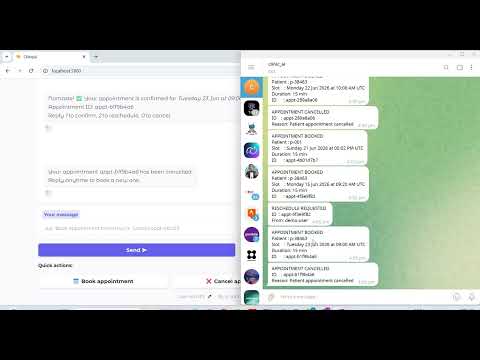
Giving doctors and nurses back the hours they lose to paperwork, so they can spend that time on patients.
Built for the Hugging Face "Build Small" Hackathon — a suite of small, open, ≤32B models doing real hospital back-office work, with a human approving every decision that touches a patient.
Status note: This README describes what actually runs today, verified against the code and test suite. The original planning document (which scoped only 3 agents as "shipping") is preserved as
README_OLD.mdfor pitch/historical context. Since then, all seven agents have been implemented.
The Problem
Indian doctors spend 2–3 hours every day on documentation. Nurses build duty rosters by hand over half a day. Receptionists book appointments by phone. Patients leave 4–6 hours late because pharmacy, billing, and family hand-offs all wait on each other.
None of this needs medical judgment. It is mechanical, repetitive, and automatable — and that is exactly the layer CliniqAI takes over, while clinicians stay in control of every clinical call.
The design rule: Agents prepare. Humans decide. No agent sends or files anything patient-facing without explicit human approval.
What the App Is
A single Gradio web app with three role-based consoles, backed by a FastAPI service and a LangGraph multi-agent orchestrator. Seven agents share one typed state object and return validated Pydantic outputs, so everything is parseable, logged, and auditable.
        Doctor console        Patient console        Nurse & Admin console
              │                      │                        │
              └──────────────┬───────┴────────────┬───────────┘
                             ▼                     ▼
                        FastAPI  ───────►  LangGraph Orchestrator
                                                   │
   ┌──────────┬───────────┬──────────┬────────────┬───────────┬──────────┐
 Documentation  Appointment  Roster   Handover    Discharge   Clerical   Wiki
   ▼            ▼            ▼          ▼            ▼           ▼          ▼
        Retrieval (Chroma + BM25)  ·  PostgreSQL  ·  LLM router (Groq / OpenRouter / Ollama)
What Actually Works Today
Legend: ✅ working & demoable · 🟡 works, needs an API key / external creds to go fully live · ⚙️ wired, depends on a build/seed step
| Capability | Status | Notes |
|---|---|---|
| Doctor console — SOAP documentation | ✅ | Paste a transcript (or record audio), get an editable SOAP draft with ICD-10 suggestions + citations, edit, then Approve to write it to the patient's wiki page. Falls back to a realistic mock draft if no LLM key is set, so it always demos. |
| Audio transcription (Whisper) | 🟡 | Groq-hosted whisper-large-v3-turbo; needs GROQ_API_KEY. Transcript paste works with no key. |
| Patient console — appointment chat | ✅ | Chat widget routes to the Appointment Agent: parses intent, finds a free slot, books it, and replies with a confirmation + 1/2/0 confirm-reschedule-cancel flow. |
| Appointment booking + reminders | ✅ | Slot-finding over a calendar; queues T-24h email + chat reminders via Celery. Uses a local calendar fallback so it runs offline. |
| Nurse — shift handover brief | ✅ | Generates a prioritised ward brief (urgent → watch → stable) with per-patient one-liners and pending actions. |
| Admin — duty rostering | ✅ | Greedy 14-day roster from a staff CSV (or demo data) in well under a second, with a fairness score; plus same-role, lowest-load sick-call replacement. |
| Nurse — discharge coordination | ✅ | Fans out 5 subtasks in parallel (summary, pharmacy, family notify, follow-up booking, billing) and reports each one's status; failures are isolated. |
| Wiki health — lint report | ✅ | One click runs lint_wiki() over the public corpus: missing frontmatter, stale pages (>180d), broken [[cross-refs]]. Currently 0 issues across the seeded corpus. |
| Orchestrator routing | ✅ | LangGraph state graph routes each request to the right agent (6 agent nodes + orchestrator). |
| Knowledge retrieval (Chroma + BM25) | ⚙️ | Hybrid search is wired behind one search() API; populate the index with scripts/build_indices.py. |
| LLM routing | ✅ | LiteLLM picks Groq / OpenRouter / Ollama per task; degrades to mocks when no provider is configured. |
| Patient notifications (Telegram / WhatsApp) | 🟡 | Telegram (free Bot API) and WhatsApp (Twilio) send paths exist; both no-op safely to a stub until credentials are set, so nothing crashes in a dry run. |
| Observability (Langfuse) | 🟡 | LLM + retrieval calls are traced when Langfuse keys are present. |
Agents — all seven implemented
| Agent | Does |
|---|---|
| Documentation | Transcript → retrieves patient history + guidelines + ICD-10 → drafts a SOAP note with citations → writes to the patient wiki on approval. |
| Appointment | Parses booking/cancel/reschedule intent, checks availability, books, confirms, and schedules reminders. |
| Rostering | Builds a fair 14-day roster from a CSV; resolves sick calls in real time. |
| Handover | Produces a prioritised end-of-shift patient brief. |
| Discharge | Coordinates the 5-stream discharge fan-out in parallel. |
| Clerical | Drafts referral letters and post-visit summaries (human-approved). |
| Wiki Maintenance | Updates patient pages and lints the knowledge corpus for staleness / broken links. |
How It Works
1. The knowledge layer — wiki + RAG, not just chunks
CliniqAI follows the LLM-Wiki pattern: structured markdown pages (one per patient, drug, condition, protocol) that the system keeps current and cross-linked, instead of blindly chunking documents. When a guideline changes you update the page and mark the old content superseded — so the next query reads a clean synthesis, not a blend of old and new. Large reference data (ICD-10 codes, formularies) lives in a Chroma + BM25 hybrid index for keyword-precise lookup. Structured operational data (appointments, rosters) lives in PostgreSQL.
2. The orchestration layer — typed, auditable agents
Every request enters the LangGraph graph, the orchestrator classifies it, and it flows to the owning agent. Each agent returns a validated Pydantic model (SOAPNoteDraft, BookingResult, RosterResult, HandoverBrief, DischargeCoordination, CommunicationDraft, …). State updates follow strict rules — lists append, scalars overwrite, no node mutates shared state directly.
3. The model layer — small, open, swappable
Tasks are routed by LiteLLM: heavy reasoning (SOAP notes, handover, discharge summaries) → a 32B-class model on Groq; high-frequency simple replies → a fast 8B model; offline → Ollama locally. Every model in the routing table is free and ≤32B parameters — the spirit of the Build Small hackathon. If no provider is configured, the app serves realistic mocks so the UI still demos end-to-end.
4. The safety layer
Every clinical output is traceable to a source page or guideline, nothing patient-facing is sent without human approval, and all agent actions are traceable via Langfuse.
Why It's Beneficial
Carried forward from the original product thesis — these are the targets the workflows are built to hit:
| Workflow | Today (manual) | With CliniqAI |
|---|---|---|
| SOAP note sign-off | 8–10 min/consult | < 90 sec review-and-approve |
| Duty roster generation | 3–5 hours | < 5 min (sub-second in practice) |
| Sick-call replacement | 30–60 min | < 15 min |
| Discharge → patient leaves | 4–6 hours | < 1.5 hours (parallel fan-out) |
| No-show rate | 15–20% | < 8% (reminders + waitlist) |
The compounding win: a doctor reclaiming ~2 hours/day is the equivalent of adding clinical capacity without hiring — the most expensive constraint in Indian healthcare — while the patient experience (faster discharge, fewer missed appointments, clearer summaries) improves at the same time.
Demo / Run It Locally
Prereqs: Docker (for Postgres/Redis), and uv. The app runs with no API keys thanks to mock fallbacks; add keys to .env.local to go fully live.
# 1. Install deps into the uv-managed venv (Python 3.12)
uv sync

# 2. Bring up Postgres + Redis
docker compose -f infra/docker-compose.dev.yml up -d

# 3. Create the schema and seed demo data
uv run alembic -c infra/alembic.ini upgrade head
PYTHONHASHSEED=0 uv run python scripts/seed_demo.py

# 4. Launch the Gradio app  →  http://127.0.0.1:7860
uv run python deploy/hf_space/app.py
Then click through the three consoles:
- Doctor → paste a consult transcript → Draft SOAP note → edit → Approve.
- Patient → type "Book an appointment for tomorrow" → confirm with 1.
- Nurse & Admin → Handover (Generate brief) · Roster (Generate roster, then Find replacement) · Discharge queue (Initiate discharge) · Wiki health (Run lint).
Optional live integrations (add to .env.local, then restart):
GROQ_API_KEY (LLM + Whisper) · OPENROUTER_API_KEY (fallback) · TELEGRAM_BOT_TOKEN + TELEGRAM_CHAT_ID (free patient notifications) · LANGFUSE_* (tracing).
To deploy: the same deploy/hf_space/app.py runs on Hugging Face Spaces — push, set secrets in the Spaces panel, done.
Testing
PYTHONHASHSEED=0 uv run pytest -q
64 tests pass today — documentation, rostering, handover, clerical, orchestrator routing, integrations, and contracts suites are all green. The appointment and discharge happy-path tests currently error/fail due to a mock-patching harness issue (they patch names that are imported lazily inside functions, so mock.patch can't find them) — the underlying agent code is verified working via direct smoke tests; only the test wiring needs the patch target corrected.
Tech Stack (as actually wired)
Backend: Python 3.12 · FastAPI · LangGraph (orchestration) · LiteLLM (model routing) · Pydantic v2 (typed outputs) · SQLAlchemy + Alembic + PostgreSQL · Celery + Redis (reminders).
AI & retrieval: Groq Whisper (whisper-large-v3-turbo) · ChromaDB + rank-bm25 (hybrid search) · Langfuse (tracing).
Frontend: Gradio (three consoles, one-command HF Spaces deploy).
Integrations: Google Calendar (with offline local-calendar fallback) · Gmail · Telegram Bot API · WhatsApp (Twilio).
Repository Map
| Path | What's there |
|---|---|
app/agents/ |
The seven agents (documentation, appointment, roster, handover, discharge, clerical, wiki) |
app/orchestrator.py |
LangGraph state graph + routing |
app/ui/ |
Gradio consoles: doctor_tab, patient_tab, nurse_admin_tab |
app/retrieval/ |
Chroma + BM25 indices behind index_api.search() |
app/integrations/ |
Calendar, Gmail, Telegram, WhatsApp, Whisper |
app/llm/router.py |
LiteLLM task routing + mock fallback |
wiki/ |
The markdown knowledge corpus (10 condition pages seeded) |
deploy/hf_space/app.py |
Gradio entrypoint (local + HF Spaces) |
scripts/ |
seed_demo.py, build_indices.py, fetch_data.sh |
plans/, README_OLD.md |
Original planning docs and pitch context |
Team
Built by:
Clinical Safety
- Every clinical recommendation is traceable to a specific wiki page or guideline source.
- No agent sends a patient-facing communication without human approval.
- Patient data is handled in line with India's Digital Personal Data Protection Act (DPDPA); synthetic data only in this repo.
- Full audit trail of agent actions via Langfuse.