
Spaces:
Running on Zero

Running on Zero

A newer version of the Gradio SDK is available: 6.19.0
metadata
title: EchoYard
sdk: gradio
sdk_version: 6.18.0
app_file: app.py
python_version: '3.10'
license: apache-2.0
tags:
  - build-small
  - gradio
  - backyard-ai
  - best-minicpm-build
  - tiny-titan
  - openbmb
  - minicpm
  - voxcpm2
  - text-to-speech
  - language-learning
  - speech-practice
  - track:backyard
  - sponsor:openbmb
  - achievement:offgrid
EchoYard
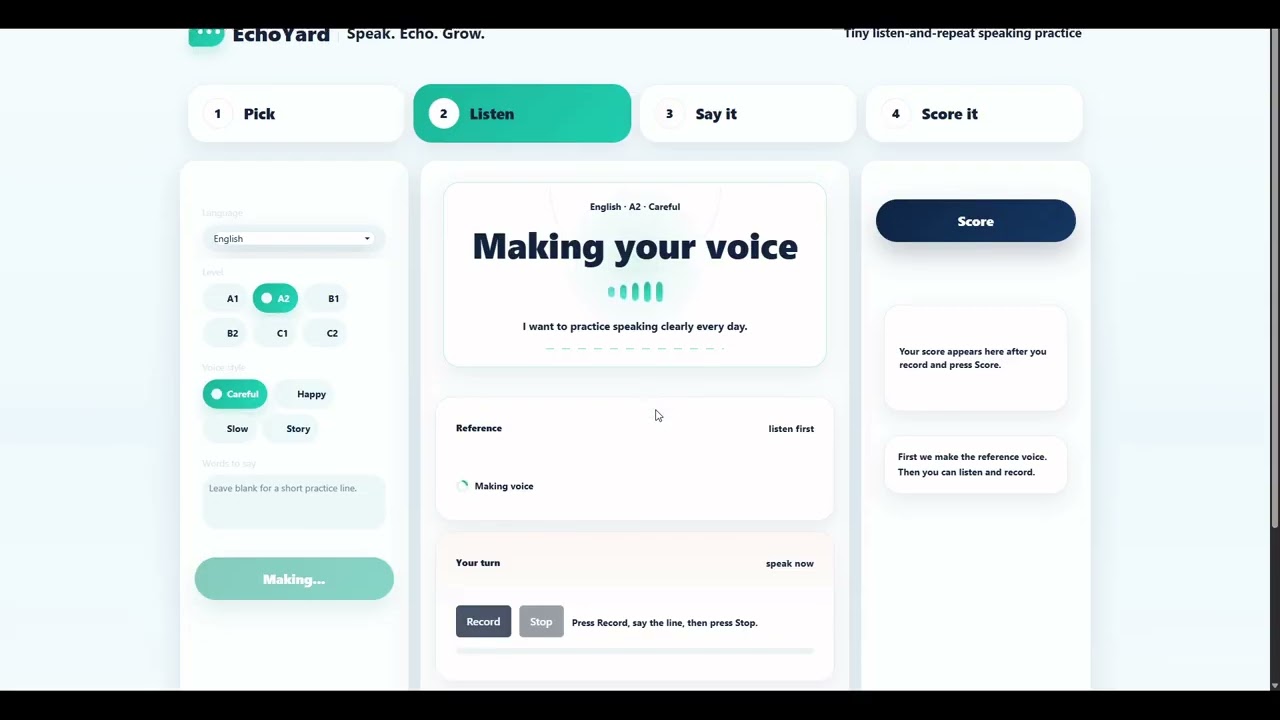
EchoYard is a tiny listen-and-repeat speaking practice app. Pick a language, level, and voice style; listen to a short reference voice; record yourself; then get a simple score and practical next step.
It is built for Build Small as a practical daily speaking tool: short voice prompts, quick browser recording, and friendly feedback powered by compact open models.
Demo Video
Community Post
Read the EchoYard community post on Hugging Face
How It Works
- Choose a supported language, level, and voice style.
- Leave the text blank for a short starter line, or type a custom sentence.
- Press Make voice to load a prebuilt sample or synthesize a short reference.
- Record your attempt in the browser.
- Press Score to compare the attempt with the reference.
- Read the short feedback and try the next line.
Build Notes
openbmb/VoxCPM2generates multilingual reference speech for custom lines and the prebuilt starter library.openbmb/MiniCPM5-1Breturns the final score, sub-scores, short feedback, and next practice line.facebook/wav2vec2-base-960hadds English-only transcript and word-match evidence.- Deterministic audio features provide duration, active speech, timing, rhythm, pitch, and sound-shape evidence.
- A custom browser recorder captures microphone audio and the server converts it to scoring-ready WAV.
- A prebuilt reference-audio dataset keeps the first starter example fast for all supported languages and voice styles.
Runtime And Privacy
Generated custom audio is stored only in the active Space runtime filesystem. User recordings are processed for scoring and are not written to a database.