
Spaces:
Running

From Power Flow to Safety: How Far Does GENCO’s Capability Carry?

Can learning power flow help a model assess grid safety? GENCO learns relationships among network structure, power injections, voltages, and reactive power. These relationships also matter for safety, making capability reuse a reasonable expectation. But predicting a physical state and deciding whether it violates an operating limit are different tasks. We investigate how far that reuse carries, and where it breaks down.
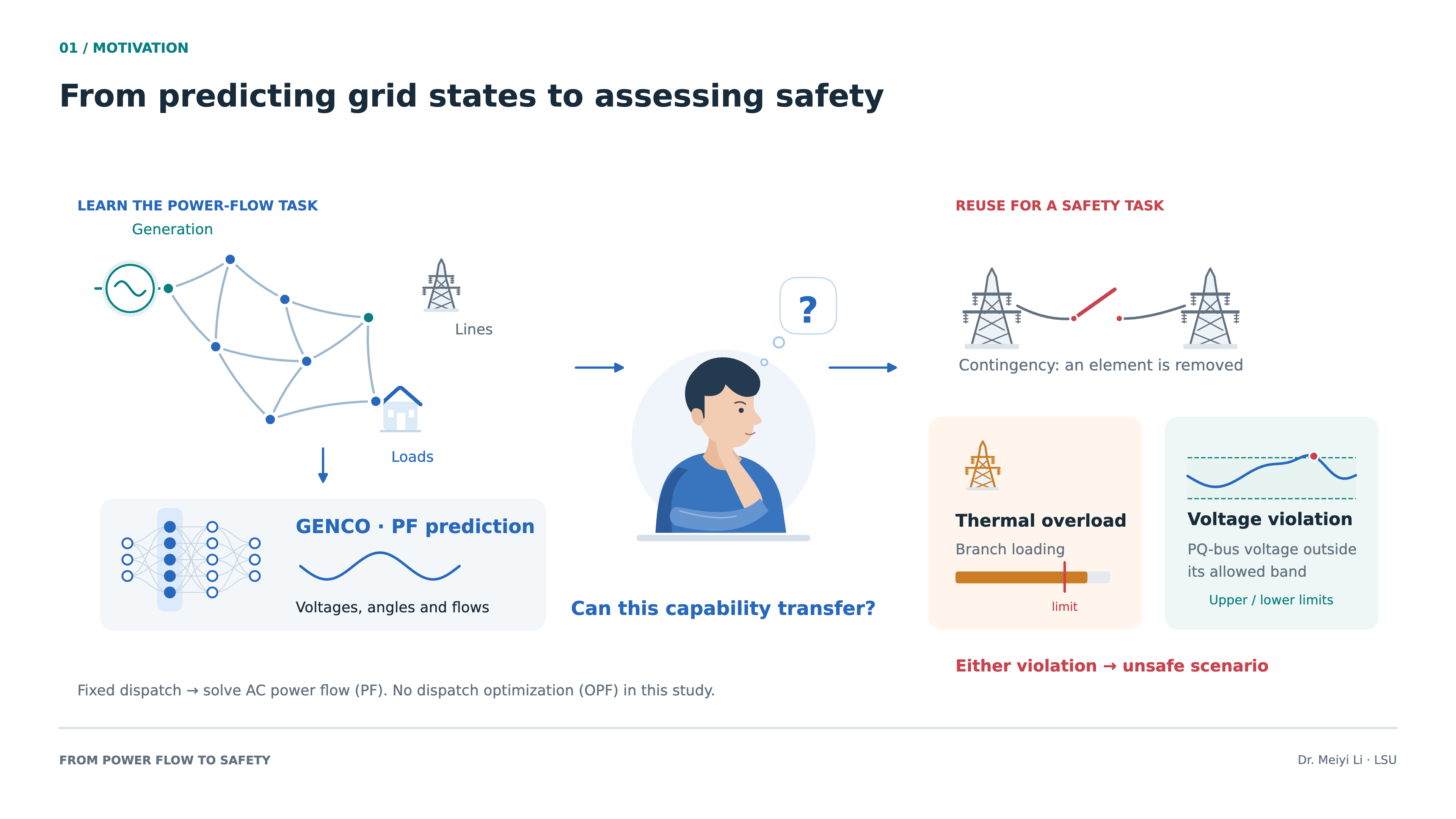
How do we test this capability? We built a dedicated evaluation dataset and trained lightweight predictors to test whether GENCO’s power-flow capabilities carry over to safety:
- We generated an N−1 contingency dataset for four small grids unseen during GENCO’s training, computing AC power-flow solutions and labeling thermal overloads and PQ-bus voltage violations.
- We trained lightweight probes to predict whether generators hit reactive-power limits, comparing GENCO’s hidden features with its decoded-output features while keeping GENCO frozen.
We also evaluated the published N−2 predictions on the Texas 2000-bus grid used in GENCO’s training to assess safety-review prioritization.
Can GENCO help prioritize safety checks? Yes. On Texas, ranking contingencies by GENCO’s predicted violations identifies more unsafe scenarios than a DC power-flow baseline at the same review budget. Its predictions can therefore help prioritize cases for exact AC evaluation, extending their value beyond numerical state estimation.
Texas N−2: 8,712 scenarios with predictions, including 1,549 unsafe scenarios. All methods review the same 3,098 scenarios (35.6%). Intervals are 95% bootstrap CIs.
Where does accurate prediction still fall short? Near an operating limit, a small prediction error can flip a safety judgment. At the tested review budget, all 122 missed unsafe Texas scenarios lie close to operating limits. Safety assessment requires resolving which side of a limit a scenario occupies, not merely predicting a nearby state.
Left: illustrative 99% / 101% loading. Right: observed Texas misses at the stated review budget; group percentages have separate denominators.
Are final predictions the best starting point for a new task? For generator reactive-limit switching, probes using frozen hidden features distinguish cases that hit reactive-power limits from those that do not more effectively than probes using the tested local output features. Hidden features score higher in seven of eight grid–probe comparisons; the remaining comparison ties.
Four grids × two probe heads; frozen layer 11; both feature sets include Q limits. The separation score is AUROC: 0.5 is chance ranking, 1 is perfect separation. Gains use unrounded scores. This comparison does not isolate a benefit caused by pretraining; raw-input controls are discussed in the source documentation.
Conclusion
On Texas, GENCO’s outputs improve safety-review prioritization, while the remaining misses cluster near operating limits. For reactive-limit prediction on unseen small grids, frozen hidden features can be more useful than the tested local output features.
Next steps
We plan to continue this work on downstream safety tasks. Our results suggest three directions: adding operating-limit and margin information to the learning target, so that the model can better resolve cases near limits; fine-tuning on safety labels, beyond frozen features; and testing whether these findings hold on more grids.
Resources and reproducibility
- Code and high-resolution figures: GitHub repository. The MIT-licensed package reproduces these five figures and animations from aggregate results; it is not the complete experimental pipeline.
- Frozen small-grid model: GENCO pretraining checkpoint source, with checkpoint identity and toolkit version.
- Published Texas data and predictions: gridfm/genco-pf-contingency.
- OpenGridFM toolkit: gridfm-graphkit. GENCO paper.
- Data availability: The newly generated small-grid scenarios, labels and hidden activations remain private. The repository includes the aggregate values needed to redraw the figures. Upstream model and data terms remain their owners’ terms.
Author and contact
Dr. Meiyi Li · Louisiana State University (LSU)