

Ideogram 4 Non-Commercial License
This repository is publicly accessible, but you have to accept the conditions to access its files and content.
This NVFP4 quantized derivative is provided under the Ideogram Non-Commercial Model Agreement. Access is for non-commercial purposes only.
Log in or Sign Up to review the conditions and access this model content.
NVFP4 quantization
This repository is an NVFP4 quantized derivative of ideogram-ai/ideogram-4-fp8.
- Source revision:
ee79a7237b519f1402ceacf952f30c8a31ec5073 - Quantizer: NVIDIA TensorRT Model Optimizer /
modelopt.torch.quantization.NVFP4_DEFAULT_CFG - Quantized components:
transformer,unconditional_transformer - Preserved components from source:
text_encoderFP8,vae,tokenizer, assets, scheduler config, and license files - Export format: Ideogram4 fused-
qkvtransformer checkpoints with ModelOpt NVFP4 packed weights insafetensors - Runtime loader:
ideogram4_nvfp4_loader.pyin this repository - Quantized on: NVIDIA RTX PRO 6000 Blackwell Workstation Edition / compute capability 12.0
- License: Ideogram Non-Commercial Model Agreement. See
LICENSE.mdandNOTICE.txt.
Smoke tests before upload:
- The official Ideogram4 FP8 loader was used so fused
qkvFP8 weights load correctly. - FP8 linear modules were dequantized to BF16 and then compressed with ModelOpt NVFP4.
- The quantized checkpoints were checked for packed
uint8NVFP4 weights andfloat8_e4m3fnscales. - The full Ideogram4 pipeline was loaded from the quantized files and used to generate initial low-resolution smoke-test images.
- Additional quality smoke tests used structured JSON captions,
V4_DEFAULT_20, 768x768 resolution, and the same seeds/prompts as a local FP8 reference run. The NVFP4 outputs preserved the expected objects, layout, and typography behavior with no image collapse.
Example NVFP4 smoke outputs, generated at 768x768 with V4_DEFAULT_20:
| Product photo | Typography poster |
|---|---|
 |
 |
Runtime note:
- This is not a standard Diffusers
AutoModelexport. The FP8 source checkpoint uses Ideogram4 fused-qkvtransformer weights, so this repository includesideogram4_nvfp4_loader.pyto restore the ModelOpt NVFP4 state. - In the smoke-test environment, the custom Ideogram4 fused-
qkvarchitecture restored ModelOpt NVFP4 weights and ran end-to-end through PyTorch/ModelOpt fallback paths for some linear layers where optimized real-quant GEMM kernels were not selected.
Basic loading pattern:
import torch
from huggingface_hub import snapshot_download
from ideogram4 import PRESETS

model_dir = snapshot_download("switzerchees/Ideogram-4-NVFP4")

import sys
sys.path.insert(0, model_dir)

from ideogram4_nvfp4_loader import load_pipeline

pipe = load_pipeline(model_dir, device="cuda", dtype=torch.bfloat16)
preset = PRESETS["V4_DEFAULT_20"]
images = pipe(
    "{\"high_level_description\":\"A clean product photo of a red ceramic teapot on a marble tabletop.\"}",
    height=768,
    width=768,
    num_steps=preset.num_steps,
    guidance_schedule=preset.guidance_schedule,
    mu=preset.mu,
    std=preset.std,
    seed=1234,
    raise_on_caption_issues=False,
)
images[0].save("out.png")
The original model card follows below.

Ideogram 4: Open image model at the forefront of design





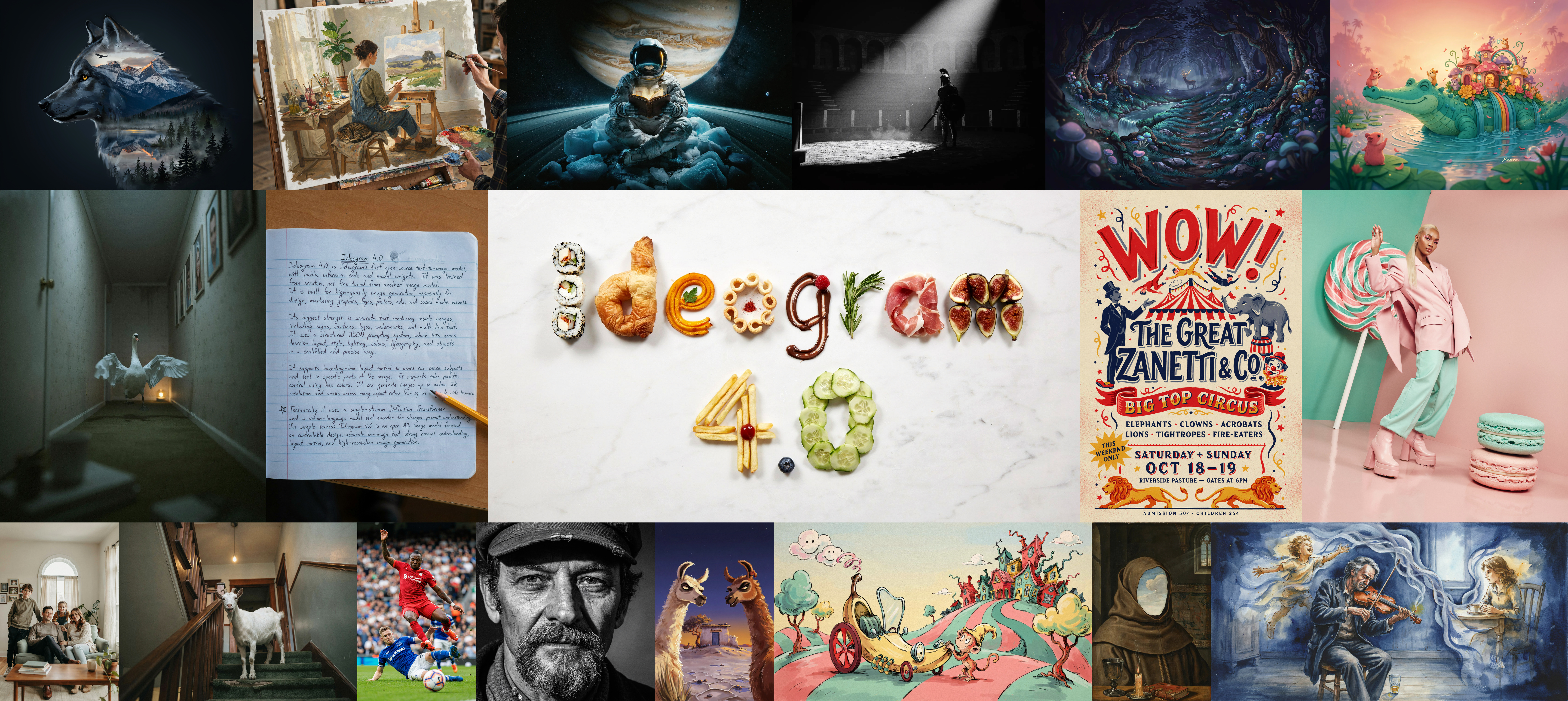
Ideogram 4 is Ideogram's first open weight text-to-image model. It is a state-of-the-art foundation model trained from scratch — not a fine-tune of any existing model. It introduces a new structured JSON prompting interface, with best-in-class multilingual text rendering, deep language understanding, explicit bounding-box layout and color-palette controls, and native 2k resolution images. The easiest way to try the model is online at ideogram.ai.
We believe openness drives innovation, and we invite the research community to innovate with us on the forefront of visual intelligence.
Table of Contents
News
- [2026-06-03] Ideogram 4 released! Inference code and weights are now public, and our technical blog post is live. See the Quick Start section to generate your first image, or try the model online at ideogram.ai.
Model Zoo
| Model | Params | Weight Quantization | Supported Hardware | Diffusers Support | License |
|---|---|---|---|---|---|
| Ideogram 4 (nf4) | 9.3B | nf4 | CUDA | Yes | Ideogram 4 Non-Commercial |
| Ideogram 4 (fp8) | 9.3B | fp8 | All | No | Ideogram 4 Non-Commercial |
We plan to support more quantizations in the future.
Performance
We evaluate Ideogram 4 across third-party arenas and benchmarks, standard open-source benchmarks, and our own internal human-preference benchmark. Across all of them, Ideogram 4 is the best open-weight image model by far, and sits at the frontier of design.
Design Arena
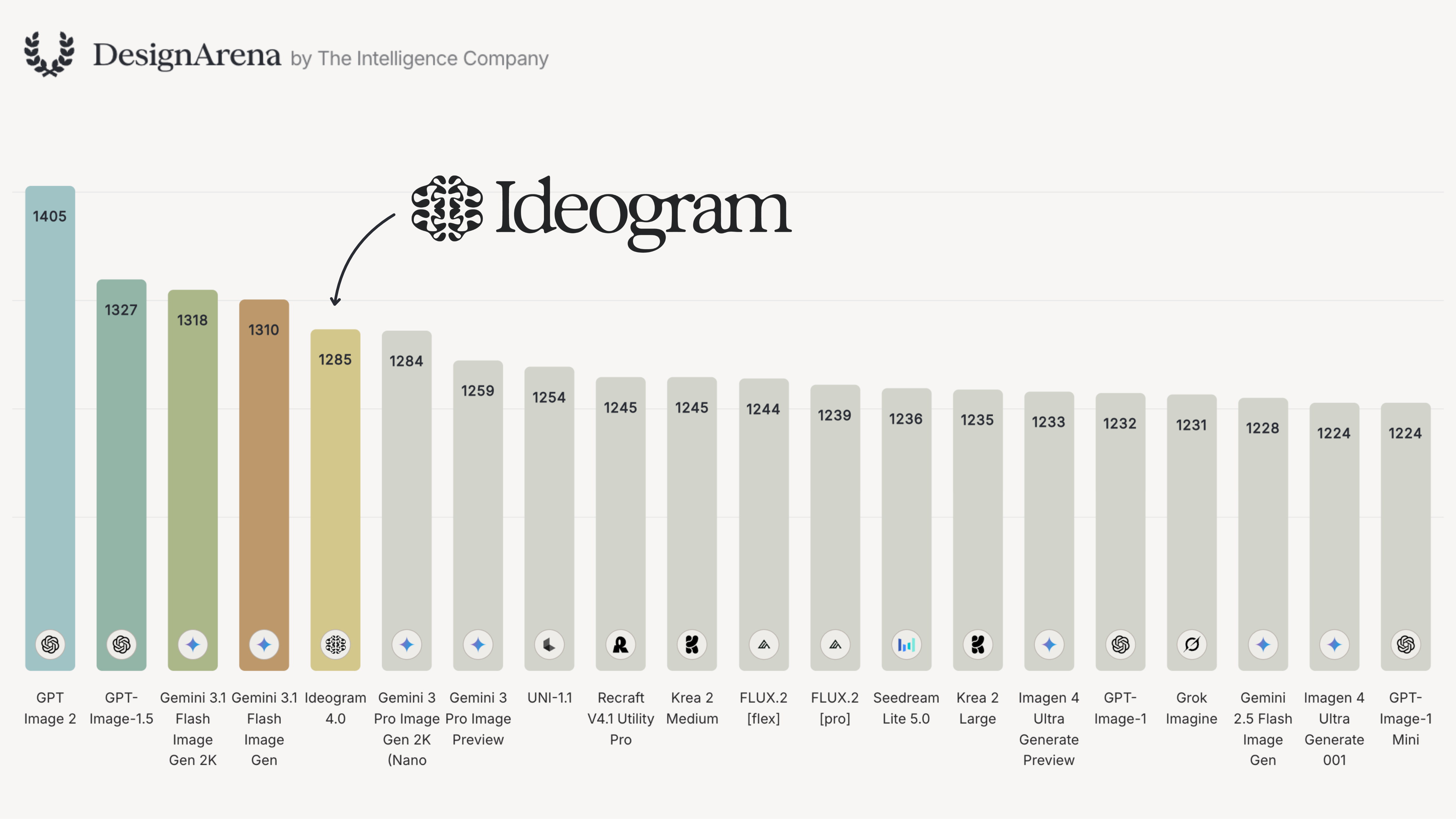
Design Arena is a third-party image Elo leaderboard focused specifically on design-oriented generation. On the overall board, Ideogram 4 is the top-ranked open-weight model, trailing only proprietary GPT and Gemini models:
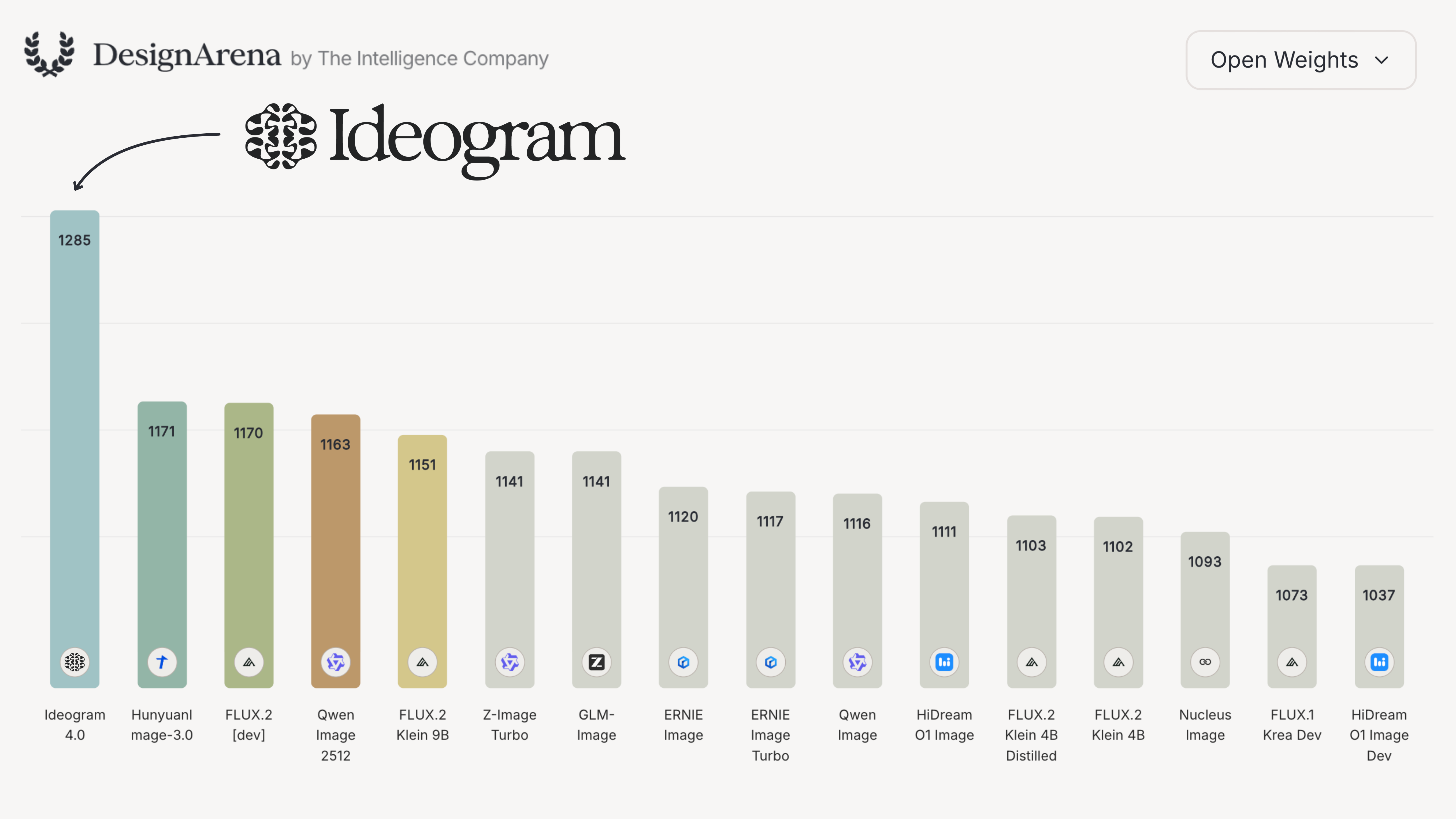
Filtered to open-weight models only, Ideogram 4 leads by a commanding margin, well ahead of the next-best open model:
ContraLabs
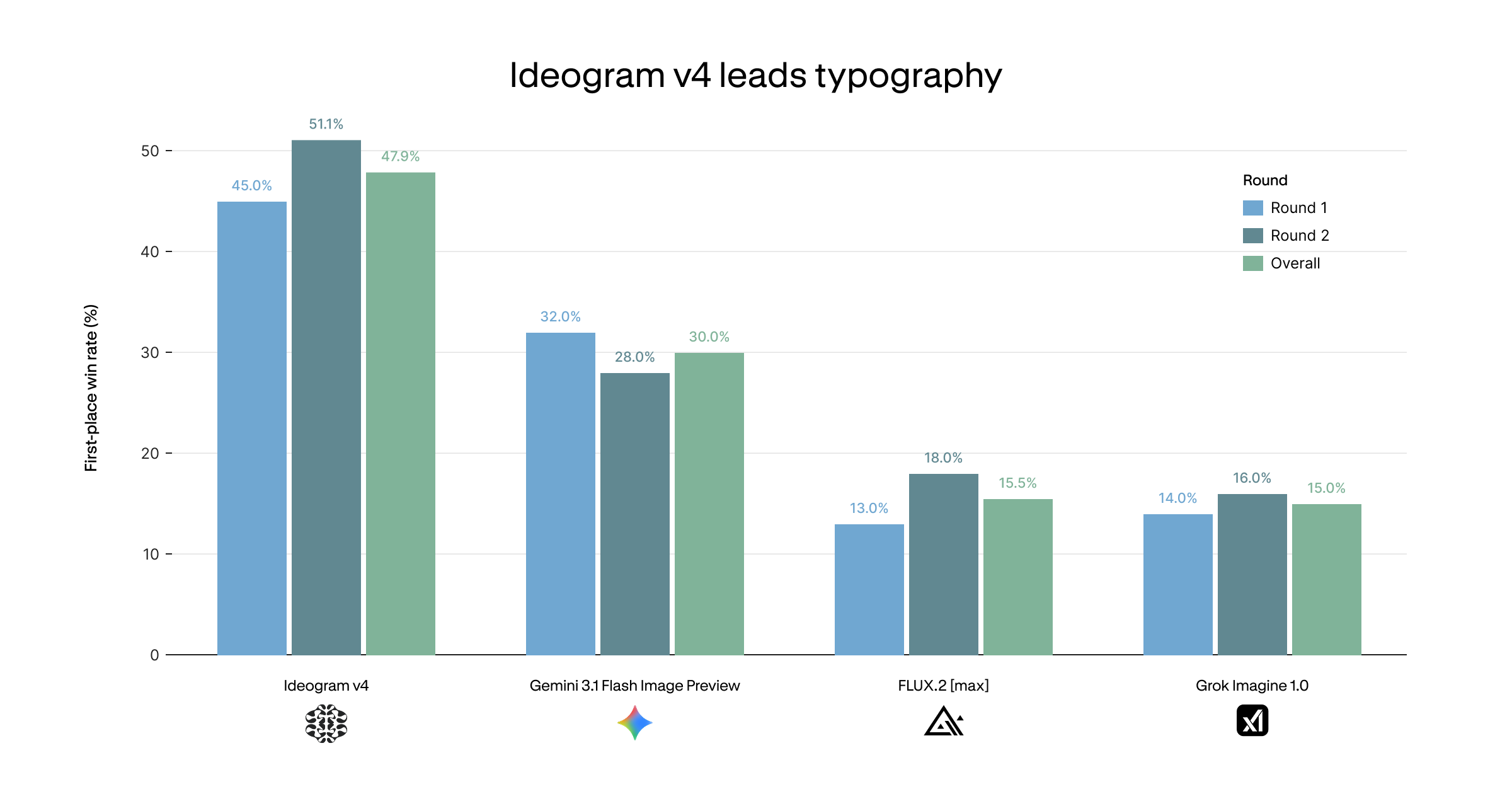
ContraLabs ran a blind typography evaluation judged by ten professional designers from Contra's top-earning talent. Ideogram 4 leads on first-place win rate, picked as the best of four models 47.9% of the time overall — well ahead of Gemini 3.1 Flash Image Preview (Nano Banana 2) at 30.0%, FLUX.2 [max] (15.5%), and Grok Imagine 1.0 (15.0%):
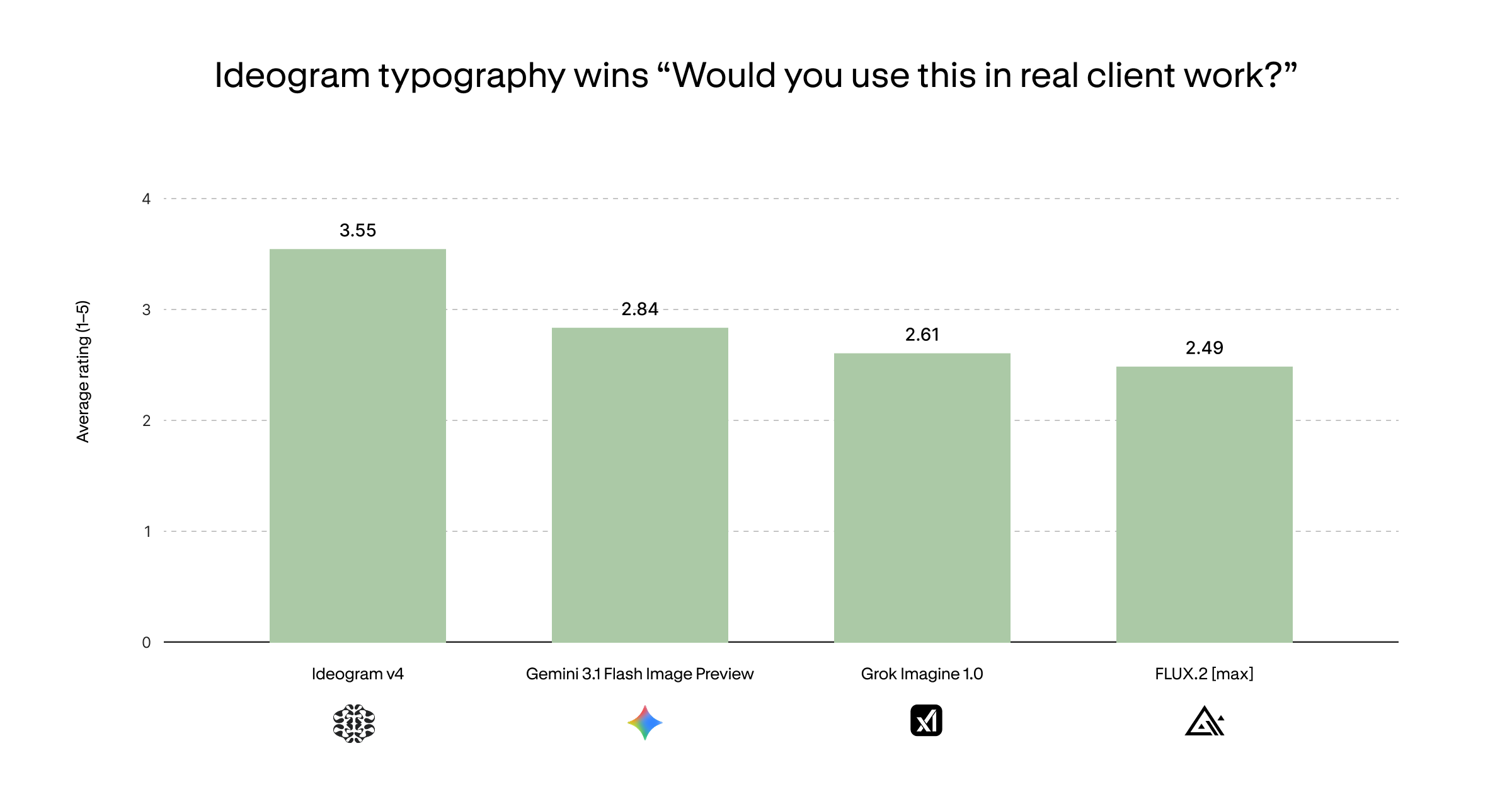
It also wins on practical usability: asked "Would you use this in real client work?", the same designers rated Ideogram 4 highest at 3.55 / 5 — significantly above Nano Banana 2 (2.84), Grok Imagine 1.0 (2.61), and FLUX.2 [max] (2.49):
LMArena
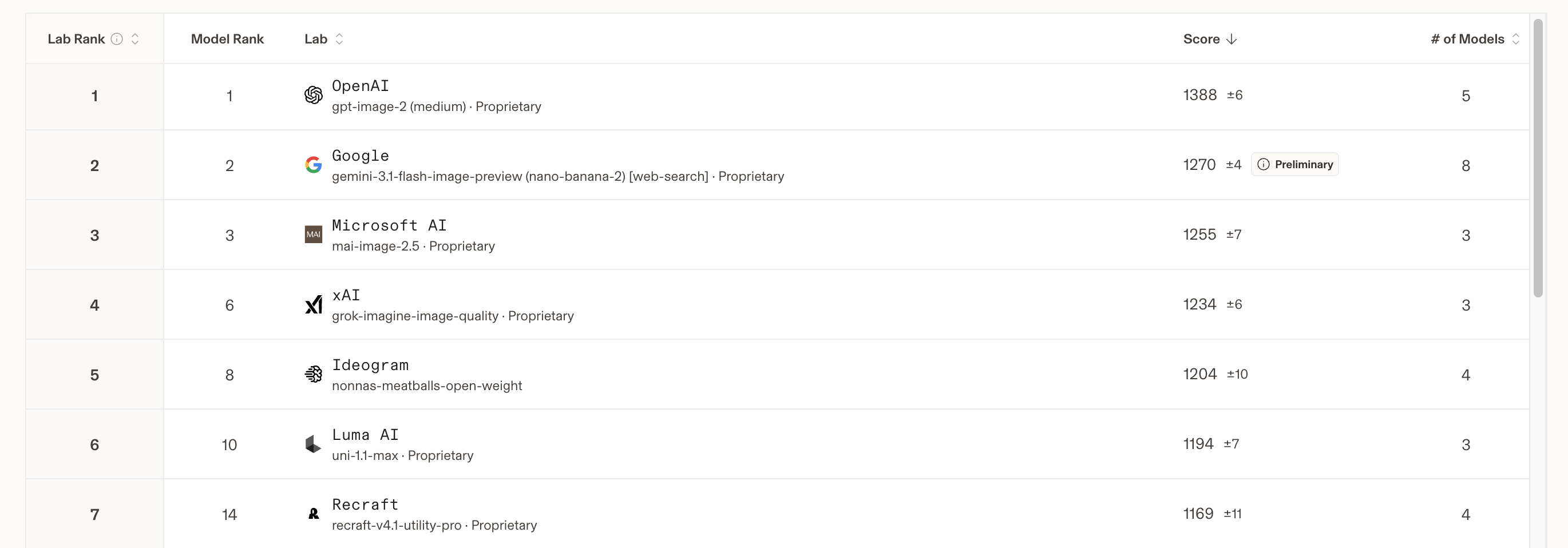
On LMArena, a third-party text-to-image leaderboard that measures general-purpose text-to-image use cases, Ideogram is the top-ranked open-weight lab and a top-5 image generation lab overall — beaten only by giant companies with vastly larger budgets and resources:
Ideogram internal eval
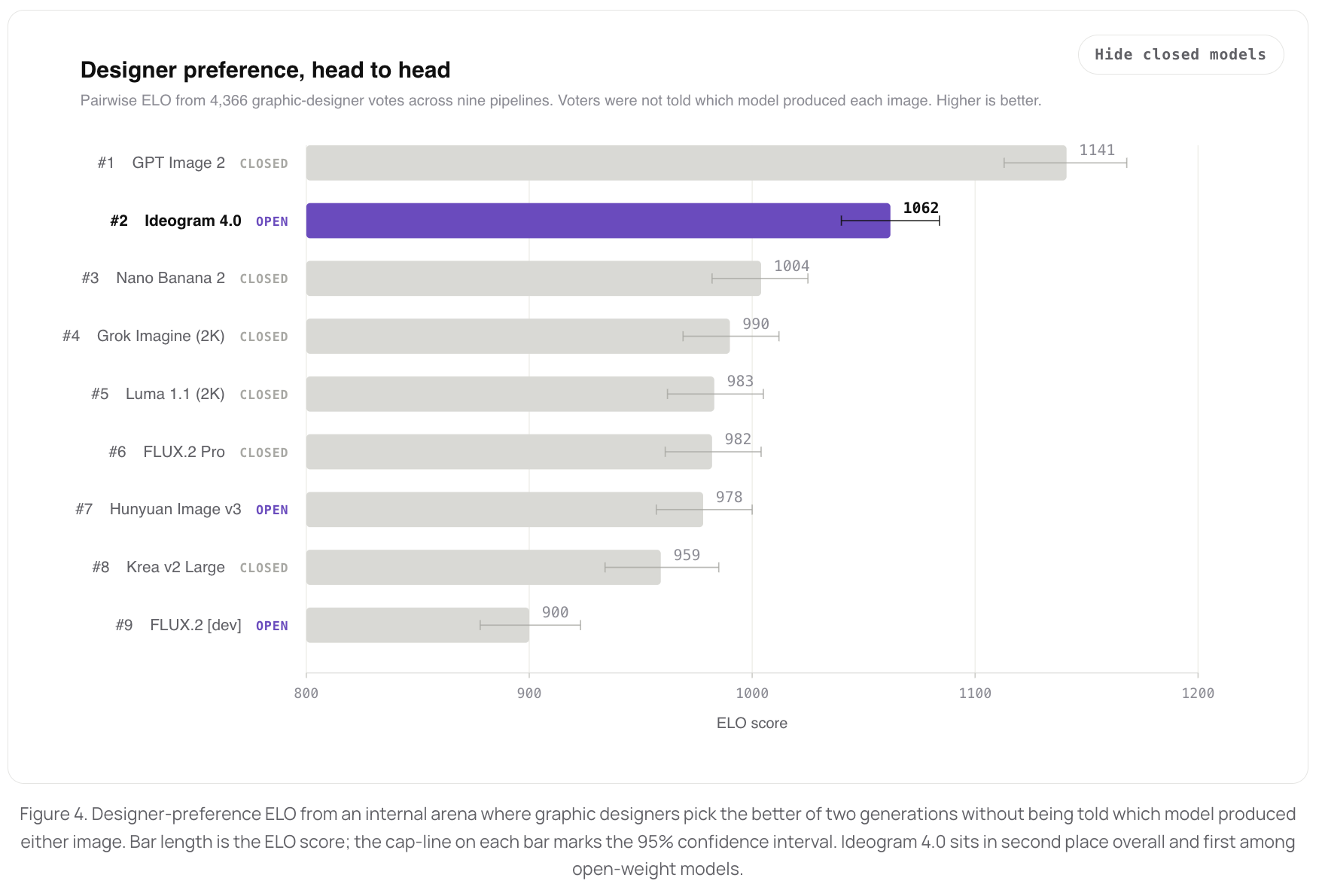
For our internal human-preference benchmark, focused on graphic design and photography, we had graphic designers deeply familiar with professional design work do the rating blind. Bradley-Terry scores rank Ideogram 4 #2 overall — behind only GPT Image 2 medium — and the top open-weight model:
Open-source benchmarks
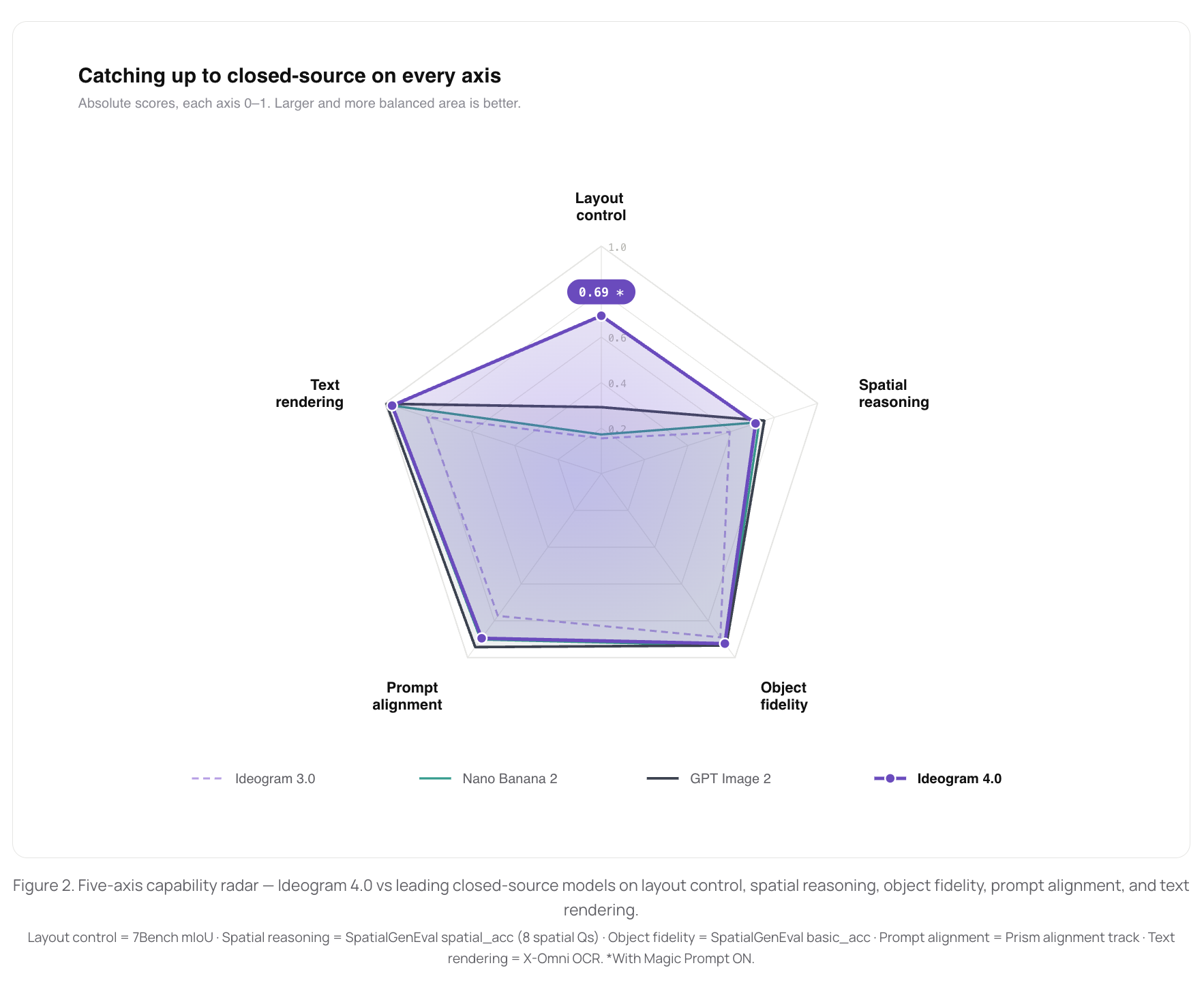
On standard open-source benchmarks measuring core capabilities — layout control (7Bench), spatial reasoning and object fidelity (SpatialGenEval), text rendering (X-Omni OCR), and prompt alignment (Prism) — Ideogram 4 closes the gap to the leading closed-source models across every axis. On layout control (7Bench), it is significantly better than all closed-source models:
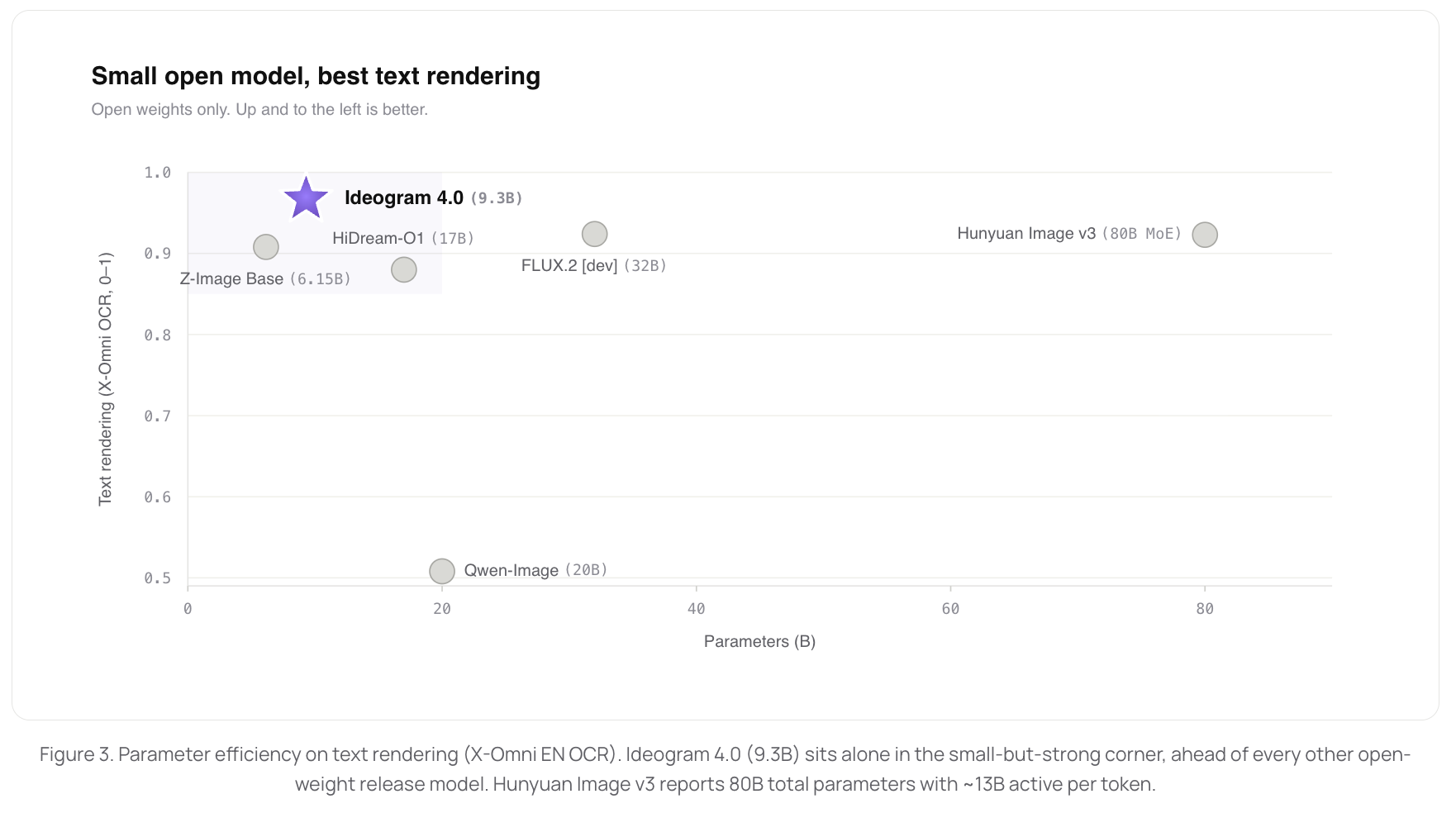
At 9.3B parameters, Ideogram 4 delivers the best text rendering of any open-weight release we benchmarked — ahead of much larger models like Qwen-Image (20B), FLUX.2 [dev] (32B), and HunyuanImage 3.0 (80B MoE):
Quick Start
Install
The inference code lives in the ideogram4 GitHub repo. Clone it, then from the repo root:
pip install .
If you plan to modify the code, install in editable mode instead so changes
under src/ideogram4/ take effect without reinstalling:
pip install -e .
Model access
The model weights are gated on Hugging Face, so you must accept the gate and
authenticate before the code can download them — otherwise the download fails
with a 404 / GatedRepoError.
Open the model page — ideogram-ai/ideogram-4-nf4 (or ideogram-ai/ideogram-4-fp8) — and click Agree and access repository to accept the license gate.
Create a Hugging Face access token at huggingface.co/settings/tokens and log in so the download is authenticated:
hf auth loginAlternatively, export the token directly:
export HF_TOKEN="hf_...".
CLI
The plain --prompt is rewritten into the structured JSON caption the model
expects by a "magic prompt" LLM. By default this uses Ideogram's hosted
magic-prompt API, which is free and does the expansion server-side (no local
model or system prompt needed). It reads IDEOGRAM_API_KEY — get a key at
developer.ideogram.ai:
python run_inference.py \
  --prompt "a ginger cat wearing a tiny wizard hat reading a spellbook" \
  --output out.png \
  --quantization "nf4" \
  --magic-prompt-key "$IDEOGRAM_API_KEY"
You can also run the expansion through your own LLM provider — one of our magic-prompt system prompt is open source. See the Prompting Guide for details.
For the highest-quality images, set --height 2048 --width 2048 and
--sampler-preset V4_QUALITY_48.
Safety screening with Hive
Prompt and output safety screening is performed via Hive.
Sign up and create a Text Moderation key and a Visual Content Moderation key,
then export them as HIVE_TEXT_MODERATION_KEY and HIVE_VISUAL_MODERATION_KEY
(or pass them via --hive-text-key / --hive-visual-key).
python run_inference.py \
  --prompt "an isometric illustration of a tiny city floating in the clouds" \
  --output out.png \
  --quantization "nf4" \
  --magic-prompt-key "$MAGIC_PROMPT_API_KEY" \
  --hive-text-key "$HIVE_TEXT_MODERATION_KEY" \
  --hive-visual-key "$HIVE_VISUAL_MODERATION_KEY"
For sampler presets, parameter reference, and optimization tips, see docs/inference.md.
Model Summary
Ideogram 4 is a foundation model trained entirely from scratch, not a fine-tune or distillation of any existing checkpoint. It is a flow-matching text-to-image model built on a fully single-stream Diffusion Transformer (DiT) architecture.
Architecture:
- Fully single-stream DiT. Text and image tokens are concatenated into one unified sequence and processed through the same 34-layer transformer, with no separate text or image branches. This enables deep cross-modal interaction at every layer.
- Vision-language model as text encoder. Instead of a text-only encoder like CLIP or T5, Ideogram 4 uses Qwen3-VL-8B-Instruct, a full vision-language model that provides far richer understanding of visual concepts. Hidden states are extracted from 13 intermediate layers and concatenated, giving the model multi-scale semantic features ranging from surface-level token information to deep compositional understanding.
- Dual-branch classifier-free guidance. The conditional (positive) and unconditional (negative) branches can be independently refined, enabling separate control over prompt adherence and image quality.
- Flexible resolution. Native support for any resolution from 256 to 2048 (multiples of 16), with aspect ratios up to 6:1. A single model handles everything from square thumbnails to ultrawide banners, with the noise schedule auto-adjusting per resolution.
Key Capabilities:
- Extreme controllability. Ideogram 4 is trained on structured JSON captions, giving users unprecedented control over composition, style, lighting, color palette, typography, and spatial layout, all from a single prompt.
- State-of-the-art text rendering. Ideogram 4 delivers best-in-class in-image text generation (signage, logos, captions, watermarks, multi-line text) with high fidelity directly from the prompt.
- Spatial layout control. Bounding-box coordinates in the prompt allow explicit placement of subjects, text elements, and background regions.
- Color palette conditioning. Specify hex colors in the prompt to steer the image's dominant color scheme.
For full architecture details, see docs/model_architecture.md. For a walkthrough of how the pipeline components fit together, see docs/pipeline.md.
Prompting Guide
Ideogram 4 is trained exclusively on structured JSON captions. While plain-text prompts work, you will get the best results by providing a JSON object that follows our caption schema.
Key points:
- Use JSON prompts for maximum controllability — the model was trained on them and understands the structure natively.
- Color palette conditioning — specify a
colour_palettearray of hex colors in the style description to steer the image's color scheme. - Aspect ratio flexibility — Ideogram 4 supports a wide range of aspect ratios (any multiple-of-16 resolution from 256 to 2048 on each side). This is a key advantage for practical use: portraits, landscapes, banners, phone wallpapers, social media formats, etc.
- Bounding-box layout — specify
bboxcoordinates in the prompt to explicitly place subjects, text elements, and background regions. - Compositional control — use
compositional_deconstructionwith bounding boxes and per-element descriptions for precise spatial layout.
Why JSON-only training? We train exclusively on JSON so that training and inference share a single, common prompt format. The training captions themselves are deliberately extremely descriptive: each JSON exhaustively describes everything in the image to maximize training efficiency. The more text-to-image relationships each caption pins down, the more grounded supervision the model extracts from a single training pair, rather than having to infer those relationships across many sparsely-captioned samples.
Why JSON at inference time? Because the model was trained on captions that name every object explicitly, the most reliable way to get every requested object rendered is to mirror that pattern. Plain-text prompts still work, but won't perform as well since the model was only trained on structured JSON captions.
Don't want to write JSON by hand? That's what magic prompt is for: it uses
an LLM to expand a plain-text prompt into a full structured caption before
generation, so you get JSON-quality results from a casual prompt. It runs by
default in run_inference.py (see the CLI section).
See docs/prompting.md for a full guide.
Documentation
| Document | Description |
|---|---|
| docs/prompting.md | How to write JSON prompts, color palette conditioning, aspect ratios |
| docs/inference.md | Sampler presets, parameter reference, resolutions, optimization tips |
| docs/model_architecture.md | Architecture diagram, DiT spec, component details |
| docs/pipeline.md | Conceptual pipeline walkthrough — how all components fit together |
| docs/development.md | Dev setup, pre-commit hooks, contributing |
| docs/safety.md | Pre-training, post-training, and inference-time safety mitigations; how to report violations |
Citation
If you find the provided code or models useful for your research, consider citing them as:
@misc{ideogram-4-2026,
    author={Ideogram AI},
    title={{Ideogram 4}},
    year={2026},
    howpublished={\url{https://ideogram.ai/blog/ideogram-4.0/}},
}
We're Hiring!
We're looking for Research Scientists and Research Engineers to work on next-generation generative models and the products built on top of them. Interested candidates please apply https://jobs.ashbyhq.com/ideogram
Model tree for switzerchees/Ideogram-4-NVFP4
Base model
ideogram-ai/ideogram-4-fp8