

| <div align="center"> | |
| # ZEGGS | |
| ## ZeroEGGS: Zero-shot Example-based Gesture Generation from Speech | |
| [](https://arxiv.org/abs/2209.07556) | |
| </div> | |
| This repository contains the code for the ZeroEGGS project from | |
| this [article](https://arxiv.org/abs/2209.07556). | |
| It also contains our stylized speech and gesture dataset | |
| <div align="center"> | |
| [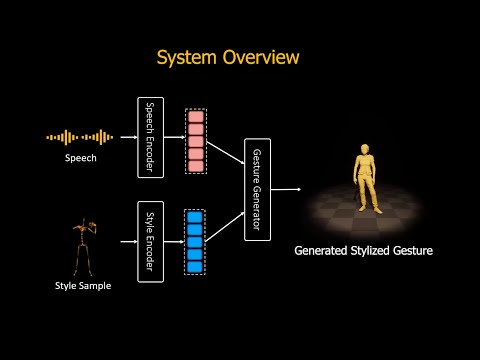](http://www.youtube.com/watch?v=YFg7QKWkjwQ "Click to watch the video demo") | |
| [Click](http://www.youtube.com/watch?v=YFg7QKWkjwQ) to watch the video demo | |
| </div> | |
| ## Environment Setup | |
| Create and activate a virtual environment to work in, e.g. using Conda: | |
| ```sh | |
| conda create -n zeggs python=3.8 | |
| conda activate zeggs | |
| ``` | |
| Install CUDA and PyTorch 1.12.x For CUDA 11.3, this would look like: | |
| ```sh | |
| conda install pytorch torchvision cudatoolkit=11.3 -c pytorch | |
| ``` | |
| Install the remaining requirements with pip: | |
| ```sh | |
| pip install -r requirements.txt | |
| ``` | |
| > You may need to install [`sox`](http://sox.sourceforge.net/) on your system | |
| ## ZEGGS Dataset | |
| <div align="center"> | |
|  | |
| </div> | |
| ZEGGS dataset contains 67 sequences of monologues performed by a female actor speaking in English and covers 19 different motion styles. | |
| The following styles are present in the ZEGGS dataset: | |
| <div align="center"> | |
| | **Style** | **Length (mins)** | **Style** | **Length (mins)** | | |
| |--------------|-----------------------|-------|---------------| | |
| | Agreement | 5.25 | Pensive | 6.21 | | |
| | Angry | 7.95 | Relaxed | 10.81 | | |
| | Disagreement | 5.33 | Sad | 11.80 | | |
| | Distracted | 5.29 | Sarcastic | 6.52 | | |
| | Flirty | 3.27 | Scared | 5.58 | | |
| | Happy | 10.08 | Sneaky | 6.27 | | |
| | Laughing | 3.85 | Still | 5.33 | | |
| | Oration | 3.98 | Threatening | 5.84 | | |
| | Neutral | 11.13 | Tired | 7.13 | | |
| | Old | 11.37 | Total | 134.65 | | |
| </div> | |
| ### Access to the data | |
| > This repository contains large files. In order to clone this repository including | |
| > the the large zip files, you need to use [git lfs](https://github.com/git-lfs/git-lfs/wiki/Installation). | |
| > If you still get errors, directly download `zip` files. | |
| The speech and gesture data are contained in the `./data/Zeggs_data.zip`, `./data/Zeggs_data.z01`, and `./data/Zeggs_data.z02` files. You must put all of these parts to the same folder, and extract `.zip` file by WinRAR or Winzip. | |
| When you extract the zip file, there are two folders: | |
| - `original` folder contains the original data where the animation and audio files are in their raw version and not | |
| processed. | |
| - `clean` contains aligned animation and audio data and without unwanted audio of other speaker. For more details on how | |
| these files have been processed check `data_pipeline.py` | |
| All the animation sequences are in the BVH file format and all the audio data are in WAV format. | |
| ## Data Preparation | |
| Extract the data from the `Zeggs_data.zip` file and place it in the `data` folder. Next run: | |
| ```sh | |
| python data_pipeline.py | |
| ``` | |
| This processes data and creates the necessary files for training and evaluation in the "processed" folder. You can | |
| customize the data pipeline by changing `data_pipeline_conf.json` config file. Two suggested configurations are provided | |
| in the `configs` folder. You should change the configuration file name in the script. | |
| ## Training | |
| To train the model, run: | |
| ```sh | |
| python ./main.py -o <configs> -n <run_name> | |
| ``` | |
| For example, to train the model with the default configuration, run: | |
| ```sh | |
| python ./main.py -o "../configs/configs_v1.json" -n "zeggs_v1" | |
| ``` | |
| ## Inference | |
| After training is finished or using provided pretrained models (provided in `./data/outputs`), you can generate gestures | |
| given speech and style as | |
| input | |
| using `generate.py`. The output will be save in `bvh` format. For full functionality (blending, transitions, using | |
| pre-extracted style encodings, etc. ) you need | |
| to directly use `generate_gesture` function. Otherwise, you can use CLI as explained below. | |
| ### Using the CLI | |
| You can run the inference using the CLI in two ways: | |
| #### 1. Generating a single sample from a single audio/style pair | |
| The CLI command looks like this: | |
| ```sh | |
| python ./generate.py -o <options file> -s <style file> -a <audio file> | |
| ``` | |
| where `options file` is similar to the training config file but contains the path to the saved pretrained models and | |
| other required data. For example, you can run: | |
| ```sh | |
| python ./generate.py -o "../data/outputs/v1/options.json" -s "../data/clean/067_Speech_2_x_1_0.bvh" -a "../data/clean/067_Speech_2_x_1_0.wav" | |
| ``` | |
| To get more help on how to set other parameters such as seed, temperature, output file name, etc., run the command | |
| below: | |
| ```sh | |
| python ./generate.py -h. | |
| ``` | |
| #### 2. Generating a batch of samples from a CSV file | |
| You can generate a batch of animated gestures from a csv file containing audio and style file paths along with other | |
| parameters by running: | |
| ```sh | |
| python ./generate.py -o <options file> -c <CSV file> | |
| ``` | |
| For example, you can run: | |
| ```sh | |
| python ./generate.py -o "../data/outputs/v1/options_file.json" -c "../data/test/evaluation.csv" | |
| ``` | |
| ## Citation | |
| If you use this code and dataset, please cite our paper | |
| ``` | |
| @article{ghorbani2022zeroeggs, | |
| title={ZeroEGGS: Zero-shot Example-based Gesture Generation from Speech}, | |
| author={Ghorbani, Saeed and Ferstl, Ylva and Holden, Daniel and Troje, Nikolaus F and Carbonneau, Marc-Andr{\'e}}, | |
| journal={arXiv preprint arXiv:2209.07556}, | |
| year={2022} | |
| } | |
| ``` | |
| © [2022] Ubisoft Entertainment. All Rights Reserved | |