


base_model:
  - Qwen/Qwen2.5-VL-7B-Instruct
datasets:
  - Senqiao/VisionThink-General-Train
  - Senqiao/VisionThink-General-Val
license: apache-2.0
pipeline_tag: image-text-to-text
library_name: transformers
tags:
  - vision-language-model
  - multimodal
  - qwen
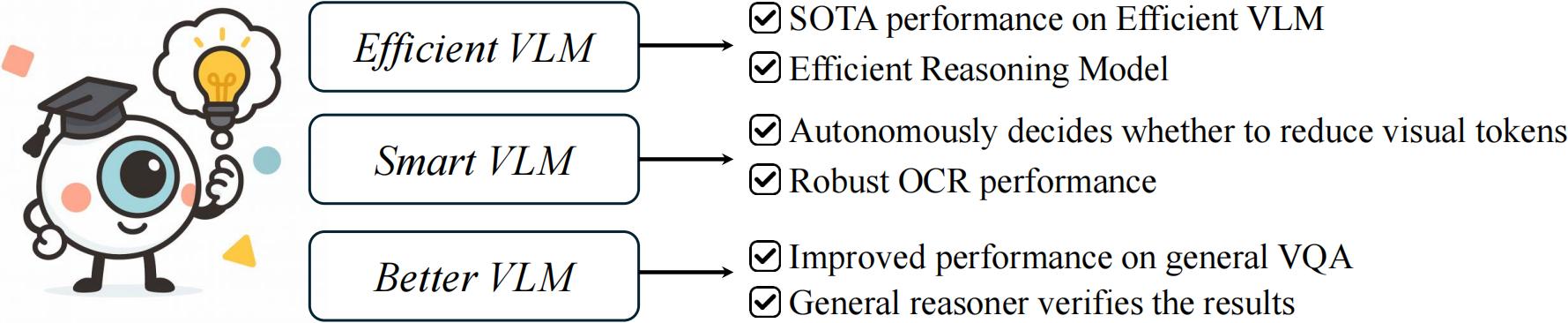
VisionThink: Smart and Efficient Vision Language Model via Reinforcement Learning
This repository contains the VisionThink-General model, a smart and efficient vision-language model. VisionThink introduces a new paradigm for visual token compression in Vision-Language Models (VLMs). It starts with a downsampled image and smartly decides whether it is sufficient for problem solving. Otherwise, the model could output a special token to request the higher-resolution image. Unlike existing Efficient VLM methods that compress tokens using fixed pruning ratios or thresholds, VisionThink autonomously decides whether to compress tokens case by case.
The model was presented in the paper VisionThink: Smart and Efficient Vision Language Model via Reinforcement Learning.
The official code and more details can be found on the VisionThink GitHub repository.
Highlights
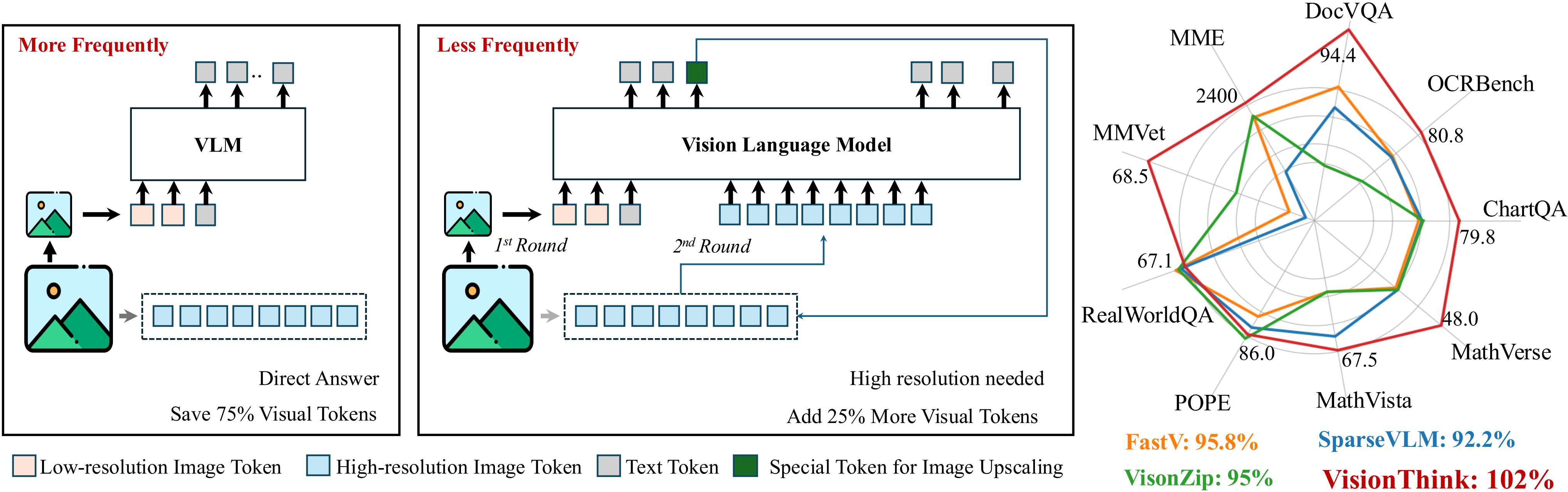
Our VisionThink leverages reinforcement learning to autonomously learn whether to reduce visual tokens. Compared to traditional efficient VLM approaches, our method achieves significant improvements on fine-grained benchmarks, such as those involving OCR-related tasks.
VisionThink improves performance on General VQA tasks while reducing visual tokens by 50%, achieving 102% of the original model’s performance across nine benchmarks.
VisionThink achieves strong performance and efficiency by simply resizing input images to reduce visual tokens. We hope this inspires further research into Efficient Reasoning Vision Language Models.
Installation
The environment follows the Verl.
git clone https://github.com/dvlab-research/VisionThink.git
conda create -n visionthink python=3.11 -y
conda activate visionthink
# veRL
pip3 install -e .
# flash-attn
pip3 install flash-attn --no-build-isolation
If you want to use the Qwen3 as the Judge Model.
pip install -U tensordict
pip install transformers==4.51.0
Usage
You can easily load and use VisionThink with the Hugging Face transformers library. Below is a quick example demonstrating how to load the VisionThink-General model and perform inference.
from transformers import AutoProcessor, AutoModelForCausalLM
from PIL import Image

# Load model and processor
model_id = "Senqiao/VisionThink-General" # Or "Senqiao/VisionThink-Efficient"
processor = AutoProcessor.from_pretrained(model_id)
model = AutoModelForCausalLM.from_pretrained(
    model_id,
    torch_dtype="auto",
    device_map="auto",
    trust_remote_code=True
)

# Prepare input image and text
# Replace with your image path
image = Image.open("./path/to/your/image.jpg").convert("RGB")
messages = [
    {
        "role": "user",
        "content": [
            {"type": "image", "image": image},
            {"type": "text", "text": "Describe this image in detail."},
        ],
    }
]

# Apply chat template and process inputs
text = processor.apply_chat_template(
    messages, tokenize=False, add_generation_prompt=True
)
inputs = processor(text=text, images=image, return_tensors="pt")
inputs = inputs.to(model.device)

# Generate response
generated_ids = model.generate(**inputs, max_new_tokens=512)

# Decode and print the output
generated_ids = generated_ids[:, inputs["input_ids"].shape[1]:]
response = processor.batch_decode(generated_ids, skip_special_tokens=True)[0]
print(response)
Citation
If you find this project useful in your research, please consider citing:
@article{yang2025visionthink,
  title={VisionThink: Smart and Efficient Vision Language Model via Reinforcement Learning},
  author={Yang, Senqiao and Li, Junyi and Lai, Xin and Yu, Bei and Zhao, Hengshuang and Jia, Jiaya},
  journal={arXiv preprint arXiv:2507.13348},
  year={2025},
}
Acknowledgement
This work is built upon Verl, EasyR1, Lmms-Eval, and MMSearch-R1. We thank them for their excellent open-source contributions.
We also thank Qwen, DeepSeek-R1, VisionZip, FastV, SparseVLM, and others for their contributions, which have provided valuable insights.