


| # SimWorld: An Open-ended Realistic Simulator for Autonomous Agents in Physical and Social Worlds | |
| <p align="center"> | |
| <img src="https://github.com/user-attachments/assets/5d2da588-9470-44ef-82a9-5d45d592497a" width="840" height="795" alt="image" /> | |
| </p> | |
| **SimWorld** is a simulation platform for developing and evaluating **LLM/VLM** AI agents in complex physical and social environments. | |
| <div align="center"> | |
| <a href="https://simworld-ai.github.io/"><img src="https://img.shields.io/badge/Website-SimWorld-blue" alt="Website" /></a> | |
| <a href="https://github.com/maitrix-org/SimWorld"><img src="https://img.shields.io/github/stars/maitrix-org/SimWorld?style=social" alt="GitHub Stars" /></a> | |
| <a href="https://simworld.readthedocs.io/en/latest"><img src="https://img.shields.io/badge/Documentation-Read%20Docs-green" alt="Documentation" /></a> | |
| <a href="https://arxiv.org/abs/2512.01078"><img src="https://img.shields.io/badge/arXiv-2512.01078-b31b1b?logo=arxiv&logoColor=white" alt="arXiv:2512.01078" /></a> | |
| </div> | |
| ## 🔥 News | |
| - 2025.11 The white paper of **SimWorld** is available on arxiv! | |
| - 2025.9 **SimWorld** has been accepted to NeurIPS 2025 main track as a **spotlight** paper! 🎉 | |
| - 2025.6 The first formal release of **SimWorld** has been published! 🚀 | |
| - 2025.3 Our demo of **SimWorld** has been accepted by CVPR 2025 Demonstration Track! 🎉 | |
| ## 💡 Introduction | |
| SimWorld is built on Unreal Engine 5 and offers core capabilities to meet the needs of modern agent development. It provides: | |
| - Realistic, open-ended world simulation with accurate physics and language-based procedural generation. | |
| - Rich interface for LLM/VLM agents, supporting multi-modal perception and natural language actions. | |
| - Diverse and customizable physical and social reasoning scenarios, enabling systematic training and evaluation of complex agent behaviors like navigation, planning, and strategic cooperation. | |
| ## 🏗️ Architecture | |
| <p align="center"> | |
| <img width="799" height="671" alt="image" src="https://github.com/user-attachments/assets/2e67356a-7dca-4eba-ab57-de1226e080bb" /> | |
| </p> | |
| **SimWorld** consists of three layers: | |
| - the Unreal Engine Backend, providing diverse and open-ended environments, rich assets and realistic physics simulation; | |
| - the Environment layer, supporting procedural city generation, language-driven scene editing, gym-like APIs for LLM/VLM agents and traffic simulation; | |
| - the Agent layer, enabling LLM/VLM agents to reason over multimodal observations and history while executing actions via a local action planner; | |
| SimWorld's architecture is designed to be modular and flexible, supporting an array of functionalities such as dynamic world generation, agent control, and performance benchmarking. The components are seamlessly integrated to provide a robust platform for **Embodied AI** and **Agents** research and applications. | |
| ### Project Structure | |
| ```bash | |
| simworld/ # Python package | |
| local_planner/ # Local action planner component | |
| agent/ # Agent system | |
| assets_rp/ # Live editor component for retrieval and re-placing | |
| citygen/ # City layout procedural generator | |
| communicator/ # Core component to connect Unreal Engine | |
| config/ # Configuration loader and default config file | |
| llm/ # Basic llm class | |
| map/ # Basic map class and waypoint system | |
| traffic/ # Traffic system | |
| utils/ # Utility functions | |
| data/ # Necessary input data | |
| config/ # Example configuration file and user configuration file | |
| scripts/ # Examples of usage, such as layout generation and traffic simulation | |
| docs/ # Documentation source files | |
| README.md | |
| ``` | |
| ## Setup | |
| ### Installation | |
| + Python Client | |
| Make sure to use Python 3.10 or later. | |
| ```bash | |
| git clone https://github.com/SimWorld-AI/SimWorld.git | |
| cd SimWorld | |
| conda create -n simworld python=3.10 | |
| conda activate simworld | |
| pip install -e . | |
| ``` | |
| + UE server | |
| Download the SimWorld server executable from S3: | |
| We offer two versions of the SimWorld UE package: the base version, which comes with an empty map, and the additional environments version, which provides extra pre-defined environments for more diverse simulation scenarios. Both versions include all the core features of SimWorld. | |
| | Platform | Package | Scenes/Maps Included | Download | Notes | | |
| | --- | --- | --- | --- | --- | | |
| | Windows | Base | Empty map for procedural generation | [Download (Base)](https://simworld-release.s3.us-east-1.amazonaws.com/SimWorld-Win64-v0_1_0-Foundation.zip) | Full agent features; smaller download. | | |
| | Windows | Additional Environments | 100+ maps (including the empty one) | [Download (100+ Maps)](https://simworld-release.s3.us-east-1.amazonaws.com/SimWorld-Win64-v0_1_0-100Maps.zip) | Full agent features; larger download. | | |
| | Linux | Base | Empty map for procedural generation | [Download (Base)](https://simworld-release.s3.us-east-1.amazonaws.com/SimWorld-Linux-v0_1_0-Foundation.zip) | Full agent features; smaller download. | | |
| | Linux | Additional Environments | 100+ maps (including the empty one) | [Download (100+ Maps)](https://simworld-release.s3.us-east-1.amazonaws.com/SimWorld-Linux-v0_1_0-100Maps.zip) | Full agent features; larger download. | | |
| **Note:** | |
| 1. Please check the [documentation](https://simworld.readthedocs.io/en/latest/getting_started/additional_environments.html#usage) for usage instructions of the **100+ Maps** version. | |
| 2. If you only need core functionality for development or testing, use **Base**. If you want richer demonstrations and more scenes, use the **Additional Environments (100+ Maps)**. | |
| ### Quick Start | |
| We provide several examples of code in `examples/`, showcasing how to use the basic functionalities of SimWorld, including city layout generation, traffic simulation, asset retrieval, and activity-to-actions. Please follow the examples to see how SimWorld works. | |
| #### Configuration | |
| SimWorld uses YAML-formatted configuration files for system settings. The default configuration files are located in the `simworld/config` directory while user configurations are placed in the `config` directory. | |
| - `simworld/config/default.yaml` serves as the default configuration file. | |
| - `config/example.yaml` is provided as a template for custom configurations. | |
| Users can switch between different configurations by specifying a custom configuration file path through the `Config` class: | |
| To set up your own configuration: | |
| 1. Create your custom configuration by copying the example template: | |
| ```bash | |
| cp config/example.yaml config/your_config.yaml | |
| ``` | |
| 2. Modify the configuration values in `your_config.yaml` according to your needs | |
| 3. Load your custom configuration in your code: | |
| ```python | |
| from simworld.config import Config | |
| config = Config('path/to/your_config') # use absolute path here | |
| ``` | |
| #### Agent Action Space | |
| SimWorld provides a comprehensive action space for pedestrians, vehicles and robots (e.g., move forward, sit down, pick up). For more details, see [actions](https://simworld.readthedocs.io/en/latest/components/ue_detail.html#actions) and `examples/ue_command.ipynb`. | |
| #### Using the Camera | |
| SimWorld supports a variety of sensors, including RGB images, segmentation maps, and depth images. For more details, please refer to the [sensors](https://simworld.readthedocs.io/en/latest/components/ue_detail.html#sensors) and the example script `examples/camera.ipynb`. | |
| #### Commonly Used APIs | |
| All APIs are located in `simworld/communicator`. Some of the most commonly used ones are listed below: | |
| - `communicator.get_camera_observation` | |
| - `communicator.spawn_object` | |
| - `communicator.spawn_agent` | |
| - `communicator.generate_world` | |
| - `communicator.clear_env` | |
| #### Simple Running Example | |
| Once the SimWorld UE5 environment is running, you can connect from Python and control an in-world humanoid agent in just a few lines: | |
| (The whole example of minimal demo is shown in `examples/gym_interface_demo.ipynb`) | |
| ```python | |
| from simworld.communicator.unrealcv import UnrealCV | |
| from simworld.communicator.communicator import Communicator | |
| from simworld.agent.humanoid import Humanoid | |
| from simworld.utils.vector import Vector | |
| from simworld.llm.base_llm import BaseLLM | |
| from simworld.local_planner.local_planner import LocalPlanner | |
| from simworld.llm.a2a_llm import A2ALLM | |
| # Connect to the running Unreal Engine instance via UnrealCV | |
| ucv = UnrealCV() | |
| comm = Communicator(ucv) | |
| class Agent: | |
| def __init__(self, goal): | |
| self.goal = goal | |
| self.llm = BaseLLM("gpt-4o") | |
| self.system_prompt = f"You are an intelligent agent in a 3D world. Your goal is to: {self.goal}." | |
| def action(self, obs): | |
| prompt = f"{self.system_prompt}\n You are currently at: {obs}\nWhat is your next action?" | |
| action = self.llm.generate_text(system_prompt=self.system_prompt, user_prompt=prompt) | |
| return action | |
| class Environment: | |
| def __init__(self, comm: Communicator): | |
| self.comm = comm | |
| self.agent: Humanoid | None = None | |
| self.action_planner = None | |
| self.agent_name: str | None = None | |
| self.target: Vector | None = None | |
| self.action_planner_llm = A2ALLM(model_name="gpt-4o-mini") | |
| def reset(self): | |
| """Clear the UE scene and (re)spawn the humanoid and target.""" | |
| # Clear spawned objects | |
| self.comm.clear_env() | |
| # Blueprint path for the humanoid agent to spawn in the UE level | |
| agent_bp = "/Game/TrafficSystem/Pedestrian/Base_User_Agent.Base_User_Agent_C" | |
| # Initial spawn position and facing direction for the humanoid (2D) | |
| spawn_location, spawn_forward = Vector(0, 0), Vector(0, 1) | |
| self.agent = Humanoid(spawn_location, spawn_forward) | |
| self.action_planner = LocalPlanner(agent=self.agent, model=self.action_planner_llm, rule_based=False) | |
| # Spawn the humanoid agent in the Unreal world | |
| self.comm.spawn_agent(self.agent, name=None, model_path=agent_bp, type="humanoid") | |
| # Define a target position the agent is encouraged to move toward (example value) | |
| self.target = Vector(1000, 0) | |
| # Return initial observation (optional, but RL-style) | |
| observation = self.comm.get_camera_observation(self.agent.camera_id, "lit") | |
| return observation | |
| def step(self, action): | |
| """Use action planner to execute the given action.""" | |
| # Parse the action text and map it to the action space | |
| primitive_actions = self.action_planner.parse(action) | |
| self.action_planner.execute(primitive_actions) | |
| # Get current location from UE (x, y, z) and convert to 2D Vector | |
| location = Vector(*self.comm.unrealcv.get_location(self.agent)[:2]) | |
| # Camera observation for RL | |
| observation = self.comm.get_camera_observation(self.agent.camera_id, "lit") | |
| # Reward: negative Euclidean distance in 2D plane | |
| reward = -location.distance(self.target) | |
| return observation, reward | |
| if __name__ == "__main__": | |
| # Create the environment wrapper | |
| agent = Agent(goal='Go to (1700, -1700) and pick up GEN_BP_Box_1_C.') | |
| env = Environment(comm) | |
| obs = env.reset() | |
| # Roll out a short trajectory | |
| for _ in range(100): | |
| action = agent.action(obs) | |
| obs, reward = env.step(action) | |
| print(f"obs: {obs}, reward: {reward}") | |
| # Plug this into your RL loop / logging as needed | |
| ``` | |
| ## For Contributors | |
| ### Precommit Setup | |
| We use Google docstring format for our docstrings and the pre-commit library to check our code. To install pre-commit, run the following command: | |
| ```bash | |
| conda install pre-commit # or pip install pre-commit | |
| pre-commit install | |
| ``` | |
| The pre-commit hooks will run automatically when you try to commit changes to the repository. | |
| ### Commit Message Guidelines | |
| All commit messages should be clear, concise, and follow this format: | |
| ``` | |
| <type>: <short summary> | |
| [optional body explaining the change] | |
| ``` | |
| Recommended types: | |
| + feat: A new feature | |
| + fix: A bug fix | |
| + docs: Documentation changes | |
| + refactor: Code restructuring without behavior changes | |
| + style: Code style changes (formatting, linting) | |
| + test: Adding or updating tests | |
| + chore: Non-code changes (e.g., updating dependencies) | |
| Example: | |
| ``` | |
| feat: add user login API | |
| ``` | |
| ### Issue Guidelines | |
| + Use clear titles starting with [Bug] or [Feature]. | |
| + Describe the problem or request clearly. | |
| + Include steps to reproduce (for bugs), expected behavior, and screenshots if possible. | |
| + Mention your environment (OS, browser/runtime, version, etc.). | |
| ### Pull Request Guidelines | |
| + Fork the repo and create a new branch (e.g., feature/your-feature, fix/bug-name). | |
| + Keep PRs focused: one feature or fix per PR. | |
| + Follow the project’s coding style and naming conventions. | |
| + Test your changes before submitting. | |
| + Link related issues using Fixes #issue-number if applicable. | |
| + Add comments or documentation if needed. | |
| We appreciate clean, well-described contributions! 🚀 | |
| ## Star History | |
| [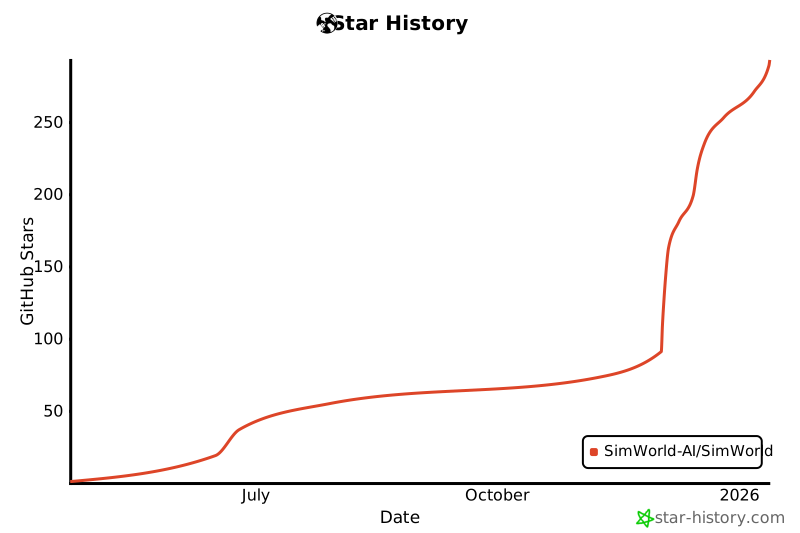](https://www.star-history.com/#SimWorld-AI/SimWorld&type=date&legend=bottom-right) | |