
Buckets:


Building a Svelte application
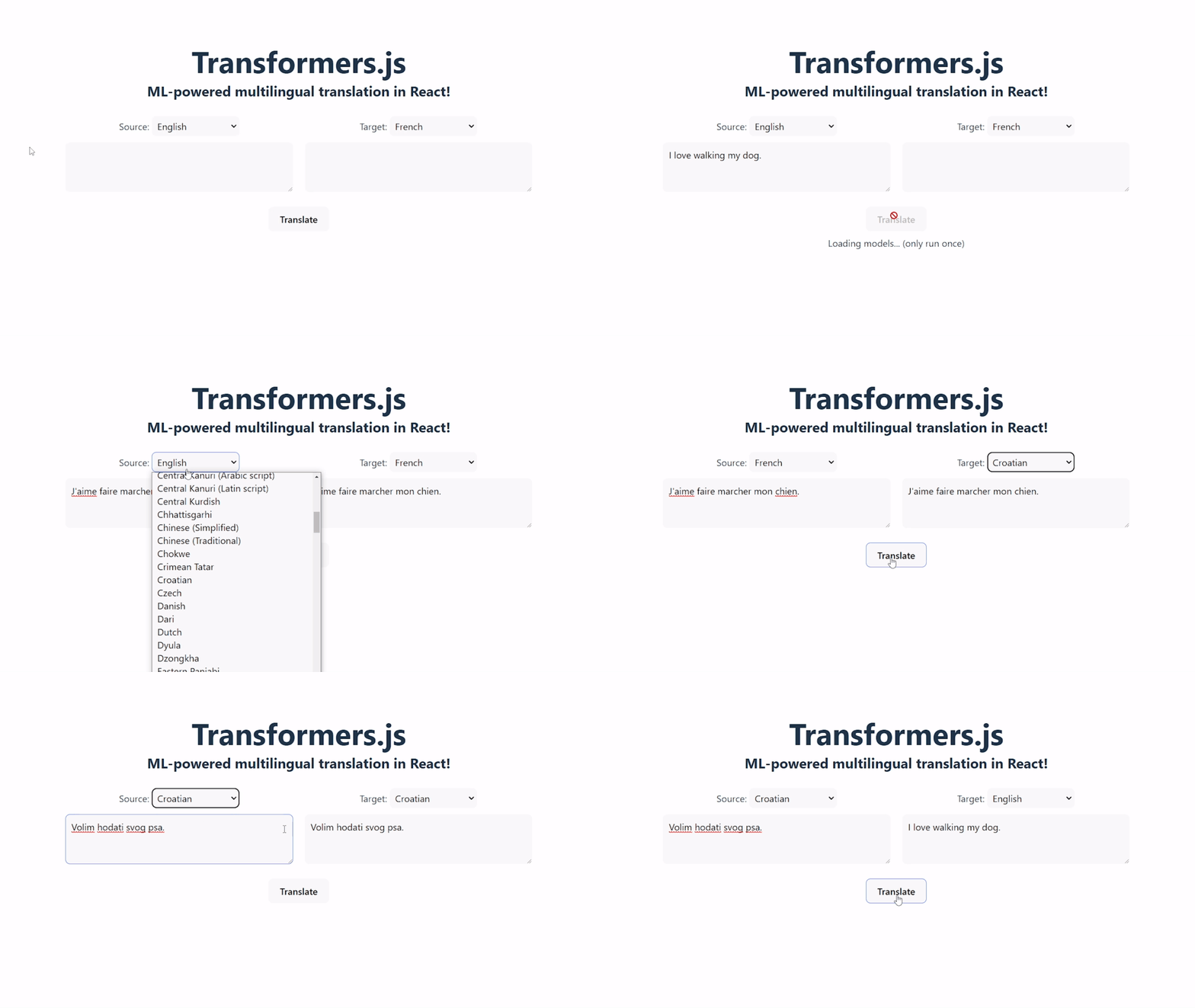
In this tutorial, we'll be building a simple Svelte application that performs multilingual translation using Transformers.js! The final product will look something like this:
Useful links:
Prerequisites
Step 1: Initialise the project
For this tutorial, we will use Vite to initialise our project. Vite is a build tool that allows us to quickly set up a Svelte application with minimal configuration. Run the following command in your terminal:
npm create vite@latest svelte-translator -- --template svelte
If prompted to install create-vite, type y and press Enter.
Next, enter the project directory and install the necessary development dependencies:
cd svelte-translator
npm install
To test that our application is working, we can run the following command:
npm run dev
Visiting the URL shown in the terminal (e.g., http://localhost:5173/) should show the default "Svelte + Vite" landing page. You can stop the development server by pressing Ctrl + C in the terminal.
Step 2: Install and configure Transformers.js
Now we get to the fun part: adding machine learning to our application! First, install Transformers.js from NPM with the following command:
npm install @huggingface/transformers
For this application, we will use the Xenova/nllb-200-distilled-600M model, which can perform multilingual translation among 200 languages. Before we start, there are 2 things we need to take note of:
- ML inference can be quite computationally intensive, so it's better to load and run the models in a separate thread from the main (UI) thread.
- Since the model is quite large (>1 GB), we don't want to download it until the user clicks the "Translate" button.
We can achieve both of these goals by using a Web Worker.
Create a file called worker.js in the src directory. This script will do all the heavy-lifting for us, including loading and running of the translation pipeline. To ensure the model is only loaded once, we will create the MyTranslationPipeline class which uses the singleton pattern to lazily create a single instance of the pipeline when getInstance is first called, and use this pipeline for all subsequent calls:
import { pipeline, TextStreamer } from "@huggingface/transformers";

class MyTranslationPipeline {
  static task = "translation";
  static model = "Xenova/nllb-200-distilled-600M";
  static instance = null;

  static async getInstance(progress_callback = null) {
    this.instance ??= pipeline(this.task, this.model, { progress_callback });
    return this.instance;
  }
}
Step 3: Design the user interface
We recommend starting the development server again with npm run dev
(if not already running) so that you can see your changes in real-time.
First, let's create some child components. Create a folder called lib in the src directory, and create the following files:
LanguageSelector.svelte: This component will allow the user to select the input and output languages. Check out the full list of languages here.export let type = ''; export let defaultLanguage = ''; export let onChange = () => {}; const LANGUAGES = { "Acehnese (Arabic script)": "ace_Arab", "Acehnese (Latin script)": "ace_Latn", "Afrikaans": "afr_Latn", // ... full list omitted for brevity "Zulu": "zul_Latn", }; {type}: {#each Object.entries(LANGUAGES) as [key, value]} {key} {/each}Progress.svelte: This component will display the progress for downloading each model file.export let text = ''; export let percentage = 0; {text} ({percentage.toFixed(2)}%)
Now let's update App.svelte in the src directory. Replace its contents with the following, which sets up our state variables and renders the UI:
  import LanguageSelector from './lib/LanguageSelector.svelte';
  import Progress from './lib/Progress.svelte';
  import './app.css';

  // Model loading
  let ready = null;
  let disabled = false;
  let progressItems = [];

  // Inputs and outputs
  let input = 'I love walking my dog.';
  let sourceLanguage = 'eng_Latn';
  let targetLanguage = 'fra_Latn';
  let output = '';

  Transformers.js
  ML-powered multilingual translation in Svelte!


       sourceLanguage = e.target.value}
      />
       targetLanguage = e.target.value}
      />


  Translate


    {#if ready === false}
      Loading models... (only run once)
    {/if}
    {#each progressItems as data (data.file)}


    {/each}
Don't worry about the translate function for now. We will define it in the next section.
Next, let's add some CSS to make our app look a little nicer. Modify the following files in the src directory:
app.css:View code
:root {
  font-family: Inter, system-ui, Avenir, Helvetica, Arial, sans-serif;
  line-height: 1.5;
  font-weight: 400;
  color: #213547;
  background-color: #ffffff;

  font-synthesis: none;
  text-rendering: optimizeLegibility;
  -webkit-font-smoothing: antialiased;
  -moz-osx-font-smoothing: grayscale;
  -webkit-text-size-adjust: 100%;
}

body {
  margin: 0;
  display: flex;
  place-items: center;
  min-width: 320px;
  min-height: 100vh;
}

h1 {
  font-size: 3.2em;
  line-height: 1;
}

h1,
h2 {
  margin: 8px;
}

select {
  padding: 0.3em;
  cursor: pointer;
}

textarea {
  padding: 0.6em;
}

button {
  padding: 0.6em 1.2em;
  cursor: pointer;
  font-weight: 500;
}

button[disabled] {
  cursor: not-allowed;
}

select,
textarea,
button {
  border-radius: 8px;
  border: 1px solid transparent;
  font-size: 1em;
  font-family: inherit;
  background-color: #f9f9f9;
  transition: border-color 0.25s;
}

select:hover,
textarea:hover,
button:not([disabled]):hover {
  border-color: #646cff;
}

select:focus,
select:focus-visible,
textarea:focus,
textarea:focus-visible,
button:focus,
button:focus-visible {
  outline: 4px auto -webkit-focus-ring-color;
}
Add the following styles. You can either put them in
app.cssor in a `` block at the bottom ofApp.svelte:View code
#app {
  max-width: 1280px;
  margin: 0 auto;
  padding: 2rem;
  text-align: center;
}

.language-container {
  display: flex;
  gap: 20px;
}

.textbox-container {
  display: flex;
  justify-content: center;
  gap: 20px;
  width: 800px;
}

.textbox-container > textarea,
.language-selector {
  width: 50%;
}

.language-selector > select {
  width: 150px;
}

.progress-container {
  position: relative;
  font-size: 14px;
  color: white;
  background-color: #e9ecef;
  border: solid 1px;
  border-radius: 8px;
  text-align: left;
  overflow: hidden;
}

.progress-bar {
  padding: 0 4px;
  z-index: 0;
  top: 0;
  width: 1%;
  overflow: hidden;
  background-color: #007bff;
  white-space: nowrap;
}

.progress-text {
  z-index: 2;
}

.selector-container {
  display: flex;
  gap: 20px;
}

.progress-bars-container {
  padding: 8px;
  height: 140px;
}

.container {
  margin: 25px;
  display: flex;
  flex-direction: column;
  gap: 10px;
}
Step 4: Connecting everything together
Now that we have a basic user interface set up, we can finally connect everything together.
First, let's set up the Web Worker and the translate function. Add the following to the `` section of App.svelte:
  import { onMount, onDestroy } from 'svelte';
  import LanguageSelector from './lib/LanguageSelector.svelte';
  import Progress from './lib/Progress.svelte';
  import './app.css';

  // ... state variables from before ...

  let worker;

  onMount(() => {
    worker = new Worker(new URL('./worker.js', import.meta.url), {
      type: 'module',
    });

    worker.addEventListener('message', onMessageReceived);
  });

  onDestroy(() => {
    worker?.removeEventListener('message', onMessageReceived);
  });

  function onMessageReceived(e) {
    switch (e.data.status) {
      case 'initiate':
        ready = false;
        progressItems = [...progressItems, e.data];
        break;

      case 'progress':
        progressItems = progressItems.map((item) => {
          if (item.file === e.data.file) {
            return { ...item, progress: e.data.progress };
          }
          return item;
        });
        break;

      case 'done':
        progressItems = progressItems.filter(
          (item) => item.file !== e.data.file,
        );
        break;

      case 'ready':
        ready = true;
        break;

      case 'update':
        output += e.data.output;
        break;

      case 'complete':
        disabled = false;
        break;
    }
  }

  function translate() {
    disabled = true;
    output = '';
    worker.postMessage({
      text: input,
      src_lang: sourceLanguage,
      tgt_lang: targetLanguage,
    });
  }
Now, let's add an event listener in src/worker.js to listen for messages from the main thread. We will send back messages (e.g., for model loading progress and text streaming) to the main thread with self.postMessage.
// Listen for messages from the main thread
self.addEventListener("message", async (event) => {
  // Retrieve the translation pipeline. When called for the first time,
  // this will load the pipeline and save it for future use.
  const translator = await MyTranslationPipeline.getInstance((x) => {
    // We also add a progress callback to the pipeline so that we can
    // track model loading.
    self.postMessage(x);
  });

  // Capture partial output as it streams from the pipeline
  const streamer = new TextStreamer(translator.tokenizer, {
    skip_prompt: true,
    skip_special_tokens: true,
    callback_function: function (text) {
      self.postMessage({
        status: "update",
        output: text,
      });
    },
  });

  // Actually perform the translation
  const output = await translator(event.data.text, {
    tgt_lang: event.data.tgt_lang,
    src_lang: event.data.src_lang,

    // Allows for partial output to be captured
    streamer,
  });

  // Send the output back to the main thread
  self.postMessage({
    status: "complete",
    output,
  });
});
You can now run the application with npm run dev and perform multilingual translation directly in your browser!
(Optional) Step 5: Build and deploy
To build your application, simply run npm run build. This will bundle your application and output the static files to the dist folder.
For this demo, we will deploy our application as a static Hugging Face Space, but you can deploy it anywhere you like! If you haven't already, you can create a free Hugging Face account here.
- Visit https://huggingface.co/new-space and fill in the form. Remember to select "Static" as the space type.
- Go to "Files" → "Add file" → "Upload files". Drag the
index.htmlfile andpublic/folder from thedistfolder into the upload box and click "Upload". After they have uploaded, scroll down to the button and click "Commit changes to main".
That's it! Your application should now be live at https://huggingface.co/spaces//!
Xet Storage Details
- Size:
- 12.5 kB
- Xet hash:
- d91a8db13f9bdef7748e5d3cfb76af10265bca40ba1c1619b811c99a79b54665
Xet efficiently stores files, intelligently splitting them into unique chunks and accelerating uploads and downloads. More info.