| --- |
| license: mit |
| --- |
| |
| ## Mel-Spectrogram Image Dataset (Generated via Custom Pipeline) |
|
|
| > **This dataset was fully generated through my notebook |
| > *“Building an Audio Classification Pipeline with DL”* available on my profile.** |
| > It represents a complete end-to-end transformation from raw audio to clean, balanced Mel-spectrogram images suitable for deep learning. |
|
|
| --- |
|
|
| ### **Dataset Summary** |
|
|
| | Property | Description | |
| | ---------------------------- | --------------------------------------------- | |
| | **Number of Classes** | 13 distinct audio categories | |
| | **Original Audio per Class** | ~40 raw recordings | |
| | **Average Duration** | ~5 seconds per audio file | |
| | **Final Images per Class** | 125 Mel-spectrogram images | |
| | **Final Dataset Size** | 13 × 125 = **1625 images** | |
| | **Sampling Rate** | Standardized to **16 kHz** | |
| | **Audio Length** | Uniform **5-second** fixed length | |
| | **Spectrogram Type** | 128-Mel frequency bins, `melspectrogram → dB` | |
|
|
| --- |
|
|
| ### **High-Level Processing Pipeline** |
|
|
| The dataset was built using a **fully custom preprocessing, cleaning, and augmentation pipeline**, implemented step-by-step in the notebook. |
|
|
| #### **1. Data Ingestion** |
|
|
| * Loaded all raw audio files from 13 folders |
| * Parsed metadata (sample rate, duration, amplitude, SNR, etc.) |
|
|
| #### **2. Cleaning & Standardization** |
|
|
| * Removed corrupt, silent, or unreadable audio files |
| * Normalized peak amplitudes |
| * Trimmed silence using `librosa.effects.trim` |
| * Performed noise reduction (`noisereduce`) |
| * Converted all audio to **mono** |
| * Resampled to **16,000 Hz** |
| * Ensured each sample is **exactly 5 seconds** |
|
|
| #### **3. Dataset Balancing** |
|
|
| * Used augmentation for minority classes |
| * Used controlled undersampling or oversampling where necessary |
| * Verified all classes contain equal counts |
|
|
| #### **4. Audio Augmentation (Used for Balancing & Variability)** |
|
|
| Augmentations built with **audiomentations**: |
|
|
| * Time shift |
| * Pitch shift |
| * Time stretching |
| * Gaussian noise injection |
| * Random perturbations for robustness |
|
|
| #### **5. Splitting & Chunking** |
|
|
| * Long samples were split into 5-second chunks |
| * Shorter samples padded to match target duration |
| * Ensured strict uniformity before feature extraction |
|
|
| #### **6. Mel-Spectrogram Generation** |
|
|
| Converted all cleaned audio files into Mel-spectrogram images using: |
|
|
| * `n_fft = 1024` |
| * `hop_length = 512` |
| * `n_mels = 128` |
| * Converted to decibel scale (`power_to_db`) |
| * Saved images in **RGBA format** to preserve color-mapped spectral information |
|
|
| --- |
|
|
| ### **Final Technical Description** |
|
|
| > **“The final dataset consists of 13 audio classes, each expanded to exactly 125 Mel-spectrogram images through a rigorous pipeline of cleaning, normalization, augmentation, noise reduction, resampling, duration standardization, and feature extraction. All processing steps were implemented in my notebook *‘Building an Audio Classification Pipeline with DL,’* where raw 5-second audio recordings were transformed into high-quality Mel-spectrogram images suitable for deep learning models.”** |
|
|
| --- |
|
|
| ### **Examples of the Images** |
|
|
| 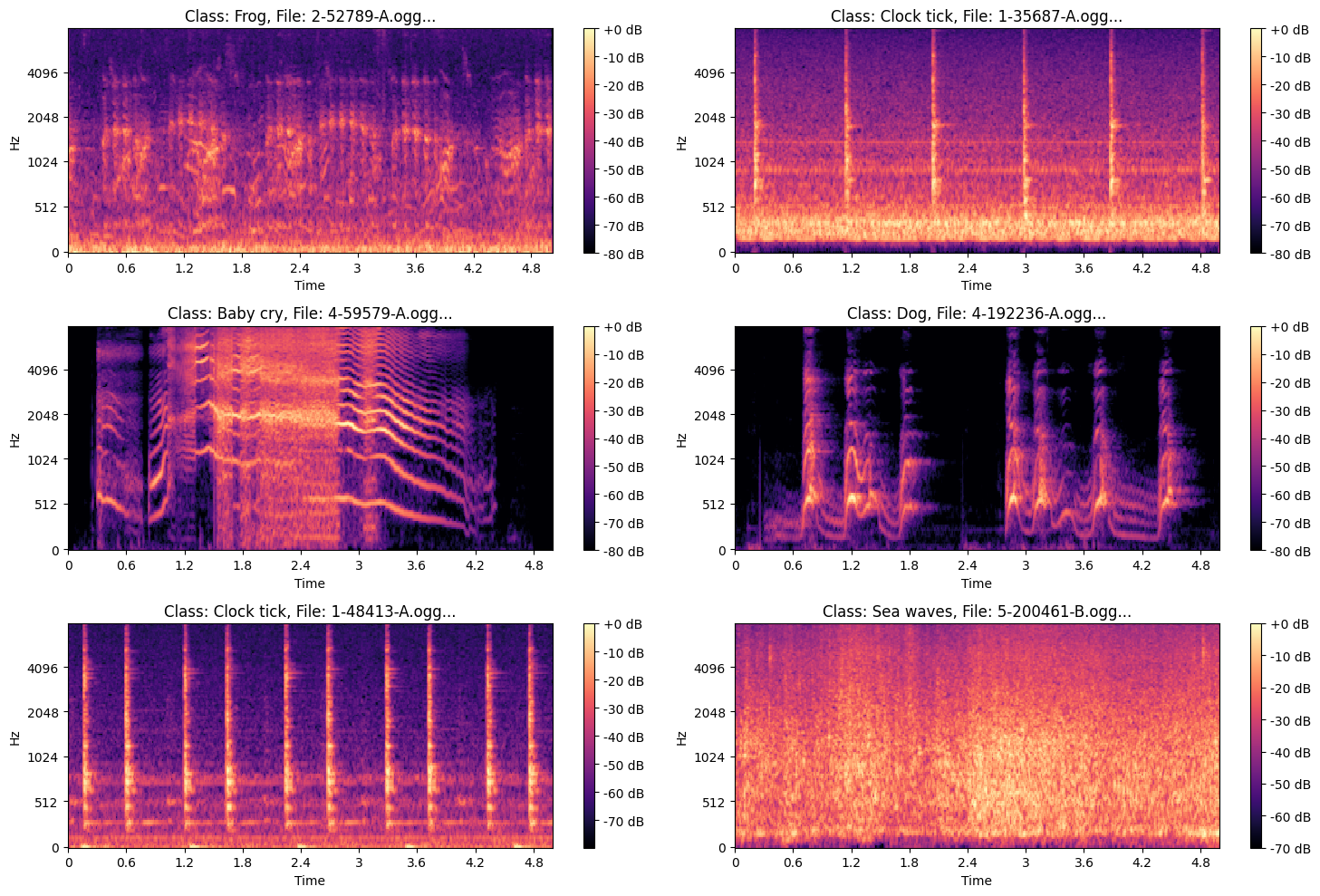 |
|
|
| .png?generation=1763570855911665&alt=media) |

