

| # A statically generated landing page using Next.js and Plasmic | |
| This example showcases Next.js's [Static Generation](https://nextjs.org/docs/basic-features/pages) feature using [Plasmic](https://www.plasmic.app/) as the visual page builder. | |
| You'll get: | |
| - Statically generated pages from your visual designs | |
| - Development server on [preview mode](https://nextjs.org/docs/advanced-features/preview-mode) watches for changes from Plasmic Studio | |
| ## Demo | |
| ### [https://nextjs-plasmic-example.vercel.app/](https://nextjs-plasmic-example.vercel.app/) | |
| ## Deploy your own | |
| Once you have access to the [environment variables you need](#step-3-set-up-environment-variables), deploy the example using [Vercel](https://vercel.com?utm_source=github&utm_medium=readme&utm_campaign=next-example). | |
| [](https://vercel.com/new/clone?repository-url=https%3A%2F%2Fgithub.com%2Fvercel%2Fnext.js%2Ftree%2Fcanary%2Fexamples%2Fcms-plasmic&env=NEXT_PUBLIC_PLASMIC_PROJECT_ID,NEXT_PUBLIC_PLASMIC_PROJECT_API_TOKEN,PLASMIC_PREVIEW_SECRET&envDescription=Required%20to%20connect%20the%20app%20with%20Plasmic&envLink=https%3A%2F%2Fgithub.com%2Fvercel%2Fnext.js%2Ftree%2Fcanary%2Fexamples%2Fcms-plasmic) | |
| ### Related examples | |
| - [AgilityCMS](/examples/cms-agilitycms) | |
| - [Builder.io](/examples/cms-builder-io) | |
| - [ButterCMS](/examples/cms-buttercms) | |
| - [Contentful](/examples/cms-contentful) | |
| - [Cosmic](/examples/cms-cosmic) | |
| - [DatoCMS](/examples/cms-datocms) | |
| - [DotCMS](/examples/cms-dotcms) | |
| - [Drupal](/examples/cms-drupal) | |
| - [Enterspeed](/examples/cms-enterspeed) | |
| - [Ghost](/examples/cms-ghost) | |
| - [GraphCMS](/examples/cms-graphcms) | |
| - [Kontent.ai](/examples/cms-kontent-ai) | |
| - [MakeSwift](/examples/cms-makeswift) | |
| - [Payload](/examples/cms-payload) | |
| - [Plasmic](/examples/cms-plasmic) | |
| - [Prepr](/examples/cms-prepr) | |
| - [Prismic](/examples/cms-prismic) | |
| - [Sanity](/examples/cms-sanity) | |
| - [Sitecore XM Cloud](/examples/cms-sitecore-xmcloud) | |
| - [Sitefinity](/examples/cms-sitefinity) | |
| - [Storyblok](/examples/cms-storyblok) | |
| - [TakeShape](/examples/cms-takeshape) | |
| - [Tina](/examples/cms-tina) | |
| - [Umbraco](/examples/cms-umbraco) | |
| - [Umbraco heartcore](/examples/cms-umbraco-heartcore) | |
| - [Webiny](/examples/cms-webiny) | |
| - [WordPress](/examples/cms-wordpress) | |
| - [Blog Starter](/examples/blog-starter) | |
| ## How to use | |
| Execute [`create-next-app`](https://github.com/vercel/next.js/tree/canary/packages/create-next-app) with [npm](https://docs.npmjs.com/cli/init), [Yarn](https://yarnpkg.com/lang/en/docs/cli/create/), or [pnpm](https://pnpm.io) to bootstrap the example: | |
| ```bash | |
| npx create-next-app --example cms-plasmic cms-plasmic-app | |
| ``` | |
| ```bash | |
| yarn create next-app --example cms-plasmic cms-plasmic-app | |
| ``` | |
| ```bash | |
| pnpm create next-app --example cms-plasmic cms-plasmic-app | |
| ``` | |
| ## Configuration | |
| ### Step 1. Create an account and a project on Plasmic | |
| First, [create an account on Plasmic](https://studio.plasmic.app/). | |
| After creating an account, create a new project. | |
| ### Step 2. Gather your project ID and API token | |
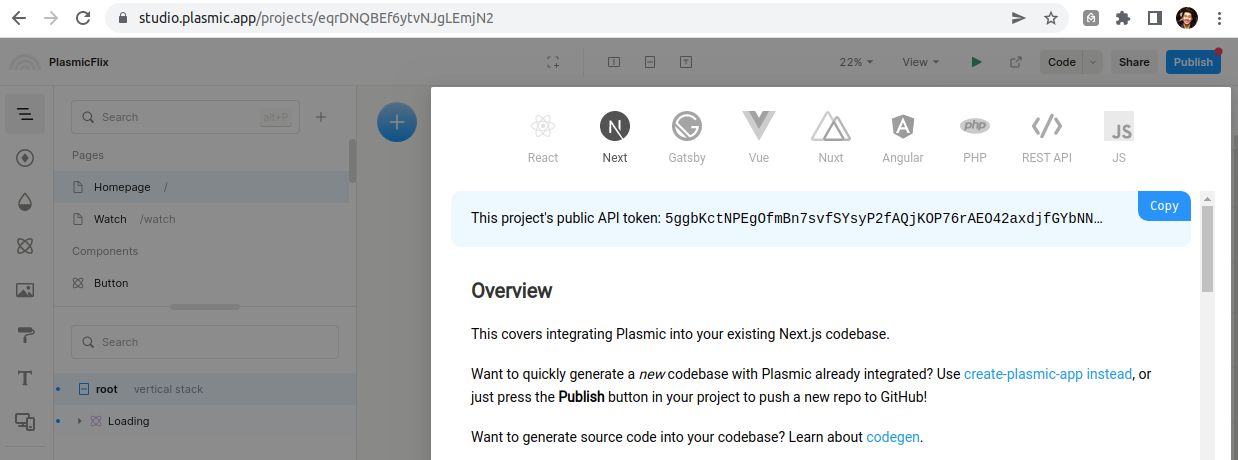
| Once you've opened your Plasmic project, you can find the project ID in the URL: `https://studio.plasmic.app/projects/PROJECTID`. | |
| The API token can be found by clicking the Code button in the top bar. | |
|  | |
| ### Step 3. Set up environment variables | |
| Copy the `.env.local.example` file in this directory to `.env.local` (which will be ignored by Git): | |
| ```bash | |
| cp .env.local.example .env.local | |
| ``` | |
| Then set each variable on `.env.local`: | |
| - `NEXT_PUBLIC_PLASMIC_PROJECT_ID` should be the `projectId` value in step 2. | |
| - `NEXT_PUBLIC_PLASMIC_PROJECT_API_TOKEN` should be the API token gathered in previous step. | |
| - `PLASMIC_PREVIEW_SECRET` can be any random string (but avoid spaces), like `MY_SECRET` - this is used for [Preview Mode](https://nextjs.org/docs/advanced-features/preview-mode). | |
| ### Step 4. Run Next.js in development mode | |
| ```bash | |
| npm install | |
| npm run dev | |
| # or | |
| yarn install | |
| yarn dev | |
| ``` | |
| Your blog should be up and running on [http://localhost:3000](http://localhost:3000)! If it doesn't work, post on [GitHub discussions](https://github.com/vercel/next.js/discussions). | |
| ### Step 5. Try preview mode | |
| By default, the code is set up to only build published Plasmic projects. | |
| If you want to see changes as you make them in the Plasmic Studio, enter preview mode by opening the following URL: | |
| ``` | |
| http://localhost:3000/api/preview?secret=PLASMIC_PREVIEW_SECRET&slug=PATH | |
| ``` | |
| Be sure to replace the secret with the chosen secret in Step 3 and pick a path to preview (e.g. `http://localhost:3000/api/preview?secret=123456&slug=/`) | |
| Now you can make edits in the Studio and see them reflected in the development server live. | |
| You can exit preview mode at any time by going to the following URL: | |
| ``` | |
| http://localhost:3000/api/exit-preview | |
| ``` | |
| ### Step 6. Deploy on Vercel | |
| You can deploy this app to the cloud with [Vercel](https://vercel.com?utm_source=github&utm_medium=readme&utm_campaign=next-example) ([Documentation](https://nextjs.org/docs/deployment)). | |
| To deploy your local project to Vercel, push it to GitHub/GitLab/Bitbucket and [import to Vercel](https://vercel.com/new?utm_source=github&utm_medium=readme&utm_campaign=next-example). | |
| **Important**: When you import your project on Vercel, make sure to click on **Environment Variables** and set them to match your `.env.local` file. | |
| ## Next steps: | |
| With Plasmic, you can enable non-developers on your team to publish pages and content into your website or app. | |
| To learn more about Plasmic, take a look at the following resources: | |
| - [Plasmic Website](https://www.plasmic.app/) | |
| - [Plasmic Documentation](https://docs.plasmic.app/learn/) | |
| - [Plasmic Slack Community](https://www.plasmic.app/slack) | |
| You can check out [the Plasmic GitHub repository](https://github.com/plasmicapp/plasmic) - your feedback and contributions are welcome! | |