

Auxiliary Cross-Modal Representation Learning with Triplet Loss Functions for Online Handwriting Recognition
Paper • 2202.07901 • Published
The dataset viewer is not available because its heuristics could not detect any supported data files. You can try uploading some data files, or configuring the data files location manually.
This repository mirrors the datasets described on the Fraunhofer IIS OnHW website. Dataset ZIP links below refer to files stored alongside this README, using the original archive filenames. Supporting documentation and research code retain their original links.
Handwriting is an important skill. In children, it benefits motor control, visual-motor integration, proprioception and sustained attention. Studies have also shown that handwriting improves the brain’s processing capabilities compared to typing notes on a laptop. Furthermore, it enhances the users’ ideation abilities. Despite these scientific advantages, the main reason for most people to use pen and paper is just the comfortable, analog, natural look-and-feel.
The dataset can be downloaded here (895 MB). (Update:2021-06-30)
For more information, see the readme.pdf file.
To obtain the sensor data, we implemented a recording app that connects to a DigiPen and tells the volunteers which letter to write. These are some of the constraints that were met during the recordings:
Hardware
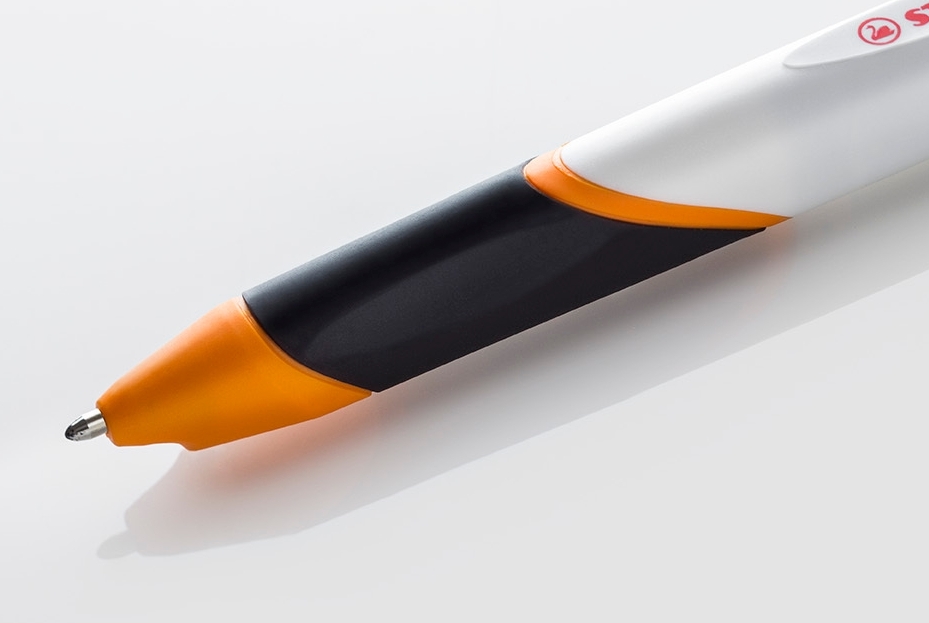
The STABILO Digipen is a sensor-enhanced ballpoint pen with internal data processing capabilities. Its Bluetooth module enables live streaming sensor data to a connected device. The pen’s internal power source lasts at least 17 hours and is recharcheable via micro USB. Its diameter is 15mm, its overall length is 167mm and it weighs 25g which, along with its ergonomic soft-touch grip zone, makes it comfortable and easy-to-use.
Each Digipen is equipped with five sensors.
Sensor Data
The sensors’ raw data stream is provided in the files called sensor_data.csv. Each file consists of 15 columns:
If you use the OnHW dataset, please cite:
Felix Ott*, Mohamad Wehbi*, Tim Hamann, Jens Barth, Björn Eskofier, and Christopher Mutschler. The OnHW Dataset: Online Handwriting Recognition from IMU-Enhanced Ballpoint Pens with Machine Learning. In Proc. of the ACM Interact. Mob. Wearable Ubiquitous Technol. (IMWUT), vol. 4, no. 3, article 92, pages 1-20, Cancún, Mexico, September 2020, doi: 10.1145/3411842.
BibTeX:
@inproceedings{ott_onhw,
  author = {Felix Ott and Mohamad Wehbi and Tim Hamann and Jens Barth and Björn Eskofier and Christopher Mutschler},
  title = {{The OnHW Dataset: Online Handwriting Recognition from IMU-Enhanced Ballpoint Pens with Machine Learning}},
  booktitle = {Proc. of the ACM on Interactive, Mobile, Wearable and Ubiquitous Technologies (IMWUT)},
  volume = {4(3), article 92},
  pages = {1--20},
  address = {Canc\'{u}n, Mexico},
  month = sep,
  year = {2020},
  doi = {10.1145/3411842}
}
The supplementary material of the paper and the dataset can be downloaded here (28 MB).
For more information, see the readme.txt file.
If you use the dataset, please cite:
Felix Ott, David Rügamer, Lucas Heublein, Bernd Bischl, and Christopher Mutschler. Joint Classification and Trajectory Regression of Online Handwriting using a Multi-Task Learning Approach. In Proc. of the IEEE/CVF Winter Conf. on Applications of Computer Vision (WACV), pages 266-276, Waikoloa, HI, January 2022, doi: 10.1109/WACV51458.2022.00131.
BibTeX:
@inproceedings{ott_wacv,
  author = {Felix Ott and David Rügamer and Lucas Heublein and Bernd Bischl and Christopher Mutschler},
  title = {{Joint Classification and Trajectory Regression of Online Handwriting using a Multi-Task Learning Approach}},
  booktitle = {Proc. of the IEEE/CVF Winter Conf. for Applications on Computer Vision (WACV)},
  address = {Waikoloa, HI},
  pages = {266--276},
  month = jan,
  year = {2022},
  doi = {10.1109/WACV51458.2022.00131}
}
If you use the dataset, please cite:
Felix Ott, David Rügamer, Lucas Heublein, Tim Hamann, Jens Barth, Bernd Bischl, and Christopher Mutschler. Benchmarking Online Sequence-to-Sequence and Character-based Handwriting Recognition from IMU-Enhanced Pens. In International Journal on Document Analysis and Recognition (IJDAR), September 2022, doi: 10.1007/s10032-022-00415-6.
BibTeX:
@inproceedings{ott_ijdar,
  author = {Felix Ott and David Rügamer and Lucas Heublein and Tim Hamann and Jens Barth and Bernd Bischl and Christopher Mutschler},
  title = {{Benchmarking Online Sequence-to-Sequence and Character-based Handwriting Recognition from IMU-Enhanced Pens}},
  booktitle = {International Journal on Document Analysis and Recognition (IJDAR)},
  month = sep,
  year = {2022},
  doi = {10.1007/s10032-022-00415-6}
}
| Dataset | Right-handed: Writer-dependent | Right-handed: Writer-independent | Left-handed: Writer-dependent | Left-handed: Writer-independent |
|---|---|---|---|---|
| OnHW-equations | OnHW-equations_dep.zip | OnHW-equations_indep.zip | OnHW-equations_dep_L.zip | OnHW-equations_indep_L.zip |
| OnHW-words500 | OnHW-words500_dep.zip | OnHW-words500_indep.zip | OnHW-words500_dep_L.zip | OnHW-words500_indep_L.zip |
| OnHW-wordsTraj | OnHW-wordsTraj_person1.zip OnHW-wordsTraj_person2.zip |
- | - | - |
| ICROW | ICROW_dep.zip | ICROW_indep.zip | - | - |
We used a writer-dependent and writer-independent split of the VNOnDB and IAM-OnDB datasets. For more information, see for the VNOnDB dataset and see for the IAM-OnDB dataset.
If you use the dataset, please cite:
Felix Ott, David Rügamer, Lucas Heublein, Tim Hamann, Jens Barth, Bernd Bischl, and Christopher Mutschler. Benchmarking Online Sequence-to-Sequence and Character-based Handwriting Recognition from IMU-Enhanced Pens. In International Journal on Document Analysis and Recognition (IJDAR), September 2022, doi: 10.1007/s10032-022-00415-6.
BibTeX:
@inproceedings{ott_ijdar,
  author = {Felix Ott and David Rügamer and Lucas Heublein and Tim Hamann and Jens Barth and Bernd Bischl and Christopher Mutschler},
  title = {{Benchmarking Online Sequence-to-Sequence and Character-based Handwriting Recognition from IMU-Enhanced Pens}},
  booktitle = {International Journal on Document Analysis and Recognition (IJDAR)},
  month = sep,
  year = {2022},
  doi = {10.1007/s10032-022-00415-6}
}
| Dataset | Right-handed: Writer-dependent | Right-handed: Writer-independent | Left-handed |
|---|---|---|---|
| OnHW-symbols, split OnHW_equations | OnHW-symbols_equations_dep.zip | OnHW-symbols_equations_indep.zip | OnHW-symbols_equations_L.zip |
| OnHW-symbols, split OnHW_equations (CTC split) | OnHW-equations_dep_split_ctc.zip | OnHW-equations_indep_split_ctc.zip | - |
| OnHW-chars | See top | See top | OnHW-chars_L.zip |
When combining right-handed and left-handed writers (an underrepresented group), out-of-distribution data with domain shifts appear. Uncertainty quantification (UQ) techniques can detect such a domain shift. We conduct a broad evaluation of aleatoric (data) and epistemic (model) UQ based on two prominent techniques for Bayesian inference, Stochastic Weight Averaging-Gaussian (SWAG) and Deep Ensembles.
The corresponding code of the paper can be downloaded here. This paper uses the right-handed OnHW-chars and left-handed OnHW-chars-L datasets (see top). Our paper is accepted for publication at the 1st Intl. Workshop on Spatio-Temporal Reasoning and Learning (STRL) collocated with the Intl. Joint Conf. on Artificial Intelligence IJCAI-ECAI 2022.
Andreas Klaß, Sven M. Lorenz, Martin W. Lauer-Schmaltz, David Rügamer, Bernd Bischl, Christopher Mutschler, and Felix Ott. Uncertainty-aware Evaluation of Time-Series Classification for Online Handwriting Recognition with Domain Shift. In IJCAI-ECAI Intl. Workshop on Spatio-Temporal Reasoning and Learning (STRL), volume 3190, Vienna, Austria, July 2022.
BibTeX:
@inproceedings{klass_lorenz_strl,
  author = {Andreas Klaß and Sven M. Lorenz and Martin W. Lauer-Schmaltz and David Rügamer and Bernd Bischl and Christopher Mutschler and Felix Ott},
  title = {{Uncertainty-aware Evaluation of Time-Series Classification for Online Handwriting Recognition with Domain Shift}},
  booktitle = {IJCAI-ECAI Intl. Workshop on Spatio-Temporal Reasoning and Learning (STRL)},
  volume = {3190},
  month = jul,
  year = 2022,
  address = {Vienna, Austria},
  issn = {1613-0073}
}
When combining right-handed and left-handed writers (an underrepresented group), out-of-distribution data with domain shifts appear. We propose a method based on optimal transport to transform source domain features into target domain features. The corresponding code of the paper can be downloaded here.
Our paper uses the right-handed OnHW-chars and left-handed OnHW-chars-L datasets (see top). Our paper is accepted for publication at the ACM Intl. Conf. on Multimedia (ACMMM), October 2022.
If you use our method, please cite:
Felix Ott, David Rügamer, Lucas Heublein, Bernd Bischl, and Christopher Mutschler. Domain Adaptation for Time-Series Classification to Mitigate Covariate Shift. In Proc. of the ACM Intl. Conf. on Multimedia (ACMMM), pages 5934-5943, October 2022, Lisboa, Portugal, doi: 10.1145/3503161.3548167.
BibTeX:
@inproceedings{ott_acmmm,
  author = {Felix Ott and David Rügamer and Lucas Heublein and Bernd Bischl and Christopher Mutschler},
  title = {{Domain Adaptation for Time-Series Classification to Mitigate Covariate Shift}},
  booktitle = {Proc. of the ACM Intl. Conf. on Multimedia (ACMMM)},
  pages = {5934--5943},
  month = oct,
  year = 2022,
  address = {Lisboa, Portugal},
  doi = {10.1145/3503161.3548167}
}
To combine applications to write on paper with sensor-enhanced pens and applications to write on touch screen surfaces with a stylus pen, we integrated a Wacom EMR tip into the sensor-enhaned pen and collected data for writing on tablet. As a domain shift appears between sensor data for writing on tablet and on paper, we propose a representation learning technique to align the features between both representations. The paper is accepted for publication at IAPR Intl. Workshop on Multimodal Pattern Recognition of Social Signals in Human Computer Interaction (MPRSS).
If you use our method, please cite:
Felix Ott, David Rügamer, Lucas Heublein, Bernd Bischl, and Christopher Mutschler. Representation Learning for Tablet and Paper Domain Adaptation in Favor of Online Handwriting Recognition. In IAPR Intl. Workshop on Multimodal Pattern Recognition of Social Signals in Human Computer Interaction (MPRSS), August 2022, Montreal, Canada.
BibTeX:
@inproceedings{ott_mprss,
  author = {Felix Ott and David Rügamer and Lucas Heublein and Bernd Bischl and Christopher Mutschler},
  title = {{Representation Learning for Tablet and Paper Domain Adaptation in Favor of Online Handwriting Recognition}},
  booktitle = {IAPR Intl. Workshop on Multimodal Pattern Recognition of Social Signals in Human Computer Interaction (MPRSS)},
  month = aug,
  year = {2022},
  address = {Montreal, Canada}
}
To enhance to time-series classification task for online handwriting recognition, we augment the embeddings with image data for offline handwriting recognition. Our method first generates arbitrarily many image samples with ScrabbleGAN, trains an offline HWR architecture, and learns a common representation between the offline and online HWR architectures using pairwise and triplet learning techniques.
If you use our method, please cite:
Felix Ott, David Rügamer, Lucas Heublein, Bernd Bischl, and Christopher Mutschler. Cross-Modal Common Representation Learning with Triplet Loss Functions. In arXiv preprint arXiv:2202.07901, February 2022.
BibTeX:
@inproceedings{ott_cmr,
  author = {Felix Ott and David Rügamer and Lucas Heublein and Bernd Bischl and Christopher Mutschler},
  title = {{Cross-Modal Common Representation Learning with Triplet Loss Functions}},
  booktitle = {arXiv preprint arXiv:2202.07901},
  month = feb,
  Year = {2022},
  doi = {10.48550/arXiv.2202.07901}
}
Except for the third-party ICROW dataset described below, all datasets provided in this repository are licensed under the Creative Commons Attribution-NonCommercial 4.0 International (CC BY-NC 4.0) license.
You may use, share, and adapt these datasets for non-commercial purposes only, provided that you give appropriate credit to the dataset creators, include a link to the license, and indicate any modifications. Commercial use is not permitted under this license. Please also cite the corresponding publications listed in this README.
The ICROW dataset, provided as ICROW_dep.zip and ICROW_indep.zip, originates from the UNIPEN-ICROW-03 benchmark set. It remains subject to the original copyright notice of the International Unipen Foundation, copyright © 2003 International Unipen Foundation.
The original terms permit free use and copying of the data and software. The material is intended for technology research and is supplied without warranties; the provider disclaims liability for damages arising from its use.
The ICROW data must not be used to train or heuristically improve handwriting recognition systems, so that the dataset remains usable for benchmarking by the research community. This restriction must also be respected when using the ICROW splits provided here.
The CC BY-NC 4.0 license for the OnHW datasets does not replace ICROW's original terms.
stv. Gruppenleitung Self-Learning Systems
Fraunhofer-Institut für Integrierte Schaltungen IIS
Nordostpark 84
90411 Nürnberg
felix.ott@iis.fraunhofer.de
© 2026 Fraunhofer-Gesellschaft. Fraunhofer-Institut für Integrierte Schaltungen IIS.