


license: cc-by-nc-sa-2.0
Advances in AI Systems on Islamic Knowledge Capabilities: A Critical Survey




A comprehensive systematic survey of 160+ papers (2016–2026) examining how AI systems operationalize Islamic knowledge, spanning NLP, information retrieval, speech processing, multimodal learning, educational technology, and LLM alignment.
-1.png)
Abstract
AI systems are increasingly mediating how Islamic communities access, study, and apply Islamic sources; still, research on Islamic-knowledge capabilities remains fragmented across NLP, information retrieval, speech, multimodal learning, educational technology, and recent LLM alignment work.
This survey presents a critical systematic review of 160+ papers from the past decade that incorporate Islamic knowledge in Machine Learning/AI. We propose a layered taxonomy that separates an epistemic view of Islamic knowledge (authority-bearing foundations and established disciplines) from an instrumental AI task layer (data and corpora, retrieval and grounding, understanding, reasoning support, evaluation and governance, and multimodal methods), while treating normative concerns as cross-cutting constraints.
Using this framework, we synthesize trends in datasets, benchmarks, and system architectures, highlighting the shift toward retrieval-grounded LLM pipelines, verification and deferral mechanisms, and emerging multimodal recitation and manuscript-processing systems. We also consolidate evaluation practices for trustworthiness, including provenance and faithfulness, disagreement-aware and school-of-thought-sensitive framing, calibrated abstention under underspecified queries, and safety and bias assessment for Islamic contexts.
Key Contributions
- Layered Taxonomy — A two-layer framework separating the epistemic view of Islamic knowledge (Qur'an, Hadith, Fiqh, Theology, etc.) from the instrumental AI task layer (retrieval, grounding, reasoning, evaluation, multimodal methods).
- Systematic Review (PRISMA-ScR) — Rigorous screening of 1,743 initial records down to 160 included studies, following the PRISMA-ScR framework for transparency and reproducibility.
- Cross-Cutting Normative Dimensions — Analysis of doctrinal integrity, disagreement-aware framing, and deployment safety as cross-cutting concerns.
- Comprehensive Papers Database — A searchable, filterable collection of all surveyed papers with metadata on domains, tasks, and research areas.
Taxonomy
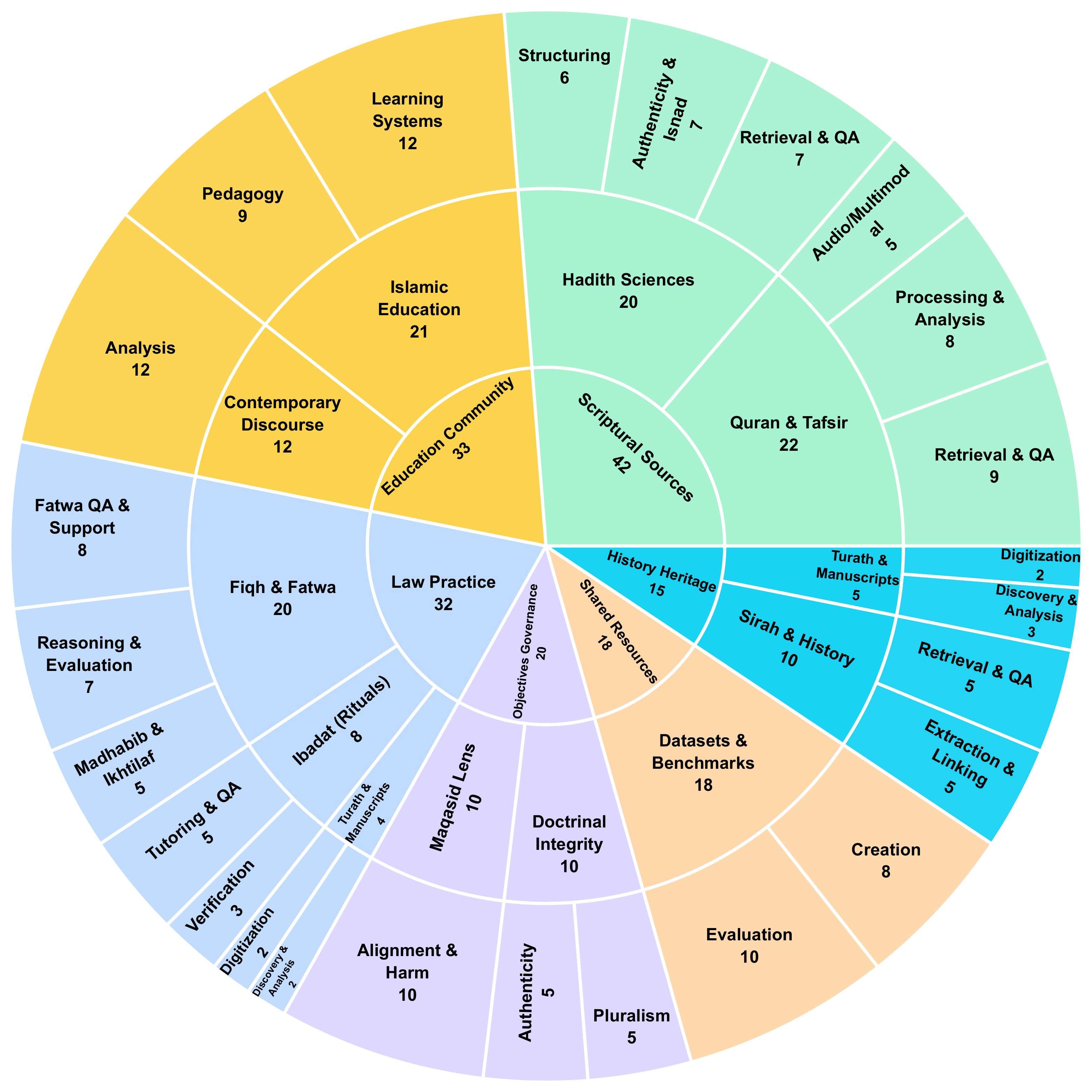
Epistemic Layer
| Category | Domains |
|---|---|
| Foundations | Qur'an, Hadith |
| Disciplines | Qur'anic Sciences, Hadith Sciences, Usul al-Fiqh, Fiqh, Theology (Kalam), Sufism (Tasawwuf), History & Sirah |
AI Task Layer
| Task Family | Description |
|---|---|
| Data & Corpora | Digitized texts, annotated datasets, knowledge graphs |
| Retrieval & Grounding | Source-grounded search, RAG pipelines, citation verification |
| Understanding | Classification, NER, topic modeling, sentiment analysis |
| Reasoning Support | QA, fatwa generation, legal reasoning, school-aware inference |
| Evaluation & Governance | Trustworthiness metrics, bias assessment, abstention protocols |
| Multimodal Methods | Recitation analysis, manuscript OCR, speech processing |
Research Questions
- RQ1 — Domains & Tasks: What Islamic knowledge domains and application tasks have been operationalized in ML/AI systems, and how is this work distributed across subfields?
- RQ2 — Resources & Measurement: What datasets, benchmarks, and knowledge resources are available, and what assumptions do they encode about evidence, provenance, and interpretive diversity?
- RQ3 — Evaluation & Trustworthiness: How do studies evaluate trustworthiness, especially source faithfulness, doctrinal correctness, pluralism-aware answering, and safety/bias?
Methodology
We followed the PRISMA-ScR (Preferred Reporting Items for Systematic reviews and Meta-Analyses extension for Scoping Reviews) framework:
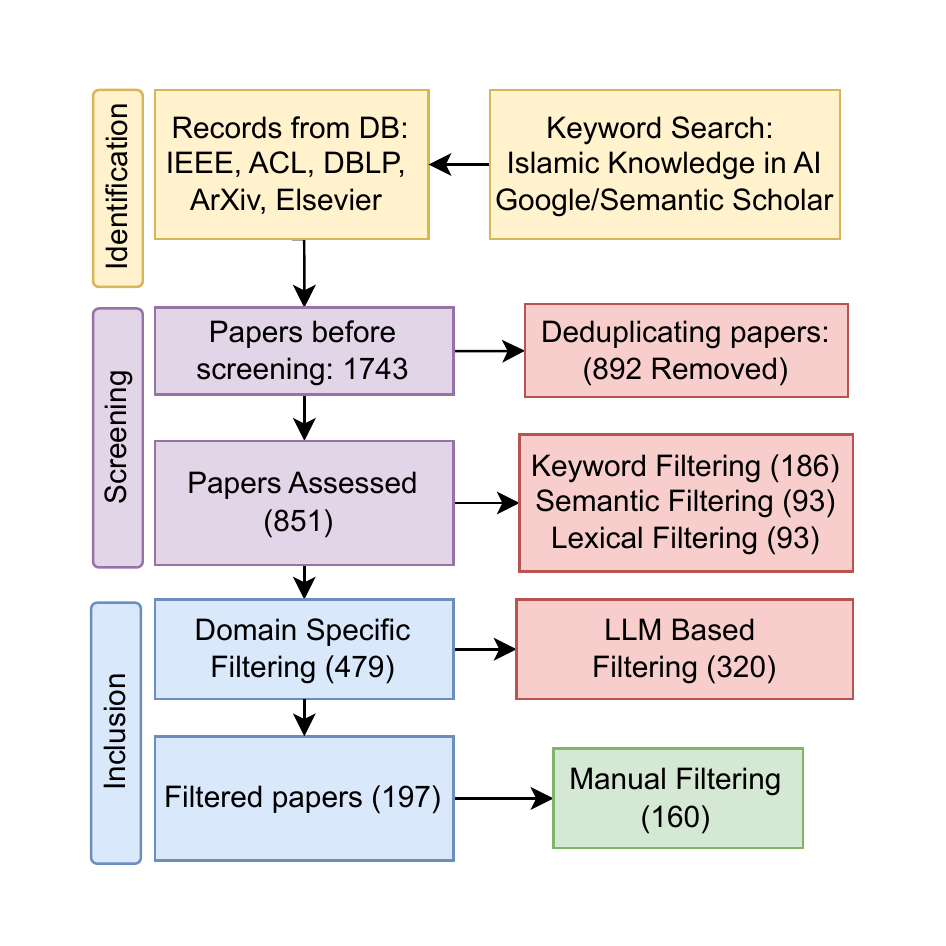
- Sources: Semantic Scholar, IEEE Xplore, ACM Digital Library, ACL Anthology, arXiv
- Coverage: 2016–2026
- Screening: 1,743 initial records → 160 included papers
Key Findings & Challenges
| Challenge | Description |
|---|---|
| Data Scarcity | Most Islamic NLP datasets are small-scale and single-domain; cross-domain benchmarks are rare |
| Pluralism Gaps | Systems tend to collapse diverse scholarly opinions into single answers rather than presenting school-of-thought-aware alternatives |
| Hallucination Risks | LLMs fabricate Qur'anic verses and Hadith with confident presentation; fabricated citations are uniquely harmful in religious contexts |
| Safety & Governance | High-stakes religious guidance requires conservative abstention strategies, scholar-in-the-loop validation, and Islamic-specific red-teaming protocols |
Engineering Priorities
- Provenance-preserving grounding — Retrieval-grounded pipelines with verifiable citations
- Disagreement-aware systems — Present alternative scholarly views with supporting evidence
- Calibrated abstention — Defer to qualified authority when grounding is unreliable
- Interdisciplinary collaboration — AI researchers, Islamic scholars ('ulama), and community stakeholders
- Benchmark investment — Evaluation protocols that penalize fabricated citations, with disagreement-aware scoring
- Safety-first deployment — Islamic-specific red-teaming, bias checks, and governance frameworks
Citation
If you use this survey in your research, please cite:
@article{Bhatia_2026,
  title     = {Advances in AI Systems on Islamic Knowledge Capabilities: A Critical Survey},
  url       = {http://dx.doi.org/10.36227/techrxiv.177155997.77147487/v1},
  DOI       = {10.36227/techrxiv.177155997.77147487/v1},
  author    = {Bhatia, Gagan and Mubarak, Hamdy and Hawasly, Majd and Jarrar, Mustafa and
               Mikros, George and Zaraket, Fadi and Alhirthani, Mahmoud and Al-Khatib, Mutaz and
               Cochrane, Logan and Darwish, Kareem and Yahiaoui, Rashid and Alam, Firoj},
  year      = {2026},
  month     = feb
}