

pipeline_tag: image-text-to-text
datasets:
  - laiyingxin/TouchReason
tags:
  - tactile-reasoning
  - multimodal
  - physical-reasoning
  - reinforcement-learning
  - robotics
  - arxiv:2605.27154
Touch-R1
Reinforcing Touch Reasoning in MLLMs
Paper · Project Page · GitHub · TouchReason Dataset
Touch-R1 brings explicit reasoning to physical contact. It connects optical tactile observations with vision and language, enabling multimodal models to use contact evidence when judging physical properties and revising misleading visual impressions.
Release status: Model card available. Model weights and verified inference instructions are coming soon. The GitHub repository currently hosts the project website; research code is forthcoming.
Model Summary
| Item | Description |
|---|---|
| Model type | Tactile reasoning multimodal large language model |
| Backbone reported in the paper | Qwen2.5-VL-7B |
| Research data | TouchReason-1M and TouchReason-Bench |
| Inputs | Optical tactile observations, visual context, and language questions |
| Outputs | Structured textual reasoning and physical-property judgments |
Approach
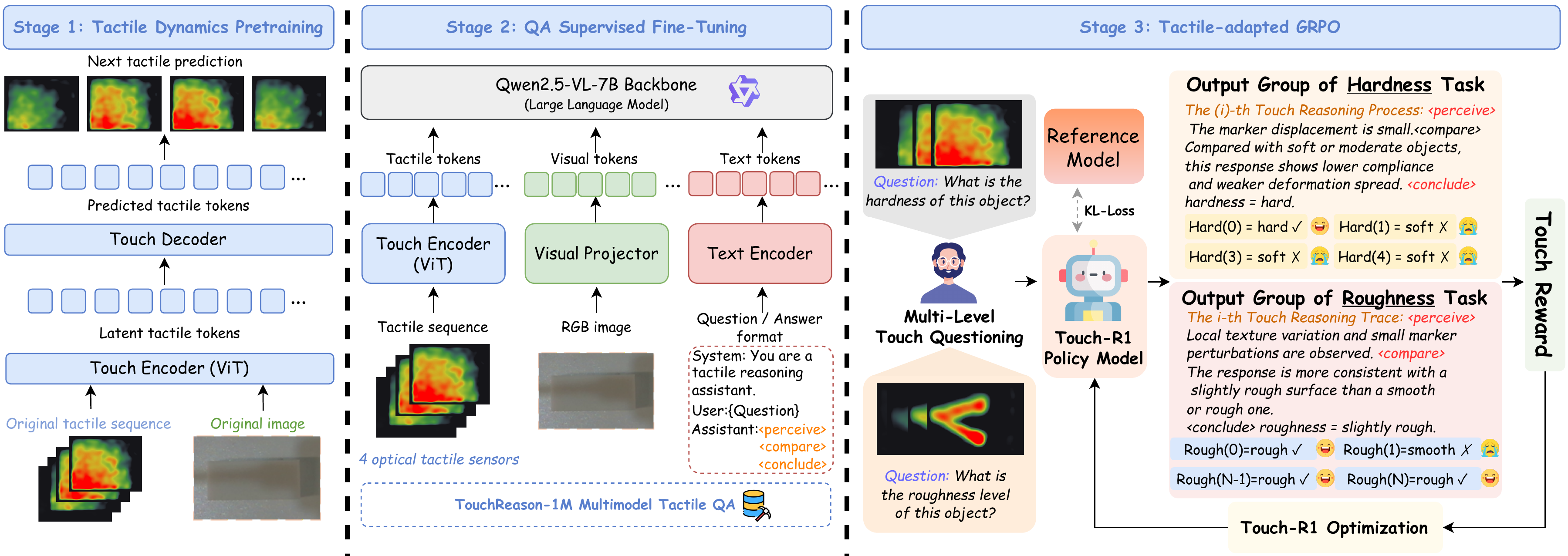
The training pipeline combines three stages:
- Tactile dynamics pretraining learns contact-sensitive representations by predicting future tactile tokens.
- QA supervised fine-tuning aligns touch, vision, and language with structured reasoning.
- Tactile-grounded GRPO combines ordinal-aware accuracy, cross-sensor physical consistency, and structured-format rewards with an input-side tactile grounding objective.
Responses organize evidence through <perceive>, <compare>, and <conclude> stages. Counterfactual tactile inputs—removed, shuffled, or noise-masked—help identify predictions that depend on genuine contact evidence.
Research Use
Touch-R1 is designed for physical-property inference, ordinal comparison, cross-sensor reasoning, and visual–tactile conflict resolution. Its intended interface is tactile/visual question answering with structured textual judgments.
The paper reports a 60.1 average score for Touch-R1-7B on TouchReason-Bench. See the paper for the evaluation protocol and complete results.
Related Resources
- Dataset: TouchReason
- Project page: Method, acquisition videos, and object atlas
- Project repository: Touch-R1
Citation
@misc{lai2026touchr1reinforcingtouchreasoning,
  title         = {{Touch-R1}: Reinforcing Touch Reasoning in {MLLMs}},
  author        = {Yingxin Lai and Yafei Zhou and Fucai Zhu and Siyu Zhu and Weihao Yuan},
  year          = {2026},
  eprint        = {2605.27154},
  archivePrefix = {arXiv},
  primaryClass  = {cs.CV},
  url           = {https://arxiv.org/abs/2605.27154}
}