

datasets:
  - letxbe/BoundingDocs
language:
  - en
pipeline_tag: visual-question-answering
tags:
  - Visual-Question-Answering
  - Question-Answering
  - Document
license: apache-2.0
DocExplainerV0: Visual Document QA with Bounding Box Localization



Model description
DocExplainerV0 is a first-step approach to Visual Document Question Answering with bounding box localization.
Unlike standard VLMs that only provide text-based answers, DocExplainerV0 adds visual evidence through bounding boxes, making model predictions more interpretable.
It is designed as a plug-and-play module to be combined with existing Vision-Language Models (VLMs), decoupling answer generation from spatial grounding.
⚠️ Important Note:
This model is not intended as a final solution, but rather as a baseline framework and proof of concept. Its purpose is to highlight the gap between textual accuracy and spatial grounding in current VLMs, and to serve as a foundation for future research on interpretable document understanding.
- Authors: Alessio Chen, Simone Giovannini, Andrea Gemelli, Fabio Coppini, Simone Marinai
- Affiliations: Letxbe AI, University of Florence
- License: CC-BY-4.0
- Paper: "Towards Reliable and Interpretable Document Question Answering via VLMs" by Alessio Chen et al.

.png)
Model Details
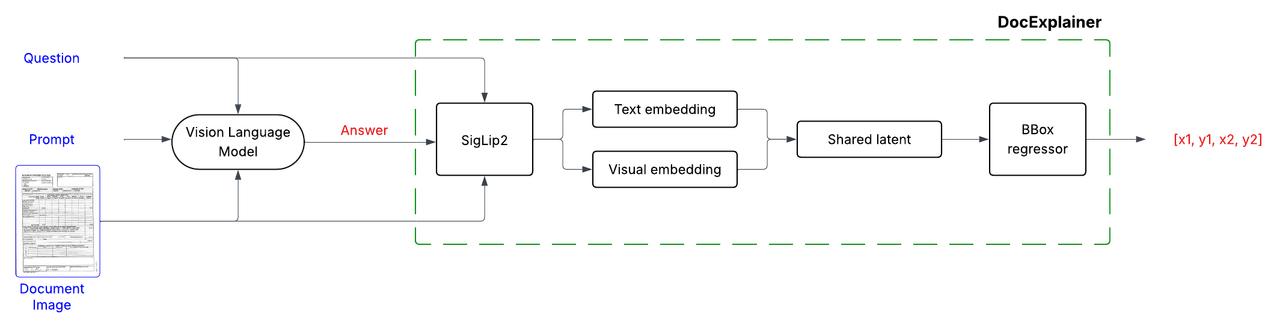
DocExplainerV0 is a fine-tuned SigLIP-based regressor that predicts bounding box coordinates for answer localization in document images. The system operates in a two-stage process:
- Question Answering: Any VLM processes the document image and question to generate a textual answer.
- Bounding Box Explanation: DocExplainerV0 takes the image, question, and generated answer to predict the coordinates of the supporting evidence.
Model Architecture
DocExplainerV0 builds on SigLIP2 visual and text embeddings.
Training Procedure
- Visual and textual embeddings from SigLiP2 are projected into a shared latent space, fused via fully connected layers.
- A regression head outputs normalized coordinates
[x1, y1, x2, y2]. - Backbone: SigLiP2 (frozen).
- Loss Function: Smooth L1 (Huber loss) applied to normalized coordinates in [0,1].
Training Setup
- Dataset: BoundingDocs v2.0
- Epochs: 20
- Optimizer: AdamW (default settings)
- Hardware: 1 × NVIDIA L40S-1-48G GPU
- Model Selection: Best checkpoint chosen by highest mean IoU on the validation split.
Quick Start
Here is a simple example of how to use DocExplainer to get an answer and its corresponding bounding box from a document image.
from PIL import Image
import requests
from transformers import AutoModel

# Load example document image
url = "https://datasets-server.huggingface.co/cached-assets/letxbe/BoundingDocs/--/47db6d2b6af0aadfd082591a8445d0f47c3b8d61/--/default/test/7/doc_images/image-1d100e9.jpg"
image = Image.open(requests.get(url, stream=True).raw).convert("RGB")
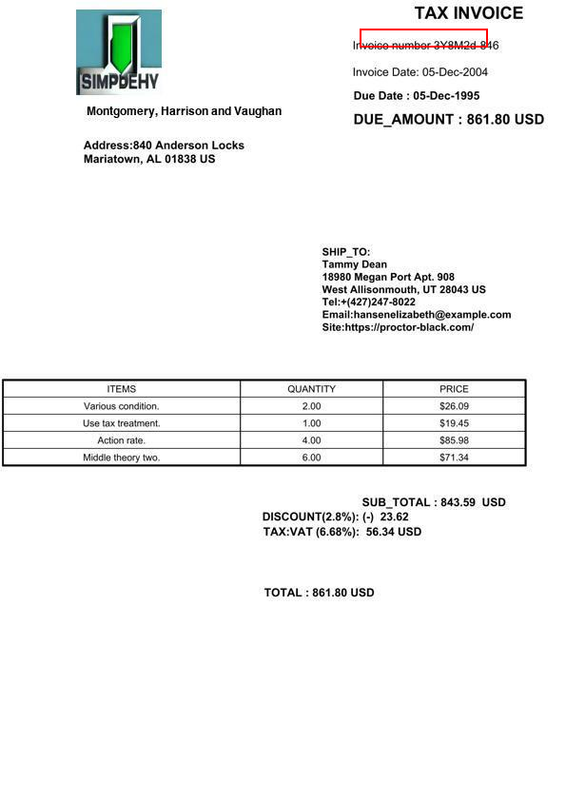
question = "What is the invoice number?"
answer = "3Y8M2d-846" # generate it with any VLM

explainer = AutoModel.from_pretrained("letxbe/DocExplainerv0", trust_remote_code=True)
bbox = explainer.predict(image, answer)
print(f"Bounding box: {bbox}")  # [x1, y1, x2, y2]
|
Example Output:
Question: What is the invoice number? |
Visualized Answer Location:
|
Performance
Evaluated on BoundingDocs v2.0 dataset:
Full DocExplainer Pipeline
| VLM Model | ANLS ↑ | IoU ↑ |
|---|---|---|
| SmolVLM2-2.2b | 0.572 | 0.175 |
| qwen2.5-vl-7b | 0.689 | 0.188 |
VLM-only Baseline (for comparison)
| VLM Model | ANLS ↑ | IoU ↑ |
|---|---|---|
| SmolVLM2-2.2b | 0.561 | 0.011 |
| qwen2.5-vl-7b | 0.720 | 0.038 |
| Claude Sonnet 4 | 0.737 | 0.031 |
Limitations
- Prototype only: Intended as a first approach, not a production-ready solution.
- Dataset constraints: Current evaluation is limited to cases where an answer fits in a single bounding box. Answers requiring reasoning over multiple regions or not fully captured by OCR cannot be properly evaluated.
Citation
If you use this model in your research, please cite:
bibtex@misc{docexplainer2025,
  title={Towards Reliable and Interpretable Document Question Answering via VLMs},
  author={[Your Name]},
  year={2025},
  url={}
}