| Trove |
| ===== |
|
|
| Trove is a CUDA library that provides efficient vector loads and |
| stores. It works for CUDA architectures 3.0 and above, and uses no |
| CUDA shared memory, making it easy to integrate. It is useful for |
| working with data in an Array of Structures format, and also when |
| writing code that consumes or produces an array of data per CUDA |
| thread. |
|
|
| How it Works |
| ============ |
|
|
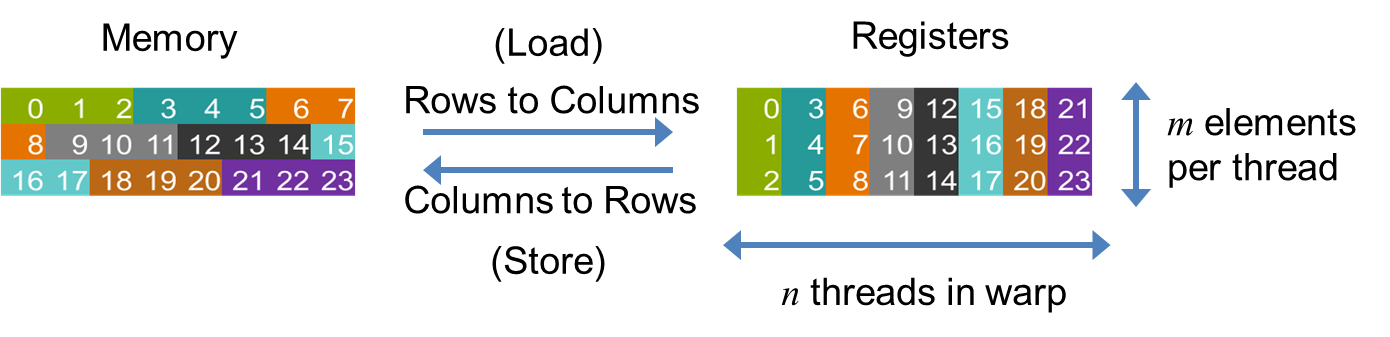
| This functionality is built out of a transposition routine that uses |
| the warp shuffle intrinsic to redistribute data amongst threads in the |
| CUDA warp. For example, when every thread in |
| the warp is loading contiguous structures from an array, the threads |
| collaboratively load all the data needed by the warp, using coalesced |
| memory accesses, then transpose the data to redistribute it to the |
| correct thread. |
|
|
| The following cartoon illustrates how this works, for a notional warp |
| with eight threads. |
|
|
|  |
|
|
| Performance |
| =========== |
|
|
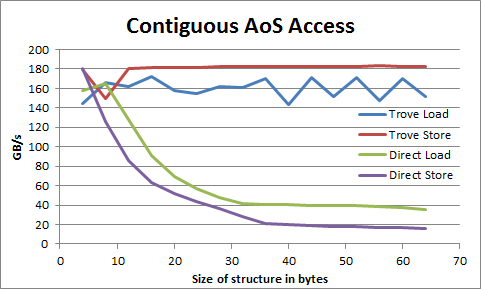
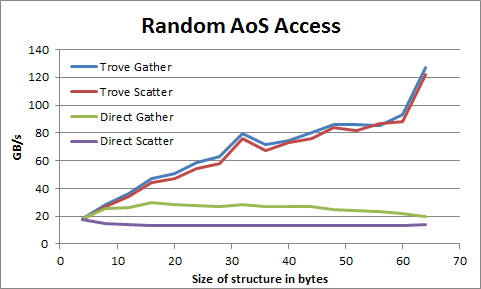
| Accesses to arrays of structures can be 6X faster than direct memory |
| accesses using compiler generated loads and stores. The following |
| benchmarks were taken on a Tesla K20c. The structure `T` being loaded |
| and stored in these benchmarks is made of one to sixteen 32-bit integers. |
|
|
|  |
|  |
|
|
| High-level Interface |
| ==================== |
|
|
| ```c++ |
| #include <trove/ptr.h> |
| |
| template<typename T> |
| __global__ void |
| trove_gather(const int length, const int* indices, |
| trove::coalesced_ptr<T> src, //Wrapped pointer |
| trove::coalesced_ptr<T> dst) { |
| int global_index = threadIdx.x + blockDim.x * blockIdx.x; |
| if (global_index < length) { |
| int index = indices[global_index]; |
| T data = src[index]; |
| dst[global_index] = data; |
| } |
| } |
| ``` |
|
|
| The high-level interface allows you to load and store structures |
| directly. Just wrap the pointers of your arrays in |
| `trove::coalesced_ptr<T>`. You don't need to worry if the warp is |
| converged, or if the addresses you're accessing are contiguous. This |
| interface loses some performance, since it has to dynamically check |
| whether the warp is converged, and also broadcast all pointers from |
| all threads in each warp to all other threads in the warp, but it is |
| simple to use. |
|
|
|
|
| There are two restrictions on `T`: |
|
|
| * `sizeof(T)` must be divisible by 4 |
| * `T` must have a default constructor |
|
|
| Block Interface |
| =============== |
|
|
| It's common for CUDA code to process or produce several values per thread. For |
| example, a merge operation may process 7 values per thread, to increase the |
| amount of serial work. For these cases, we provide a blocked interface |
| that enables efficient block-wise vector loads and stores. |
|
|
| This interface relies on an array type `trove::array<T, s>`, where `T` |
| is the type of each element of the array, and `s` is an integer that |
| statically determines the length of the array. `trove::array` types |
| can be converted to and from standard C arrays (see |
| [array.h](http://github.com/BryanCatanzaro/trove/blob/master/trove/array.h) |
| ), but they have value |
| semantics rather than reference semantics, and they can only be |
| indexed statically. |
|
|
| With this interface, each thread is assumed to be reading or writing |
| from contiguous locations in the input or output array. The user is |
| responsible for checking for convergence, which they probably do |
| anyway for functional reasons. If the warp is not converged, we |
| provide fallback functions that load and store arrays using compiler |
| generated code. |
|
|
| ```c++ |
| #include <trove/block.h> |
| |
| template<typename T, int s> |
| __global__ void test_block_copy(const T* x, T* r, int l) { |
| typedef trove::array<T, s> s_ary; |
| int global_index = threadIdx.x + blockIdx.x * blockDim.x; |
| |
| for(int index = global_index; index < l; index += gridDim.x * blockDim.x) { |
| |
| //The block memory accesses only function |
| //correctly if the warp is converged. Here we check. |
| if (trove::warp_converged()) { |
| //Warp converged, indices are contiguous, call the fast |
| //load and store |
| s_ary d = trove::load_array_warp_contiguous<s>(x, index); |
| trove::store_array_warp_contiguous(r, index, d); |
| } else { |
| //Warp not converged, call the slow load and store |
| s_ary d = trove::load_array<s>(x, index); |
| trove::store_array(r, index, d); |
| } |
| } |
| } |
| ``` |
|
|
| Low-level Interface |
| =================== |
|
|
| If you know your warp is converged, and that your threads are all |
| accessing contiguous locations in your array, you can use the |
| low-level interface for maximum performance. By contiguous, we mean |
| that if threads with indices *i* and thread *j* are in the same warp, |
| the pointers *pi* and *pj* you pass to the library must obey the |
| relation *pj* - *pi* == *j* - *i*. The low-level interface has the |
| following functions in `<trove/aos.h>`: |
|
|
| `template<typename T> __device__ T load_warp_contiguous(const T* |
| src);` |
|
|
| `template<typename T> __device__ void store_warp_contiguous(const T& |
| data, T* dest);` |
|
|


