| --- |
| license: other |
| license_name: glm-5.3 |
| license_link: https://huggingface.co/orcarouter/GLM-5.3-MLX/blob/main/LICENSE |
| base_model: zai-org/GLM-5.3 |
| base_model_relation: quantized |
| pipeline_tag: text-generation |
| library_name: mlx |
| language: |
| - en |
| - zh |
| tags: |
| - glm |
| - glm-5 |
| - glm_moe_dsa |
| - mlx |
| - apple-silicon |
| - quantized |
| - 2-8bit |
| - moe |
| - orcasaq |
| - dynamic-quant |
| - reasoning |
| - coding |
| - agentic |
| --- |
| |
| <div align="center"> |
|
|
| <a href="https://www.orcarouter.ai" target="_blank"> |
| <img src="https://www.orcarouter.ai/orca-logo-classic.png" alt="OrcaRouter" width="110"> |
| </a> |
|
|
| <h1>GLM-5.3-MLX</h1> |
|
|
| <p><em>An MLX build of the official GLM-5.3 — 2 / 3 / 4 / 6-bit OrcaSAQ quant for Apple Silicon & the MLX CUDA backend</em></p> |
|
|
| <p> |
| <a href="https://www.orcarouter.ai"><img src="https://img.shields.io/badge/Website-orcarouter.ai-1E6FEB" alt="Website"></a> |
| <a href="https://www.orcarouter.ai/models"><img src="https://img.shields.io/badge/OrcaRouter-Model%20Catalog-2EA043" alt="Model Catalog"></a> |
| <a href="https://www.orcarouter.ai/models/z-ai/glm-5.3"><img src="https://img.shields.io/badge/OrcaRouter-Hosted%20API-6F42C1" alt="Hosted API"></a> |
| <a href="./LICENSE"><img src="https://img.shields.io/badge/License-GLM--5.3-4C8BF5" alt="License"></a> |
| <img src="https://img.shields.io/badge/Format-MLX-00A67E" alt="MLX"> |
| <img src="https://img.shields.io/badge/Quants-2%20|%203%20|%204%20|%206--bit-FF8800" alt="Quants"> |
| <img src="https://img.shields.io/badge/Method-OrcaSAQ-E67E22" alt="OrcaSAQ"> |
| <img src="https://img.shields.io/badge/Params-753B%20%2F%20~39B%20active-9B59B6" alt="Params"> |
| <img src="https://img.shields.io/badge/Context-1M-2EA043" alt="Context"> |
| <a href="https://github.com/Continuum-AI-Corp/Orca-Code-Review"><img src="https://img.shields.io/badge/OrcaCode-Review-181717?logo=github" alt="OrcaCode Review"></a> |
| </p> |
|
|
| <p><strong>One Gateway. Every Model.</strong> — Route Smarter · Ship Safer · Spend Less.<br> |
| <a href="https://www.orcarouter.ai/models/z-ai/glm-5.3">GLM-5.3 on OrcaRouter →</a></p> |
|
|
| <p> |
| <a href="https://www.orcarouter.ai">Website</a> · |
| <a href="https://www.orcarouter.ai/models">Model Catalog</a> · |
| <a href="https://www.orcarouter.ai/models/z-ai/glm-5.3">Model API</a> · |
| <a href="https://github.com/Continuum-AI-Corp">GitHub</a> · |
| <a href="https://github.com/Continuum-AI-Corp/Orca-Code-Review">OrcaCode Review</a> · |
| <a href="https://discord.gg/yAh6Tex6kx">Discord</a> · |
| <a href="https://x.com/OrcaRouter">X</a> |
| </p> |
|
|
| </div> |
|
|
| --- |
|
|
| > An **MLX** build of the official [`zai-org/GLM-5.3`](https://huggingface.co/zai-org/GLM-5.3) |
| > — Z.AI's **753B-total / ~39B-active** MoE flagship for frontier coding and long-horizon |
| > agentic engineering, built on the **`glm_moe_dsa`** architecture (MLA + DeepSeek-style |
| > **sparse attention with a shared indexer**, 1M context) — quantized to **MLX** for |
| > **Apple Silicon** and the MLX CUDA backend. Four precisions (**2 / 3 / 4 / 6-bit**) ship as |
| > subfolders with the **4-bit build mirrored at the repo root**, produced with **OrcaSAQ |
| > (Sensitivity-Aware Quantization)**: calibration-free and architecture-aware, giving sensitive |
| > tensors more bits (shared experts `+2`, `down_proj` `+1`) while **attention stays at 8-bit and |
| > the DSA indexer stays in BF16** in every build. Browse all models in the |
| > [OrcaRouter Model Catalog](https://www.orcarouter.ai/models); deployed as API |
| > [here](https://www.orcarouter.ai/models/z-ai/glm-5.3). Put this model to work reviewing your |
| > pull requests with **[OrcaCode Review](https://github.com/Continuum-AI-Corp/Orca-Code-Review)**. |
| |
| --- |
| |
| ## Available quantizations |
| |
| | Folder | Expert base bits | Group size | Size | Min RAM | Quality vs FP8 | |
| |---|---|---|---:|---:|---| |
| | `6-bit/` | 6 | 64 | **671 GB** (625 GiB) | ~700 GB | **Near-lossless** — best quality | |
| | `4-bit/` | 4 | 64 | **459 GB** (427 GiB) | ~480 GB | Very good — **recommended default** | |
| | `3-bit/` | 3 | 64 | **368 GB** (343 GiB) | ~390 GB | Good — aggressive but usable | |
| | `2-bit/` | 2 | 32 | **322 GB** (300 GiB) | ~340 GB | Aggressive — best-effort | |
| |
| The **repository root is a mirror of `4-bit/`**, so `orcarouter/GLM-5.3-MLX` resolves to the recommended default with no subfolder needed. |
| |
| > Quantized from the official **FP8** release (756 GB, block-wise `e4m3` 128×128, dynamic activation scheme). Bit-widths above are the **expert base** precision; the OrcaSAQ policy below raises sensitive tensors above the base. Group size is 64 everywhere except the `2-bit` routed experts, which use 32 — at two bits the finer grid is what keeps the build usable (see the fidelity table). |
| |
| **Hardware reality check.** This is a 753B model; even the smallest build is 322 GB. On a **512 GB M3 Ultra Mac Studio**, `2-bit` and `3-bit` leave comfortable KV headroom and `4-bit` fits but runs tight — raise the wired-memory limit and keep the context bounded. `6-bit` does not fit any single Apple Silicon machine today: run it across two 512 GB boxes with `mlx.distributed`, or on a CUDA host (8×H200 = 1128 GB) via the MLX CUDA backend. If the hardware isn't there, the [hosted API](https://www.orcarouter.ai/models/z-ai/glm-5.3) needs no local memory at all. |
| |
| No 8-bit build was produced: `6-bit` already lands at cosine ≥ 0.9997 against FP8, and 8-bit expert weights would exceed the FP8 source in size. |
| |
| --- |
| |
| ## OrcaSAQ — Sensitivity-Aware Quantization |
| |
| OrcaSAQ is a **calibration-free, architecture-aware mixed-precision quantization method** designed to preserve model quality while aggressively reducing memory footprint. |
| |
| Instead of running expensive calibration datasets or per-layer sensitivity searches, OrcaSAQ uses **architectural and tensor-role priors** to determine which weights are most sensitive to quantization. Critical components receive higher precision, while more quantization-tolerant tensors remain at the target base precision. |
| |
| For MoE architectures, for example, OrcaSAQ can preserve shared experts at **base +2 bits**, `down_proj` at **base +1 bit**, keep `gate_proj` and `up_proj` at the base precision, and retain sensitive non-quantized components at their source dtype. |
|
|
| The result is a **fast, deterministic, zero-calibration quantization pipeline** that can be applied to new architectures without costly dataset-driven optimization. |
|
|
| **Architecture-aware. Calibration-free. Quality-preserving.** |
|
|
| Two properties of this checkpoint drive the whole recipe: |
|
|
| - **Attention is FP8 upstream** (unlike GLM-5.3-Flash, where it shipped BF16), so it *is* quantizable — and it is **pinned to 8-bit in every build**, never dropped to the base tier. |
| - **The DSA indexer is kept in BF16 everywhere.** It selects which tokens attention attends to, so it sits directly on the long-context path and is left at full precision. |
|
|
| Everything that was *not* FP8 in the base release — the indexer, router `gate` weights, the FP32 `e_score_correction_bias`, every norm, `embed_tokens` and `lm_head` — is carried through at its **original dtype**, never a lossy cast. |
|
|
| ### Bit allocation for GLM-5.3 |
|
|
| | Component | Tensors | Params | 2-bit | 3-bit | 4-bit | 6-bit | Policy | |
| |---|---:|---:|---|---|---|---|---| |
| | Expert `gate_proj` / `up_proj` | 38,400 | 483.2B | 2 `gs32` | 3 | 4 | 6 | base | |
| | Expert `down_proj` | 19,200 | 241.6B | 3 `gs32` | 4 | 5 | 8 | base **+1** | |
| | Shared expert `gate` / `up` / `down` | 225 | 2.83B | 4 | 5 | 6 | 8 | base **+2** | |
| | MLA `q_a` / `q_b` / `kv_a_with_mqa` / `kv_b` / `o_proj` | 390 | 12.87B | **8** | **8** | **8** | **8** | pinned 8-bit | |
| | Dense-MLP `gate` / `up` / `down` (layers 0–2) | 9 | 0.68B | **6** | **6** | **6** | **6** | pinned 6-bit | |
| | DSA indexer `wk` / `wq_b` / `weights_proj` | 63 | 0.19B | BF16 | BF16 | BF16 | BF16 | never quantized | |
| | Router `gate.weight` | 75 | 0.12B | BF16 | BF16 | BF16 | BF16 | never quantized | |
| | Router `e_score_correction_bias` | 75 | — | FP32 | FP32 | FP32 | FP32 | never quantized | |
| | Norms (incl. indexer `k_norm`), `embed_tokens`, `lm_head` | 357 | 1.90B | BF16 | BF16 | BF16 | BF16 | never quantized | |
|
|
| **58,224 tensors are quantized** in total (97.5 % of all parameters live in the routed experts). Bits are rounded to the nearest MLX-supported width (`{2,3,4,5,6,8}`), and group size must divide the tensor's last dim — `gs64` on attention is mandatory because `qk_nope_head_dim` is 192 and `gs128` breaks mlx-lm's `kv_b → embed_q` re-quantization. |
|
|
| Effective width on the experts, including the FP16 scales and biases MLX stores per group: |
|
|
| | Build | Expert effective bpw | Experts as share of build | |
| |---|---:|---:| |
| | `2-bit` | 3.33 | 93.7 % | |
| | `3-bit` | 3.83 | 94.4 % | |
| | `4-bit` | 4.83 | 95.4 % | |
| | `6-bit` | 7.17 | 96.8 % | |
|
|
| The assignment is recorded in `config.json` → `quantization` (and mirrored to `quantization_config`) as **per-module `{group_size, bits}` overrides keyed by MLX module path** — e.g. `model.layers.3.mlp.switch_mlp.down_proj`. MLX fuses a layer's 256 routed experts into one `switch_mlp`, so **699 entries** cover all 58,224 tensors. This is what the loader reads at load time and it is **required**: the top-level `bits`/`group_size` alone would mis-shape every raised-precision tensor. A full per-tensor record is also shipped as `quantization_map.json`. |
|
|
| The **MTP (multi-token prediction) layer — layer 78 — is dropped**, and `num_nextn_predict_layers` is set to `0`. 791 tensors (~9.95B params) are removed; MLX runtimes drop it at load anyway. |
|
|
| --- |
|
|
| ## Quality vs FP8 |
|
|
| All three tables compare each build against the full **FP8** reference (dequantized to BF16 and run |
| through the identical `glm_moe_dsa` forward, so the only variable is the quantization). Sizes are |
| decimal GB, matching the file sizes in this repo. |
|
|
| **Perplexity** |
|
|
| Measured against the **FP8 reference** on wikitext-2 test, 4 chunks × 1024 tokens |
| (4,092 predicted tokens). Both sides run the identical `glm_moe_dsa` forward on the |
| same FP8 kernels — each build's actual dequantized bytes are injected back into the |
| transformers model — so quantization is the only variable. |
|
|
| | Build | Size | PPL | ΔPPL | |
| |---|---:|---:|---:| |
| | **FP8 (ref)** | 756 GB | **1.6666** | — | |
| | **6-bit** | 671 GB | **1.6642** | **−0.14 %** | |
| | **4-bit** | 459 GB | **1.7015** | **+2.10 %** | |
| | **3-bit** | 368 GB | **1.8249** | **+9.50 %** | |
| | **2-bit** | 322 GB | **2.6385** | **+58.3 %** | |
|
|
| `6-bit` lands within noise of the FP8 reference — read it as indistinguishable. |
|
|
| **KL divergence & Top-1 token agreement** |
|
|
| KLD is `KL(ref ‖ quant)` per token against the FP8 reference distribution, Top-1 is how |
| often the build's argmax matches the reference's. Lower KLD and higher Top-1 = closer to |
| the original. Same corpus and token budget as the PPL table. |
|
|
| | Build | Size | Mean KLD | KLD p95 | Top-1 agreement | |
| |---|---:|---:|---:|---:| |
| | **FP8 (ref)** | 756 GB | — | — | 100 % | |
| | **6-bit** | 671 GB | **0.0295** | 0.1629 | **96.39 %** | |
| | **4-bit** | 459 GB | **0.0574** | 0.3049 | **95.46 %** | |
| | **3-bit** | 368 GB | **0.1668** | 0.9764 | **90.43 %** | |
| | **2-bit** | 322 GB | **0.5272** | 2.7405 | **80.18 %** | |
|
|
| All three measurements — weight fidelity, perplexity, and KLD/Top-1 — agree on the |
| ordering: `6-bit` is effectively lossless, `4-bit` costs about **2 % perplexity for 43 % |
| less memory** and is the recommended default, and `3-bit` holds up well at 40 % under |
| FP8. `2-bit` is the memory-first option — reach for it when the hardware cannot hold |
| anything larger. |
|
|
| **Weight-space fidelity** — measured on every quantized tensor at pack time (58,224 per build): |
|
|
| | Build | Size | Cosine sim | SNR (dB) | Rel. error | |
| |---|---:|---:|---:|---:| |
| | `6-bit` | 671 GB | **0.9998** | **37.2** | **1.7 %** | |
| | `4-bit` | 459 GB | **0.9968** | **22.9** | **7.6 %** | |
| | `3-bit` | 368 GB | **0.9865** | **16.7** | **15.7 %** | |
| | `2-bit` | 322 GB | **0.9517** | **11.2** | **29.7 %** | |
|
|
| Worst-case per build (`cos_min` / `snr_min`): `6-bit` 0.99972 / 32.5 dB · `4-bit` 0.99509 / 20.1 dB · `3-bit` 0.97869 / 13.7 dB · `2-bit` 0.92718 / 8.3 dB. |
|
|
| > Relative error is the mean of the **per-tensor** relative error `10^(-SNR/20)` over all 58,224 quantized tensors — not a value back-derived from the mean SNR, which would understate it (1.4 / 7.1 / 14.7 / 27.5 %). |
|
|
| Per role — this is where the OrcaSAQ policy shows up: |
|
|
| | Role | bits/gs | 2-bit cos | 3-bit cos | 4-bit cos | 6-bit cos | |
| |---|---|---:|---:|---:|---:| |
| | Expert `gate_proj`/`up_proj` | base | 0.93417 | 0.98169 | 0.99570 | 0.99975 | |
| | Expert `down_proj` | base +1 | 0.98510 | 0.99568 | 0.99898 | 0.99998 | |
| | Shared expert | base +2 | 0.99561 | 0.99896 | 0.99974 | 0.99998 | |
| | MLA attention | 8/64 | 0.99998 | 0.99998 | 0.99998 | 0.99998 | |
| | Dense MLP | 6/64 | 0.99975 | 0.99975 | 0.99975 | 0.99975 | |
|
|
| Cosine distribution across all quantized tensors (tight percentiles = no outlier tensors hiding behind a good mean): |
|
|
| | Build | min | p1 | p5 | median | p95 | max | |
| |---|---:|---:|---:|---:|---:|---:| |
| | `2-bit` | 0.92718 | 0.93133 | 0.93390 | 0.93437 | 0.98515 | 0.99999 | |
| | `3-bit` | 0.97869 | 0.98047 | 0.98157 | 0.98178 | 0.99571 | 0.99999 | |
| | `4-bit` | 0.99509 | 0.99546 | 0.99566 | 0.99571 | 0.99899 | 0.99999 | |
| | `6-bit` | 0.99972 | 0.99974 | 0.99975 | 0.99975 | 0.99999 | 0.99999 | |
|
|
| The worst tensors in every build are the same ones — early-layer routed experts (`layers.3–5`, e.g. `layers.4.mlp.experts.168.gate_proj`) — and `6-bit` still holds them above 0.9997. |
|
|
| **Build verification** — every build passed a structural release gate before upload: |
|
|
| - **accounting** — 175,242 tensors on disk, 58,224 quantized modules, `weight`/`scales`/`biases` triplets all paired |
| - **dtype preservation** — kept tensors byte-identical in their source dtype (FP32 router bias stays FP32; FP8 `keep` goes through a proper block dequant, never a raw cast) |
| - **index integrity** — `model.safetensors.index.json` resolves every tensor; `total_size` matches the shards on disk |
| - **config ↔ map reconstruction** — the 699 per-module overrides reproduce the full per-tensor map exactly |
| - **spot dequant** — randomly sampled tensors per role dequantized and compared against the golden FP8 values |
| - **runtime skeleton** — mlx-vlm's `glm_moe_dsa` module tree vs the post-sanitize key set: **1497/1497**, zero missing, zero extra |
|
|
| --- |
|
|
| --- |
|
|
| ## Usage |
|
|
| ### Hosted API — no download |
|
|
| The full-precision model is live on OrcaRouter as **`z-ai/glm-5.3`** — 1M context, 128K max output, $1.26 / $3.96 per 1M input / output tokens: |
|
|
| ```python |
| import os |
| from openai import OpenAI |
| |
| client = OpenAI( |
| base_url="https://api.orcarouter.ai/v1", |
| api_key=os.environ["ORCAROUTER_API_KEY"], |
| ) |
| |
| response = client.chat.completions.create( |
| model="z-ai/glm-5.3", |
| messages=[{"role": "user", "content": "Refactor this module and explain the tradeoffs."}], |
| ) |
| print(response.choices[0].message.content) |
| ``` |
|
|
| **https://www.orcarouter.ai/models/z-ai/glm-5.3** |
|
|
| ### Run it locally (mlx-vlm) |
|
|
| > **Use `mlx-vlm`, not `mlx-lm`.** GLM-5.3 is a text-only model, but as of **mlx-lm 0.31.3** the `glm_moe_dsa` implementation builds an indexer for *every* layer, while this checkpoint shares one indexer across four layers (`indexer_types`) — 285 tensors come up missing. **mlx-vlm 0.6.17** implements the shared-indexer layout and loads these builds as-is. Check for mlx-lm support before switching back. |
| |
| ```bash |
| pip install -U "mlx-vlm>=0.6.17" |
| ``` |
| |
| The repo root is the 4-bit build, so the recommended default needs no subfolder — the excludes are what stop `hf download` from also pulling the four variant folders: |
| |
| ```bash |
| hf download orcarouter/GLM-5.3-MLX --local-dir ./GLM-5.3-MLX \ |
| --exclude "2-bit/*" "3-bit/*" "4-bit/*" "6-bit/*" |
| |
| python -m mlx_vlm.generate --model ./GLM-5.3-MLX \ |
| --prompt "Write a Rust function that merges overlapping intervals." --max-tokens 512 |
| ``` |
| |
| To pick a different precision, download just that subfolder and load it from the local path: |
|
|
| ```bash |
| hf download orcarouter/GLM-5.3-MLX --include "6-bit/*" --local-dir ./GLM-5.3-MLX |
| |
| python -m mlx_vlm.generate --model ./GLM-5.3-MLX/6-bit \ |
| --prompt "Write a Rust function that merges overlapping intervals." --max-tokens 512 |
| ``` |
|
|
| Python API: |
|
|
| ```python |
| from mlx_vlm import load, generate |
| from mlx_vlm.prompt_utils import apply_chat_template |
| |
| model, processor = load("./GLM-5.3-MLX") # repo root == 4-bit |
| prompt = apply_chat_template(processor, model.config, "Explain MLA vs GQA in three sentences.") |
| |
| print(generate(model, processor, prompt, max_tokens=512, verbose=True)) |
| ``` |
|
|
| **Reasoning effort.** GLM-5.3's chat template takes a `reasoning_effort` variable — `low`, `high`, or `max` (the default when unset) — emitted as a system directive, plus a `clear_thinking` flag that strips prior `<think>` blocks from the history. Both pass straight through `apply_chat_template`: |
|
|
| ```python |
| prompt = apply_chat_template(processor, model.config, "Port this service to async.", |
| reasoning_effort="low") |
| ``` |
|
|
| Tool calling is in the template too (`<tool_call>` / `<arg_key>` blocks, `tools=[...]`). |
|
|
| > **Long context.** `max_position_embeddings` is **1,048,576** (`rope_theta` 8e6). The KV cache, not the weights, is what will bite you at those lengths — budget for it, or cap it with `--max-kv-size` / quantize it with `--kv-bits`. |
| > |
| > On Apple Silicon the Metal backend is used automatically. On the Linux **CUDA** backend install `mlx[cuda]` and set `MLX_CUDA_USE_CUDNN_SDPA=0`. |
| |
| --- |
| |
| ## 🐳 Run it with OrcaCode Review |
| |
| [Website](https://www.orcarouter.ai) · [GitHub](https://github.com/Continuum-AI-Corp/Orca-Code-Review) |
| |
| **Models are only half the system.** |
| |
| [**OrcaCode Review**](https://github.com/Continuum-AI-Corp/Orca-Code-Review) turns every model listed on [**OrcaRouter**](https://www.orcarouter.ai) into a production code-review agent: |
| |
| - reviews every PR |
| - finds security + correctness issues |
| - posts inline findings |
| - P0/P1 can block merges |
| - swap models anytime |
| |
| **Open model. Open harness. Open bill.** |
| |
| - Website — https://www.orcarouter.ai |
| - GitHub — https://github.com/Continuum-AI-Corp/Orca-Code-Review |
| |
| --- |
| |
| ## Build Provenance |
| |
| | | | |
| |---|---| |
| | Source | `zai-org/GLM-5.3` (FP8, 141 shards, 756 GB) | |
| | Quantized | 2026-08-28 | |
| | Toolchain | MLX 0.32.2, safetensors 0.8.0, NumPy 2.5.2 | |
| | Method | OrcaSAQ — calibration-free, role-based mixed precision | |
| | Per-build files | 140 shards + `config.json`, `quantization_map.json`, `build_manifest.json`, `fidelity_summary.json`, tokenizer, chat template | |
|
|
| Each folder carries its own `build_manifest.json` (exact recipe, source path, dropped-tensor count, toolchain versions) and `fidelity_summary.json` (per-role cosine/SNR with the five worst tensors named), so any claim in this card can be checked against the build itself. |
|
|
| --- |
|
|
| # GLM-5.3 |
|
|
| > Available full-precision on the OrcaRouter API as **`z-ai/glm-5.3`** — |
| > **https://www.orcarouter.ai/models/z-ai/glm-5.3** |
|
|
| --- |
|
|
| ## GLM-5.3 Highlights |
|
|
| GLM-5.3 uses the same base model as GLM-5.2 — every gain comes from post-training. Compared with GLM-5.2, it is much better at complex coding and long-horizon tasks: |
|
|
| - **Stronger coding:** the most capable open-weights model for coding, with a **50 % improvement over GLM-5.2** on Z.AI's in-house Code Bench, and open-source SOTA on public benchmarks including Terminal Bench 3.0 and Agents' Last Exam. |
| - **Emergent cyber capability:** state of the art on **CyberGym** for vulnerability discovery, with the largest gains further up the exploitation chain — more than doubling GLM-5.2 on exploitation benchmarks. |
|
|
| <div align="center"> |
| <img src="https://raw.githubusercontent.com/zai-org/GLM-5/refs/heads/main/resources/logo.svg" width="30%" alt="GLM-5" /> |
| </div> |
|
|
| --- |
|
|
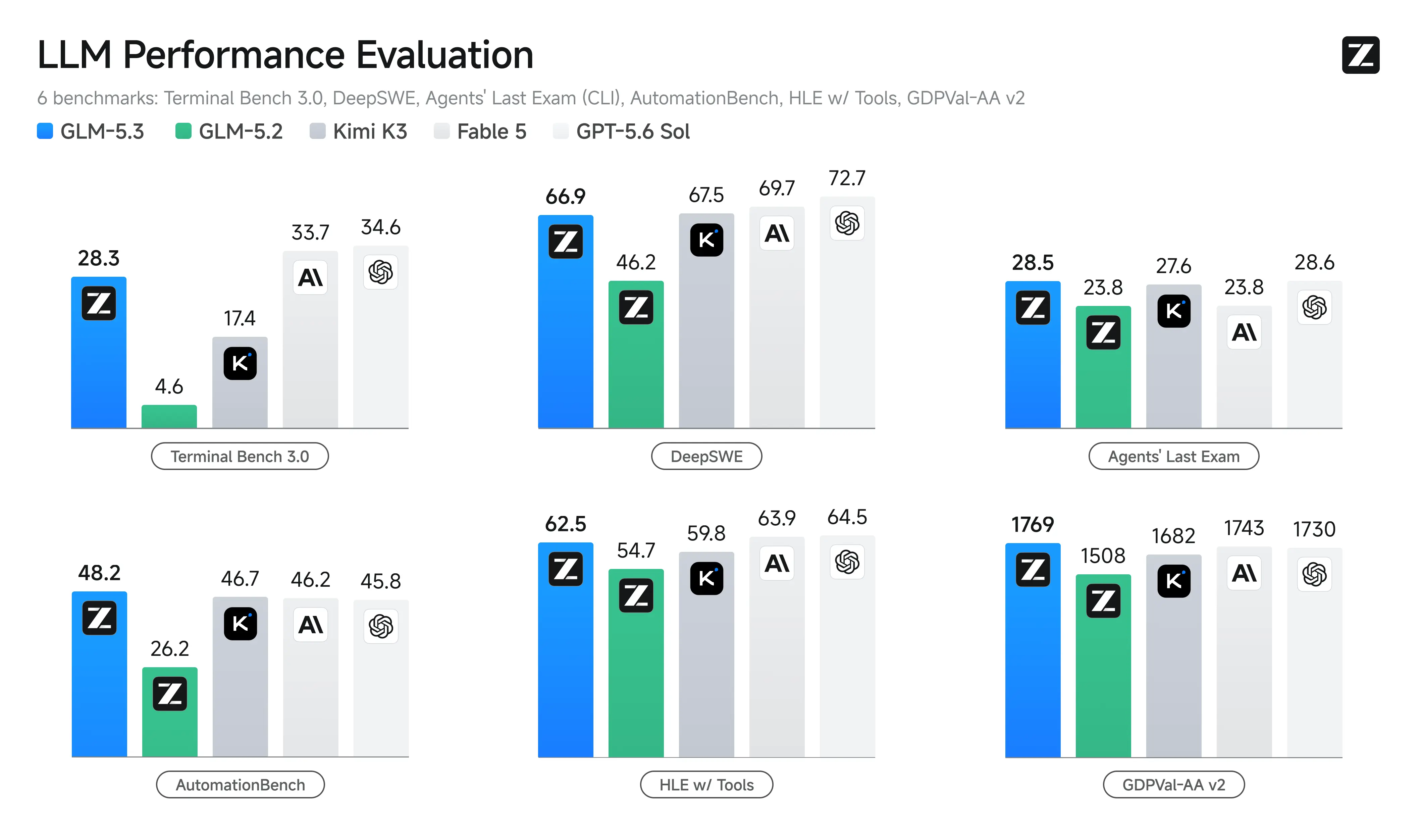
| ## Official benchmarks |
|
|
| Reported by Z.AI for the full-precision model. These are the upstream model's numbers, not measurements of these MLX builds — see [Quality vs FP8](#quality-vs-fp8) above for how each quantization tracks the FP8 release. |
|
|
|  |
|
|
| | Benchmark | GLM-5.3 | GLM-5.2 | Kimi K3 | DeepSeek-V4 Pro-0813 | Qwen3.8-Max | Opus 4.8 | Fable 5 (w/ fallback) | GPT-5.6 Sol | |
| |---|---|---|---|---|---|---|---|---| |
| | Terminal Bench 2.1 | 88.2 | 81.0 | 88.3 | 87.9 | 86.6 | 85.0 | 88.0 | **88.8** | |
| | Terminal Bench 3.0 | 28.3 | 4.6 | 17.4 | – | – | 21.1 | 33.7 | **34.6** | |
| | DeepSWE (v1.1) | 66.9 | 46.2 | 67.5 | 62.7 | 56.6 | 58.0 | 69.7 | **72.7** | |
| | NL2Repo | 58.0 | 48.9 | 58.0 | 61.1 | 55.9 | **69.7** | – | – | |
| | ProgramBench (Almost Solved) | 19.0 | 9.5 | 17.5 | – | 10.5 | 15.5 | **33.0** | 23.0 | |
| | FrontierSWE | 78.1 | 67.5 | – | – | – | 66.5 | **88.2** | – | |
| | SWE-Marathon (v1.1) | 42.5 | 19.4 | 48.1 | – | – | **48.8** | 33.1 | 42.5 | |
| | PostTrainBench | 39.8 | 31.7 | 32.0 | – | – | 32.9 | **41.8** | 36.2 | |
| | CyberGym | **84.5** | 77.2 | 80.0 | 83.3 | 78.5 | 78.1 | 83.8 | 83.6 | |
| | ExploitGym (2h / 6h) | 105 / 130 | 29 / 39 | 36 / 70 | – | 14 / 26 | 80 / 120 | 181 / 247 | **216 / 293** | |
| | ExploitBench | 54.4 | 24.4 | 32.2 | – | 28.8 | 40.0 | **78.0** | 76.5 | |
| | Toolathlon Verified | 73.0 | 59.9 | **76.5** | 74.1 | 72.5 | 76.2 | 74.7 | 74.9 | |
| | AutomationBench (v1.0.6) | **48.2** | 26.2 | 46.7 | 43.2 | 39.8 | 41.0 | 46.2 | 45.8 | |
| | Agents' Last Exam (ALE-CLI) | 28.5 | 23.8 | 27.6 | 25.7 | 27.0 | 25.7 | 23.8 | **28.6** | |
| | HLE w/ Tools | 62.5 | 54.7 | 59.8 | 60.0 | 56.2 | 57.9 | 63.9 | **64.5** | |
| | GDPval-AA v2 | **1769** | 1508 | 1682 | 1590 | 1739 | 1588 | 1743 | 1730 | |
|
|
| Full evaluation protocols and footnotes are in the [official model card](https://huggingface.co/zai-org/GLM-5.3). |
|
|
| --- |
|
|
| ## Model Overview |
|
|
| - **Type:** Mixture-of-Experts Causal LM (`glm_moe_dsa`, `GlmMoeDsaForCausalLM`) |
| - **Parameters:** **753B total** · **~39B active** per token (22.6B routed + 16.7B always-on; 743B after the MTP layer is dropped) |
| - **Experts:** 256 routed + 1 shared, **top-8** routing, sigmoid scoring with `e_score_correction_bias`, single group, `routed_scaling_factor` 2.5 |
| - **Layers:** 78 (3 dense + 75 MoE), plus 1 MTP layer (dropped in these builds) |
| - **Attention:** **MLA** — `q_lora_rank` 2048, `kv_lora_rank` 512, 64 heads, `qk_nope` 192 + `qk_rope` 64, `v_head_dim` 256 — with a **DeepSeek-style sparse-attention indexer** (`index_topk` 2048, 32 index heads) built on every 4th layer and shared by the three that follow |
| - **Precision (base release):** FP8 (block-wise `e4m3`, 128×128), dynamic activation scheme |
| - **Context:** 1,048,576 tokens · vocab 154,880 |
| - **Modality:** text |
|
|
| --- |
|
|
| ## Best Practices |
|
|
| - **Pick a precision:** `6-bit` for near-lossless, `4-bit` (repo root) as the everyday default, `3-bit` when memory is the binding constraint, `2-bit` when nothing else fits — the tables above quantify the trade at each step. |
| - **Sampling:** follow the official GLM-5.3 guidance. The shipped `generation_config.json` is `temperature` 1.0, `top_p` 0.95; long-horizon agentic and coding tasks want generous `max-tokens` headroom. |
| - **Reasoning effort:** leave it at the default `max` for hard engineering work; drop to `low` for latency-sensitive turns. |
| - **Long context:** budget KV, not just weights — at 1M tokens the cache dwarfs the difference between two of these builds. |
| - **Or skip the download:** the unquantized model is served at full precision on the [OrcaRouter API](https://www.orcarouter.ai/models/z-ai/glm-5.3) as `z-ai/glm-5.3`. |
|
|
| --- |
|
|
| ## Citation |
|
|
| ```bibtex |
| @misc{glm5team2026glm5vibecodingagentic, |
| title={GLM-5: from Vibe Coding to Agentic Engineering}, |
| author={GLM-5-Team and Aohan Zeng and Xin Lv and Zhenyu Hou and Zhengxiao Du and others}, |
| year={2026}, |
| eprint={2602.15763}, |
| archivePrefix={arXiv}, |
| primaryClass={cs.LG}, |
| url={https://arxiv.org/abs/2602.15763}, |
| } |
| ``` |
|
|
| ## License |
|
|
| Inherited from [`zai-org/GLM-5.3`](https://huggingface.co/zai-org/GLM-5.3) — an MIT-style grant (use, modify, distribute, fine-tune, sell) with one added condition: operators of a **Model-as-a-Service** business whose aggregate revenue exceeds **US$10B over any 12 consecutive months** must pass a Z.AI security review before commercial use. The full text ships as [`LICENSE`](./LICENSE) in this repo. Quantization does not change the underlying license obligations. |
|
|


