

 EdgeRock


YANchor-4B: Effective Long-Horizon Reasoning in O(N) Time with O(1) Memory
Paper • 2610.10118 • Published
EdgeRock-4B-FP8 — quantized release
Blockwise FP8 E4M3 weights with dynamic FP8 activations; a 5.592 GB weight package.
Run this version · GitHub · Original model
The overview, benchmark tables, and performance figures below describe the original EdgeRock-4B release. This package's quantization settings, launch commands, and conversion checks are in Quantized release.
EdgeRock brings strong reasoning to a fixed history budget. EdgeRock-4B, our first open-source release, supports text and image reasoning. Its constant-size history leaves more GPU memory available for sustained reasoning and concurrent serving. More model sizes are in preparation.
Quick start · Key results · How RMA works · Documentation
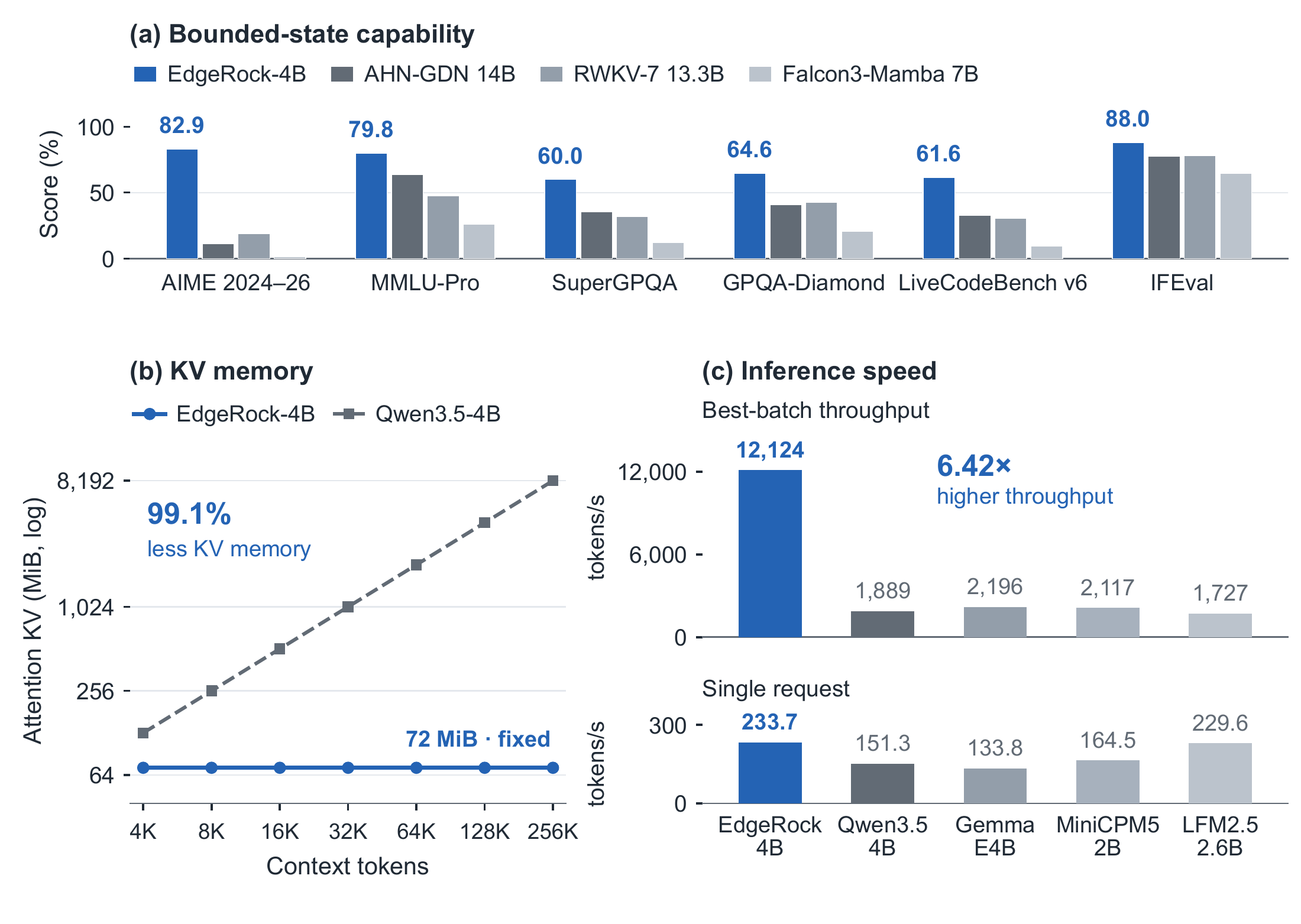
AIME is mean pass@1 across 2024–2026; KV is compared at 256K context. Serving throughput uses 32K input and 32K output on one Hopper 80GB GPU at each model's best measured batch. It counts output tokens only, with elapsed time including prefill.
| Model | Input modalities | Model weights |
|---|---|---|
| EdgeRock-4B | Text, images | Hugging Face · ModelScope |
git clone https://github.com/rockmatrix-ai/EdgeRock.git
cd EdgeRock
python -m venv .venv
source .venv/bin/activate
python -m pip install ./wheels/transformers-5.7.0.dev0-py3-none-any.whl -e .
hf download rockmatrix-ai/EdgeRock --local-dir checkpoints/EdgeRock-4B \
  --include '*.safetensors' '*.json' '*.jinja' 'tokenizer*' 'vocab*' 'merges*' \
  --exclude 'evaluation_data/*'
cp config.json configuration_edgerock.py modeling_edgerock.py checkpoints/EdgeRock-4B/
python run.py demo --model checkpoints/EdgeRock-4B \
  --prompt 'Solve 17 × 23, explaining your reasoning.' --max-new-tokens 2048
For optimized inference and serving, see the inference guide.
EdgeRock-4B demonstrates strong mathematical reasoning at constant memory: 82.9% mean AIME 2024–2026 pass@1, versus 18.8% for RWKV-7 G1j in the 14B class. It leads 24 of 29 text benchmarks, with a 77.2% mean versus 53.4% for AHN-GDN Qwen2.5 14B.
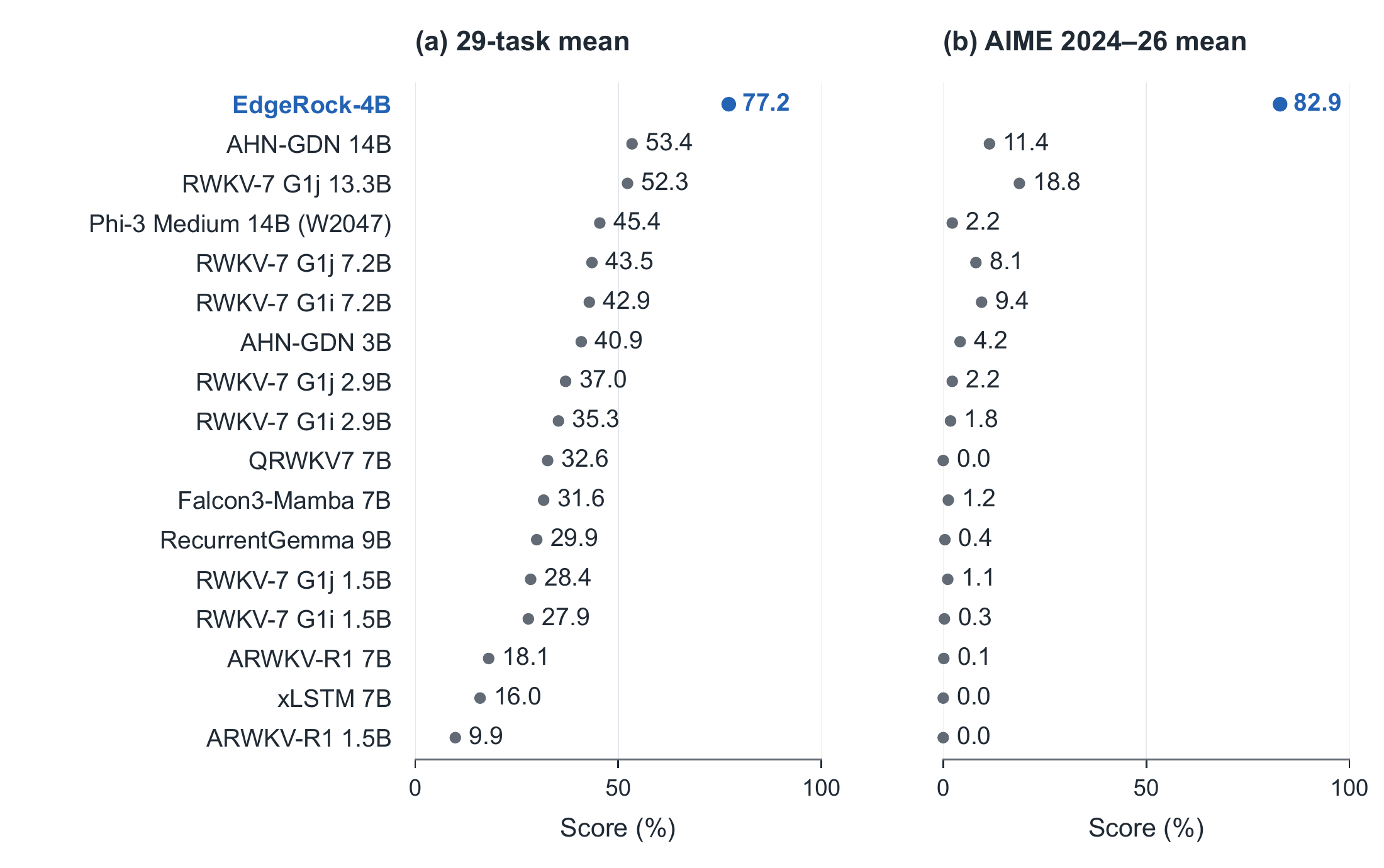
Bounded-state models. W2047 denotes Phi-3 Medium's configured 2,047-token attention window.
| Model | 29-benchmark mean | AIME mean | MATH-500 | MMLU-Pro | LiveCodeBench v6 | IFEval |
|---|---|---|---|---|---|---|
| EdgeRock-4B | 77.2 | 82.9 | 97.5 | 79.8 | 61.6 | 88.0 |
| AHN-GDN Qwen2.5 14B | 53.4 | 11.4 | 80.0 | 63.5 | 32.9 | 77.4 |
| RWKV-7 G1j 13.3B | 52.3 | 18.8 | 77.2 | 47.6 | 30.7 | 77.8 |
| Phi-3 Medium 4K Instruct (W2047) | 45.4 | 2.2 | 49.0 | 54.0 | 19.1 | 61.4 |
| RWKV-7 G1j 7.2B | 43.5 | 8.1 | 64.2 | 46.2 | 21.3 | 66.5 |
| RWKV-7 G1i 7.2B | 42.9 | 9.4 | 68.6 | 44.9 | 18.8 | 53.4 |
| AHN-GDN Qwen2.5 3B | 40.9 | 4.2 | 66.2 | 42.8 | 14.6 | 58.6 |
| RWKV-7 G1j 2.9B | 37.0 | 2.2 | 48.2 | 37.9 | 12.1 | 56.4 |
| RWKV-7 G1i 2.9B | 35.3 | 1.8 | 43.8 | 37.8 | 11.6 | 43.1 |
| QRWKV7 7B Instruct | 32.6 | 0.0 | 41.0 | 23.0 | 12.4 | 59.0 |
| Falcon3-Mamba 7B Instruct | 31.6 | 1.2 | 41.8 | 26.1 | 9.3 | 64.7 |
| RecurrentGemma 9B IT | 29.9 | 0.4 | 22.8 | 13.4 | 7.9 | 39.7 |
| RWKV-7 G1j 1.5B | 28.4 | 1.1 | 31.4 | 16.6 | 6.3 | 46.2 |
| RWKV-7 G1i 1.5B | 27.9 | 0.3 | 28.2 | 13.3 | 7.2 | 37.0 |
| ARWKV-R1 7B | 18.1 | 0.1 | 33.2 | 8.8 | 2.6 | 10.4 |
| xLSTM 7B | 16.0 | 0.0 | 25.0 | 4.6 | 2.2 | 34.0 |
| ARWKV-R1 1.5B | 9.9 | 0.0 | 13.6 | 7.5 | 0.3 | 11.1 |
EdgeRock-4B leads the compact-model comparison on MMLU-Pro and SuperGPQA and exceeds LFM2.5-2.6B on 28 of 29 text benchmarks, with constant persistent history. Baselines include Qwen3.5-4B, MiniCPM5-2B, and LFM2.5-2.6B, all using growing history.
| Model | AIME mean | MMLU-Pro | SuperGPQA | GPQA-Diamond | LiveCodeBench v6 | IFEval |
|---|---|---|---|---|---|---|
| EdgeRock-4B | 82.9 | 79.8 | 60.0 | 64.6 | 61.6 | 88.0 |
| Qwen3.5-4B | 86.1 | 77.7 | 52.8 | 77.3 | 75.7 | 89.6 |
| Gemma4-E4B-it | 40.1 | 69.0 | 41.1 | 55.6 | 69.1 | 84.3 |
| Nemotron-3-Nano-4B | 57.1 | 56.8 | 37.4 | 43.4 | 66.4 | 89.5 |
| Phi-4-mini-reasoning | 38.9 | 38.5 | 32.2 | 48.0 | 35.3 | 45.7 |
| MiniCPM5-2B | 87.8 | 65.3 | 40.9 | 67.7 | 83.3 | 86.3 |
| LFM2.5-2.6B | 56.2 | 59.9 | 27.1 | 58.2 | 59.7 | 93.3 |
Converting Qwen3.5-4B to EdgeRock-4B preserves 96.3% of its AIME mean, achieves 97.5% on MATH-500, and improves eight text benchmarks.
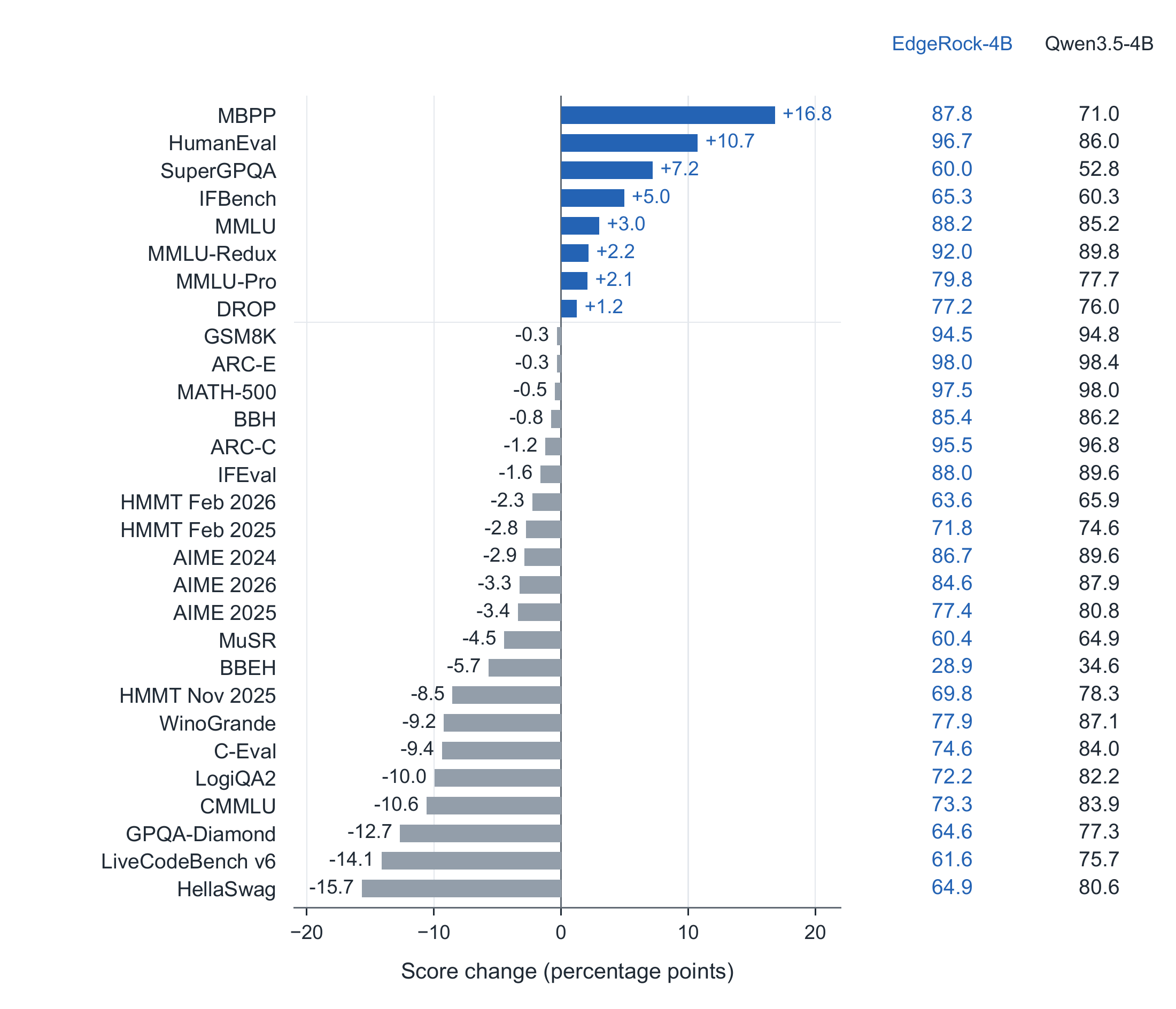
The figure ranks EdgeRock-4B minus Qwen3.5-4B in percentage points. Tables give absolute scores; retention is the ratio to Qwen3.5-4B (%).
| Benchmark | EdgeRock-4B | Qwen3.5-4B | Retained (%) |
|---|---|---|---|
| AIME 2024 | 86.7 | 89.6 | 96.8 |
| AIME 2025 | 77.4 | 80.8 | 95.8 |
| AIME 2026 | 84.6 | 87.9 | 96.2 |
| HMMT Feb 2025 | 71.8 | 74.6 | 96.2 |
| HMMT Nov 2025 | 69.8 | 78.3 | 89.1 |
| HMMT Feb 2026 | 63.6 | 65.9 | 96.5 |
| MATH-500 | 97.5 | 98.0 | 99.5 |
| AIME three-year mean | 82.9 | 86.1 | 96.3 |
| Benchmark | EdgeRock-4B | Qwen3.5-4B |
|---|---|---|
| GSM8K | 94.5 | 94.8 |
| MATH-500 | 97.5 | 98.0 |
| AIME 2024 | 86.7 | 89.6 |
| AIME 2025 | 77.4 | 80.8 |
| AIME 2026 | 84.6 | 87.9 |
| HMMT Feb 2026 | 63.6 | 65.9 |
| MMLU | 88.2 | 85.2 |
| MMLU-Pro | 79.8 | 77.7 |
| MMLU-Redux | 92.0 | 89.8 |
| CMMLU | 73.3 | 83.9 |
| C-Eval | 74.6 | 84.0 |
| GPQA-Diamond | 64.6 | 77.3 |
| SuperGPQA | 60.0 | 52.8 |
| WinoGrande | 77.9 | 87.1 |
| HellaSwag | 64.9 | 80.6 |
| ARC-C | 95.5 | 96.8 |
| ARC-E | 98.0 | 98.4 |
| BBH | 85.4 | 86.2 |
| BBEH | 28.9 | 34.6 |
| HumanEval | 96.7 | 86.0 |
| MBPP | 87.8 | 71.0 |
| LiveCodeBench v6 | 61.6 | 75.7 |
| IFEval | 88.0 | 89.6 |
| IFBench | 65.3 | 60.3 |
| DROP | 77.2 | 76.0 |
| MuSR | 60.4 | 64.9 |
| LogiQA2 | 72.2 | 82.2 |
| HMMT Feb 2025 | 71.8 | 74.6 |
| HMMT Nov 2025 | 69.8 | 78.3 |
EdgeRock-4B achieves 84.9% mean answer-level accuracy across six visual benchmarks, retaining 95.3% of Qwen3.5-4B's mean. Retention is the ratio to Qwen3.5-4B (%).
| Benchmark | EdgeRock-4B | Qwen3.5-4B | Retained (%) |
|---|---|---|---|
| MMBench EN | 88.3 | 90.1 | 98.0 |
| MMBench CN | 89.0 | 91.4 | 97.4 |
| POPE | 85.4 | 88.8 | 96.2 |
| MME | 83.0 | 86.8 | 95.6 |
| ChartQA | 83.9 | 90.3 | 92.9 |
| AI2D | 80.0 | 87.0 | 92.0 |
| Equal-weight mean | 84.9 | 89.1 | 95.3 |
Standard MME scores (benchmark points):
| MME metric | EdgeRock-4B | Qwen3.5-4B |
|---|---|---|
| Perception (points) | 1,600.4 | 1,738.3 |
| Cognition (points) | 728.2 | 751.8 |
| Total (points) | 2,328.7 | 2,490.1 |
All runtime measurements use one Hopper 80GB GPU.
EdgeRock-4B's attention-KV capacity stays at 72 MiB per sequence, versus Qwen3.5-4B's 8 GiB at 256K context—99.1% less with BF16 KV. Capacities below are calculated from model configurations.
| Model | 32K context (MiB) | 64K context (MiB) | 128K context (MiB) | 256K context (MiB) | History growth |
|---|---|---|---|---|---|
| EdgeRock-4B | 72 | 72 | 72 | 72 | O(1) |
| Qwen3.5-4B | 1,024 | 2,048 | 4,096 | 8,192 | O(N) |
Batch-runtime persistent history: 97.76 MiB per sequence. The local ring stores 1,023 preceding positions; the decoder supplies the current token.
| Component | MiB per sequence |
|---|---|
| Committed RMA anchors | 32.00 |
| Pending RMA candidates | 8.00 |
| Local-window KV | 31.97 |
| FP16 recurrent matrices | 24.00 |
| Convolution state | 1.50 |
| Metadata | 0.29 |
| Total persistent history | 97.76 |
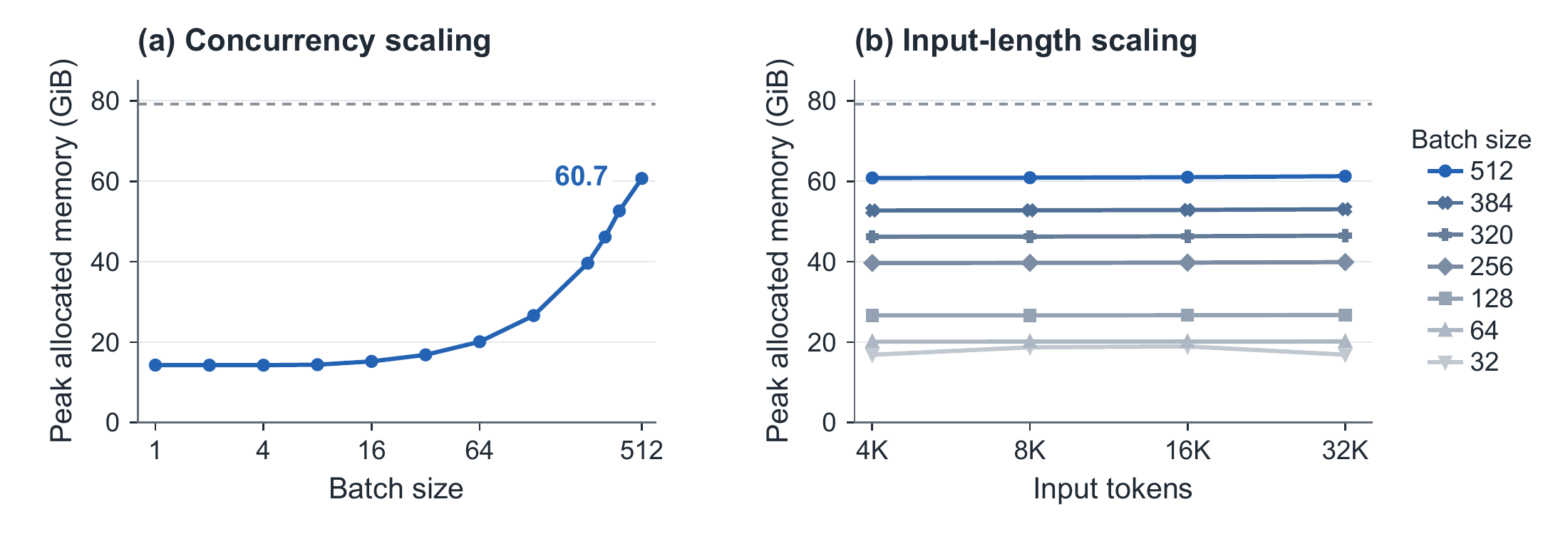
Measured GPU allocation, including weights, history, buffers, and workspace, peaks at 16.02 GiB for 128K input + 128K output at batch size 1 and 61.26 GiB across the 16 long-generation workloads at batch size 512 on one Hopper 80GB GPU.
Runtime protocol. 1K = 1,024 tokens. EdgeRock reports medians of three runs per workload; weighted rates pool decode tokens and time. Timing excludes loading, warmup, tokenization, and text decoding. Batch size counts submitted requests; vLLM schedules within its cache budget. Runtime details specify sampling, warmup, and workload construction.
EdgeRock-4B serves 512 concurrent long-generation sequences on one Hopper 80GB GPU. All runtime comparisons use BF16 weights/KV and ordinary autoregressive decoding with GPU-resident state; EdgeRock-4B uses FP32 GDN updates, with FP32 state storage at batch size 1 and FP16 storage for larger batches. Qwen3.5-4B uses FP32 GDN state.
The portable backend supports CPU and CUDA. For Hopper, the inference guide provides a fast profile with fused BF16 operations, CUDA Graphs, FP32 GDN updates, and FP32 state storage at batch size 1 or FP16 storage for larger batches.
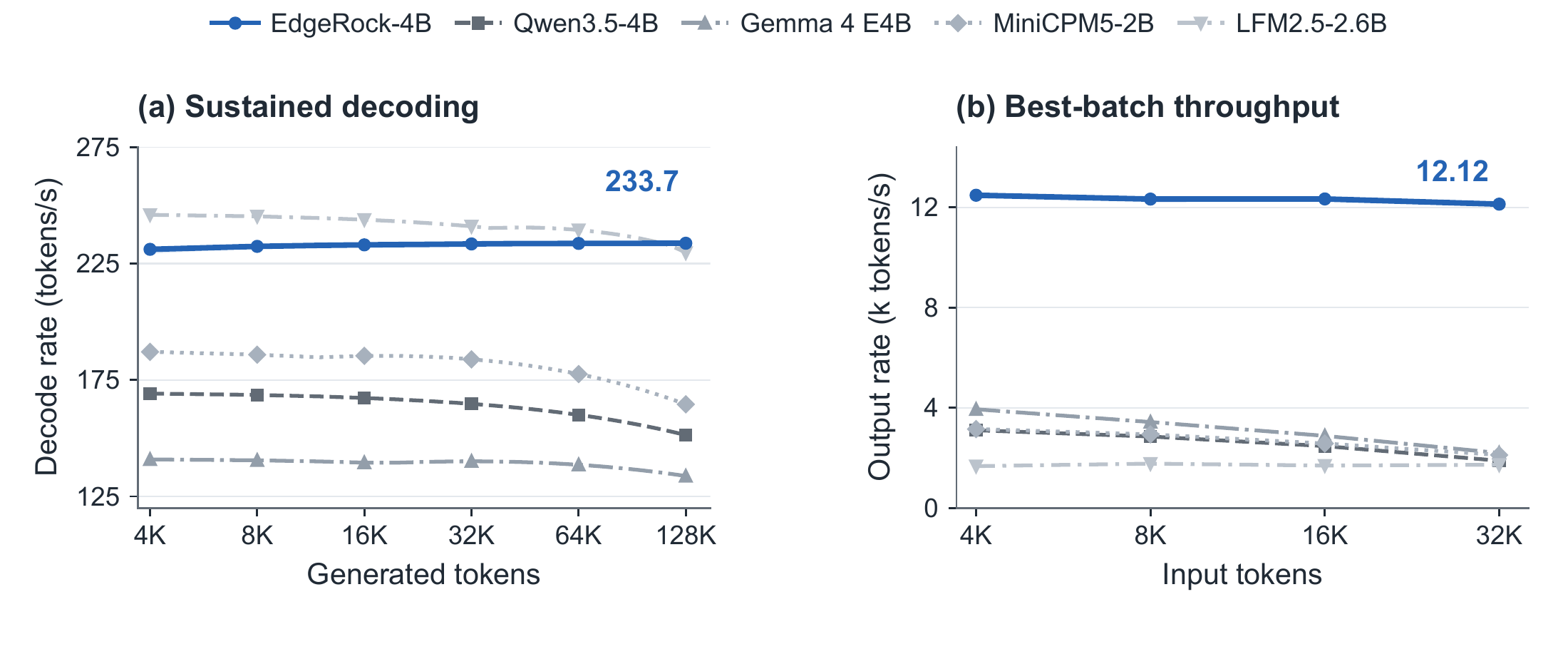
EdgeRock-4B delivers 6.42× Qwen3.5-4B's output throughput at 32K input + 32K output on one Hopper 80GB GPU: 12,124 tokens/s at batch size 512 versus 1,889 at batch size 64, each model's best measured batch.
All columns use 32K output. Cells give tokens/s: output tokens / total time including prefill, with batch size in parentheses.
| Model | 4K input | 8K input | 16K input | 32K input |
|---|---|---|---|---|
| EdgeRock-4B | 12,479 (512) | 12,325 (512) | 12,330 (512) | 12,124 (512) |
| Qwen3.5-4B | 3,103 (64) | 2,853 (64) | 2,472 (64) | 1,889 (64) |
| Gemma 4 E4B | 3,940 (128) | 3,432 (128) | 2,880 (128) | 2,196 (64) |
| MiniCPM5-2B | 3,152 (64) | 2,938 (64) | 2,575 (32) | 2,117 (32) |
| LFM2.5-2.6B | 1,673 (64) | 1,771 (64) | 1,695 (32) | 1,727 (64) |
Across 4K–32K inputs with 32K output, EdgeRock-4B's mean best-batch output throughput is 4.94× Qwen3.5-4B's and 7.18× LFM2.5-2.6B's.
EdgeRock-4B sustains 233.7 decode tokens/s, versus 151.3 for Qwen3.5-4B (1.54×), at 128K input + 128K output, batch size 1, on one Hopper 80GB GPU. Decode timing covers tokens after the first, including sampling and state updates; it excludes prefill.
| Model | Decode tokens/s |
|---|---|
| EdgeRock-4B | 233.7 |
| Qwen3.5-4B | 151.3 |
| Gemma 4 E4B | 133.8 |
| MiniCPM5-2B | 164.5 |
| LFM2.5-2.6B | 229.6 |
At 254K input + 2K output, EdgeRock-4B reaches 226.6 decode tokens/s versus Qwen3.5-4B's 133.9 (1.69×).
EdgeRock-4B supports 512 concurrent long-generation sequences on one Hopper 80GB GPU, with 12,497 weighted decode tokens/s and 61.26 GiB peak allocation across 16 input/output length pairs.
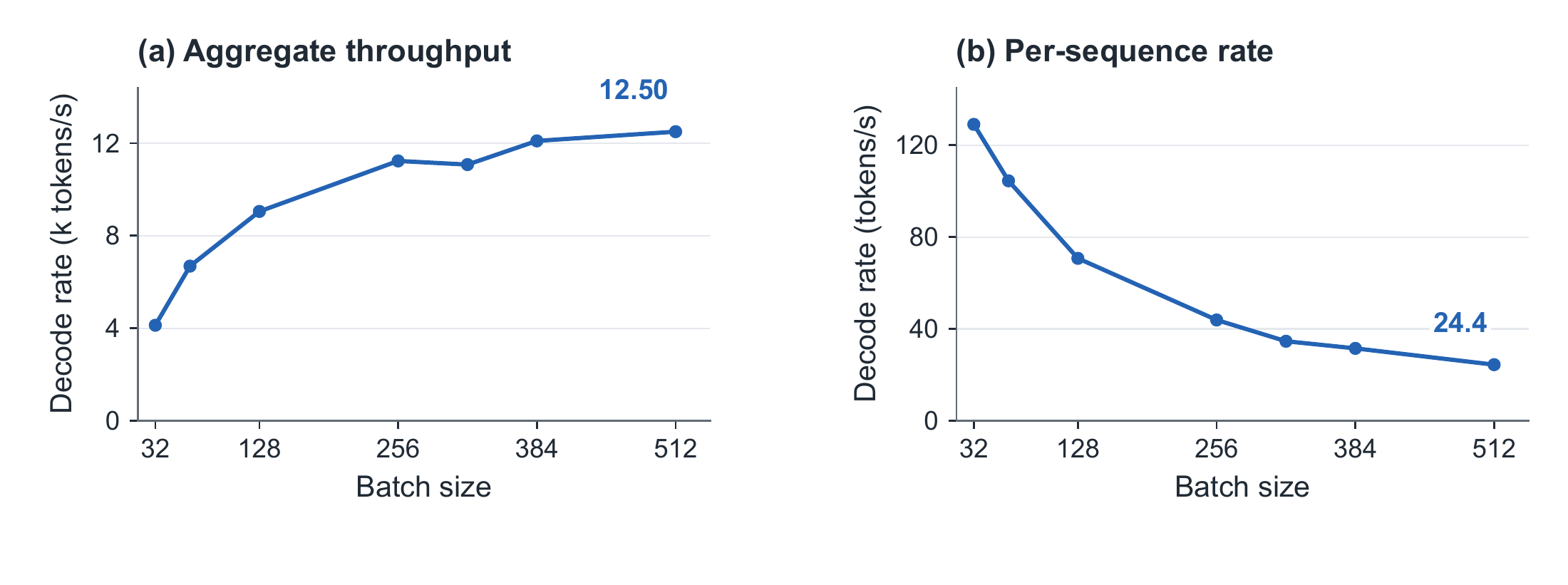
At batch size 512 on one Hopper 80GB GPU, EdgeRock-4B reaches 12,497 weighted decode tokens/s, or 24.4 per sequence, across the 16 input/output pairs formed from 4K, 8K, 16K, and 32K lengths. Rates divide pooled subsequent output tokens by pooled decode time; memory values are workload peaks.
| Batch size | Weighted decode tokens/s | Per-sequence tokens/s | Peak allocated GiB | Peak reserved GiB |
|---|---|---|---|---|
| 32 | 4,128 | 129.0 | 18.94 | 19.49 |
| 64 | 6,685 | 104.5 | 20.16 | 21.80 |
| 128 | 9,049 | 70.7 | 26.74 | 27.92 |
| 256 | 11,231 | 43.9 | 39.90 | 41.77 |
| 320 | 11,074 | 34.6 | 46.49 | 50.69 |
| 384 | 12,099 | 31.5 | 53.06 | 57.27 |
| 512 | 12,497 | 24.4 | 61.26 | 66.97 |
At 4K input and 2K output, decode throughput scales from 229.6 tokens/s at batch size 1 to 12,481 at batch size 512, excluding prefill.
With 4K input + 2K output on one Hopper 80GB GPU, EdgeRock-4B scales from 229.6 decode tokens/s at batch size 1 to 12,481 at batch size 512, excluding prefill.
| Batch size | Decode tokens/s | Per-sequence tokens/s | Peak allocated GiB |
|---|---|---|---|
| 1 | 230 | 229.6 | 14.27 |
| 2 | 358 | 178.8 | 14.27 |
| 4 | 692 | 172.9 | 14.27 |
| 8 | 1,322 | 165.2 | 14.40 |
| 16 | 2,442 | 152.6 | 15.21 |
| 32 | 4,053 | 126.7 | 16.84 |
| 64 | 6,698 | 104.7 | 20.10 |
| 128 | 9,066 | 70.8 | 26.60 |
| 256 | 11,100 | 43.4 | 39.62 |
| 320 | 11,062 | 34.6 | 46.14 |
| 384 | 12,086 | 31.5 | 52.64 |
| 512 | 12,481 | 24.4 | 60.71 |
A memory anchor is a learned key–value record retrievable after its source information leaves the local attention window. In EdgeRock's fixed-capacity bank, the writer creates records, admission selects which remain, and retrieval brings relevant records into the current computation.
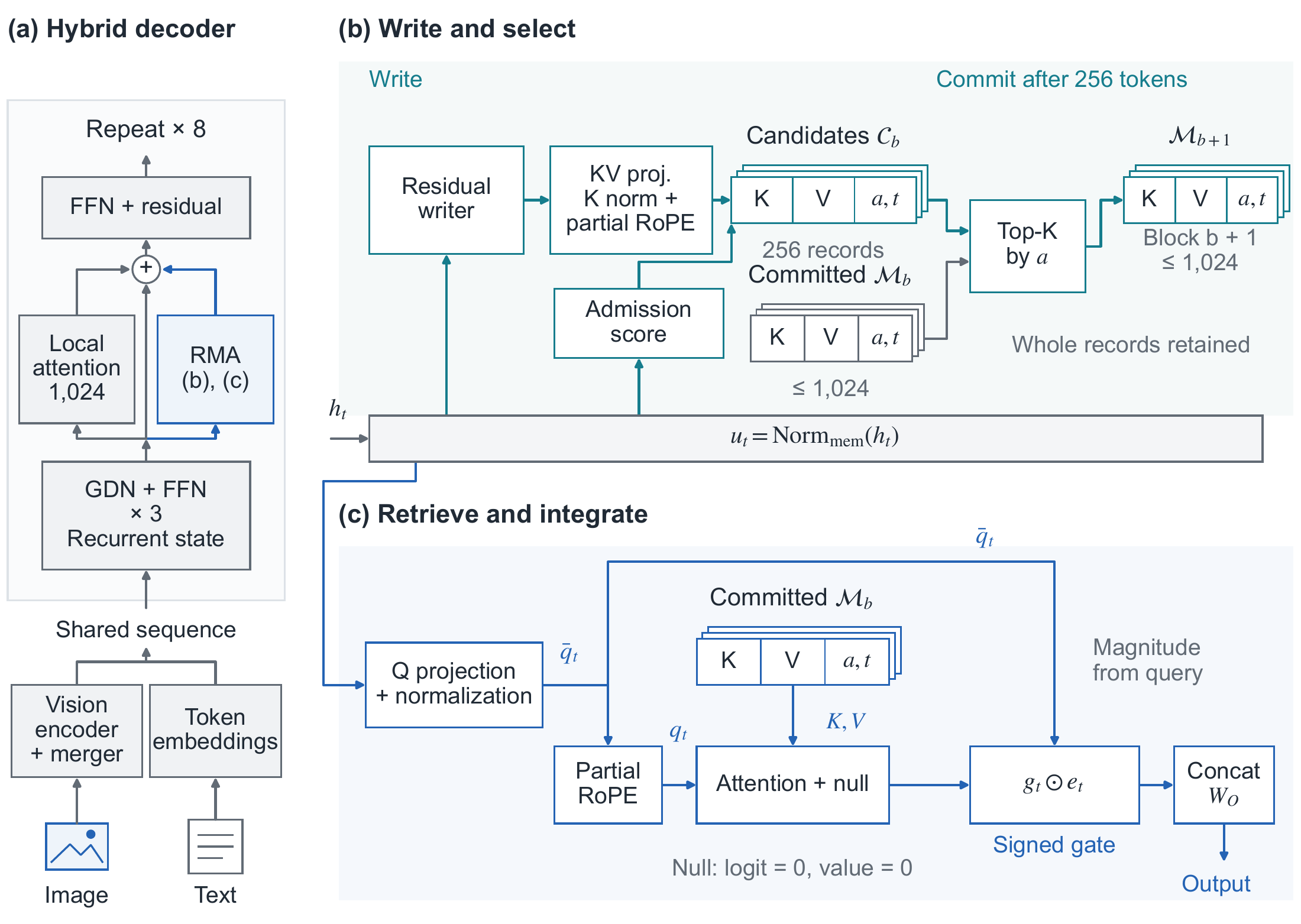
EdgeRock-4B converts the eight full-attention layers of its Qwen3.5-4B backbone while retaining 24 Gated DeltaNet layers and the feed-forward blocks:
[GDN, GDN, GDN, sliding-window attention ∥ RMA] × 8
| History component | Role | Capacity |
|---|---|---|
| Recurrent state | Summarize the evolving context | Fixed-dimensional matrices |
| Local attention | Resolve recent token interactions | 1,024 positions |
| RMA anchor bank | Retain individually retrievable distant records | 1,024 records per KV group |
| Pending candidates | Collect records for the next admission update | 256 positions |
Every 256 tokens, admission selects up to 1,024 records per KV group from existing anchors and new candidates. Queries read the committed bank; updates take effect in the next block. A query-dependent signed gate combines retrieved records with local attention.
Fixed component capacities give O(1) persistent history in sequence length and O(N) generation work for N output tokens at fixed model and memory dimensions.
EdgeRock-4B achieves 94.1% distant-memory query accuracy, versus 0.4% with all eight RMA modules disabled, across 256 contexts of 16K–130,000 input tokens. All four queries are correct in 80.1% of contexts.
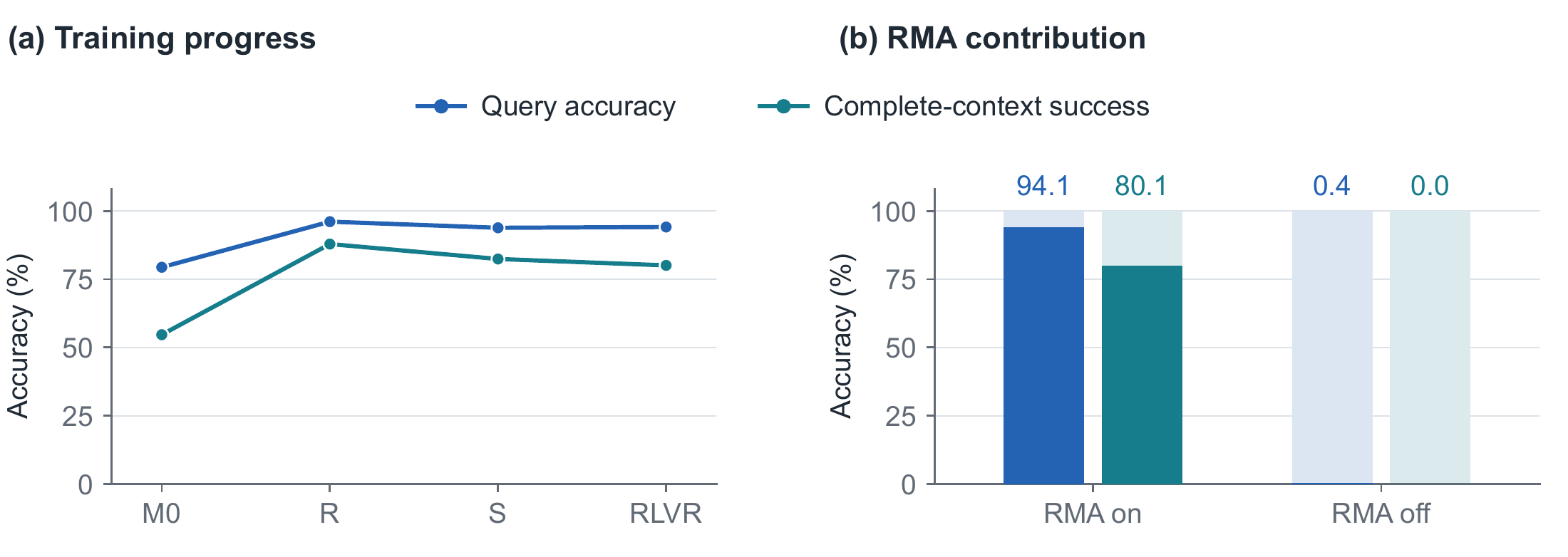
Adaptation stages. Each stage uses the same 256 contexts and 1,024 queries. RLVR denotes reinforcement learning with verifiable rewards.
| Adaptation stage | Query accuracy (%) | All four correct (%) |
|---|---|---|
| RMA adaptation (M0) | 79.4 | 54.7 |
| Joint adaptation (R) | 96.1 | 87.9 |
| Supervised fine-tuning (S) | 93.8 | 82.4 |
| Reinforcement learning (RLVR) | 94.1 | 80.1 |
RMA contribution. Recurrence and local attention remain active in both settings.
| Final-model setting | Correct queries / total | Query accuracy (%) | Complete contexts / total | All four correct (%) |
|---|---|---|---|---|
| RMA enabled | 964 / 1,024 | 94.1 | 205 / 256 | 80.1 |
| RMA disabled | 4 / 1,024 | 0.4 | 0 / 256 | 0.0 |
Results by task. Each task contains 64 contexts and requires four correct answers per context.
| Task | Complete contexts / total | All four correct (%) |
|---|---|---|
| Exact retrieval | 58 / 64 | 90.6 |
| State-update interpretation | 56 / 64 | 87.5 |
| Cross-document combination | 57 / 64 | 89.1 |
| Variable binding | 34 / 64 | 53.1 |
| All tasks | 205 / 256 | 80.1 |
Paired evidence changes. Success requires both answers in a pair to be correct.
| Change to distant evidence | Correct pairs / total | Pair accuracy (%) |
|---|---|---|
| Answer should change | 230 / 256 | 89.8 |
| Answer should stay the same | 247 / 256 | 96.5 |
EdgeRock-4B is compared with 16 bounded-state baselines and 11 growing-history models across all 29 text benchmarks. Scores use each benchmark's primary metric on a 0–100 scale; bold marks column maxima, including ties. AIME reports mean pass@1, and DROP reports F1.
Phi-3 Medium uses a configured 2,047-token attention window.
| Model | GSM8K | MATH-500 | AIME 2024 | AIME 2025 | AIME 2026 | HMMT Feb 2025 | HMMT Nov 2025 | HMMT Feb 2026 |
|---|---|---|---|---|---|---|---|---|
| EdgeRock-4B | 94.5 | 97.5 | 86.7 | 77.4 | 84.6 | 71.8 | 69.8 | 63.6 |
| ARWKV-R1 1.5B | 24.8 | 13.6 | 0.0 | 0.0 | 0.0 | 0.4 | 0.8 | 1.1 |
| RWKV-7 G1i 1.5B | 60.3 | 28.2 | 0.0 | 0.4 | 0.4 | 1.7 | 5.0 | 0.0 |
| RWKV-7 G1j 1.5B | 57.2 | 31.4 | 1.2 | 2.1 | 0.0 | 1.7 | 4.2 | 0.0 |
| RWKV-7 G1i 2.9B | 71.7 | 43.8 | 1.7 | 1.7 | 2.1 | 1.7 | 5.0 | 0.8 |
| RWKV-7 G1j 2.9B | 74.1 | 48.2 | 0.4 | 4.6 | 1.7 | 2.1 | 5.0 | 0.4 |
| AHN-GDN Qwen2.5 3B | 83.8 | 66.2 | 7.1 | 2.1 | 3.3 | 2.9 | 6.7 | 4.9 |
| ARWKV-R1 7B | 51.2 | 33.2 | 0.0 | 0.0 | 0.4 | 0.8 | 1.7 | 1.1 |
| Falcon3-Mamba 7B Instruct | 61.4 | 41.8 | 1.7 | 0.8 | 1.2 | 0.8 | 5.4 | 2.7 |
| QRWKV7 7B Instruct | 65.5 | 41.0 | 0.0 | 0.0 | 0.0 | 0.0 | 6.7 | 0.0 |
| xLSTM 7B | 43.4 | 25.0 | 0.0 | 0.0 | 0.0 | 1.7 | 5.0 | 1.5 |
| RWKV-7 G1i 7.2B | 85.1 | 68.6 | 8.8 | 11.7 | 7.9 | 2.1 | 5.0 | 3.4 |
| RWKV-7 G1j 7.2B | 81.8 | 64.2 | 8.3 | 11.2 | 4.6 | 4.2 | 4.2 | 0.8 |
| RecurrentGemma 9B IT | 51.7 | 22.8 | 0.4 | 0.8 | 0.0 | 1.2 | 5.4 | 1.9 |
| RWKV-7 G1j 13.3B | 94.6 | 77.2 | 17.5 | 27.5 | 11.2 | 3.3 | 5.8 | 12.1 |
| AHN-GDN Qwen2.5 14B | 93.6 | 80.0 | 13.8 | 10.0 | 10.4 | 7.5 | 10.0 | 4.9 |
| Phi-3 Medium 4K Instruct | 85.3 | 49.0 | 3.3 | 3.3 | 0.0 | 6.7 | 2.5 | 3.0 |
| Model | MMLU | MMLU-Pro | MMLU-Redux | CMMLU | C-Eval | GPQA-Diamond | SuperGPQA |
|---|---|---|---|---|---|---|---|
| EdgeRock-4B | 88.2 | 79.8 | 92.0 | 73.3 | 74.6 | 64.6 | 60.0 |
| ARWKV-R1 1.5B | 17.4 | 7.5 | 17.9 | 15.6 | 15.2 | 13.1 | 5.8 |
| RWKV-7 G1i 1.5B | 49.7 | 13.3 | 55.4 | 33.6 | 33.0 | 26.8 | 17.7 |
| RWKV-7 G1j 1.5B | 49.3 | 16.6 | 53.8 | 35.3 | 33.3 | 26.3 | 16.1 |
| RWKV-7 G1i 2.9B | 63.6 | 37.8 | 63.4 | 36.1 | 32.5 | 26.8 | 21.6 |
| RWKV-7 G1j 2.9B | 64.7 | 37.9 | 58.9 | 37.9 | 36.5 | 31.8 | 21.8 |
| AHN-GDN Qwen2.5 3B | 62.7 | 42.8 | 65.7 | 62.4 | 62.9 | 31.3 | 23.0 |
| ARWKV-R1 7B | 32.3 | 8.8 | 35.2 | 29.0 | 29.0 | 13.1 | 8.8 |
| Falcon3-Mamba 7B Instruct | 57.7 | 26.1 | 64.8 | 33.4 | 35.2 | 20.7 | 12.2 |
| QRWKV7 7B Instruct | 64.6 | 23.0 | 34.1 | 57.7 | 56.0 | 8.6 | 15.4 |
| xLSTM 7B | 19.6 | 4.6 | 37.9 | 16.9 | 19.5 | 12.1 | 5.3 |
| RWKV-7 G1i 7.2B | 69.4 | 44.9 | 73.5 | 49.8 | 51.6 | 30.3 | 25.7 |
| RWKV-7 G1j 7.2B | 67.5 | 46.2 | 72.7 | 50.8 | 48.9 | 36.9 | 25.3 |
| RecurrentGemma 9B IT | 55.5 | 13.4 | 55.0 | 43.4 | 41.7 | 24.7 | 19.5 |
| RWKV-7 G1j 13.3B | 76.7 | 47.6 | 81.8 | 67.4 | 66.3 | 42.4 | 31.8 |
| AHN-GDN Qwen2.5 14B | 77.2 | 63.5 | 83.5 | 75.0 | 74.2 | 40.9 | 35.5 |
| Phi-3 Medium 4K Instruct | 76.3 | 54.0 | 81.4 | 53.3 | 51.3 | 26.8 | 25.6 |
| Model | WinoGrande | HellaSwag | ARC-C | ARC-E | BBH | BBEH |
|---|---|---|---|---|---|---|
| EdgeRock-4B | 77.9 | 64.9 | 95.5 | 98.0 | 85.4 | 28.9 |
| ARWKV-R1 1.5B | 31.4 | 7.4 | 19.6 | 22.3 | 9.8 | 1.6 |
| RWKV-7 G1i 1.5B | 46.6 | 33.4 | 68.6 | 83.0 | 27.8 | 4.6 |
| RWKV-7 G1j 1.5B | 49.3 | 24.6 | 66.2 | 80.8 | 31.4 | 5.0 |
| RWKV-7 G1i 2.9B | 57.4 | 62.7 | 81.9 | 92.2 | 30.3 | 4.5 |
| RWKV-7 G1j 2.9B | 58.1 | 65.9 | 83.3 | 91.6 | 39.5 | 6.5 |
| AHN-GDN Qwen2.5 3B | 61.7 | 52.3 | 76.6 | 86.1 | 39.5 | 4.6 |
| ARWKV-R1 7B | 34.4 | 10.0 | 47.4 | 56.8 | 16.6 | 2.4 |
| Falcon3-Mamba 7B Instruct | 57.5 | 38.6 | 74.8 | 87.6 | 32.8 | 3.4 |
| QRWKV7 7B Instruct | 61.8 | 48.0 | 86.3 | 95.4 | 37.4 | 1.9 |
| xLSTM 7B | 28.3 | 7.9 | 25.1 | 28.2 | 12.8 | 3.3 |
| RWKV-7 G1i 7.2B | 60.4 | 70.2 | 84.5 | 94.5 | 38.8 | 7.0 |
| RWKV-7 G1j 7.2B | 59.4 | 71.7 | 83.7 | 94.5 | 41.4 | 7.7 |
| RecurrentGemma 9B IT | 56.4 | 45.8 | 73.3 | 87.2 | 35.5 | 3.2 |
| RWKV-7 G1j 13.3B | 72.1 | 77.4 | 91.8 | 96.3 | 48.7 | 7.7 |
| AHN-GDN Qwen2.5 14B | 74.0 | 67.9 | 91.5 | 94.0 | 52.0 | 5.3 |
| Phi-3 Medium 4K Instruct | 79.6 | 74.0 | 89.8 | 95.3 | 53.3 | 3.1 |
| Model | HumanEval | MBPP | LiveCodeBench v6 | IFEval | IFBench |
|---|---|---|---|---|---|
| EdgeRock-4B | 96.7 | 87.8 | 61.6 | 88.0 | 65.3 |
| ARWKV-R1 1.5B | 4.3 | 5.4 | 0.3 | 11.1 | 8.3 |
| RWKV-7 G1i 1.5B | 42.1 | 36.6 | 7.2 | 37.0 | 14.7 |
| RWKV-7 G1j 1.5B | 41.5 | 38.6 | 6.3 | 46.2 | 16.0 |
| RWKV-7 G1i 2.9B | 58.5 | 49.2 | 11.6 | 43.1 | 17.0 |
| RWKV-7 G1j 2.9B | 58.5 | 48.2 | 12.1 | 56.4 | 17.3 |
| AHN-GDN Qwen2.5 3B | 67.7 | 49.0 | 14.6 | 58.6 | 26.3 |
| ARWKV-R1 7B | 16.5 | 21.2 | 2.6 | 10.4 | 8.3 |
| Falcon3-Mamba 7B Instruct | 34.1 | 39.2 | 9.3 | 64.7 | 18.7 |
| QRWKV7 7B Instruct | 62.2 | 30.2 | 12.4 | 59.0 | 21.3 |
| xLSTM 7B | 36.6 | 9.2 | 2.2 | 34.0 | 14.7 |
| RWKV-7 G1i 7.2B | 65.2 | 59.0 | 18.8 | 53.4 | 17.7 |
| RWKV-7 G1j 7.2B | 72.6 | 58.0 | 21.3 | 66.5 | 18.3 |
| RecurrentGemma 9B IT | 37.2 | 19.0 | 7.9 | 39.7 | 12.7 |
| RWKV-7 G1j 13.3B | 86.0 | 67.4 | 30.7 | 77.8 | 27.3 |
| AHN-GDN Qwen2.5 14B | 75.6 | 68.6 | 32.9 | 77.4 | 33.3 |
| Phi-3 Medium 4K Instruct | 73.8 | 59.4 | 19.1 | 61.4 | 22.0 |
| Model | DROP F1 | MuSR | LogiQA2 |
|---|---|---|---|
| EdgeRock-4B | 77.2 | 60.4 | 72.2 |
| ARWKV-R1 1.5B | 5.6 | 8.6 | 17.5 |
| RWKV-7 G1i 1.5B | 23.0 | 19.3 | 38.7 |
| RWKV-7 G1j 1.5B | 24.9 | 29.1 | 36.1 |
| RWKV-7 G1i 2.9B | 24.6 | 31.9 | 47.6 |
| RWKV-7 G1j 2.9B | 30.7 | 34.5 | 45.4 |
| AHN-GDN Qwen2.5 3B | 32.8 | 37.8 | 50.1 |
| ARWKV-R1 7B | 11.1 | 15.4 | 26.8 |
| Falcon3-Mamba 7B Instruct | 19.9 | 29.1 | 41.4 |
| QRWKV7 7B Instruct | 21.2 | 2.6 | 33.2 |
| xLSTM 7B | 29.0 | 19.3 | 20.0 |
| RWKV-7 G1i 7.2B | 33.3 | 49.6 | 53.1 |
| RWKV-7 G1j 7.2B | 34.2 | 48.6 | 56.4 |
| RecurrentGemma 9B IT | 37.1 | 35.2 | 40.2 |
| RWKV-7 G1j 13.3B | 51.5 | 51.4 | 66.6 |
| AHN-GDN Qwen2.5 14B | 66.5 | 56.4 | 72.3 |
| Phi-3 Medium 4K Instruct | 51.5 | 51.1 | 62.7 |
EdgeRock-4B retains constant persistent history; the eleven comparison models retain history that grows with sequence length.
| Model | GSM8K | MATH-500 | AIME 2024 | AIME 2025 | AIME 2026 | HMMT Feb 2025 | HMMT Nov 2025 | HMMT Feb 2026 |
|---|---|---|---|---|---|---|---|---|
| EdgeRock-4B | 94.5 | 97.5 | 86.7 | 77.4 | 84.6 | 71.8 | 69.8 | 63.6 |
| Qwen3.5-4B | 94.8 | 98.0 | 89.6 | 80.8 | 87.9 | 74.6 | 78.3 | 65.9 |
| Gemma4-E2B-it | 90.1 | 78.8 | 38.3 | 33.8 | 33.8 | 21.7 | 17.5 | 20.1 |
| MiniCPM5-2B | 93.6 | 97.0 | 87.5 | 85.4 | 90.4 | 76.7 | 74.6 | 63.3 |
| LFM2.5-2.6B | 91.0 | 92.7 | 63.4 | 56.3 | 48.9 | 34.7 | 42.9 | 32.9 |
| Qwen3.5-2B | 87.6 | 86.8 | 41.2 | 34.2 | 35.4 | 26.2 | 23.3 | 25.4 |
| Granite4.2-3B | 93.8 | 97.8 | 85.0 | 78.8 | 82.9 | 75.8 | 72.5 | 59.5 |
| Phi-4-mini-reasoning | 93.6 | 91.6 | 45.4 | 32.5 | 38.8 | 25.0 | 28.7 | 24.6 |
| Gemma4-E4B-it | 91.3 | 88.2 | 42.1 | 40.0 | 38.3 | 25.4 | 32.9 | 28.8 |
| Nemotron-3-Nano-4B | 92.4 | 94.8 | 60.8 | 56.7 | 53.8 | 40.0 | 47.1 | 36.4 |
| Granite4.2-8B | 94.4 | 98.0 | 88.3 | 87.9 | 91.7 | 81.7 | 86.7 | 73.9 |
| MiniCPM4.1-8B | 93.6 | 96.4 | 77.1 | 70.0 | 70.8 | 58.3 | 59.6 | 49.2 |
| Model | MMLU | MMLU-Pro | MMLU-Redux | CMMLU | C-Eval | GPQA-Diamond | SuperGPQA |
|---|---|---|---|---|---|---|---|
| EdgeRock-4B | 88.2 | 79.8 | 92.0 | 73.3 | 74.6 | 64.6 | 60.0 |
| Qwen3.5-4B | 85.2 | 77.7 | 89.8 | 83.9 | 84.0 | 77.3 | 52.8 |
| Gemma4-E2B-it | 72.2 | 47.0 | 78.2 | 60.2 | 61.2 | 46.5 | 34.1 |
| MiniCPM5-2B | 79.6 | 65.3 | 85.3 | 79.2 | 78.3 | 67.7 | 40.9 |
| LFM2.5-2.6B | 75.3 | 59.9 | 81.7 | 57.2 | 59.5 | 58.2 | 27.1 |
| Qwen3.5-2B | 72.5 | 62.8 | 79.5 | 68.2 | 68.7 | 54.5 | 39.3 |
| Granite4.2-3B | 77.2 | 66.4 | 81.6 | 59.1 | 60.8 | 58.6 | 39.5 |
| Phi-4-mini-reasoning | 77.5 | 38.5 | 78.3 | 45.3 | 42.4 | 48.0 | 32.2 |
| Gemma4-E4B-it | 81.2 | 69.0 | 86.4 | 68.7 | 68.6 | 55.6 | 41.1 |
| Nemotron-3-Nano-4B | 75.8 | 56.8 | 81.5 | 54.6 | 56.4 | 43.4 | 37.4 |
| Granite4.2-8B | 78.6 | 72.0 | 86.3 | 55.1 | 58.4 | 61.6 | 45.7 |
| MiniCPM4.1-8B | 82.7 | 67.0 | 87.8 | 80.2 | 79.0 | 51.5 | 40.6 |
| Model | WinoGrande | HellaSwag | ARC-C | ARC-E | BBH | BBEH |
|---|---|---|---|---|---|---|
| EdgeRock-4B | 77.9 | 64.9 | 95.5 | 98.0 | 85.4 | 28.9 |
| Qwen3.5-4B | 87.1 | 80.6 | 96.8 | 98.4 | 86.2 | 34.6 |
| Gemma4-E2B-it | 63.2 | 50.9 | 89.2 | 94.8 | 80.3 | 11.6 |
| MiniCPM5-2B | 69.8 | 52.2 | 91.9 | 97.0 | 82.1 | 25.4 |
| LFM2.5-2.6B | 67.9 | 40.7 | 91.6 | 96.5 | 76.7 | 13.1 |
| Qwen3.5-2B | 71.5 | 59.3 | 91.4 | 95.5 | 79.1 | 14.9 |
| Granite4.2-3B | 74.0 | 67.4 | 92.4 | 97.1 | 85.5 | 24.5 |
| Phi-4-mini-reasoning | 75.8 | 62.6 | 90.2 | 94.4 | 72.5 | 12.9 |
| Gemma4-E4B-it | 76.5 | 53.5 | 94.3 | 97.7 | 84.1 | 17.4 |
| Nemotron-3-Nano-4B | 65.6 | 46.3 | 91.9 | 96.7 | 79.3 | 10.8 |
| Granite4.2-8B | 76.2 | 63.1 | 90.9 | 94.6 | 88.9 | 31.5 |
| MiniCPM4.1-8B | 78.2 | 49.8 | 93.4 | 97.4 | 86.6 | 14.0 |
| Model | HumanEval | MBPP | LiveCodeBench v6 | IFEval | IFBench |
|---|---|---|---|---|---|
| EdgeRock-4B | 96.7 | 87.8 | 61.6 | 88.0 | 65.3 |
| Qwen3.5-4B | 86.0 | 71.0 | 75.7 | 89.6 | 60.3 |
| Gemma4-E2B-it | 90.9 | 79.6 | 59.6 | 82.4 | 29.0 |
| MiniCPM5-2B | 97.6 | 94.8 | 83.3 | 86.3 | 64.0 |
| LFM2.5-2.6B | 92.9 | 73.6 | 59.7 | 93.3 | 56.2 |
| Qwen3.5-2B | 54.9 | 35.4 | 25.0 | 81.5 | 43.7 |
| Granite4.2-3B | 97.0 | 92.6 | 75.9 | 92.2 | 74.3 |
| Phi-4-mini-reasoning | 79.9 | 64.0 | 35.3 | 45.7 | 14.3 |
| Gemma4-E4B-it | 93.9 | 79.2 | 69.1 | 84.3 | 34.7 |
| Nemotron-3-Nano-4B | 90.9 | 72.2 | 66.4 | 89.5 | 57.7 |
| Granite4.2-8B | 96.3 | 95.4 | 85.6 | 94.6 | 77.0 |
| MiniCPM4.1-8B | 98.2 | 92.2 | 70.4 | 73.4 | 23.7 |
| Model | DROP F1 | MuSR | LogiQA2 |
|---|---|---|---|
| EdgeRock-4B | 77.2 | 60.4 | 72.2 |
| Qwen3.5-4B | 76.0 | 64.9 | 82.2 |
| Gemma4-E2B-it | 72.9 | 58.9 | 59.4 |
| MiniCPM5-2B | 76.0 | 65.3 | 73.7 |
| LFM2.5-2.6B | 72.3 | 60.4 | 63.2 |
| Qwen3.5-2B | 73.7 | 61.3 | 66.3 |
| Granite4.2-3B | 83.7 | 65.1 | 69.5 |
| Phi-4-mini-reasoning | 50.6 | 56.7 | 58.5 |
| Gemma4-E4B-it | 72.9 | 62.2 | 72.6 |
| Nemotron-3-Nano-4B | 72.6 | 58.2 | 67.9 |
| Granite4.2-8B | 76.9 | 62.4 | 73.8 |
| MiniCPM4.1-8B | 78.3 | 64.5 | 75.7 |
The 29-benchmark mean weights tasks equally after their subject/subtask aggregation. AIME pools responses within each edition, then averages editions equally. EdgeRock text evaluation uses temperature 0.6, top-p 0.95, top-k 20, and a 131,072-token response cap. Repetition counts vary by model and benchmark; evaluation details and Appendix A of the report give sampling and scoring procedures.
EdgeRock-4B is Rock Matrix's first open-source 4B multimodal reasoning model. It supports text and image reasoning with constant-size persistent history. Weights and inference code are available.
In the batch runtime, EdgeRock-4B's persistent history stays at 97.76 MiB per sequence, including attention KV and recurrent state, as sequence length grows. Total GPU memory also includes weights and execution buffers and grows with concurrency.
Sliding-window attention reads recent tokens. Rock Memory Anchors preserve selected distant information as individually retrievable key–value records in a fixed-capacity bank, extending direct retrieval beyond the local window.
EdgeRock-4B's reported runtime uses unquantized BF16 weights and KV, FP32 GDN updates, and ordinary autoregressive decoding. GDN state storage is FP32 at batch size 1 and FP16 for larger batches. Fixed-capacity history provides the memory savings; CUDA Graphs and fused operators accelerate execution. See the runtime configuration.
@techreport{edgerock2026,
  title = {EdgeRock: Strong Reasoning at Constant Memory},
  author = {Ji, Huishan and Zhang, Weiming and Ye, Qirui and Xu, Jinchao and Guo, Yike and Xu, Hua},
  institution = {Rock Matrix},
  year = {2026},
  eprint = {2610.10118},
  archivePrefix = {arXiv},
  url = {https://arxiv.org/abs/2610.10118}
}
Runtime code is distributed under Apache-2.0. Model weights are governed by the model license. See NOTICE for attribution and third-party terms.
EdgeRock's constant-memory reasoning architecture in a smaller weight package. This release uses FP8 E4M3 weights in 128 × 128 blocks, with dynamic FP8 activations. It retains the full recurrent-state, local-attention, and Rock Memory Anchors (RMA) architecture.
The source is Rock Matrix's EdgeRock, frozen at a6a53a5573f1. Quantization changes the large projection and MLP matrices. RMA weights, small recurrent gates, the tied embedding/output head, cache capacity, and recurrent-state settings retain their source values. This is mixed-precision quantization; the format name describes the quantized matrices.
hf download rockmatrix-ai/EdgeRock-4B-FP8 --local-dir ./EdgeRock-4B-FP8
cd EdgeRock-4B-FP8
python -m pip install -r requirements.txt
Use a fresh Python environment and install this repository's requirements.txt. The pinned Transformers wheel contains the Qwen3.5 implementation used by EdgeRock. This package contains the text model and supports the PyTorch inference path.
import torch
from transformers import AutoModelForCausalLM, AutoTokenizer

model_id = "rockmatrix-ai/EdgeRock-4B-FP8"
tokenizer = AutoTokenizer.from_pretrained(model_id, trust_remote_code=True)
from transformers.integrations import finegrained_fp8
finegrained_fp8._deepgemm_available = False  # Validated Triton path for the pinned Transformers version.
model = AutoModelForCausalLM.from_pretrained(
    model_id, trust_remote_code=True, dtype=torch.bfloat16, device_map={"": 0},
).eval()
messages = [{"role": "user", "content": "Calculate 17 * 23."}]
text = tokenizer.apply_chat_template(messages, tokenize=False, add_generation_prompt=True)
inputs = tokenizer(text, return_tensors="pt", add_special_tokens=False).to("cuda")
output = model.generate(**inputs, max_new_tokens=2048, do_sample=False)
print(tokenizer.decode(output[0, inputs.input_ids.shape[1]:], skip_special_tokens=True))
FP8 execution requires an NVIDIA GPU with compute capability 9.0 or newer. The first run downloads the finegrained-FP8 kernel from Hugging Face.
The quantization configuration is embedded in config.json; loading does not require a second quantization pass.
| Check | BF16 source | This release |
|---|---|---|
| Weight files | 8.527 GiB | 5.208 GiB |
| Teacher-forced NLL on 32 GSM8K test examples | 0.9892 | 0.9932 |
| Maximum logit change after saving and reloading | — | 0 |
The NLL check scores the final up-to-64 tokens of each question/answer sequence, truncated to 512 tokens. Lower is better; these examples are held out from conversion and are not calibration data. This is a conversion check, not a GSM8K accuracy score.
Fresh-process checks verified 168 protected tensors against the source bit for bit. All three arithmetic checks and both identifier-retrieval checks passed; retrieval prompts span approximately 2K and 8K tokens. A Chinese-to-English translation check is included. See validation.json for the exact protocol and outputs. Full benchmark accuracy and optimized serving throughput have not been remeasured for these quantized weights.
A separate generation screen uses GSM8K test rows 32–47, greedy decoding and a 4,096-token output budget. Correct complete answers: 15/16, compared with 15/16 for the BF16 source. Two additional memory update/key-disambiguation checks use 9,664 and 10,462 input tokens: 2/2, compared with 2/2 for BF16. A correct answer must match the expected value, close the thinking section, and reach EOS within the budget. These small screens do not establish unchanged full-benchmark accuracy.
The source model's multimodal frontend and native serving adapters are distributed in the original repository. This quantized package validates text inference; it does not bundle or validate the visual frontend. It is not a GGUF or Ollama model.
The weights retain the EdgeRock Model License 1.0; code retains Apache-2.0. Original notices are preserved in NOTICE. Changes in this derivative release consist of weight quantization, the packaged chat template and generation settings, and the packaged inference dependencies. Source benchmark claims are described in the technical report.
Base model
rockmatrix-ai/EdgeRock