
Spaces:
Sleeping

Sleeping
| title: Adaptive Study Agent | |
| emoji: 📚 | |
| colorFrom: blue | |
| colorTo: purple | |
| sdk: gradio | |
| sdk_version: "6.9.0" | |
| app_file: app.py | |
| pinned: false | |
| private: true | |
| # Adaptive Study Agent | |
| A **two-model LLM self-examination simulation** built with **LangGraph**, **Claude (Anthropic)**, and **GPT-4o-mini (OpenAI)**. The agent reads any document you provide and runs a fully autonomous study loop — no human answers anything. | |
| **How the two models collaborate:** | |
| - **GPT-4o-mini** generates comprehension questions from document chunks (temperature 0.7 — creative) and evaluates the answers against the source material (temperature 0.0 — deterministic) | |
| - **Claude Sonnet** answers the questions using RAG retrieval from ChromaDB (temperature 0.3 — balanced) | |
| - **OpenAI text-embedding-3-small** handles document chunking and embedding into ChromaDB only — not used for reasoning | |
| The purpose is to **probe where Claude's understanding of the document breaks down** — GPT acts as the examiner, Claude as the student. When Claude scores below the mastery threshold, the agent re-reads the weak chunk and tries again. | |
| The output is a structured session report revealing Claude's weak areas within your document — useful for identifying conceptually dense or underrepresented sections in any text. | |
| Applicable to **any domain** — ML papers, medical literature, legal documents, textbooks — anything in PDF or TXT format. | |
| --- | |
| ## Research Connection | |
| This is a standalone extended example project inspired by ongoing research on multi-agent knowledge systems. The core idea — using retrieval-augmented self-evaluation to surface knowledge gaps — is the single-agent version of a feedback mechanism explored at scale in that research. There is no shared infrastructure or data pipeline between the two. | |
| --- | |
| --- | |
| ## Architecture | |
| The agent operates as a LangGraph state machine with conditional branching. After evaluating each answer, the agent decides whether to re-read weak material, continue to the next question, or finalize the session. | |
| 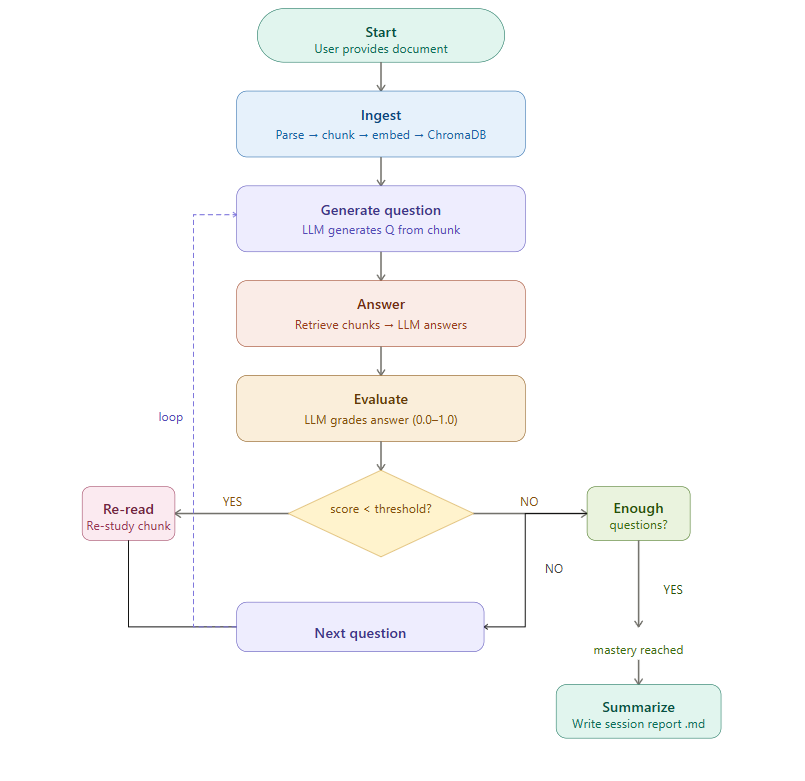 | |
|  | |
| --- | |
| ## Tech Stack | |
| | Component | Technology | Purpose | | |
| |------------------|-------------------------------|------------------------------------------------------| | |
| | Agent framework | LangGraph | Stateful loops with conditional branching | | |
| | Examiner LLM | GPT-4o-mini (OpenAI) | Question generation (0.7) + evaluation (0.0) | | |
| | Student LLM | Claude Sonnet 4 (Anthropic) | Answering questions via RAG (0.3) | | |
| | Embeddings | OpenAI text-embedding-3-small | Document chunking and embedding into ChromaDB only | | |
| | Vector store | ChromaDB (local, embedded) | No Docker required | | |
| | Document parsing | PyMuPDF (fitz) | PDF support | | |
| | UI | Gradio | Web interface and Hugging Face Spaces deploy | | |
| | Package manager | uv | Dependency management | | |
| --- | |
| ## Setup | |
| **1. Install dependencies** | |
| ```bash | |
| uv sync | |
| ``` | |
| **2. Configure environment variables** | |
| Create a `.env` file in the project root: | |
| ``` | |
| ANTHROPIC_API_KEY=sk-ant-... | |
| OPENAI_API_KEY=sk-... | |
| ``` | |
| The Anthropic key powers the LLM (question generation, answering, evaluation). The OpenAI key is used only for embeddings. | |
| **3. Add documents** | |
| Place PDF or TXT files in `data/documents/`. | |
| --- | |
| ## Usage | |
| ### Command line | |
| ```bash | |
| # Run with a document | |
| uv run python src/main.py --doc data/documents/attention_is_all_you_need.pdf | |
| # Override the mastery threshold (default: 0.75) | |
| uv run python src/main.py --doc data/documents/myfile.pdf --threshold 0.8 | |
| # Persist the ChromaDB collection between runs | |
| uv run python src/main.py --doc data/documents/myfile.pdf --persist | |
| ``` | |
| ### Gradio web interface | |
| ```bash | |
| uv run python app.py | |
| ``` | |
| The web interface allows you to upload a document, configure the mastery threshold, start a study session, and view the resulting session report from the browser. | |
| ### Running tests | |
| ```bash | |
| uv run pytest tests/ -v | |
| ``` | |
| --- | |
| ## Configuration | |
| The following constants in `src/graph/edges.py` control the study loop: | |
| | Parameter | Default | Description | | |
| |----------------------|---------|----------------------------------------------| | |
| | MASTERY_THRESHOLD | 0.75 | Score needed to skip re-read | | |
| | MIN_QUESTIONS | 10 | Minimum questions before mastery check | | |
| | MAX_REREAD_CYCLES | 3 | Max re-read attempts per weak chunk | | |
| The mastery threshold can also be overridden at runtime via the `--threshold` flag or the Gradio slider. | |
| --- | |
| ## Output Format | |
| Each session produces a Markdown report in `output/session_reports/`: | |
| ```markdown | |
| # Study Session Report | |
| Date: 2026-03-16 | |
| Document: attention_is_all_you_need.pdf | |
| ## Summary | |
| - Questions asked: 14 | |
| - Questions correct (score >= 0.75): 11 | |
| - Final mastery score: 0.81 | |
| - Re-read cycles triggered: 3 | |
| ## Weak Areas | |
| - Multi-head attention computation | |
| - Positional encoding formula | |
| ## Q&A Log | |
| ### Q1 | |
| Question: What is the purpose of the scaling factor in dot-product attention? | |
| Answer: ... | |
| Score: 0.9 | |
| ... | |
| ``` | |
| --- | |
| ## Author | |
| **Halima Akhter** | |
| PhD Student in Computer Science | |
| Specialization: ML, Deep Learning, Bioinformatics | |
| GitHub: [github.com/Mituvinci](https://github.com/Mituvinci) | |