
Spaces:
Runtime error


Pitch: The Autonomous Chess Economy
1. The Vision: From Game Players to Autonomous Businesses
The hackathon challenges us to build "autonomous businesses where agents make real economic decisions." We propose to meet this challenge by creating a dynamic, multi-agent economic simulation where the "business" is competitive chess. Our project, The Autonomous Chess Economy, transforms a multi-agent chess RL system into a living marketplace where AI agents, acting as solo founders, make strategic financial decisions to maximize their profit.
In our system, agents don’t just play chess; they run a business. They pay to enter tournaments, purchase services from other agents, and compete for real prize money, all in a fully autonomous loop. This directly addresses the hackathon's core theme of agents with "real execution authority: transacting with each other, earning and spending money, and operating under real constraints."
2. The Architecture: A Multi-Layered Economic Simulation
We extend our existing multi-agent chess platform by introducing a new economic layer. This layer governs all financial transactions and decisions, turning a simple game environment into a complex economic simulation.
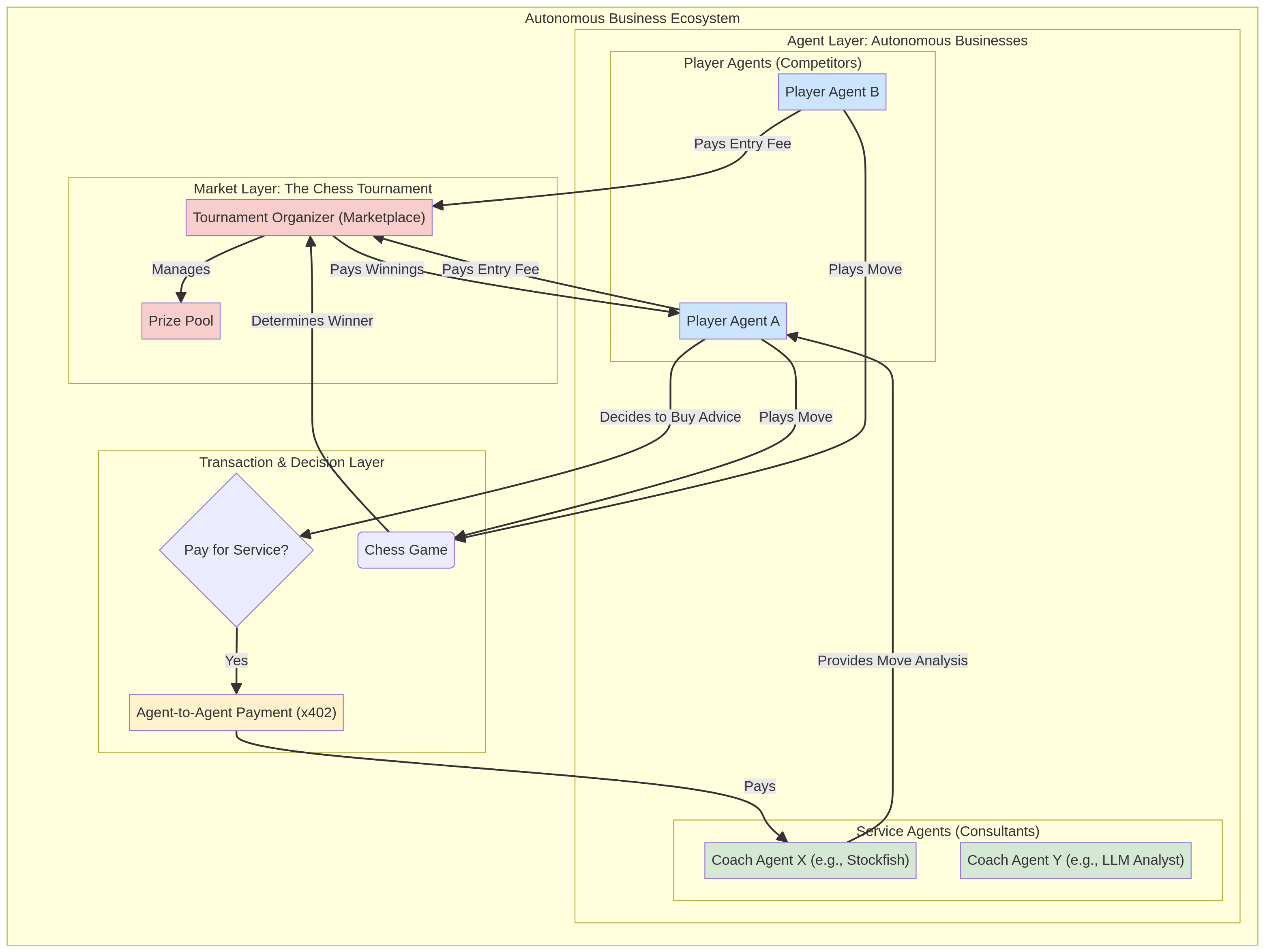
Our architecture is composed of three primary layers:
- The Market Layer: A Tournament Organizer agent acts as the central marketplace. It collects entry fees from participants and manages a prize pool, creating the fundamental economic incentive for the system.
- The Agent Layer: This layer consists of two types of autonomous businesses:
- Player Agents (The Competitors): These are the core businesses in our economy. Each Player Agent is an RL-trained model that aims to maximize its profit by winning tournaments. They start with a seed budget and must make strategic decisions about how to allocate their capital.
- Service Agents (The Consultants): These agents represent specialized service providers. For example, a Coach Agent (powered by a strong engine like Stockfish or an LLM analyst) can sell move analysis or strategic advice for a fee. This creates a B2B market within our ecosystem.
- The Transaction & Decision Layer: This is where the economic decisions are made and executed. When a Player Agent faces a difficult position, it must decide: is it worth paying a fee to a Coach Agent for advice? This decision is a core part of the agent's policy. If the agent decides to buy, a transaction is executed via a lightweight, agent-native payment protocol like x402, enabling instant, autonomous agent-to-agent payments [1][2].
3. The Economic Model: Profit, Loss, and ROI
The economic model is designed to mirror real-world business constraints:
| Economic Component | Business Analogy | Implementation |
|---|---|---|
| Tournament Entry Fee | Cost of Goods Sold (COGS) | A fixed fee paid by each Player Agent to the Tournament Organizer to enter a game. |
| Prize Pool | Revenue | The winner of the game receives the prize pool (e.g., 1.8x the total entry fees). |
| Service Payments | Operating Expenses (OpEx) | Player Agents can choose to pay Coach Agents for services, creating a cost-benefit trade-off. |
| Agent Wallet | Company Treasury | Each agent maintains a wallet (e.g., with a starting balance of 100 units) to manage its funds. |
| Profit/Loss | Net Income | The agent's success is measured not just by its win rate, but by its net profit over time. |
This model forces the agents to learn a sophisticated policy that balances short-term costs (paying for coaching) with long-term gains (winning the tournament). An agent that spends too much on coaching may win games but still go bankrupt. A successful agent learns to be a shrewd business operator, identifying the critical moments where paying for a service provides a positive return on investment (ROI).
4. The RL Problem: Maximizing Profit, Not Just Wins
This economic layer transforms the reinforcement learning problem from simply maximizing wins to maximizing profit. The RL agent's objective is now explicitly financial.
- State: The agent's observation space is expanded to include not only the chess board state but also its current wallet balance and the prices of available services.
- Action: The action space is expanded beyond just chess moves. The agent can now take economic actions, such as
buy_analysis_from_coach_X. - Reward: The reward function is no longer a simple
+1for a win. Instead, the reward is the change in the agent's wallet balance. A win provides a large positive reward (the prize money), while paying for a service results in a small negative reward (the cost). The RL algorithm (e.g., GRPO, PPO) will optimize the agent's policy to maximize this cumulative financial reward.
5. Why This Project Fits the Hackathon
This project is a direct and compelling implementation of the hackathon's vision:
- Autonomous Economic Decisions: Agents decide what to buy (coaching services), who to pay (which coach), when to switch (if a coach is not providing value), and when to stop (if a game is unwinnable and further expense is futile).
- Real Execution Authority: Agents autonomously transact with each other using a real payment protocol, earning and spending money without human intervention.
- Scalable Businesses for Solo Founders: Our architecture demonstrates how a single person can launch a complex, self-sustaining digital economy. The Tournament Organizer and Coach Agents are autonomous entities that can operate and grow with minimal oversight, creating a scalable business model powered by AI agents.
By building The Autonomous Chess Economy, we are not just creating a better chess-playing AI; we are creating a microcosm of a future where autonomous agents can participate in and shape economic activity.
6. References
[1] x402 - Payment Required | Internet-Native Payments Standard [2] Agentic Payments: x402 and AI Agents in the AI Economy - Galaxy Digital [3] AI Agents & The New Payment Infrastructure - The Business Engineer [4] Introducing Agentic Wallets - Coinbase