

license: mit
pipeline_tag: image-to-image
tags:
  - steppe
  - latent-upscaler
  - upscaler
  - super-resolution
  - comfyui
  - flux
  - flux2
  - flux.2
  - moss-image
  - flow-matching
  - distillation
base_model:
  - black-forest-labs/FLUX.2-dev
  - black-forest-labs/FLUX.2-klein-4B
  - black-forest-labs/FLUX.2-klein-9B
  - black-forest-labs/FLUX.2-klein-base-4B
  - black-forest-labs/FLUX.2-klein-base-9B
  - OpenMOSS-Team/MOSS-Image-SFT
  - OpenMOSS-Team/MOSS-Image-Base
base_model_relation: adapter
Steppe for FLUX.2 VAE latents
🧩 ComfyUI nodes: ComfyUI-Steppe
Available in ComfyUI-Manager: search for "Steppe" and install (or
comfy node install steppe). FLUX.2 support needs version 1.1.0 or newer. The nodes download these models on first use.

Steppe is a family of generative latent upscalers: small generative models trained only for upscaling, which run directly on VAE latents. The upscaled latent is decoded straight by the VAE: no second sampling pass of the base model, no hires fix, no prompt.
These models upscale latents of the FLUX.2 VAE, the latent space shared by FLUX.2 [dev], FLUX.2 [klein] and MOSS-Image.
- 2x resolution of images, e.g. 512 → 1024 or 1024 → 2048, and chained 2x → 2x.
- One step: ~40 ms model time for a 1024 px image with the default model (RTX 5090). Most of the time goes to the VAE decode.
- Close to the VAE limit: patch FID 1.75 vs 8.12 for bicubic, -59% vs our earlier FLUX.2 upscaler.
- Sharpness control through the high frequency feature conditioning (hff).
Images only: unlike the Wan 2.1 models, there is no temporal (frame rate) upscaling.
Use in ComfyUI
Install ComfyUI-Steppe: search for "Steppe" in ComfyUI-Manager,
or run comfy node install steppe. The models download automatically on first use.
KSampler → Steppe Upscale Latent → VAE Decode
Select a steppe_flux_2_* model in Load Steppe Upscaler (the same loader lists the Wan 2.1 models). Leave
steps / shift at 0 for the recommended base model sampler (30 steps, shift 2).
To install the models manually, put the files into ComfyUI/models/latent_upscale_models.
Gallery


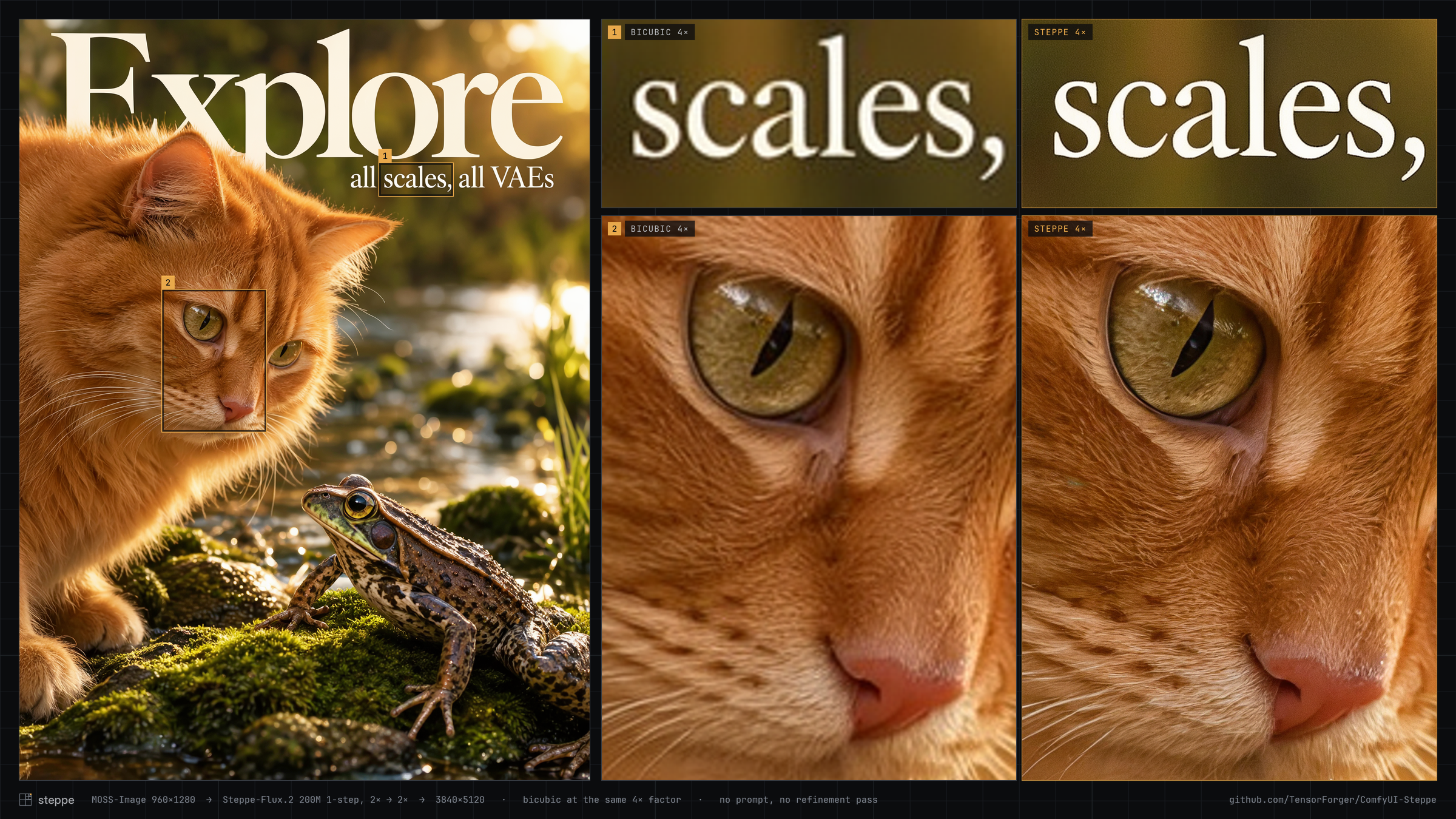
All examples: MOSS-Image at 960x1280, Steppe-Flux.2 200M 1-step, chained 2x → 2x to 3840x5120, no prompt and no refinement pass. Bicubic tiles are upscaled by the same 4x factor from the same input. Click an image for the full resolution card.
Files
| file | steps | parameters | use |
|---|---|---|---|
steppe_flux_2_200M_1step.safetensors |
1 | 192M | default, 90% of use cases: the quality of the base model in one step |
steppe_flux_2_200M_base.safetensors |
1-200 (30) | 192M | most control and research: steps, CFG on hff; same quality as the 1-step model in general use |
steppe_flux_2_20M_1step.safetensors |
1 | 20.2M | lite: 6x faster model pass, very large outputs, real time use; with a tiny decoder (TAEF2) the whole pipeline is ~19 ms |
All files are bfloat16 safetensors with the model configuration in the metadata. config.json is the catalog of this
repository (versions, recommended settings).
Compatibility
| model | VAE | status |
|---|---|---|
| FLUX.2 [dev] | FLUX.2 VAE | native |
| FLUX.2 [klein] 4B / 9B (distilled and base) | FLUX.2 VAE | native |
| MOSS-Image (SFT and base) | FLUX.2 VAE (small decoder) | native |
| FLUX.2 small decoder, TAEF2 (madebyollin/taef2) | FLUX.2 VAE decoders | works, TAEF2 benchmarked |
| FLUX.1, Wan, Qwen-Image, SD3, SDXL, … | other VAEs | not supported here (Wan 2.1 VAE: Steppe-Wan2.1) |
Tested in ComfyUI with FLUX.2 [klein] 4B (flux2-vae) and MOSS-Image (flux2-vae_small), single 2x and chained
2x → 2x. Both workflows are in
ComfyUI-Steppe/example_workflows.
Settings
- hff (
0...1, default 0.9): target amount of fine detail and sharpness. Off (-1) lets the model choose. The values are absolute: an Immerkaer noise estimate, quantile-normalized on ReLAION photos. hff acts much more strongly on these models than on the Wan 2.1 ones. - guidance:
- 1-step models: a distilled guidance input, trained on 1-2, no extra cost. The default 1 (off) is safe and stable.
- Base model: classifier free guidance between the hff and the null hff; the cost is two passes per step.
- Base model sampler: 30 Euler steps, sigma shift 2, initial noise scale 1.0.
Benchmark

1000 photos (Axis-V1), 512 → 1024. Every solution gets only the FLUX.2 latent (no prompt, no hff). Patch FID on native 256 px tiles (lower is better); latency at batch 1, VAE decode included, RTX 5090, eager bfloat16.
| solution | patch FID | FID | latency | peak VRAM |
|---|---|---|---|---|
| Steppe 200M base, 30 steps | 1.72 | 1.95 | 1671 ms | 3.0 GB |
| Steppe 200M 1-step | 1.75 | 2.02 | 172 ms | 3.0 GB |
| Steppe 20M 1-step | 2.20 | 2.63 | 131 ms | 2.6 GB |
| Steppe 200M 1-step + TAEF2 decoder | 3.22 | 4.55 | 60 ms | 1.0 GB |
| Steppe 20M 1-step + TAEF2 decoder | 3.81 | 5.17 | 19 ms | 0.7 GB |
| FlowUpscaler (our previous FLUX.2 model) | 4.28 | 4.50 | 128 ms | 2.7 GB |
| SPAN 2x after decode | 6.18 | 3.67 | 30 ms | 0.8 GB |
| SesquiLSR FLUX.2 (latent, made for hires fix) | 7.71 | 7.26 | 124 ms | 2.6 GB |
| bicubic after decode | 8.12 | 1.77 | 25 ms | 0.8 GB |
| Real-ESRGAN x2 after decode | 9.03 | 7.99 | 53 ms | 0.8 GB |
The VAE reconstruction limit on this set is patch FID 0.71. Steppe stays close to the input: roundtrip color error ΔE00 1.82 (bicubic 1.74). A FLUX.2 [klein] 9B LoRA upscaler (Hildegard, 4 steps, ~7 s per image) was compared on 30 images: it adds plausible detail but moves away from the input (ΔE00 3.8 at best vs 2.2 for Steppe on the same images).
Benchmark images: Axis-V1 by refine-axis (CC BY 4.0), cropped.
Python
pip install "steppe[standalone] @ git+https://github.com/TensorForger/ComfyUI-Steppe"
from steppe import UpscaleSettings, load_upscaler

upscaler = load_upscaler("steppe_flux_2_200M_1step.safetensors")
upscaler.model.to("cuda")

# FLUX.2 latents as ComfyUI and the diffusers FLUX.2 pipelines use them: 2x2 packed and batch norm normalized,
# [B, 128, H / 16, W / 16]. From a bare AutoencoderKLFlux2: patchify the 32 channel latent 2x2 (channel order
# C, 2, 2) and normalize it with vae.bn.running_mean / sqrt(vae.bn.running_var + 1e-4).
upscaled = upscaler.upscale(
    latents, UpscaleSettings(hff=0.9, guidance=1.0)
)  # [B, 128, H / 8, W / 8]
How it works
A window transformer runs on the full resolution latent grid (32 channels, 1/8 of the image). It uses DiT style adaLN-zero blocks, shifted 8x8 window attention and QK-norm. A learned source encoder upsamples the input latent. The model generates the normalized residual over the aligned low resolution latent with rectified flow, conditioned on the noise level and the hff.
- Base model: 192M parameters, trained from scratch for 24 h on 7 RTX 5090s. Data: images from ReLAION-high-resolution and 4KLSDB (1 : 1, large crops, 512 → 1024 and 256 → 512). Training pairs are made by downscaling and encoding with the FLUX.2 VAE; 20% of the inputs are corrupted (mostly JPEG) for robustness. No captions are used. hff dropout enables classifier free guidance.
- 1-step model: rectified flow distillation of the base model (teacher pairs generated online, ~35 min on 8 GPUs). It keeps ~99% of the base model's gain over bicubic.
- 20M model: the same architecture scaled down and trained from scratch for 6 h on pairs from the 1-step model (~93% of its gain).
The architecture and recipe come from agent-driven autoresearch on FLUX.2 and Wan 2.1 latents (rounds of parallel 30 min training runs, judged by patch FID).
Limitations
- Images only, no video and no frame rate upscaling.
- Small text and small background faces are where all upscalers fail. Steppe improves them less than textures and edges, and the 20M model the least.
- The upscaling factor is fixed at 2x. For 4x, chain two upscales.
License
MIT. Steppe works on latents of the FLUX.2 VAE (Apache-2.0, Black Forest Labs), see NOTICE. This repository
does not contain VAE or FLUX.2 model weights.
The ancestor of Steppe is comfyui-flow-upscaler (FLUX.2).
@misc{steppe2026,
  author = {TensorForger},
  title = {Steppe: Generative Latent Upscalers},
  year = {2026},
  url = {https://huggingface.co/TensorForger/Steppe-Flux.2}
}