
Datasets:

license: cc-by-4.0
language:
  - en
pretty_name: celljar
tags:
  - battery
  - lithium-ion
  - energy-storage
  - timeseries
  - electrochemistry
  - bms
  - hppc
  - cycling
size_categories:
  - 10K<n<100M
task_categories:
  - time-series-forecasting
  - tabular-regression
source_datasets:
  - bills
  - clo
  - hnei
  - kollmeyer
  - matr
  - nasa_pcoe
  - naumann
  - ornl
celljar
Public battery cell test datasets, harmonized into a canonical schema, with timeseries data in Parquet for easy query.
Every research lab publishes cycler data in its own format, units, and sign conventions, so analyzing, comparing, or using data from more than one lab means writing a loader per source. celljar reads those raw datasets, normalizes them to one canonical schema, preserves each author's citation and license, and publishes the result as Parquet + JSON. Pull just the data you need, in one unified format.
Contents: 8 unique cell models, 280 cells, 1,494 tests, ~184M timeseries rows across 10 datasets (listed below).
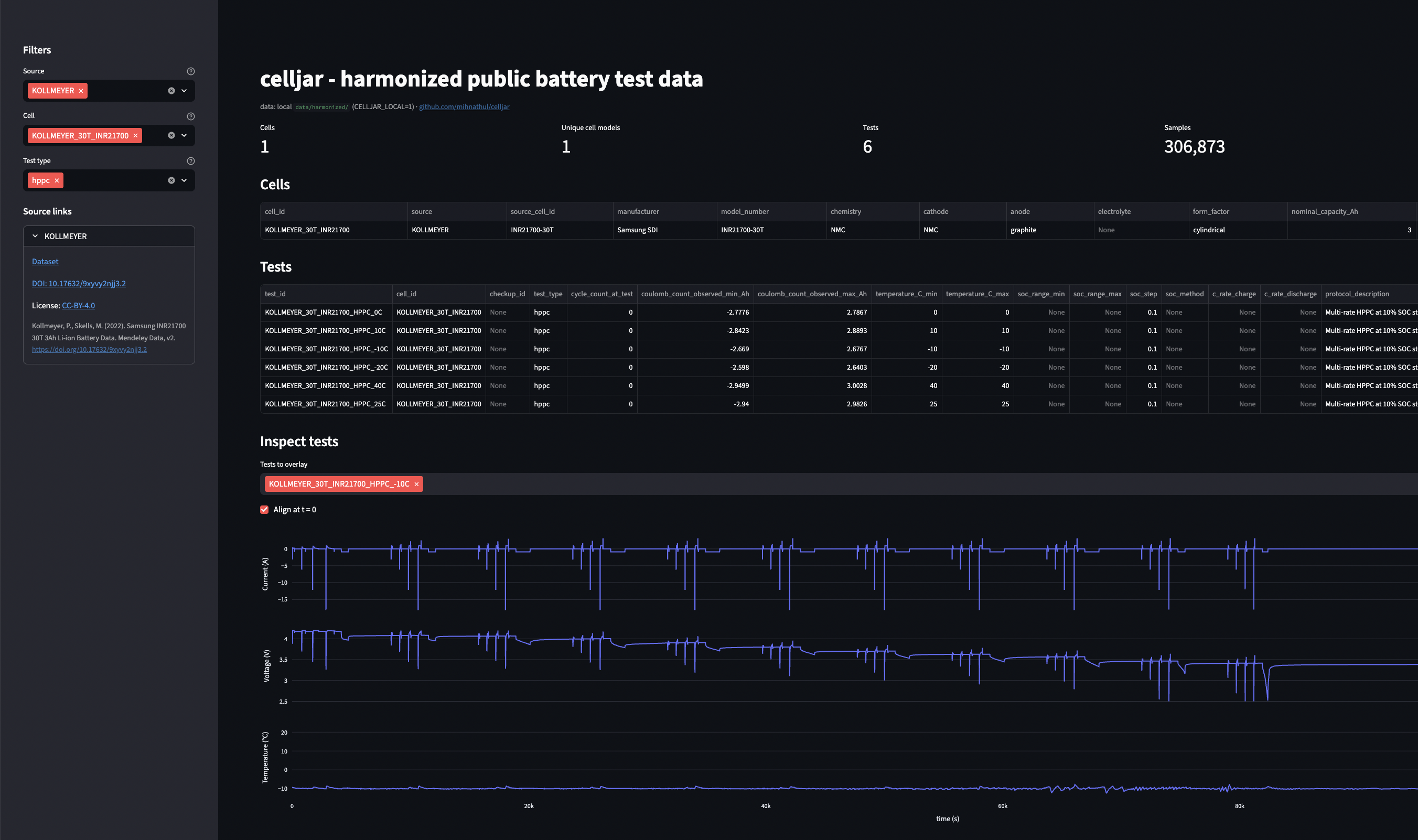
Scope: celljar harmonizes MEASUREMENTS. It converts units, normalizes the schema, and preserves provenance. It does NOT fit R_DC, dV/dQ, OCV, or ECM parameters from V/I/T - that is downstream work: fit it with your own code, or an open-source tool (PyBOP, equivalent-circuit-model, and others). Values a source publishes itself ARE carried, tagged via
*_method.
Quick start
The full bundle lives on HuggingFace. Query it directly - no clone needed:
import duckdb
df = duckdb.sql("""
    SELECT * FROM 'https://huggingface.co/datasets/mihnathul/celljar/resolve/main/timeseries.parquet'
    WHERE test_id = 'ORNL_LEAF_2013_HPPC_25C'
""").df()
pandas, Polars, and the datasets library read the same URLs - see Query in place below, including filtered reads that fetch only matching row groups instead of the whole file.
Datasets
| Dataset | Cell model | Chemistry | Test types | Cells | License | DOI |
|---|---|---|---|---|---|---|
| ORNL Leaf 2013 | AESC | mixed |
hppc |
1 | MIT | 10.5281/zenodo.2580327 |
| HNEI 18650PF | Panasonic NCR18650PF | NCA |
hppc, qocv, drive_cycle, C1Discharge |
1 | CC-BY-4.0 | 10.17632/wykht8y7tg.1 |
| MATR (Severson 2019) | A123 APR18650M1A | LFP |
cycle_aging |
135 | CC-BY-4.0 | 10.1038/s41560-019-0356-8 |
| CLO (Attia 2020) | A123 APR18650M1A | LFP |
cycle_aging |
45 | CC-BY-4.0 | 10.1038/s41586-020-1994-5 |
| BILLS eVTOL (Bills 2023) | Sony US18650VTC6 | NMC |
drive_cycle |
22 | CC-BY-4.0 | 10.1184/R1/14226830 |
| NASA PCoE | undisclosed | LCO |
cycle_aging |
34 | CC0-1.0 | dataset |
| Naumann 2018/2020 | Sony US26650FTC1 | LFP |
cycle_aging, calendar_aging |
34 | CC-BY-4.0 | 10.17632/kxh42bfgtj.1 |
| Kollmeyer 30T aging (Duque 2025) | Samsung INR21700-30T | NMC |
hppc, cycle_aging, C0p5Discharge, C1Charge, C1Discharge, C20Discharge, C2Discharge |
6 | CC-BY-4.0 | 10.5683/SP3/UYPYDJ |
| Kollmeyer 30T BoL | Samsung INR21700-30T | NMC |
hppc, qocv, drive_cycle, C0p5Discharge, C1DischargeCharge, C2Discharge |
1 | CC-BY-4.0 | 10.17632/9xyvy2njj3.2 |
| Kollmeyer HG2 BoL | LG INR18650HG2 | NMC |
hppc, drive_cycle, C0p5Discharge, C1DischargeCharge, C20DischargeCharge, C2Discharge |
1 | CC-BY-4.0 | 10.17632/cp3473x7xv.3 |
Only ORNL Leaf's raw data ships in the repo. For the other datasets you fetch the raw files yourself from the original source (each data/raw/<source>/SOURCE_DATA_PROVENANCE.md has the link and steps) and regenerate - or skip raw entirely and use the already-harmonized bundle on HuggingFace.
Schema
Four entities, joined by cell_id / test_id (and checkup_id where present):
cell_metadata   cells/*.json           one JSON per cell: chemistry, capacity, form factor
test_metadata   tests/*.json           one JSON per test: protocol, SOH, provenance, license, checkup_id
timeseries      timeseries.parquet     V / I / T per sample + signed coulomb count (∫I dt); join on test_id
cycle_summary   cycle_summary.parquet  source-published per-cycle aggregates (capacity, R_DC, ...)
Conventions: SI units, relative timestamps, missing data is explicit null. Current is normalized to one canonical sign across every source: positive = charge (into the cell), negative = discharge.
Provenance is first-class. Every test row carries source_doi / source_citation / source_license, and every value celljar could have computed instead of measured carries a *_method tag so you know where it came from:
| Field | Tag | Values |
|---|---|---|
soh_pct |
soh_method |
capacity_vs_first_checkpoint, bol_assumption, null |
soc_range_min/max |
soc_method |
protocol_asserted, source_published, null |
resistance_dc_ohm |
resistance_method |
source_published, null |
celljar never derives SOC or R_DC from the timeseries - it persists the measured coulomb_count_observed_min/max_Ah instead. Full field list, types, and enums in the JSON Schemas; the runtime Pandera mirror is harmonize_schema.py.
Download the bundle
pip install huggingface_hub
huggingface-cli download mihnathul/celljar --repo-type dataset --local-dir ./celljar-bundle
Add --revision <tag> to pin a release for reproducibility (tags are listed on the dataset's Versions tab). In Python:
from huggingface_hub import snapshot_download
local = snapshot_download(repo_id="mihnathul/celljar", repo_type="dataset")  # add revision="<tag>" to pin
Query in place - no download needed
DuckDB - full SQL across all entities over HTTPS
INSTALL httpfs; LOAD httpfs;
SELECT c.chemistry, c.nominal_capacity_Ah,
       t.test_id, t.test_type, t.soh_pct,
       COUNT(*) AS n_samples
FROM read_json('https://huggingface.co/datasets/mihnathul/celljar/resolve/main/cells/*.json')  c
JOIN read_json('https://huggingface.co/datasets/mihnathul/celljar/resolve/main/tests/*.json')  t
  ON c.cell_id = t.cell_id
JOIN 'https://huggingface.co/datasets/mihnathul/celljar/resolve/main/timeseries.parquet'       ts
  ON t.test_id = ts.test_id
GROUP BY 1,2,3,4,5
ORDER BY t.test_id;
pandas / Polars - predicate-pushdown read of one test
import pandas as pd
df = pd.read_parquet(
    "https://huggingface.co/datasets/mihnathul/celljar/resolve/main/timeseries.parquet",
    filters=[("test_id", "==", "ORNL_LEAF_2013_HPPC_25C")],
)
datasets library - streaming
from datasets import load_dataset
ds = load_dataset(
    "parquet",
    data_files="https://huggingface.co/datasets/mihnathul/celljar/resolve/main/timeseries.parquet",
    split="train",
    streaming=True,
)
for row in ds.take(5):
    print(row)
Related tools
celljar sits alongside, not in place of, the other tools in this space:
- Battery Data Commons - registry indexing 300+ public battery datasets. Great for discovery; celljar adds a harmonized data layer over a subset of them.
- Iontech (Shiyun Liu) - curated index of open-source battery monitoring and modeling datasets (RWTH home-storage, NREL failure databank, Stanford second-life, etc.) with paper links.
- BatteryLife / BatteryML - cycling-to-failure ML benchmark (KDD 2025). Optimized for lifetime-prediction ML; celljar keeps the full V/I/T timeseries that physics-based parameterization (ECM/SPM/DFN) needs.
License & citation
The science belongs to the original authors; celljar just puts their data in one schema. Cite their papers when you use the data - every test_metadata row carries its own source_doi, source_citation, and source_license so attribution is one query away.
- celljar code: MIT (LICENSE)
- Harmonized bundle (schema, packaging): CC-BY-4.0
- Upstream raw data: each publisher's original license (see the Datasets table above)
@misc{celljar,
  author       = {Mihna Neerulpan},
  title        = {celljar: Public Battery Test Dataset Harmonization with a Canonical Schema},
  year         = {2026},
  howpublished = {\url{https://github.com/mihnathul/celljar}},
}
Links
- Code: https://github.com/mihnathul/celljar
- Issues / new-source requests: https://github.com/mihnathul/celljar/issues
- Canonical JSON Schemas: https://github.com/mihnathul/celljar/tree/main/schemas
Acknowledgments
celljar exists because of the labs and authors who designed, ran, and openly published these experiments. Thank you to:
Phillip Kollmeyer (HNEI, Samsung 30T, LG HG2) - G. Wiggins, S. Allu, H. Wang (ORNL) - K. Severson, P. Attia et al. (MATR, CLO; Stanford / MIT / TRI) - A. Bills et al. (BILLS; CMU) - B. Saha, K. Goebel (NASA PCoE) - M. Naumann et al. (TUM) - J. Duque, M. Naguib (Samsung 30T aging; McMaster)