| --- |
| title: QALoop Annotation Platform |
| emoji: 📝 |
| colorFrom: blue |
| colorTo: green |
| sdk: docker |
| pinned: false |
| --- |
| |
| # QA Annotation System |
|
|
| The **Expert Validation Platform** in [QALoop](https://github.com/JackKuo666/QALoop) — a human-in-the-loop framework for large-scale agricultural QA construction and evaluation (ICDM). This web application supports **collaborative QA annotation and quality management**: multi-user task workflows, configurable annotation schemas, statistics and export, plus optional **LLM-assisted review of annotation notes**. It receives candidate QA pairs from upstream synthesis pipelines and converts expert judgments into structured feedback for pipeline iteration. |
|
|
| ## Demo Usage |
|
|
| This Space is a demo environment — **works out of the box with no manual Secrets configuration**. |
|
|
| ### Login |
|
|
| When you open the Space page, the login form is **pre-filled** with the default admin credentials. Click "Login" to start exploring. |
|
|
| | Item | Default | |
| |------|---------| |
| | Admin username | `admin` | |
| | Admin password | `123456` | |
|
|
| ### Quick Demo Flow |
|
|
| After login, sample projects and QA data are pre-loaded. You can: |
|
|
| 1. **Browse projects / datasets** — View the pre-loaded "Test" project and QA pairs in the admin dashboard |
| 2. **View annotation configs** — Explore existing rating, single-select, and other annotation dimensions |
| 3. **Claim and annotate** — Switch to the user center to complete tasks |
| 4. **View analysis / export** — Check annotation progress, LLM analysis reports, and export results |
|
|
| To build from scratch, you can also create projects, configure schemas, and import JSON / CSV data yourself. |
|
|
| ### Demo Sample Data (`seed/demo.sql`) |
|
|
| On first HF Space startup with an empty database, `scripts/space_init.py` automatically imports `seed/demo.sql` (SQLite text dump, git-friendly; HF does not accept binary `.db` files). |
|
|
| | Item | Details | |
| |------|---------| |
| | Pre-loaded content | 1 project, 3 datasets, 50 QA pairs, annotation configs, and sample annotation results | |
| | LLM config | Pre-filled Base URL and `gpt-5.1`; API Key injected via `LLM_API_KEY` env var, **not written to sql** | |
| | Runtime data | After import, written to `/data/annotations.db` inside the container; web UI changes only affect the runtime DB | |
| | Relation to sql | **Web UI actions do not write back to `demo.sql`**; updating Demo data requires manual export and push | |
|
|
| Example for updating Demo data: |
|
|
| ```bash |
| # Export from local runtime DB (remember to redact llm_api_key) |
| sqlite3 ../data/annotations.db ".dump" > seed/demo.sql |
| git add seed/demo.sql && git commit -m "Update demo seed" && git push space main |
| ``` |
|
|
| To disable auto-import: set environment variable `SEED_DEMO_DATA=false`. |
|
|
| ### Registering Regular Users |
|
|
| Currently in `production` mode: new users can self-register, but must be **manually enabled** by an admin in "User Management" before they can annotate. |
|
|
| ### Demo Default Configuration |
|
|
| | Setting | Default | Description | |
| |---------|---------|-------------| |
| | `SECRET_KEY` | `qaloop-demo-jwt-secret-key-32bytes` | JWT signing key (Demo only, do not use in production) | |
| | `ADMIN_USERNAME` | `admin` | Admin auto-created on first startup | |
| | `ADMIN_PASSWORD` | `123456` | Admin password | |
| | `DB_DIR` | `/data` | Database storage directory | |
| | `ENVIRONMENT` | `production` | New registrations require admin enablement | |
|
|
| > **Security note**: The above are public Demo settings. Do not store real sensitive data. For production deployment, override `SECRET_KEY` and `ADMIN_PASSWORD` via HF Secrets. |
|
|
| ## Deploy to Hugging Face Spaces |
|
|
| 1. Create a Space on [Hugging Face](https://huggingface.co/new-space), SDK type **Docker** |
| 2. Push the contents of `platform/` to the Space repository (you can upload only the platform subdirectory as the repo root) |
| 3. **No Secrets needed for Demo** — build and run directly |
| 4. For production deployment, override in Space **Settings → Repository secrets**: |
|
|
| | Secret | Demo Default | Description | |
| |--------|--------------|-------------| |
| | `SECRET_KEY` | `qaloop-demo-jwt-secret-key-32bytes` | JWT key; use a random string in production | |
| | `ADMIN_USERNAME` | `admin` | Admin username auto-created on first startup | |
| | `ADMIN_PASSWORD` | `123456` | Admin password (at least 6 characters) | |
|
|
| 5. Optional **Variables**: |
|
|
| | Variable | Default | Description | |
| |----------|---------|-------------| |
| | `DB_DIR` | `/data` | SQLite data directory (Dockerfile defaults to `/data`) | |
| | `ENVIRONMENT` | `production` | New registrations require admin enablement | |
| | `LLM_BASE_URL` | `http://43.159.131.233:3001/v1` | LLM API Base URL (OpenAI-compatible) | |
| | `LLM_MODEL_NAME` | `gpt-5.1` | LLM model name | |
|
|
| 6. **LLM Analysis (optional)**: Set in Space **Settings → Repository secrets**: |
|
|
| | Secret | Description | |
| |--------|-------------| |
| | `LLM_API_KEY` | LLM API Token (auto-written to system config on startup) | |
|
|
| Demo pre-fills Base URL and model name for OpenAI-compatible calls: |
|
|
| ```python |
| from openai import OpenAI |
| |
| client = OpenAI( |
| base_url="http://43.159.131.233:3001/v1", |
| api_key="your-token", # Set LLM_API_KEY in HF Secrets |
| ) |
| # model: gpt-5.1 |
| ``` |
|
|
| 7. After the Space build completes, visit the page and log in with `admin` / `123456` |
|
|
| > **Note**: On free Spaces, annotation data may be lost after sleep/restart if persistent storage is not enabled. Fine for Demo purposes; for production collaborative annotation, deploy on your own server. |
|
|
| ## Highlights |
|
|
| - **Projects and datasets** — Project-level organization with JSON / CSV import and export |
| - **Flexible annotation configs** — Rating, category, text, single/multi-select, binary; optional reason and confidence fields |
| - **Collaboration and permissions** — Superuser admin dashboard; regular users claim tasks and annotate; JWT auth |
| - **Analysis and export** — Annotation progress and statistics; configurable simplified export |
| - **Optional LLM** — OpenAI-compatible Chat API, default `http://43.159.131.233:3001/v1` + `gpt-5.1`; Token injected via `LLM_API_KEY` env var |
| - **Seed questions** — Predefined question templates organized by type/subtype |
| - **UI language** — Chinese and English (i18n) |
|
|
| ## System Overview |
|
|
|  |
|
|
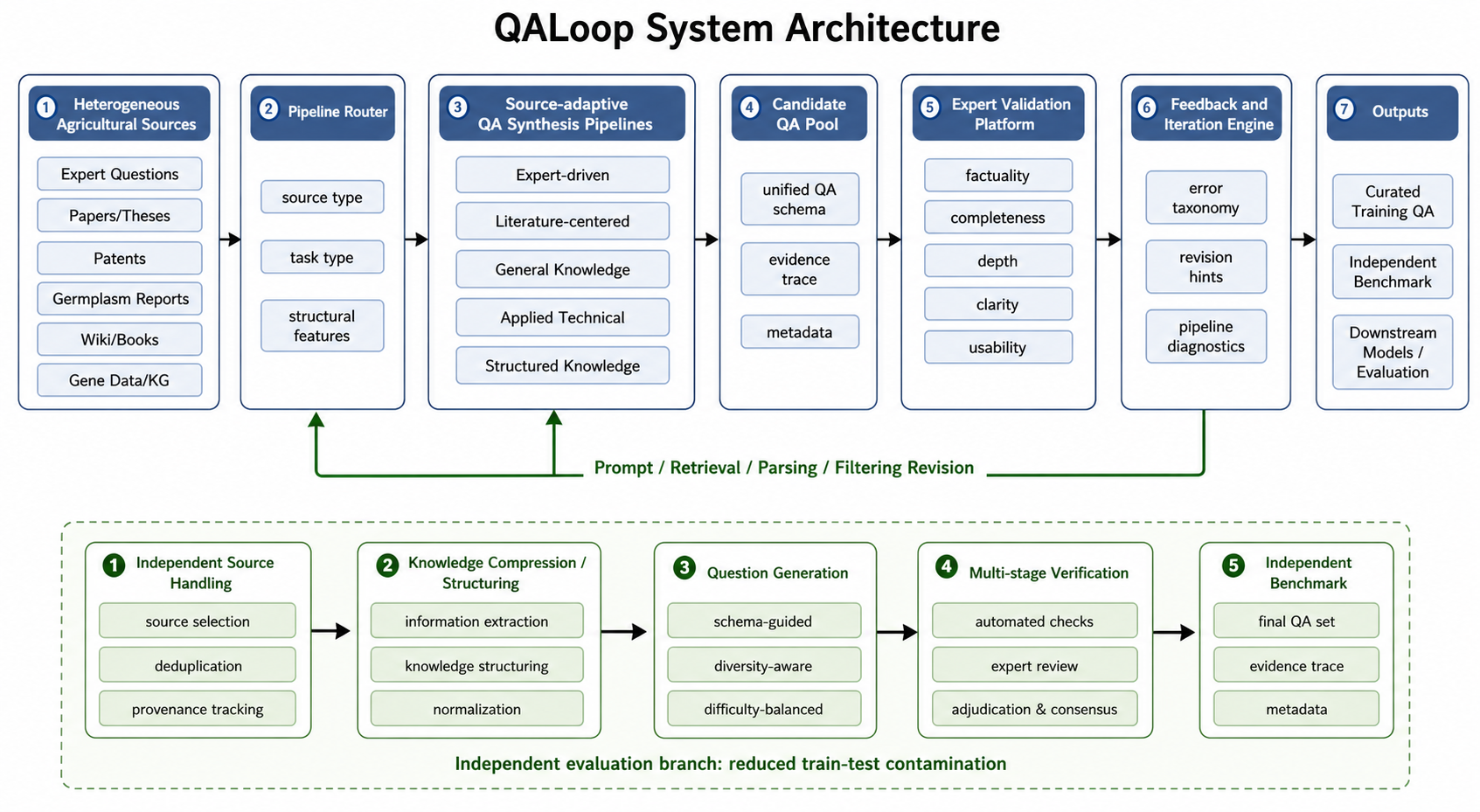
| The diagram above shows the full QALoop workflow. This platform corresponds to the **Expert Validation Platform** stage — receiving candidate QA pairs from upstream synthesis pipelines and supporting human quality review, feedback, and export. |
|
|
| This repository covers **data import → schema configuration → multi-user annotation → statistics/analysis → export**. It does not include built-in "automatic QA generation" or "automatic model scoring/evaluation" modules; these can be integrated via upstream/downstream systems. |
|
|
| ```mermaid |
| flowchart LR |
| subgraph external [External Optional] |
| Gen[QA Generation] |
| Eval[Model Evaluation] |
| end |
| subgraph app [This System] |
| Import[Import Dataset] |
| Config[Annotation Config] |
| Ann[Human Annotation] |
| Stats[Statistics & Analysis] |
| Export[Export Results] |
| end |
| Gen -.-> Import |
| Import --> Config --> Ann --> Stats --> Export |
| Export -.-> Eval |
| ``` |
|
|
| ## Configurable Schema Example |
|
|
| Annotation dimensions and field names are defined by admins in **Annotation Config**, not hardcoded in the product. If your research uses multi-dimensional quality scales (e.g., factuality, completeness), implement them via multiple `score` / `category` configs. Below is an **illustrative JSON** (actual export structure depends on your config): |
|
|
| ```json |
| { |
| "question": "What is drought resistance?", |
| "answer": "Drought resistance refers to a plant's ability to maintain growth and yield under drought conditions.", |
| "annotations": { |
| "factuality_score": 5, |
| "completeness_score": 4, |
| "notes": "Correct explanation but could add mechanistic details" |
| } |
| } |
| ``` |
|
|
| ## Tech Stack |
|
|
| - **Backend**: Python 3.12+ / FastAPI / SQLAlchemy / SQLite |
| - **Frontend**: Vanilla HTML + JS + CSS (no framework) |
| - **Auth**: JWT (SHA-256 client-side hashing) |
| - **Package manager**: uv |
|
|
| ## Requirements |
|
|
| - Python >= 3.12 |
| - [uv](https://docs.astral.sh/uv/) (Python package manager) |
|
|
| ## Quick Start |
|
|
| ### 1. Clone the Repository |
|
|
| ```bash |
| git clone <repo-url> |
| cd qa-annotation |
| ``` |
|
|
| ### 2. Install Dependencies |
|
|
| ```bash |
| # Install uv (if not already installed) |
| curl -LsSf https://astral.sh/uv/install.sh | sh |
| |
| # Create virtual environment and install all dependencies |
| uv sync |
| |
| # For dev tools (pre-commit, etc.) |
| uv sync --group dev |
| ``` |
|
|
| ### 3. Configure Environment Variables |
|
|
| Create a `.env` file: |
|
|
| ```bash |
| cp .env.example .env |
| ``` |
|
|
| Then edit `.env` and **must update `SECRET_KEY`**: |
| |
| ```ini |
| # Required |
| SECRET_KEY=your-random-secret-key-here |
| |
| # Optional (defaults below) |
| ENVIRONMENT=development |
| HOST=0.0.0.0 |
| PORT=8000 |
| RELOAD=false |
| TOKEN_EXPIRE_DAYS=7 |
| ``` |
| |
| | Variable | Required | Description | Default | |
| |----------|----------|-------------|---------| |
| | `SECRET_KEY` | Yes | JWT key; must be a random string in production | - | |
| | `ENVIRONMENT` | No | `development` or `production` | `development` | |
| | `HOST` | No | Listen address | `0.0.0.0` | |
| | `PORT` | No | Listen port | `8000` | |
| | `RELOAD` | No | Enable hot reload (for development) | `false` | |
| | `TOKEN_EXPIRE_DAYS` | No | Token expiration in days | `7` | |
| |
| > In production, newly registered users are disabled by default and require manual admin enablement. |
| |
| ### 4. Create Superuser |
| |
| ```bash |
| # Interactive creation (recommended) |
| python scripts/create_superuser.py |
| |
| # Create via command-line arguments |
| python scripts/create_superuser.py --username admin --password yourpassword |
| ``` |
| |
| ### 5. Start the Server |
| |
| ```bash |
| # Option 1: Direct run |
| uvicorn qa_annotate.main:app --reload --host 0.0.0.0 --port 8000 |
| |
| # Option 2: Via entry point (requires uv sync first) |
| qa |
| ``` |
| |
| After startup, visit `http://localhost:8000` and log in with the superuser account. API docs: `http://localhost:8000/docs`. |
| |
| ## User Guide |
| |
| ### Admin Workflow |
| |
| 1. **Login** — Log in with superuser account, enter admin dashboard |
| 2. **Create project** — Set name and description |
| 3. **Create annotation config** — Define task type (rating, category, text, single-select, multi-select, binary), and whether reason/confidence fields are required |
| 4. **Link config to project** — Associate annotation configs with projects, with ordering support |
| 5. **Import dataset** — Upload QA data in JSON or CSV format |
| 6. **Manage users** — Create/enable/disable annotator accounts |
| 7. **Configure LLM (optional)** — Fill in the following keys in "System Config" (stored in database, **not** `.env`): |
|
|
| | Config Key | Description | |
| |------------|-------------| |
| | `llm_api_key` | LLM API Key | |
| | `llm_base_url` | Base URL (e.g., `https://api.openai.com/v1`) | |
| | `llm_model_name` | Model name (e.g., `gpt-4o`) | |
|
|
| Use "Test Connection" to verify. Current implementation is mainly for **summarizing and analyzing annotation notes**; core annotation works without LLM config. |
|
|
| 8. **View analysis** — Annotation progress, statistics, and (if configured) LLM analysis reports |
|
|
| ### Annotator Workflow |
|
|
| 1. **Register/Login** — In development, registered users can usually annotate immediately; in production, admin must enable the account |
| 2. **Claim task** — Claim a dataset from "Available Tasks" |
| 3. **Annotate** — Fill in fields according to config |
| 4. **My tasks** — View and track progress |
|
|
| ### Permissions (Summary) |
|
|
| | Capability | Superuser | Regular User | |
| |------------|-----------|--------------| |
| | Admin dashboard (projects, datasets, users, system config, etc.) | Yes | No | |
| | Claim tasks and submit annotations | Yes | Yes (must be enabled) | |
|
|
| Superusers also have an active regular user identity and can participate in annotation when needed. |
|
|
| ### Data Format |
|
|
| **Import QA dataset (JSON)**: |
|
|
| ```json |
| [ |
| { |
| "question": "Question content", |
| "answer": "Answer content" |
| } |
| ] |
| ``` |
|
|
| Extra fields are supported; specify which extra fields to display in project config. |
|
|
| ## Project Structure |
|
|
| ``` |
| qa_annotate/ |
| ├── api/ # FastAPI router modules |
| │ ├── analysis.py # Annotation result analysis and LLM endpoints |
| │ ├── annotation.py # Annotation configs and results |
| │ ├── auth.py # Authentication and permissions |
| │ ├── dataset.py # Dataset management |
| │ ├── project.py # Project management |
| │ ├── seed_question.py # Seed questions |
| │ ├── system_config.py # System configuration |
| │ └── user.py # User management |
| ├── database/ # Database layer |
| │ ├── base.py # Engine, session, initialization |
| │ ├── models.py # SQLAlchemy ORM models |
| │ └── crud.py # CRUD operations |
| ├── schema/ # Pydantic request/response models |
| ├── services/ # Business services (e.g., LLM calls) |
| ├── utils/ # Utilities (password hashing, etc.) |
| ├── config.py # Global config (pydantic-settings) |
| ├── html/ # HTML pages |
| ├── static/ |
| │ ├── js/ # JavaScript |
| │ ├── css/ # Stylesheets |
| │ └── locales/ # i18n translation files |
| └── main.py # Application entry point |
| ``` |
|
|
| ## Database Backup |
|
|
| ```bash |
| # Manual backup |
| python scripts/backup_db.py |
| |
| # Scheduled backup (every 12 hours) |
| python scripts/backup_db.py --schedule --interval 12 |
| ``` |
|
|
| ## Development |
|
|
| ```bash |
| # Install dev dependencies |
| uv sync --group dev |
| |
| # Install pre-commit hooks |
| pre-commit install |
| |
| # Lint and format |
| ruff check --fix . |
| ruff format . |
| ``` |
|
|
| ## Research and Citation |
|
|
| This platform is the **Expert Validation Platform** component of QALoop. If you use it in a publication, please cite the QALoop ICDM paper and describe **annotation dimensions and guideline version**, **export format and field meanings**. See the [root README](https://github.com/JackKuo666/QALoop#citation) for BibTeX. |
|
|
| ## Roadmap |
|
|
| - Inter-annotator agreement (IAA) metrics and adjudication tools |
| - Active learning or priority queue (integrated with task claiming) |
| - Richer chain-of-thought / multi-segment annotation display (extend Schema and UI as needed) |
| - Multimodal field display (if datasets include image URLs, etc.) |
|
|
| ## License |
|
|
| MIT |
|
|

